On this page
The four N1 records in this lesson are 雷(いかずち), 降水(こうすい), 洪水(こうずい) and 津波(つなみ). Their readings carry most of the difficulty: 雷 changes register when read いかずち, 降水 and 洪水 differ by one voiced consonant, and 津波 names a specific ocean hazard rather than any unusually large wave.
Four warning-system words
| Written form | Reading | Part of speech and sense | A phrase worth keeping |
|---|---|---|---|
| 雷 | いかずち | noun; thunder or lightning, in a literary or dramatic register | 天空を裂くいかずち, thunder that tears across the sky |
| 降水 | こうすい | noun; precipitation | 年間降水量, annual precipitation |
| 洪水 | こうずい | noun; flood, especially abnormal river rise or overflow | 洪水が発生する, a flood occurs |
| 津波 | つなみ | noun; tsunami | 津波が到達する, a tsunami reaches an area |
The first word is set apart by register. The middle pair is set apart by sound and by the stage of the event: water first falls as 降水, while a river may later rise into a 洪水. 津波 belongs to a different mechanism, because seawater is displaced and travels toward the coast.
雷 read as いかずち belongs to literary and dramatic language
The kanji 雷 does not force one reading. In ordinary modern conversation and weather information, かみなり is the usual reading. いかずち is an older reading that survives in literary narration, poetry, mythology and deliberately dramatic speech. The Kotobank entry for いかずち records both the historical form and this change in ordinary usage.
遠くで、いかずちのような轟音が響いた。
とおくで、いかずちの ような ごうおんが ひびいた。
In the distance, a roar like thunder echoed.
The sentence does not describe a different type of thunder. The reading gives the line an elevated, story-like tone. A plain report would normally say:
夜になって雷が鳴り始めた。
よるに なって かみなりが なりはじめた。
Thunder began after nightfall.
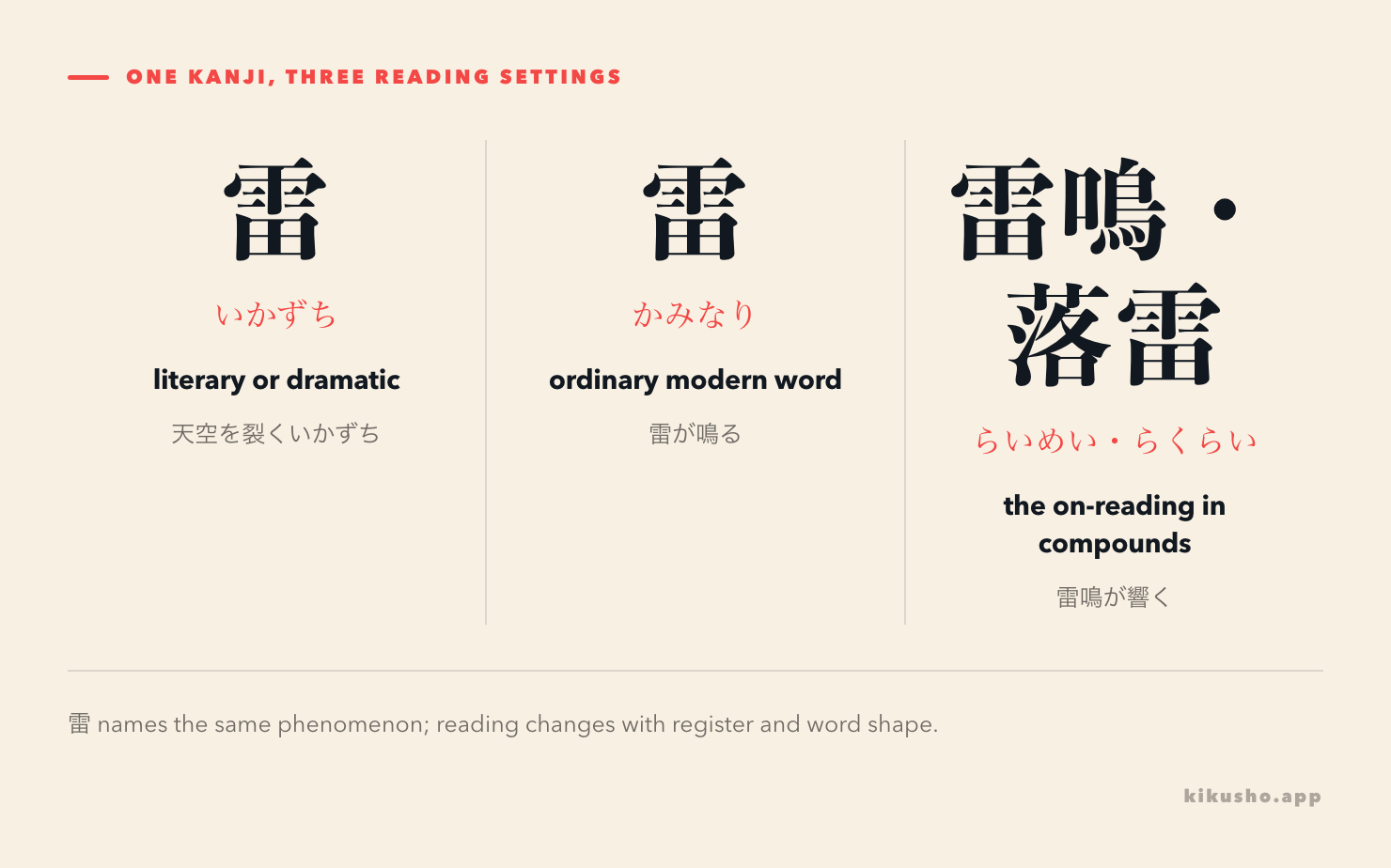
Three reading patterns are useful:
- 雷(いかずち) — a literary, poetic or dramatic independent word.
- 雷(かみなり) — the ordinary independent word in speech and weather descriptions.
- 雷鳴(らいめい), 落雷(らくらい) — compounds using the on-reading らい.
The historical kana spelling いかづち still appears in older material, but modern kana orthography writes いかずち. Bunpro's 雷 entry records the principal readings and labels the word N1. For a learner, the practical test is not “Which object is this?” but “What voice is this passage using?” A forecast saying 雷が鳴るおそれがあります expects かみなり; a myth describing a god who commands 雷 can invite いかずち.
降水 and 洪水 are near-homophones with different boundaries
降水(こうすい) begins with 降, “fall.” It is the technical umbrella term for water falling from the atmosphere. The Japan Meteorological Agency's precipitation terminology uses 降水量 when rain and snow are treated together. The amount is measured as the depth of water that would collect if it did not run off or soak away, so the term covers more than rain alone.
山間部では年間降水量が多い。
さんかんぶでは ねんかん こうすいりょうが おおい。
Annual precipitation is high in the mountain region.
Common combinations include 降水量(こうすいりょう), precipitation amount, 年間降水量, annual precipitation, and 降水確率(こうすいかくりつ), probability of precipitation. 降水確率 estimates the chance of at least one millimetre of precipitation during the stated period; it does not state how hard it will rain or how many millimetres will fall.
洪水(こうずい) begins with 洪, associated with vast or swollen water. In the JMA river terminology, it concerns an abnormal rise in river level or flow and water overflowing its ordinary channel or embankment. It names the river hazard, not the water while it is falling through the air.
長時間の雨で川の水位が上がり、洪水が発生した。
ちょうじかんの あめで かわの すいいが あがり、こうずいが はっせいした。
Prolonged rain raised the river level, and a flood occurred.
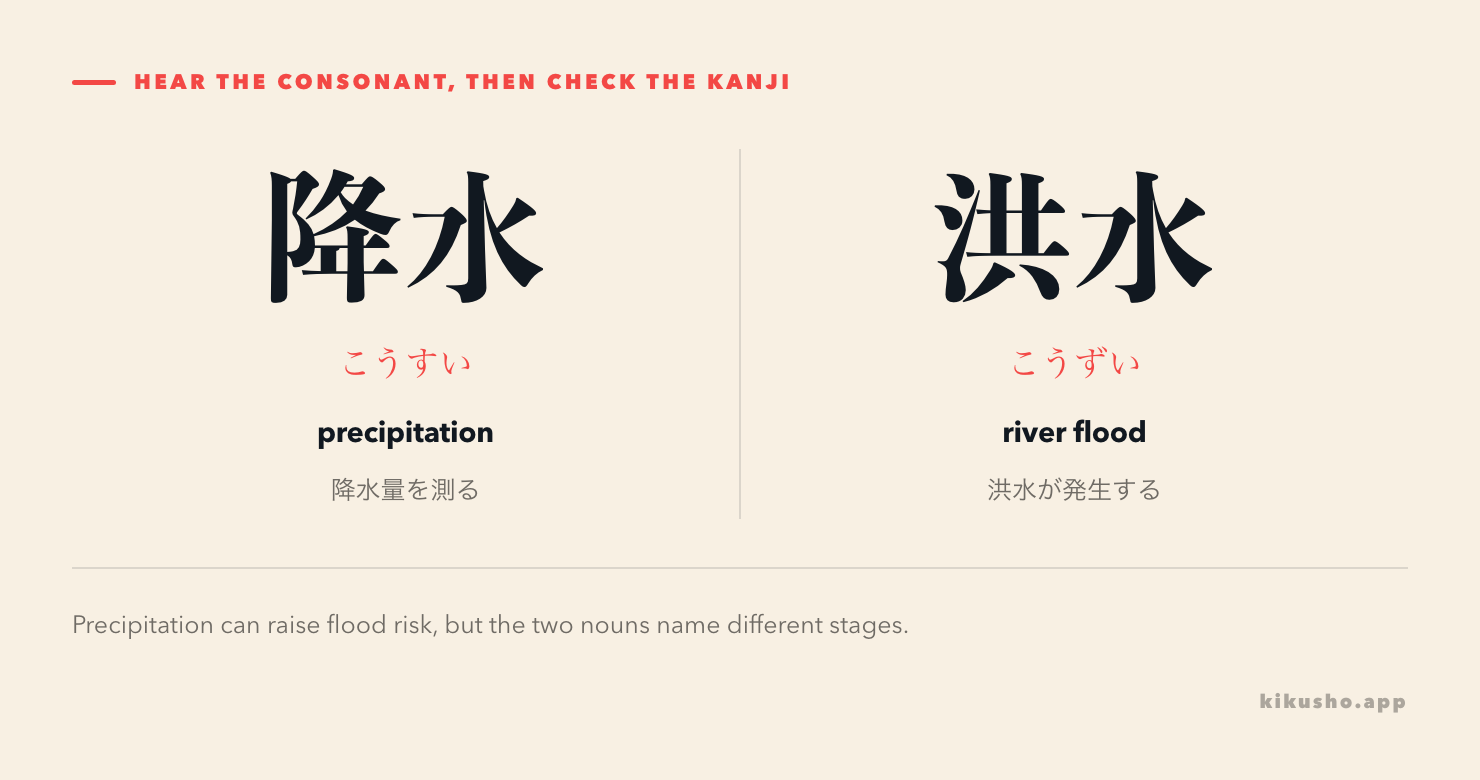
| If the sentence mentions… | Choose | Natural combinations |
|---|---|---|
| rain and snow as measured atmospheric water | 降水(こうすい) | 降水量を測る, 降水確率が高い |
| a river rising or overflowing | 洪水(こうずい) | 洪水が発生する, 洪水警報, 洪水被害 |
The sound contrast is すい versus ずい. In fast listening, context usually arrives before the noun: 年間, 量 or 確率 points toward 降水, while 川, 水位, 警報 or 被害 points toward 洪水.
The two events can be connected without being identical. Prolonged or intense 降水 can raise the risk of 洪水, but some precipitation drains safely and some floods have other contributing conditions. Japanese also distinguishes river flooding from rainwater collecting in streets or buildings. A report may use 浸水(しんすい) for water entering an area or structure, so “there is water where it should not be” does not automatically select 洪水.
津波 is moving seawater, not a high tide
津波(つなみ) is already an international loan into English as “tsunami,” and that borrowed word is more precise than the older translation “tidal wave.” A tide is driven mainly by gravitational cycles. A tsunami begins when a large volume of seawater is displaced.
The JMA explanation of tsunami generation shows the common earthquake mechanism: movement along a fault raises or lowers the seabed, the sea surface shifts with it, and waves spread outward. The JMA tsunami FAQ also notes that volcanic activity can generate a tsunami. An earthquake is therefore common, but not part of the dictionary meaning that must occur in every case.
沖合で地震が発生し、沿岸部に津波警報が発表された。
おきあいで じしんが はっせいし、えんがんぶに つなみけいほうが はっぴょうされた。
An earthquake occurred offshore, and a tsunami warning was issued for the coastal area.
Useful predicates describe generation, movement and response:
- 津波が発生する — a tsunami occurs or is generated.
- 津波が到達する — a tsunami reaches a location.
- 津波が押し寄せる — a tsunami surges toward or strikes a place.
- 津波警報が発表される — a tsunami warning is issued.
- 津波から避難する — evacuate from a tsunami.
Do not reduce 津波 to 大きな波, “a big wave.” Ordinary wind waves mainly disturb the surface; a tsunami moves a much deeper mass of water and can continue as a series. Its first visible sign need not be the sea drawing back, and the first wave need not be the largest. Those details explain why the word carries its own warning vocabulary.
A hazard report keeps the causes separate
The four records can occur in one report without describing one causal chain.
気象情報によると、この地域では降水量が増え、河川の洪水リスクが高まっている。一方、沿岸では沖合の地震を受けて津波警報が発表された。夜には雷が鳴るおそれもある。
きしょうじょうほうに よると、この ちいきでは こうすいりょうが ふえ、かせんの こうずいリスクが たかまっている。いっぽう、えんがんでは おきあいの じしんを うけて つなみけいほうが はっぴょうされた。よるには かみなりが なる おそれも ある。
According to the weather information, precipitation is increasing in this region, raising the risk of river flooding. Meanwhile, a tsunami warning was issued for the coast following an offshore earthquake. There is also a risk of thunder at night.
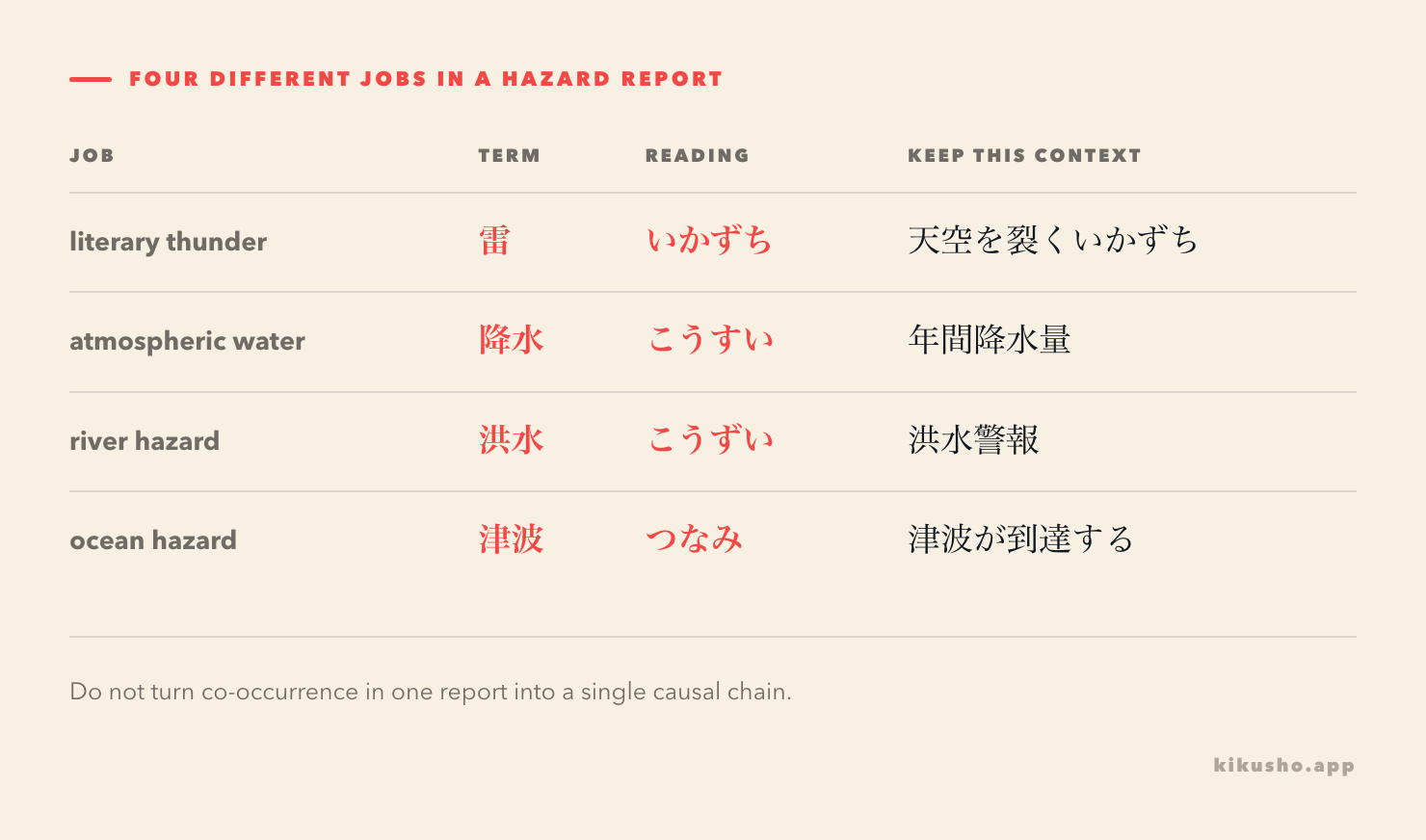
The increased 降水量 and higher 洪水 risk belong to one possible sequence. The offshore earthquake and 津波警報 belong to another. The final 雷 is read かみなり because the register is an ordinary forecast. Replacing it with いかずち would preserve the basic phenomenon but make the report sound stylised.
This register switch is part of knowing the assigned record. If a novel retells the same night as いかずちが闇を裂いた, the writer has chosen a literary voice. If an exam notice or forecast says 雷が鳴る, read the context before insisting on the N1 list's isolated reading.
The N1 label applies to a specific spelling-and-reading record
Kikusho's September 2026 reference inventory assigns 雷(いかずち), 降水(こうすい), 洪水(こうずい) and 津波(つなみ) to N1. Its two imported N1 vocabulary snapshots share the Tanos/Waller source family, so they count as one baseline rather than two independent judgments. Independent study lists also place 降水, 洪水 and 津波 in N1-oriented material, but such lists are editorial estimates.
The inventory flags one disagreement. Japanesetest4you puts the headword 雷 in its N3 material, but the entry teaches 雷(かみなり). The assigned N1 record is 雷(いかずち). This is evidence that the same written headword appears earlier with its ordinary reading; it does not show that the literary reading has the same learning boundary.
The official JLPT FAQ explains that no exhaustive current vocabulary, kanji or grammar list is published. “N1 vocabulary” here therefore means a reviewed study placement, with the precise reading and register made visible. The words remain useful even if another course introduces かみなり or つなみ earlier.
The N2 climate and natural-hazards lesson separates a volcano from an eruption and a living body suffering cold from water freezing. The N3 lesson covers measurements and changes such as temperature and freezing. Together, the levels move from observable weather toward the technical distinctions used in reports.
When saving these words in Kikusho, keep the evidence that selects the meaning: 天空を裂くいかずち, 年間降水量, 川の洪水, 津波が到達する. A card with only “thunder,” “water” or “wave” removes the register and mechanism that make the N1 item worth learning.
Test the four distinctions
Check 1 · readings
Write the kana for 降水, 洪水 and 津波.
Check 2 · literary register
Which sentence most naturally uses 雷 with the reading いかずち?
- A. 天空を裂く雷が、古い物語の神々を目覚めさせた。
- B. 明日の降水確率は四十パーセントです。
- C. 駅前の店で傘を買いました。
- D. 川の水位を毎時測定します。
Check 3 · ordinary forecast
In the plain weather sentence 今夜は雷が鳴るおそれがあります, which reading is most natural for 雷?
- A. らい
- B. いかずち
- C. かみなり
- D. こうずい
Check 4 · the near-homophones
Complete the sentence: 長時間の__で川の水位が上がり、__の危険が高まった。
- A. 洪水・降水
- B. 降水・洪水
- C. 津波・雷
- D. 雷・津波
Check 5 · quantity or probability
Which phrase refers to the measured amount of rain, snow or other precipitation?
- A. 洪水量
- B. 津波量
- C. 降水量
- D. 雷量
Check 6 · tsunami collocation
Which sentence is natural and precise?
- A. 津波警報が発表された。
- B. 津波を降水した。
- C. 津波が雷鳴を測った。
- D. 津波量が四十パーセントだ。
Check 7 · interpretation
What does 降水量が増えたが、洪水は発生していない state?
- A. Precipitation increased, but no flood occurred.
- B. A tsunami occurred before the rain.
- C. The river overflowed because of thunder.
- D. Precipitation and flooding are synonyms.
Check 8 · four-part report
Read: 沿岸では津波警報が発表され、内陸では降水量の増加による洪水が警戒されている。夜には雷も予想される。 Which summary is accurate?
- A. One tsunami directly caused every other event.
- B. Coastal tsunami risk, inland flood risk and expected thunder are reported separately.
- C. 降水 and 洪水 are two readings of the same kanji.
- D. 雷 must be read いかずち in every modern report.
Answers and explanations
1
降水 is こうすい, 洪水 is こうずい, and 津波 is つなみ. The middle pair differs by voicing: す in こうすい and ず in こうずい.
2
A. A mythic scene about thunder tearing across the sky supports the literary reading いかずち. The other sentences are plain weather, shopping or measurement contexts.
3
C, かみなり. An ordinary modern forecast uses the common independent reading かみなり. いかずち would add a literary or dramatic voice, while らい normally appears inside compounds such as 雷鳴 and 落雷.
4
B, 降水・洪水. Prolonged precipitation can raise a river and increase flood risk. The first blank describes water falling from the atmosphere; the second names the river hazard.
5
C, 降水量. This is the standard term for precipitation amount. 降水確率 instead expresses the probability of at least one millimetre of precipitation during the stated period.
6
A. 津波警報が発表される is the standard pattern for a tsunami warning being issued. The other options combine the noun with predicates or measurements that do not fit its meaning.
7
A. The sentence explicitly separates the two stages: atmospheric precipitation increased, but a river flood did not occur. It does not claim that every rise in precipitation produces flooding.
8
B. The report gives a tsunami warning for the coast, increased precipitation and flood concern inland, and expected thunder at night. Their presence in one report does not establish one shared cause, and ordinary report-style 雷 is normally read かみなり.
Common questions
What is the difference between 雷(いかずち)and 雷(かみなり)?
Both readings can name thunder and lightning, but modern ordinary speech and forecasts normally use かみなり. The reading いかずち is old and now sounds literary, poetic, mythic or dramatic. It changes the register, not the physical phenomenon.
What is the difference between 降水 and 洪水?
降水(こうすい)is precipitation falling from the atmosphere, including rain and snow. 洪水(こうずい)is a flood involving an abnormal rise or overflow of river water. Heavy precipitation can increase flood risk, but the two words do not name the same event.
Is 津波 the same as a large wave or a high tide?
No. 津波(つなみ)is a series of long waves produced when a large volume of seawater is displaced, commonly by movement of the seabed during an earthquake. Its meaning is distinct from an ordinary wind wave or a tide.
How do you read 雷鳴 and 落雷?
雷鳴 is らいめい and means a peal or rumble of thunder. 落雷 is らくらい and means a lightning strike. In these compounds, 雷 takes the on-reading らい.