On this page
天気(てんき) usually means weather, but 天気が続く means that fine weather continues. To use Japanese weather vocabulary at N5, learn the condition nouns, the verbs that report a changing sky, and the adjectives that say how the air feels. These thirteen words cover all three jobs.
Why these thirteen words belong together
A forecast can say 明日は晴れです (it will be sunny tomorrow). Later, someone may say 空が晴れました (the sky cleared). 晴れ names a condition; 晴れる reports a change. The same relationship holds for 曇り/曇る. Rain, snow, and wind keep their own established partners: 雨が降る, 雪が降る, and 風が吹く. Kanji Pedia's entries for 降る and 吹く verify those pairings.
The September 2026 Kikusho reference inventory assigns the thirteen spelling-and-reading entries below to N5, with no recorded disagreement for this particular set. A Japanese language school's N5 vocabulary list independently includes everyday weather entries and examples such as 晴れ and 晴れます. These are reference-list placements, not an official complete JLPT word syllabus.
The thirteen weather words
| Word and reading | Part of speech; useful sense | A phrase to keep together |
|---|---|---|
| 暖かい(あたたかい) | い-adjective; pleasantly warm air | 今日は暖かいです (it is warm today) |
| 暑い(あつい) | い-adjective; hot air or weather | 今日は暑いです (it is hot today) |
| 雨(あめ) | noun; rain | 雨が降ります (it rains) |
| 風(かぜ) | noun; wind | 風が吹きます (the wind blows) |
| 曇り(くもり) | noun; cloudy weather | 明日は曇りです (it will be cloudy tomorrow) |
| 曇る(くもる) | verb; to cloud over | 空が曇ります (the sky clouds over) |
| 寒い(さむい) | い-adjective; cold air or weather | 今日は寒いです (it is cold today) |
| 涼しい(すずしい) | い-adjective; pleasantly cool air | 今日は涼しいです (it is pleasantly cool today) |
| 空(そら) | noun; the sky | 空が晴れます (the sky clears) |
| 天気(てんき) | noun; weather, or fine weather in some phrases | 明日の天気 (tomorrow's weather) |
| 晴れ(はれ) | noun; clear or sunny weather | 明日は晴れです (it will be sunny tomorrow) |
| 晴れる(はれる) | verb; to clear up | 午後は晴れます (it will clear up in the afternoon) |
| 雪(ゆき) | noun; snow | 雪が降ります (it snows) |
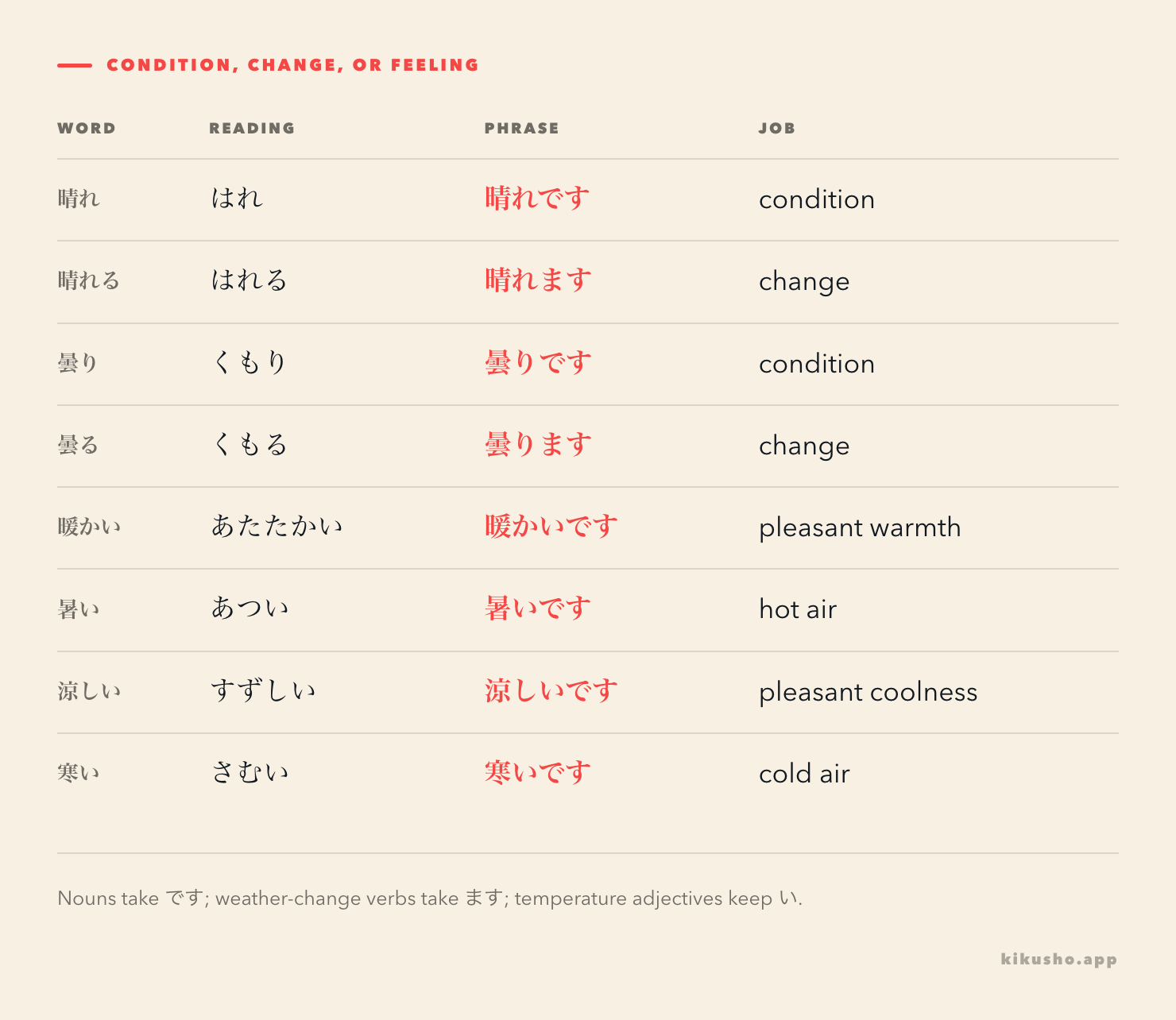
The table is selectable text: the phrase matters as much as the headword. Shogakukan's dictionary entries for 雨, 雪, 風, and 空 check the nouns and readings independently of the N5 list. Its 曇り entry names the cloudy state; Kanji Pedia's 曇る entry gives the change verb.
The pattern: a condition is not its change
晴れです and 曇りです use nouns before です. 晴れます and 曇ります are polite verb forms. You can say 明日は曇りです to name tomorrow's condition, or 空が曇ります to report the sky clouding over. Shogakukan on 晴れ identifies the noun; Kanji Pedia on 晴れる identifies the clearing verb. The sources give the weather meanings rather than relying on an English “cloudy” gloss to choose the Japanese form.
With 雨 and 雪, the phenomenon is the subject of 降る: 雨が降ります and 雪が降ります. Wind has a different verb, 風が吹きます. The が marks what is falling or blowing; you do not make these simple weather clauses by putting the phenomenon after を. If you need a fuller account of how Japanese verbs report change, the N4 change-verb lesson continues from this N5 set.
Why 天気 can point to fine weather
明日の天気は雨です means “Tomorrow's weather is rainy.” Here 天気 names the overall condition; rain is one possible answer. The Japan Meteorological Agency defines 天気 as the combined state of atmospheric factors and lists rain, snow, clear weather, and cloudiness among its types.
In 天気が続く, however, 天気 has the narrower sense fine weather: you are saying that a stretch of fair days continues. A short remark 天気だ can also mean “it's fine weather.” Both Kanji Pedia and Shogakukan's dictionary record this sense separately from the broad one. The dictionary also records an old sense, “the emperor's mood”; it is not a beginner weather phrase. Do not assume the narrow sense every time you see 天気. The surrounding words decide it.
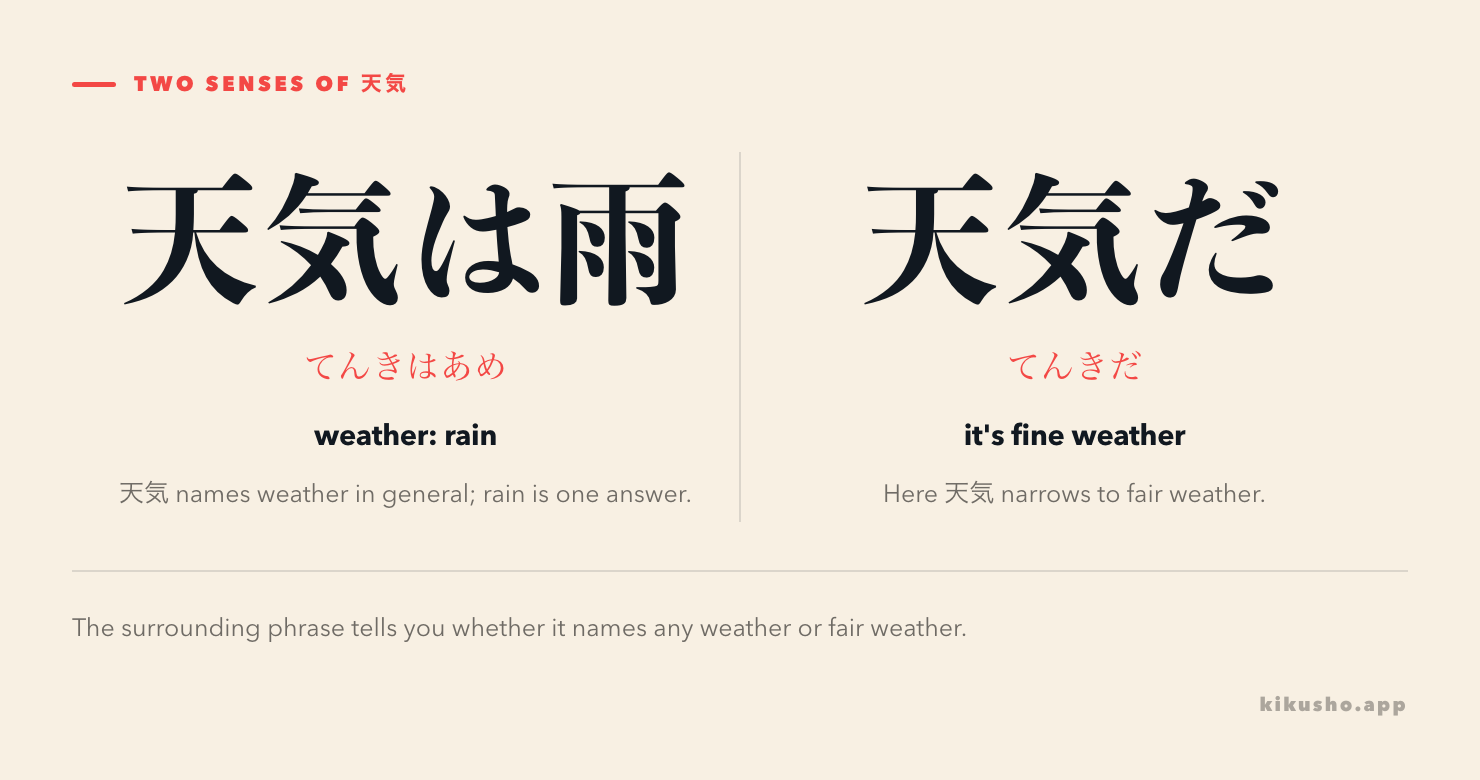
There is a useful limit to “good weather” as a translation. The meteorological agency avoids よい天気 in formal forecasts because good conditions depend on the situation; it recommends naming the specific condition. In everyday conversation, いい天気ですね is still a normal friendly remark. Formal forecast wording and small talk do different work.
Temperature words describe the air you feel
The four adjectives in the set form two practical pairs. 暑い and 寒い describe hot or cold surrounding air; strong heat or cold can be uncomfortable. 暖かい is mild warmth, and 涼しい is refreshing coolness. Shogakukan defines 暖かい as a pleasant temperature that is neither too cold nor too hot; its 涼しい entry includes comfortable coolness. The 暑い and 寒い entries verify the ambient extremes.
暑い describes a hot day, while 熱い describes something hot to the touch, such as soup. Both read あつい. Similarly, weather 暖かい is usually written with 暖, whereas a warm object or kind treatment uses 温かい. The spelling note in the 暖かい dictionary entry distinguishes warmth felt by the whole body from warmth of an object or feeling. These neighbouring spellings help you choose the assigned weather words; they are not extra N5 entries claimed by this lesson.
The phrases you can take from a forecast
Read 明日は晴れです, 午後は曇りです, or 雪が降ります as complete pieces. A forecast may name the condition with a noun; a later report can say that the sky 晴れます or 曇ります. In conversation, 今日は涼しいですね can say more than a temperature number: it reports the pleasant feel of the air.
If you notice 明日は曇りです in a weather notice, paste the whole line into Kikusho and check its drafted reading and meaning before saving. The noun, its time word, and the ending then stay on one card for offline review. Kikusho captures what you meet; it does not assign an official exam syllabus.
Check yourself
Question 1: cloudy forecast. What is the hiragana reading of 曇り?
Question 2: spelling. Which written word matches はれる, “to clear up”?
- A. 晴れ
- B. 晴れる
- C. 曇り
- D. 曇る
Question 3: noun in context. A forecast says, “It will be cloudy tomorrow.” Complete 明日は__です with the assigned noun for the condition.
Question 4: changing sky. Use 空 as the subject with が and the assigned verb 曇る in polite form to write “The sky clouds over.”
Question 5: temperature in context. Choose one assigned adjective for each scene: (a) the air is pleasantly warm, neither cold nor uncomfortably hot; (b) the air is uncomfortably hot. Write their readings too.
Question 6: paraphrase. In 天気が続きます, does 天気 name weather in general or a run of fine weather? Explain how the phrase tells you.
Answers and explanations
Answer 1. くもり. 曇り is the noun for cloudy conditions; 曇る(くもる) is the verb for the sky clouding over. The final り and る are different word endings, not interchangeable spellings.
Answer 2. B, 晴れる(はれる). 晴れ is the noun, read はれ; 曇り is cloudy weather, and 曇る means to cloud over. Only 晴れる has both the requested reading and the changing-to-clear sense.
Answer 3. 曇り: 明日は曇りです. The question asks for a cloudy condition before です. 曇る is a verb; it would need a verbal form such as 曇ります, not the noun slot in this sentence.
Answer 4. 空が曇ります. 空(そら) is the sky, が marks it as the subject, and 曇ります is the polite form of 曇る(くもる). 曇りです would name a condition instead of reporting the sky's change.
Answer 5. (a) 暖かい(あたたかい); (b) 暑い(あつい). 暖かい fits mild warmth in the air; 暑い fits uncomfortable ambient heat. 涼しい would be pleasantly cool, and 寒い would say the air is cold.
Answer 6. It means a run of fine weather continues. 天気 can name any weather in 明日の天気, but in 天気が続きます it takes the recorded narrower sense of favourable, clear conditions. The following 続きます, “continues,” points to a stretch of such days, not an unspecified weather category.
When you next read a weather line, look first for the predicate. です, ます, and an adjective ending show whether you are hearing a condition, a change, or someone's experience of the air.
Common questions
What does 天気 mean in Japanese?
天気(てんき) usually names the overall weather, including rain and snow. In expressions such as 天気が続く, it can also mean fine weather.
Is 晴れ the same word as 晴れる?
晴れ(はれ) is a noun for clear or sunny weather, as in 晴れです. 晴れる(はれる) is a verb for the sky or weather clearing, as in 晴れます.
Can I use 暑い for hot food?
暑い(あつい) describes hot air or weather. Hot food or water is usually 熱い(あつい), written with a different first kanji.