On this page
The five N2 words in this lesson are 火山(かざん), 噴火(ふんか), 凍える(こごえる), 虹(にじ) and 日差し(ひざし). They belong to one outdoor scene, but they do five different jobs: a volcano is a place or geological body, an eruption is an event, a person can suffer from cold, a rainbow can appear, and sunlight can grow stronger.
The five roles at a glance
| Term | Kana | Grammar and meaning | Keep this phrase |
|---|---|---|---|
| 火山 | かざん | noun; volcano | 火山のふもと, the foot of a volcano |
| 噴火 | ふんか | noun or する verb; volcanic eruption, erupt | 火山が噴火する, a volcano erupts |
| 凍える | こごえる | intransitive verb; become numb or stiff from cold | 手が凍える, one's hands become painfully cold |
| 虹 | にじ | noun; rainbow | 空に虹がかかる, a rainbow arches across the sky |
| 日差し | ひざし | noun; shining sunlight, rays of the sun | 日差しが強い, the sunlight is strong |
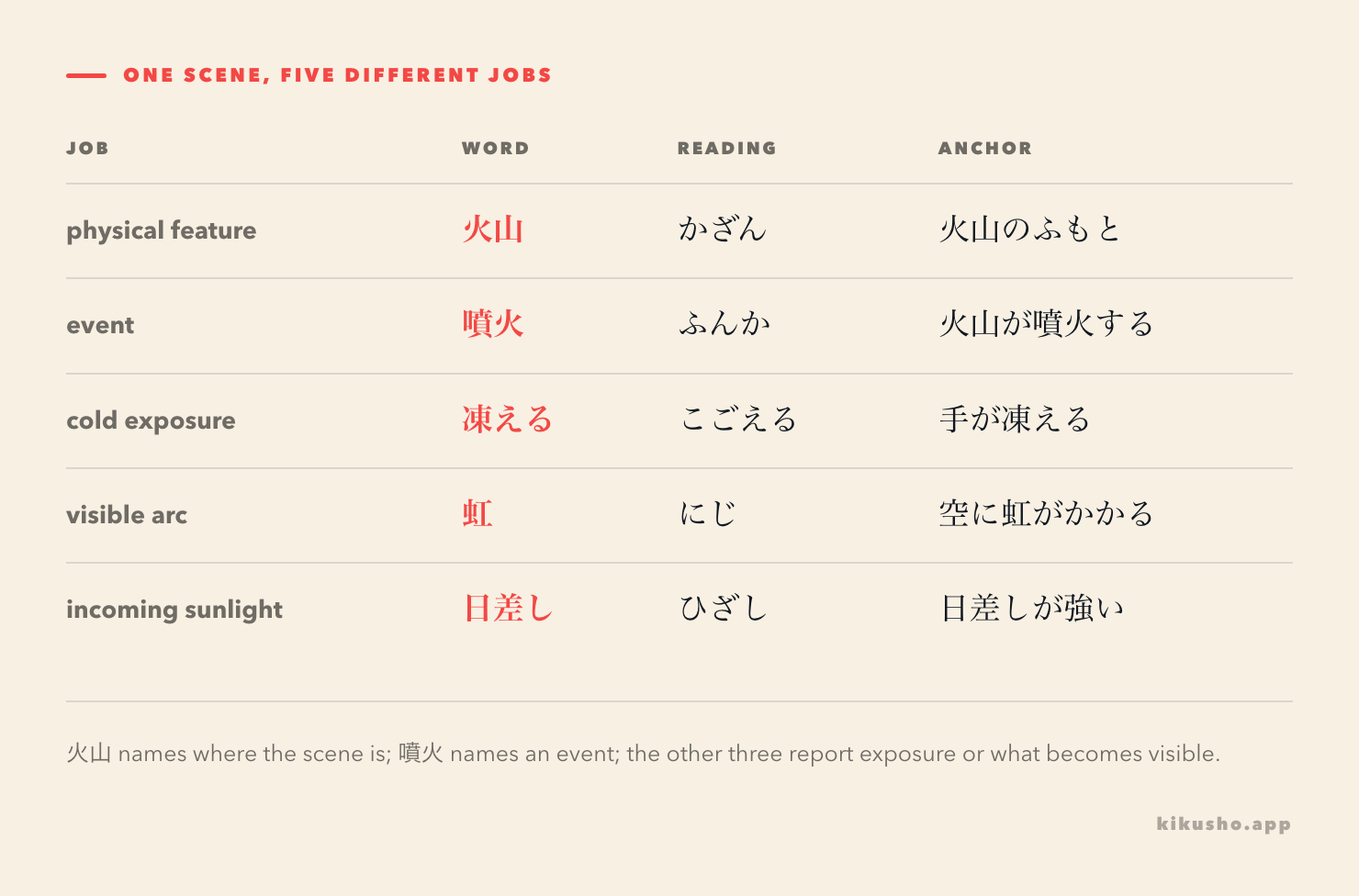
Three contrasts organise the set. 火山 exists even when nothing is erupting; 噴火 is what happens. 凍える reports the effect of severe cold on a living body, unlike water 凍る. 日差し makes the direction, strength or feel of sunlight salient, while 虹 names an optical phenomenon that becomes visible under the right conditions.
火山 is the volcano; 噴火 is the event
火山 names a volcano. It can be the subject of a description, a location in a travel account or the source of volcanic activity:
この町は火山のふもとにあります。
この まちは かざんの ふもとに あります。
This town is at the foot of a volcano.
Not every mountain is a 火山, and not every volcano is erupting now. The Japan Meteorological Agency's explanation of active volcanoes uses a long geological time frame: recent quiet does not by itself turn an active volcano into an ordinary mountain. For this vocabulary lesson, the key point is grammatical. 火山 names the physical feature; it does not itself mean “eruption.”
噴火 names the event in which volcanic material is expelled. The JMA terminology guide defines it through lava flowing from a crater or solid material such as volcanic ash being released outside it. In general Japanese, 噴火 works as a noun and as a する verb.
火山が噴火し、周辺の道路が閉鎖されました。
かざんが ふんかし、しゅうへんの どうろが へいさされました。
The volcano erupted, and nearby roads were closed.
The sentence gives the physical volcano with が and uses 噴火する as its action. A report can instead make the event the subject: 噴火が発生した, an eruption occurred. It can also link the nouns with の: 火山の噴火, a volcanic eruption.
| Focus | Natural pattern | What it says |
|---|---|---|
| physical feature | 火山を調査する | investigate a volcano |
| the volcano acts | 火山が噴火する | the volcano erupts |
| event occurrence | 噴火が発生する | an eruption occurs |
| relation | 火山の噴火 | a volcanic eruption |
Do not build 噴火を噴火する. Once 噴火 carries する, it is already the action. 噴火を観測する, observe an eruption, is different because 観測する is the verb and the eruption is its object.
The event can produce 火山灰(かざんばい), volcanic ash, and 噴煙(ふんえん), a volcanic plume. Those are useful reading words, but they are not additional assigned items in this lesson. The JMA distinguishes the event from its products precisely because warnings need to say what occurred and what is moving through the air.
凍える is cold suffered by a living body
凍える is an intransitive ichidan verb: 凍えます, 凍えた, 凍えている. It describes cold so severe that a person, animal or body part loses feeling, stiffens or becomes hard to move. Shogakukan's dictionary definition centres on the body becoming thoroughly cold and losing freedom of movement.
手袋を忘れて、手が凍えそうです。
てぶくろを わすれて、てが こごえそうです。
I forgot my gloves, and my hands feel as if they are going to freeze.
The English word “freeze” hides an important Japanese division. 凍える is exposure to bitter cold. 凍る(こおる) is the physical change in which a liquid becomes solid. 冷える(ひえる) is the broader fall in temperature.
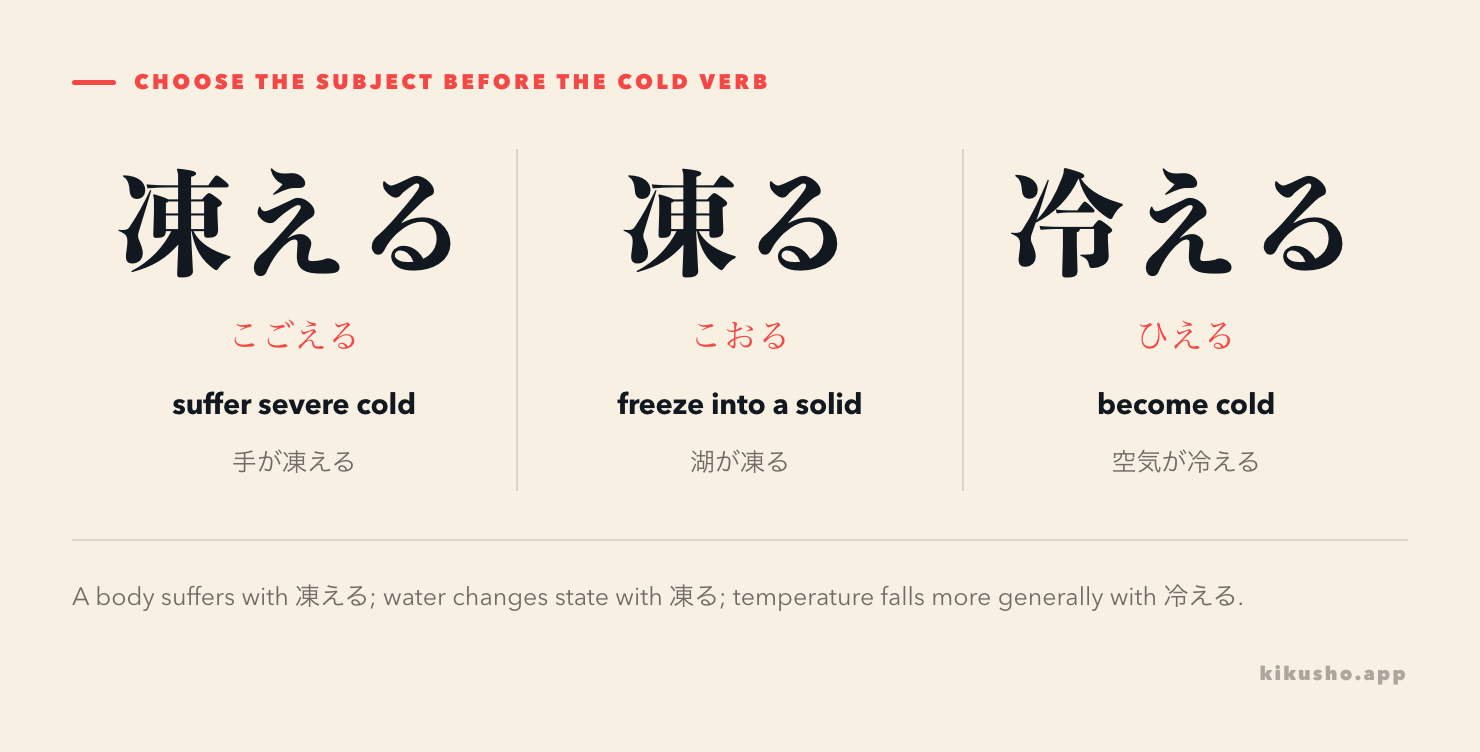
- 登山者が凍える — the climber becomes dangerously or painfully cold.
- 湖が凍る — the lake freezes into ice.
- 夜に空気が冷える — the air becomes cold at night.
The first subject experiences cold; the second undergoes a change of state; the third simply falls in temperature. The N3 climate vocabulary lesson develops 凍る, along with ice, frost and temperature measurements. The N4 lesson introduces 冷える. Reading the three levels together prevents one English gloss from flattening three Japanese verbs.
凍え死ぬ(こごえじぬ) means to freeze to death and expresses an actual fatal outcome. Do not use it as a casual substitute for 凍える. In an exaggerated complaint, 凍えそうだ, “I feel as if I might freeze,” is enough.
虹 appears; it does not “rainbow” as a verb
虹 is the noun “rainbow.” Water droplets refract and reflect sunlight, producing the coloured arc seen opposite the sun. The JMA explanation of atmospheric optical phenomena distinguishes a rainbow formed through water droplets from ice-crystal phenomena such as a halo. Kotobank's 虹 entry gives the reading にじ and describes the familiar arc after rain.
Japanese normally supplies an appearance or perception verb:
- 虹が出る — a rainbow appears.
- 虹が見える — a rainbow is visible.
- 空に虹がかかる — a rainbow arches across the sky.
- 二重の虹 — a double rainbow.
雨がやむと、火山の上に大きな虹がかかりました。
あめが やむと、かざんの うえに おおきな にじが かかりました。
When the rain stopped, a large rainbow appeared over the volcano.
The location particle changes the picture. 火山の上に虹がかかる places the visible arc over the volcano. 火山から虹が出る would make the volcano sound like the rainbow's source and would be a poor description of the same view.
日差し is sunlight as it reaches you
日差し comes from 日が差す, sunlight shines or streams in. It refers to sunlight entering or falling on a place, and often makes its strength, direction, seasonal quality or felt effect salient. The dictionary history of 日差し records both sunlight shining into a place and the lines or rays of sunlight.
雨の後、雲の間から強い日差しが戻ってきました。
あめの あと、くもの あいだから つよい ひざしが もどってきました。
After the rain, strong sunlight returned through a gap in the clouds.
Useful modifiers tell you what the speaker notices:
- 強い日差し — strong sunlight.
- 柔らかな日差し — soft sunlight.
- 春の日差し — spring sunshine.
- 窓から入る日差し — sunlight entering through a window.
- 日差しを避ける — avoid direct sunlight.
日光(にっこう) is the broader noun for the physical light of the sun. 日光を浴びる, be exposed to sunlight, and 日光で氷が溶ける, ice melts in sunlight, present it as a source of light or energy. 日差しが強い presents how that sunlight reaches and affects a scene. The meanings overlap, but the collocations are not freely interchangeable: 強い日差し is ordinary; 強い日光 is possible in a more physical or technical description and sounds less like an immediate weather remark.
Do not confuse 日差し with 日射(にっしゃ), solar radiation. Weather and health reports use 日射 when the measured radiation or exposure is the point. 日差し belongs comfortably in perception and daily description.
Read the five words in one mountain report
朝、火山のふもとでは冷たい雨が降り、手が凍えるほど寒く感じられました。昼前に雨がやむと、雲の間から日差しが戻り、火山の上に虹がかかりました。現在、噴火は確認されていませんが、登山者は最新の情報を確認しています。
あさ、かざんの ふもとでは つめたい あめが ふり、てが こごえるほど さむく かんじられました。ひるまえに あめが やむと、くもの あいだから ひざしが もどり、かざんの うえに にじが かかりました。げんざい、ふんかは かくにんされていませんが、とざんしゃは さいしんの じょうほうを かくにんしています。
In the morning, cold rain fell at the foot of the volcano, and it felt cold enough to numb the hands. When the rain stopped before noon, sunlight returned through the clouds and a rainbow appeared over the volcano. No eruption has been confirmed, but climbers are checking the latest information.
The paragraph keeps observation separate from inference. Seeing a rainbow or stronger sunlight says nothing about whether a volcano will erupt. 火山 establishes the location, 凍える the bodily effect of cold, 日差し the returning light, 虹 what becomes visible, and 噴火 the event whose status must come from monitoring.
That separation matters in an N2 reading. A sentence can mention a 火山 without reporting an emergency. A blank after 火山が may need 噴火した, while a blank after 手が and a severe-cold context may need 凍えた. A description modified by 強い is likely to select 日差し, and an arc after rain is 虹.
Why this set sits at N2
The September 2026 Kikusho inventory assigns all five spelling-and-reading records to N2, with no disagreement between its two imported snapshots. Those snapshots share the Tanos/Waller source family, so their agreement counts as one baseline rather than two independent confirmations. Independent sources do not draw every boundary in the same place: Bunpro labels 火山 N3, while the Japan Foundation's Marugoto Intermediate 2 vocabulary includes 火山 and 噴火, and the TRY! N2 list includes 噴火.
The official JLPT FAQ explains that the organisers do not publish an exhaustive vocabulary, kanji and grammar catalogue. N2 is therefore a supported study placement, not an official item-by-item ruling. This lesson states the external disagreement on 火山 and teaches all five assigned records because their contrasts are useful in real reports regardless of the exact study level.
The N1 climate and natural-hazards lesson continues from visible outdoor conditions into warning language: it separates the readings of 雷, the near-homophones 降水 and 洪水, and the distinct mechanism behind 津波.
When you save these words in Kikusho, keep the clause that reveals the role: 火山が噴火する, 手が凍える, 空に虹がかかる, 日差しが強い. A card containing only “freeze” or “sunlight” removes the subject and collocation that distinguish the intended word.
Practice the mountain report
Question 1 · sound check
Supply the kana for both 噴火 and 日差し.
Question 2 · landform and event
Complete the sentence: その__は百年前にも__した記録があります。
- A. 虹・凍え
- B. 火山・噴火
- C. 噴火・火山
- D. 日差し・虹
Question 3 · event pattern
Which sentence naturally means “An eruption occurred”?
- A. 噴火が発生しました。
- B. 噴火を噴火しました。
- C. 火山を凍えました。
- D. 虹が日差ししました。
Question 4 · cold verb
Without gloves, which form fits 手袋がなくて、手が___?
- A. 噴火しました
- B. 凍えました
- C. 凍りました
- D. 日差しました
Question 5 · 凍える or 凍る
Which pairing is accurate?
- A. 手が凍える・湖が凍る
- B. 手が凍る・湖が凍える
- C. 手が噴火する・湖が日差す
- D. 手が虹になる・湖が火山する
Question 6 · rainbow collocation
Complete the scene after rain: 空に大きな虹が___。
- A. かかりました
- B. 凍えました
- C. 噴火しました
- D. 浴びました
Question 7 · sunlight contrast
Which phrase best describes sunlight that feels strong on your face?
- A. 日差しが強い
- B. 虹が強い
- C. 火山が明るい
- D. 噴火が柔らかい
Question 8 · precise interpretation
Which conclusion is justified by 雨がやみ、火山の上に虹がかかった?
- A. The volcano has certainly erupted.
- B. The observer's hands have frozen into ice.
- C. The rain stopped and a rainbow became visible over the volcano.
- D. The phrase 火山 means volcanic eruption.
Answers and explanations
Answer 1
噴火 is ふんか; 日差し is ひざし. 噴火 names an eruption or acts as a する verb. 日差し presents sunlight as rays reaching a place or as the strength and feel of sunshine.
Answer 2
B. 火山・噴火. 火山 names the volcano. 噴火する reports the event: the volcano has a record of erupting a hundred years ago.
Answer 3
A. 噴火が発生しました. Here 噴火 is the event subject and 発生する reports its occurrence. 噴火を噴火する unnecessarily repeats the same action.
Answer 4
B. 凍えました. Hands can become numb or stiff from severe cold with 凍える. 凍る would present something physically freezing into a solid and does not fit this ordinary exposure sentence.
Answer 5
A. 手が凍える・湖が凍る. A living body or body part suffers the cold with 凍える; water undergoes a liquid-to-solid change with 凍る.
Answer 6
A. かかりました. 空に虹がかかる pictures a rainbow arching across the sky. 出る and 見える are also common verbs with 虹.
Answer 7
A. 日差しが強い. 日差し naturally takes 強い when the speaker notices the intensity of sunlight reaching the scene.
Answer 8
C. The rain stopped and a rainbow became visible over the volcano. The sentence places the rainbow over a physical volcano. It makes no claim that an eruption occurred, and 火山 does not itself mean 噴火.
Common questions
What is the difference between 火山 and 噴火?
火山(かざん)is the physical volcano. 噴火(ふんか)is an eruption and can also take する as a verb. A volcano erupts in 火山が噴火する; the two nouns name the place or geological body and the event respectively.
What is the difference between 凍える and 凍る?
凍える(こごえる)describes a person, animal or body part becoming painfully cold, numb or stiff. 凍る(こおる)describes water or another liquid freezing into a solid. 手が凍える and 水が凍る therefore report different changes.
What is the difference between 日差し and 日光?
日差し(ひざし)presents sunlight as rays shining into a place or as the strength and feel of sunshine, so 強い日差し and 窓から入る日差し are natural. 日光(にっこう)is the broader physical noun sunlight, as in 日光を浴びる.
Which verbs commonly go with 虹?
虹(にじ)commonly appears with 出る, 見える and かかる: 虹が出る means a rainbow appears, 虹が見える means one is visible, and 空に虹がかかる pictures it arching across the sky.