On this page
These 19 N3 Japanese words let you move from a climate description to a precise weather report: 気候, 気温, 温度, 湿度, 乾燥, 湿る, 蒸し暑い, 暖まる, 温まる, 冷やす, 日光, 露, 霜, 氷, 凍る, 溶ける, 霧, 雷 and 嵐. The useful work is not memorising one English label for each word; it is knowing which word measures the air, which one describes a change, and which phenomenon you can actually see.
The complete 19-word set
| Word | Reading | Part of speech and core sense | Phrase to keep |
|---|---|---|---|
| 気候 | きこう | noun; climate over a long period | 温暖な気候, a mild climate |
| 気温 | きおん | noun; air temperature | 気温が上がる, the air temperature rises |
| 温度 | おんど | noun; temperature in general | 水の温度, the water temperature |
| 湿度 | しつど | noun; humidity | 湿度が高い, the humidity is high |
| 乾燥 | かんそう | noun or する verb; dryness, drying | 空気が乾燥する, the air becomes dry |
| 湿る | しめる | intransitive verb; become damp | 土が湿る, the soil becomes damp |
| 蒸し暑い | むしあつい | i-adjective; hot and humid, muggy | 蒸し暑い夜, a muggy night |
| 暖まる | あたたまる | intransitive verb; air, a place or the body becomes warm | 部屋が暖まる, the room warms up |
| 温まる | あたたまる | intransitive verb; an object, food or the heart becomes warm | スープが温まる, the soup warms up |
| 冷やす | ひやす | transitive verb; cool or chill something | 水を冷やす, chill water |
| 日光 | にっこう | noun; sunlight | 日光を浴びる, be exposed to sunlight |
| 露 | つゆ | noun; dew | 葉に露がつく, dew forms on leaves |
| 霜 | しも | noun; frost | 霜がおりる, frost forms |
| 氷 | こおり | noun; ice | 氷が溶ける, ice melts |
| 凍る | こおる | intransitive verb; freeze | 水が凍る, water freezes |
| 溶ける | とける | intransitive verb; melt or dissolve | 雪が溶ける, snow melts |
| 霧 | きり | noun; fog | 霧が出る, fog develops |
| 雷 | かみなり | noun; thunder and lightning, the electrical phenomenon | 雷が鳴る, thunder sounds |
| 嵐 | あらし | noun; storm, tempest | 嵐が近づく, a storm approaches |
The table separates four systems. 気候, 気温, 温度 and 湿度 describe patterns or measurements. 乾燥, 湿る and 蒸し暑い describe moisture and how conditions feel. The warming and cooling verbs tell you what changes and whether an agent acts. The remaining words name visible states or weather phenomena.
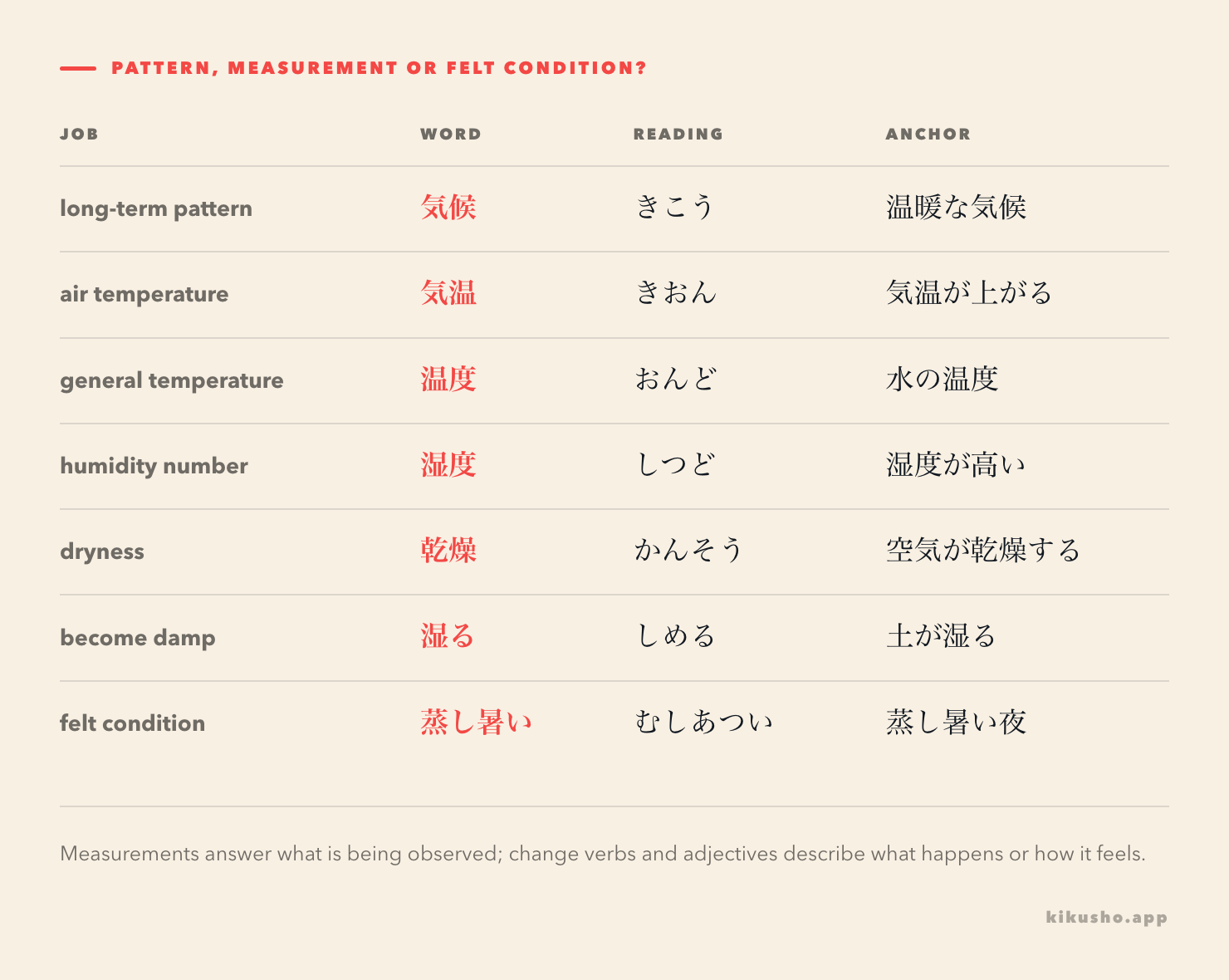
気候 lasts; 気温, 温度 and 湿度 are measured now
気候 describes the characteristic atmospheric conditions of a region over a long period. Japan's Meteorological Agency treats climate as weather conditions viewed across a comparatively long span, and standard climate averages commonly use 30 years. It does not mean today's weather.
この島は一年中、温暖な気候です。
この しまは いちねんじゅう、おんだんな きこうです。
This island has a mild climate throughout the year.
気温 is the temperature of the atmosphere. The JMA definition of 気温 specifies air temperature and describes ordinary observations made roughly 1.25 to 2 metres above the ground. That makes 今日の気温 natural, but スープの気温 impossible: soup is not the atmosphere.
午後は気温が三十度まで上がるそうです。
ごごは きおんが さんじゅうどまで あがるそうです。
The air temperature is expected to rise to 30 degrees in the afternoon.
温度 is the general measurement. Use it for water, food, a room, a refrigerator or a machine: 水の温度を測る, measure the water temperature. A room has both an air temperature and a temperature reading, so context can create overlap. The distinction still predicts the strongest collocations: forecasts report 気温, while experiments control 温度.
湿度 measures the amount of water vapour in the air, normally expressed as relative humidity. It is a number, not the same as the feeling of muggy heat.
気温は高くありませんが、湿度は八十パーセントあります。
きおんは たかくありませんが、しつどは はちじゅっぱーせんと あります。
The air temperature is not high, but the humidity is 80 percent.
乾燥, 湿る and 蒸し暑い describe three moisture conditions
乾燥 can be a noun, as in 肌の乾燥, dryness of the skin, or join する: 冬は空気が乾燥する, the air becomes dry in winter. The word can also describe deliberate drying, such as 食品を乾燥させる, drying food. In a weather report, it usually focuses on low moisture in the air.
湿る is an intransitive verb. Paper, soil, clothes or matches can absorb moisture and become damp:
雨で土が湿っています。
あめで つちが しめっています。
The soil is damp from the rain.
The subject marked by が undergoes the change. 湿度 gives a measurement; 土が湿る reports the result on an object. The transitive counterpart 湿らせる means to moisten something.
蒸し暑い combines heat and humidity into a felt condition. Dictionaries describe hot, humid weather with little relief from wind. A high humidity reading alone does not guarantee that a day is 蒸し暑い; the adjective also says the conditions feel uncomfortably hot and muggy.
梅雨には蒸し暑い日が続きます。
つゆには むしあつい ひが つづきます。
Muggy days continue during the rainy season.
The kana sequence つゆ also appears here as 梅雨, the rainy season. That is a different word from this lesson's 露(つゆ), dew. Kanji and context keep them apart.
暖まる, 温まる and 冷やす track what changes
暖まる and 温まる share the reading あたたまる and both mean “become warm.” Japanese spelling makes a useful tendency visible. The Agency for Cultural Affairs gives 暖まる for air and surroundings becoming less chilly, and 温まる for an object, food or the heart becoming pleasantly warm.
日光が入ると、部屋が暖まります。
にっこうが はいると、へやが あたたまります。
When sunlight enters, the room warms up.
鍋のスープが温まりました。
なべの すーぷが あたたまりました。
The soup in the pot has warmed up.
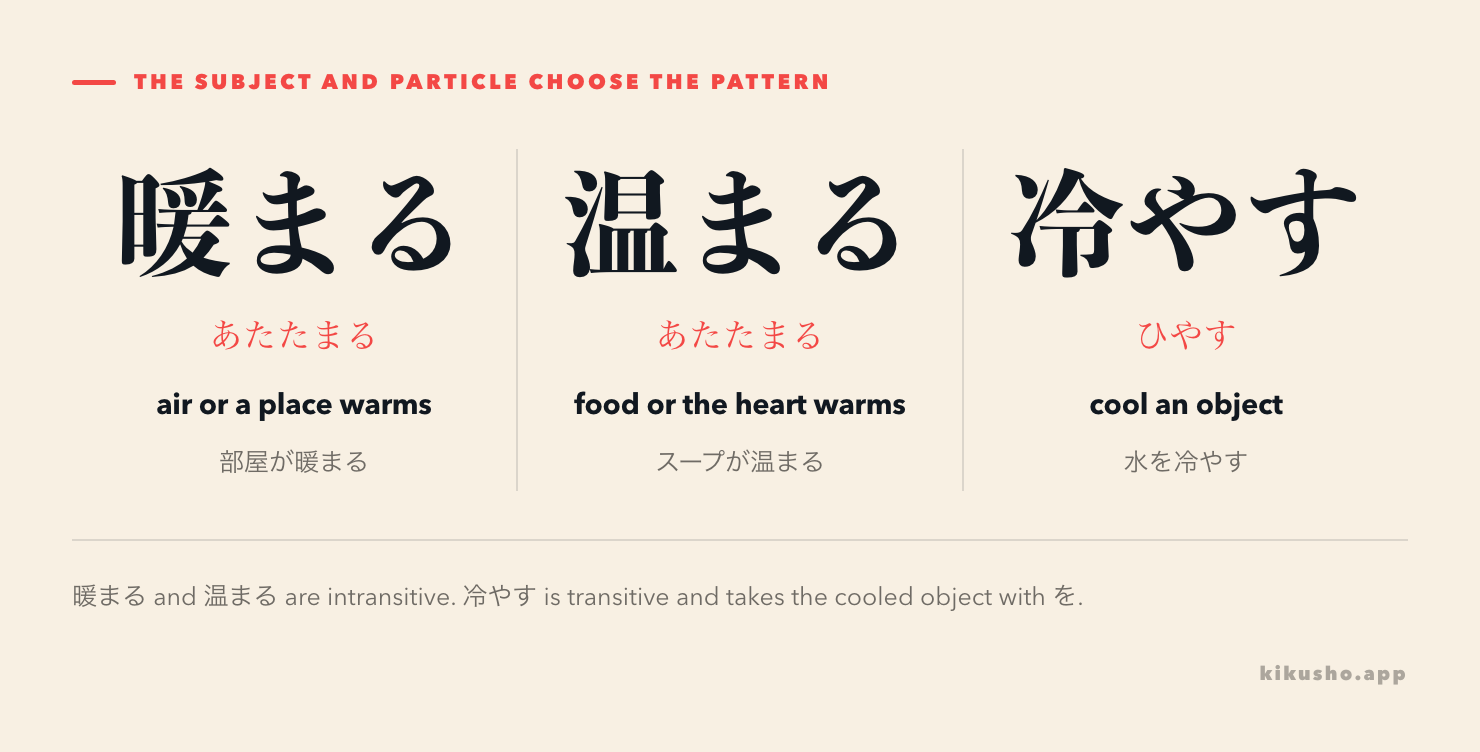
This is a spelling tendency with some overlap, not a law that divides the physical world perfectly. 体があたたまる can be written with either kanji depending on whether the writer pictures relief from surrounding cold or bodily warmth. Learn the clear examples first: 部屋が暖まる, スープが温まる, 心が温まる.
Both warming verbs are intransitive. By contrast, 冷やす is transitive: a person or thing cools an object marked by を.
飲む前に水を冷やしてください。
のむ まえに みずを ひやしてください。
Please chill the water before drinking it.
The N4 climate lesson teaches 冷える, the intransitive partner: 水が冷える, the water gets cold; 水を冷やす, someone chills the water. 日光 means sunlight in the room example. The same spelling is also the place name Nikkō, read にっこう; a place particle such as 日光へ行く makes that meaning clear.
露 and 霜 sit on surfaces; 氷, 凍る and 溶ける show state
露 and 霜 may both appear on grass in the morning, but they are not the same material. 露 is liquid water condensed into droplets. 霜 consists of ice crystals on a cold surface. The usual collocations preserve the difference: 葉に露がつく, dew forms on leaves; 霜がおりる, frost forms.
The fixed expression 霜がおりる uses a verb that can mean descend, but it does not claim that frost literally falls from the sky. The JMA terminology guide recommends this wording for frost observations.
氷 is the noun “ice.” 凍る describes a liquid becoming solid, while 溶ける describes a solid becoming liquid. Both verbs are intransitive, so the changing thing normally takes が.
夜の間に水が凍り、朝になると日光で氷が溶けました。
よるの あいだに みずが こおり、あさに なると にっこうで こおりが とけました。
The water froze during the night, and the ice melted in the morning sunlight.
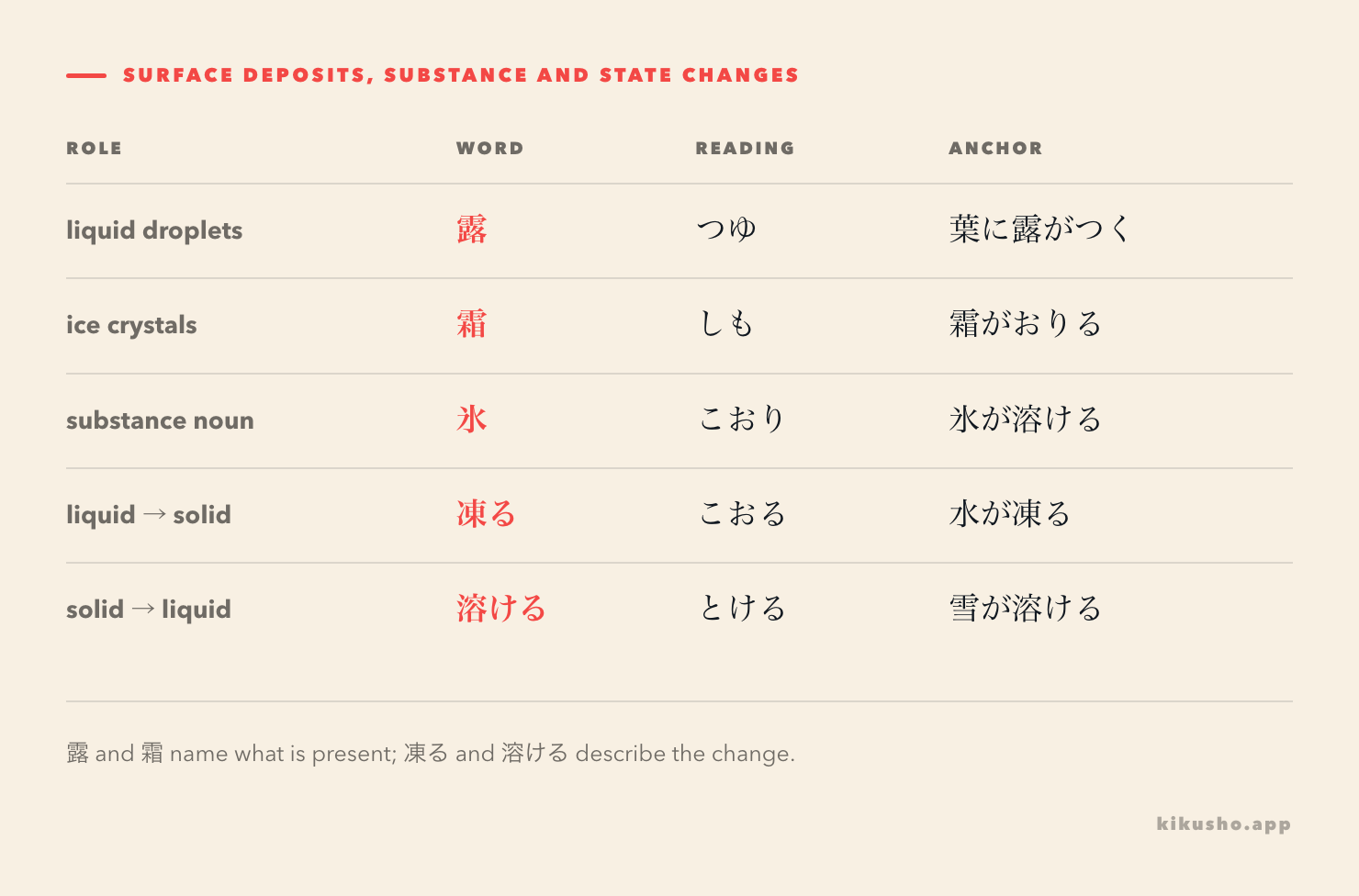
溶ける can also mean that a substance dissolves: 砂糖が水に溶ける, sugar dissolves in water. In 氷が溶ける, the context selects melting. Notice the reading contrast too: 氷(こおり) has a long お, while 凍る(こおる) ends in the verb suffix る.
霧, 雷 and 嵐 name different events
霧 is fog: tiny water droplets suspended close to the ground. In its technical observations, the JMA uses visibility below one kilometre as the boundary for 霧. Everyday speakers do not need to measure the distance before saying 霧が出ている, but the definition distinguishes fog from a cloud high in the sky.
濃い霧で山が見えません。
こい きりで やまが みえません。
The mountain is not visible because of thick fog.
雷 covers the electrical thunderstorm phenomenon. 雷が鳴る focuses on the sound of thunder. The sound itself is 雷鳴(らいめい), and a lightning strike is 落雷(らくらい). This is why translating 雷 as only “thunder” or only “lightning” can fail in a longer sentence.
遠くで雷が鳴っています。
とおくで かみなりが なっています。
Thunder is rumbling in the distance.
嵐 is the broad everyday noun “storm” or “tempest.” It can involve violent wind and rain, and it also works figuratively in phrases such as 批判の嵐, a storm of criticism. It is not the name of one technical forecast category, so a report may choose a more precise word such as 台風.
夜には嵐が近づくおそれがあります。
よるには あらしが ちかづく おそれが あります。
There is a risk that a storm will approach tonight.
For basic sky and forecast words such as 晴れ, 雨, 雪 and 曇り, review the N5 Japanese weather vocabulary lesson. For terrain that shapes local conditions, continue with the N3 landscapes and geography lesson.
Read the words in one weather report
この地方は湿度が高く、夏は蒸し暑い気候です。今日は朝から気温が上がり、日光で部屋も暖まりました。午後には空気が湿り、山に霧が出ました。夜は雷を伴う嵐になるおそれがあります。明日の朝は気温が下がるため、山では水が凍ったり、霜がおりたりするかもしれません。
この ちほうは しつどが たかく、なつは むしあつい きこうです。きょうは あさから きおんが あがり、にっこうで へやも あたたまりました。ごごには くうきが しめり、やまに きりが でました。よるは かみなりを ともなう あらしに なる おそれが あります。あしたの あさは きおんが さがるため、やまでは みずが こおったり、しもが おりたりするかもしれません。
This region has a humid climate with muggy summers. The air temperature rose from the morning today, and the sunlight warmed the room. In the afternoon the air became moist, and fog developed in the mountains. There is a risk of a storm with thunder tonight. Because the air temperature will fall tomorrow morning, water may freeze and frost may form in the mountains.
The report connects the vocabulary without claiming that each event causes the next. 気候 gives the long-term pattern. 湿度 and 気温 are measured conditions. 暖まる, 湿る and 凍る describe changes, while 霧, 雷, 嵐 and 霜 name phenomena. That division helps more than an English-to-Japanese list when a reading question removes one word.
What the N3 label means here
Kikusho's reference inventory places all 19 exact spelling-and-reading records in this N3 lesson. Independent study materials such as Japanese Compass's N3 vocabulary index and the TRY! N3 vocabulary list support the topic at this stage, but the boundaries are disputed. Imported lists place 暖まる, 温まる, 乾燥, 湿度, 湿る, 溶ける, 冷やす and 蒸し暑い at N2, and 露 at N1. The other ten assigned records have no item-level disagreement in the current inventory.
The official JLPT FAQ explains that the organizers no longer publish an exhaustive vocabulary, kanji and grammar catalogue. “N3” here is a practical study placement, not an official promise about where one isolated word must appear. Government and dictionary sources verify the meanings and distinctions; independent learning lists support the level estimate.
Continue with the N2 climate lesson for 火山/噴火, 凍える and 日差し/日光.
When you save these words in Kikusho, keep the phrase that establishes the role: 気温が上がる, 水の温度, スープが温まる, 水を冷やす, 霜がおりる. A card containing only “temperature” or “warm” discards the particle, subject and spelling decision that the sentence actually tests.
Practice the climate report
Question 1 · reading
Write the kana readings of 湿度 and 露.
Question 2 · measurement contrast
Complete the forecast: 明日の__は三十二度まで上がるでしょう。
- A. 気候
- B. 気温
- C. 露
- D. 霜
Question 3 · object temperature
Which phrase means “measure the water temperature”?
- A. 水の温度を測る
- B. 水の気候を測る
- C. 水の湿るを測る
- D. 水の嵐を測る
Question 4 · warming spelling
Choose the expected spellings: 日光で部屋が__。鍋でスープが__。
- A. 温まる・暖まる
- B. 暖まる・温まる
- C. 冷やす・湿る
- D. 溶ける・凍る
Question 5 · transitivity
Which sentence naturally means “Please chill the water”?
- A. 水が冷やしてください。
- B. 水を冷やしてください。
- C. 水を凍ってください。
- D. 水が温度してください。
Question 6 · dew and frost
Which pairing is accurate?
- A. 露 is ice crystals; 霜 is liquid droplets.
- B. 露 and 霜 are two spellings of the same word.
- C. 露 is liquid dew; 霜 is frost made of ice crystals.
- D. 露 means fog; 霜 means thunder.
Question 7 · state change
Complete the sequence: 夜に水が__。朝、日光で氷が__。
- A. 凍る・溶ける
- B. 溶ける・凍る
- C. 冷やす・湿る
- D. 乾燥する・暖まる
Question 8 · precise report
Which explanation is accurate?
- A. 気候 normally describes today's air temperature.
- B. 湿度 and 蒸し暑い always mean exactly the same thing.
- C. 雷が鳴る focuses on the sound of thunder, while 嵐 is a broad word for a storm.
- D. 霧 is an individual cloud high in the sky.
Answers and explanations
Solution 1
湿度 is しつど; 露 is つゆ. 湿度 is humidity as a measurement. 露 is liquid dew. The reading つゆ can also represent 梅雨, the rainy season, so written context matters.
Solution 2
B. 気温. A forecast reports the air temperature with 気温. 気候 describes long-term climate, while 露 and 霜 are surface phenomena.
Solution 3
A. 水の温度を測る. 温度 is the general temperature measurement for an object or substance. 気温 is reserved for the air or atmosphere.
Solution 4
B. 暖まる・温まる. 暖まる is the expected spelling for a room or its air becoming less chilly. 温まる is expected for soup becoming warm. Both are read あたたまる.
Solution 5
B. 水を冷やしてください. 冷やす is transitive, so the thing being chilled takes を. 水が冷える would mean “the water becomes cold.”
Solution 6
C. 露 is liquid dew; 霜 is frost made of ice crystals. The useful collocations are 露がつく and 霜がおりる.
Solution 7
A. 凍る・溶ける. Water freezes with 水が凍る. Ice melts with 氷が溶ける. Both verbs are intransitive here.
Solution 8
C. 雷が鳴る focuses on the sound of thunder, while 嵐 is a broad word for a storm. 気候 is long term, a humidity measurement does not by itself state a muggy feeling, and 霧 is fog close to the ground.
Common questions
What is the difference between 気温 and 温度?
気温(きおん)is the temperature of the outside air or atmosphere. 温度(おんど) is the broader measurement used for water, food, rooms, machines and other things. 気温 is therefore a kind of temperature, but their normal collocations differ.
What is the difference between 暖まる and 温まる?
Both are read あたたまる and mean to become warm. 暖まる is usual for air, a room or the body as a whole becoming less chilly. 温まる is usual for an object, food or the heart becoming pleasantly warm, as in スープが温まる and 心が温まる. Actual usage overlaps at the boundary.
What is the difference between 露 and 霜?
露(つゆ)is liquid dew that condenses into droplets. 霜(しも)is frost made of ice crystals on a cold surface. The standard weather expression is 霜がおりる, while 露 commonly takes つく.
Are all 19 words officially assigned to JLPT N3?
No official exhaustive JLPT vocabulary list exists. Kikusho's reference inventory places these exact forms in this N3 lesson, but imported lists disagree on nine items and put them at N2 or N1. The lesson reports those boundaries instead of treating one commercial list as official.