On this page
These five N1 Japanese shopping, products and customer service vocabulary records belong to the language behind a purchase: deciding what an item is worth, checking its stock and quality, comparing its market rate and preparing it for shipment. Two familiar kanji hide less familiar readings: 値 is あたい here, and 包む is くるむ.
The set is small enough to study through contrasts. If you attach each word to the decision it answers, the readings stop looking arbitrary.
Five words guide one product decision
| Word | Kana and rōmaji | Grammar role | Sense taught here | Anchor phrase |
|---|---|---|---|---|
| 値 | あたい, atai | noun | value, worth or numerical value | 変数の値を求める: find the value of a variable |
| 包む | くるむ, kurumu | transitive godan verb | wrap around; swaddle; cover by winding | 商品を緩衝材でくるむ: wrap a product in cushioning |
| 在庫 | ざいこ, zaiko | noun | stock or inventory held for sale or production | 在庫を抱える: carry inventory |
| 相場 | そうば, sōba | noun | current market price or usual going rate | 中古品の相場を調べる: check the going rate for used goods |
| 品質 | ひんしつ, hinshitsu | noun | quality or properties of goods | 品質を維持する: maintain quality |
値 asks what something amounts to. 包む names a physical handling action. 在庫 says what stock is on hand, 相場 gives a market reference, and 品質 evaluates the goods themselves.
値 has two contextual readings and one fixed N1 pattern
The kanji 値 is not tied to one pronunciation. Read it from its role in the sentence.
値(ね) is the usual reading for a price or a compact price expression.
原材料が不足し、この製品の値が上がりました。
げんざいりょうがふそくし、このせいひんのねがあがりました。
Raw materials became scarce, and the price of this product rose.
値(あたい) is used for a numerical value and for formal worth. Mathematics and data give the clearest noun examples.
測定した値を表に入力してください。
そくていしたあたいをひょうににゅうりょくしてください。
Please enter the measured value in the table.
The dictionary entry for 値 records ね for a sale price or worth, while its kanji entry gives あたい for worth and numerical value. In ordinary prose, 価値(かち) often expresses abstract value more naturally than the standalone noun 値(あたい).
N1 reading questions frequently exploit the related verb 値する(あたいする). The formal pattern noun + に値する means “to be worth” or “to deserve.”
この製品は品質が安定しており、信頼に値します。
このせいひんはひんしつがあんていしており、しんらいにあたいします。
This product has consistent quality and merits trust.
調査結果は再検討に値するものです。
ちょうさけっかはさいけんとうにあたいするものです。
The survey results deserve reconsideration.
The 値する entry defines the construction through having sufficient worth or being deserving of the action. Do not read it にねする.
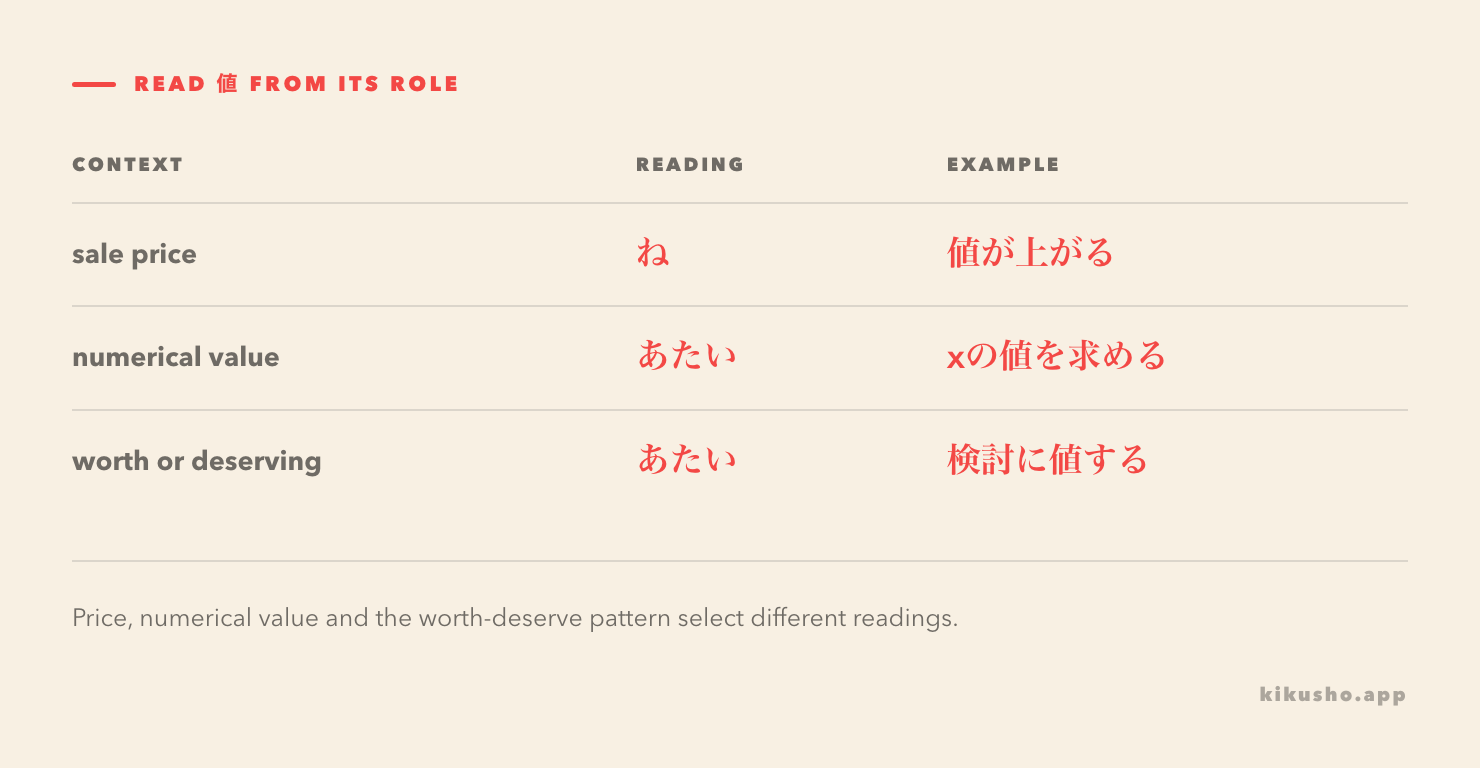
| Context | Reading | Example |
|---|---|---|
| sale price | ね | 値が上がる |
| numerical value | あたい | xの値を求める |
| worth or deserving | あたい | 検討に値する |
The N3 shopping lesson introduced 値(ね). This N1 record adds あたい without replacing the earlier reading.
包む read くるむ wraps material around something
包む(くるむ) describes covering an object by wrapping material around it. The word is often written くるむ in kana because the same kanji strongly invites the reading つつむ.
割れやすい商品を緩衝材でくるみ、箱に入れました。
われやすいしょうひんをかんしょうざいでくるみ、はこにいれました。
We wrapped the fragile product in cushioning and put it in a box.
赤ちゃんを柔らかい毛布でくるみました。
あかちゃんをやわらかいもうふでくるみました。
I wrapped the baby in a soft blanket.
The Digital Daijisen usage note says くるむ and つつむ overlap when cloth or paper covers an object. It then draws a useful tendency:
- くるむ focuses on winding or placing a covering around something, as with a blanket or cushioning.
- つつむ more broadly encloses or surrounds the object, and extends to gifts, ceremonial money, fog, mystery and feelings.
贈り物をきれいな紙で包みました。
おくりものをきれいなかみでつつみました。
I wrapped the gift in attractive paper.
会場は温かい拍手に包まれました。
かいじょうはあたたかいはくしゅにつつまれました。
The venue was enveloped in warm applause.
The gift sentence foregrounds a complete package, while the applause sentence is figurative; つつむ is natural in both. For protective material wound around a product, くるむ is a precise choice. This is a tendency with overlap, not a rule that makes every alternative impossible.
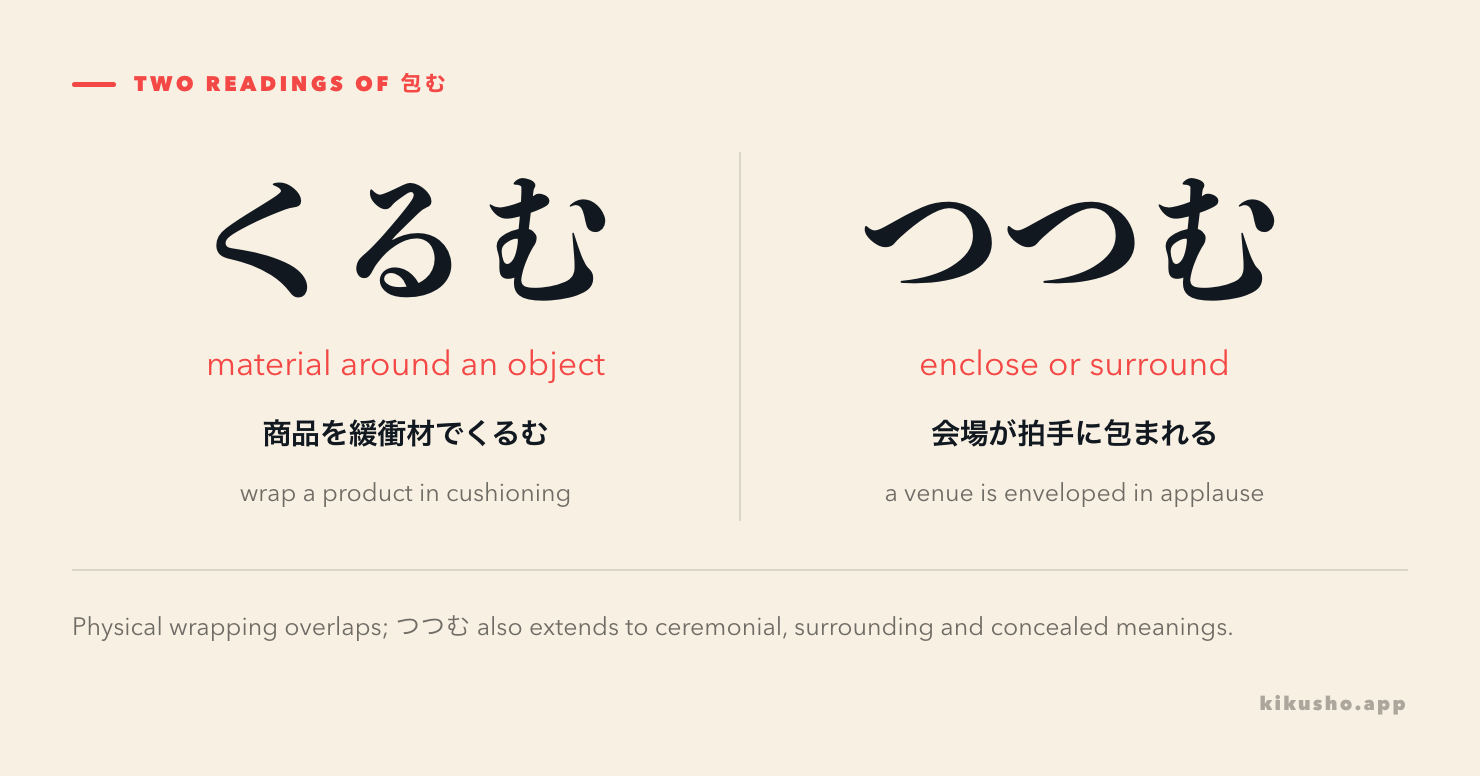
The assigned record is 包む(くるむ), so a practice answer written つつむ gives a real word but misses the required reading.
在庫 is stock held before the next sale or production step
在庫(ざいこ) refers to goods present in a warehouse or shop and, in business, to raw materials, work in progress and finished products held by a company. The Digital Daijisen entry records both the everyday shop sense and the wider business inventory sense.
店舗には在庫がありませんが、倉庫には三点残っています。
てんぽにはざいこがありませんが、そうこにはさんてんのこっています。
The shop has no stock, but three units remain in the warehouse.
Learn 在庫 through the verb that follows it:
| Pattern | Meaning |
|---|---|
| 在庫がある/ない | stock is available / unavailable |
| 在庫が切れる | stock runs out |
| 在庫を確認する | check inventory |
| 在庫を抱える | carry or be burdened with inventory |
| 在庫を補充する | replenish stock |
| 在庫を処分する | clear or dispose of inventory |
在庫切れ names a stockout. It can be temporary, so it does not by itself promise that the product has been discontinued. 売り切れ presents the customer-facing result that the available goods have sold. The N2 shopping lesson teaches that sold-out state and its verb.
Too much stock is not automatically good. Japan's official small-business support site explains that holding excess inventory can reduce cash flow and allow quality and product value to deteriorate. That source also supplies two useful compounds: 過剰在庫, excess inventory, and 在庫を抱える, to carry inventory.
相場 is a moving market reference, not a seller's fixed label
相場(そうば) names the price at which goods, securities, currencies or other assets trade in a market at a given time. It can also mean the usual social estimate or accepted range for something.
購入する前に、中古カメラの相場を調べました。
こうにゅうするまえに、ちゅうこかめらのそうばをしらべました。
Before buying, I checked the going rate for used cameras.
The dictionary entry for 相場 separates three senses: a current market price, speculative trading and a generally accepted estimate or norm. Shopping and product comparison mainly use the first and third.
この型の相場は、状態によって三万円から五万円です。
このかたのそうばは、じょうたいによってさんまんえんからごまんえんです。
The going rate for this model is ¥30,000 to ¥50,000 depending on its condition.
That range is different from three nearby price words:
| Word | What sets it | Typical question |
|---|---|---|
| 定価 | maker or seller's established list price | What was the listed reference price? |
| 販売価格 | seller's current offered price | What will this shop charge? |
| 相場 | current market transactions or common estimate | What do comparable items usually cost now? |
| 値(ね) | compact word for an item's price or worth | Has its price gone up or down? |
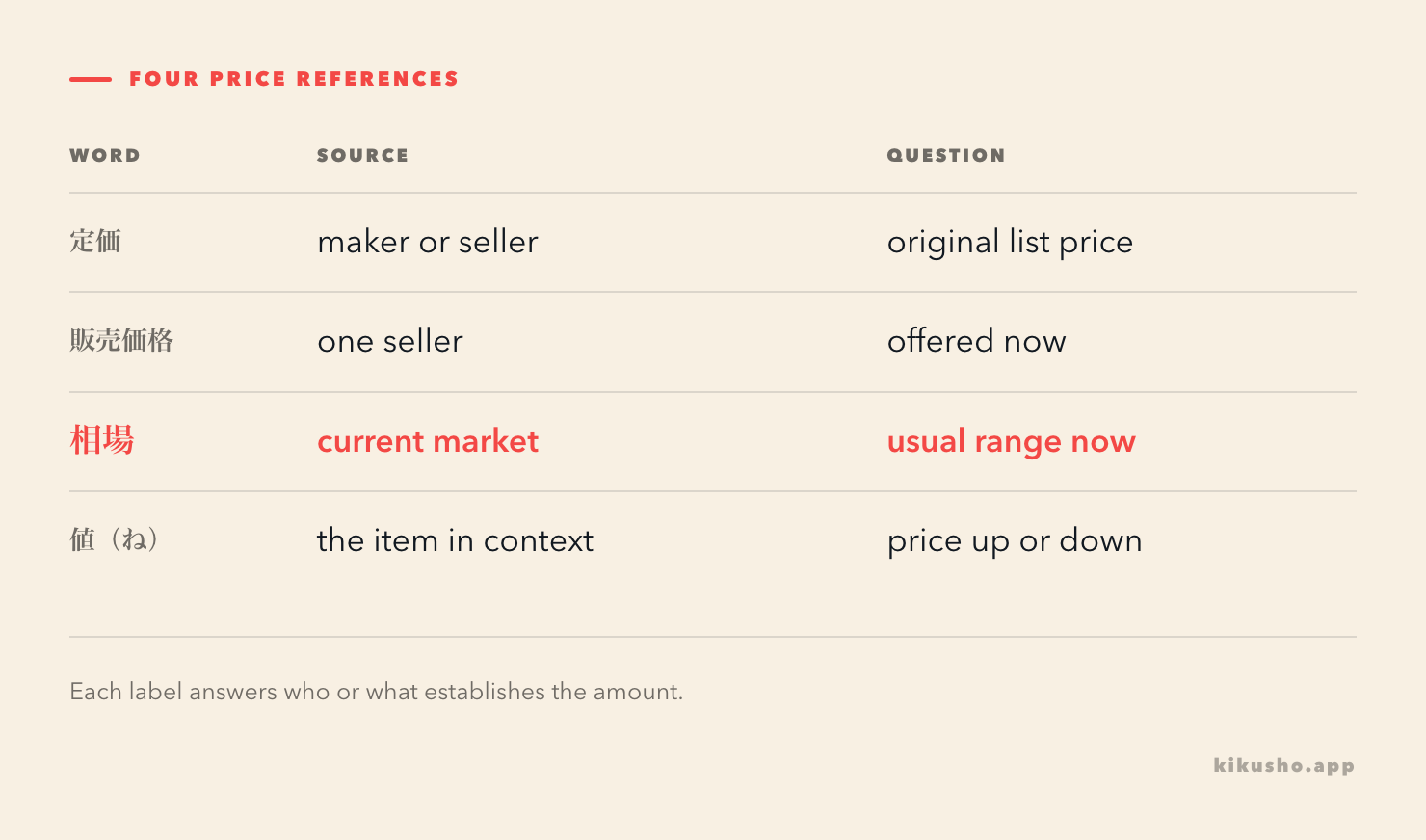
A discontinued camera can have an original 定価 of ¥80,000, one shop's 販売価格 of ¥55,000 and a current secondhand 相場 of ¥30,000 to ¥50,000. None of those labels guarantees the item's 品質.
品質 evaluates the goods, not their price or popularity
品質(ひんしつ) is the quality, nature or useful properties of goods. The dictionary definition gives the concise core 品物の質, the quality of an article, and its longer explanation connects quality with performance and usefulness for an intended purpose.
価格を下げても、品質は維持しなければなりません。
かかくをさげても、ひんしつはいじしなければなりません。
Even if the price is lowered, the quality must be maintained.
Common pairings show whether quality changes or is managed:
- 品質が高い/低い: quality is high / low
- 品質がよい/悪い: quality is good / poor
- 品質が安定している: quality is consistent
- 品質を維持する: maintain quality
- 品質を改善する: improve quality
- 品質管理: quality control
Do not replace 品質 with 品(ひん) in these patterns. 品がある describes refinement or elegance. 品質が高い evaluates the properties or performance of goods. A beautifully presented product can 品がある while still having poor 品質.
One used-camera report connects all five records
仕入れ担当者は、まず同じ型の中古カメラの相場を調べました。在庫は二十台ありましたが、保管期間が長かったため、一台ずつ品質を確認しました。検査で得られた値を記録し、販売に値すると判断した十五台だけを残しました。配送中の破損を防ぐため、本体を柔らかい布でくるんでから箱に入れます。残りの五台は修理費が相場を上回るため、販売しないことにしました。
The report starts with 相場, the market benchmark, then checks 在庫, the units on hand. 品質 is inspected rather than inferred from price. The measured 値(あたい) are recorded, and 販売に値する judges whether the cameras merit sale. Finally, the accepted units are protected by material wrapped around them, so くるむ fits.
Notice the two appearances of 値: a measured noun and the verb 値する. Neither is the price reading ね. The market price is already supplied by 相場.
The N1 label has real boundary disagreements
Kikusho's September 2026 inventory assigns these five spelling-and-reading records to N1. Its two matching baseline lists share the Waller/Tanos family, so their agreement is not independent confirmation.
Current sources disagree in useful ways. JapaneseTest4You places 在庫 at N1, while Bunpro currently places it at N2. JapaneseTest4You also places 品質 at N2. The apparent N4 match for 包む refers to つつむ, not the assigned くるむ, so it cannot verify this reading merely because the kanji match.
No official exhaustive JLPT vocabulary list settles these boundaries. The N1 value of this lesson lies mainly in reading control, formal usage and fine distinctions, rather than in claiming that every surface form is exclusive to N1.
Resolve nine prompts before revealing the key
Record every choice first. Open the disclosure only after completing the connected passage in Question 9.
Question 1 — kanji readings. Give the assigned readings of 値, 包む, 在庫, 相場 and 品質, in that order.
Question 2 — reading in context. How should 値 be read in each sentence?
- 原料の不足で商品の値が上がった。
- 実験で得られた値を記録した。
- この提案は検討に値する。
Question 3 — stock check. A warehouse worker needs to know whether units remain: 倉庫に商品が残っているか、( )を確認してください。
- ア. 相場
- イ. 在庫
- ウ. 品質
- エ. 値
Question 4 — worth judgement. Choose the interpretation of この案は検討に値する.
- ア. The proposal has already been rejected.
- イ. The proposal deserves consideration.
- ウ. The proposal's price must be calculated.
- エ. The proposal is wrapped for inspection.
Question 5 — usage. Which sentence best matches the assigned reading くるむ?
- ア. 会場は静けさに包まれた。
- イ. 祝儀として一万円を包んだ。
- ウ. 赤ちゃんを毛布で包んだ。
- エ. 本当の気持ちを包まず話した。
Question 6 — context. A secondhand dealer wants to know the usual current price range across comparable listings. Which word fits?
- ア. 定価
- イ. 品質
- ウ. 相場
- エ. 在庫
Question 7 — usage. Which sentence is natural?
- ア. 品質を維持するため、製造工程を見直した。
- イ. 相場を毛布でくるんで倉庫に置いた。
- ウ. 在庫が商品の性能を試食した。
- エ. 値するを二十台抱えている。
Question 8 — distinction. A camera originally listed at ¥80,000 now usually sells secondhand for ¥35,000 to ¥45,000. Which labels fit the two figures?
- ア. Original 定価; current 相場
- イ. Original 在庫; current 品質
- ウ. Original 相場; current 包む
- エ. Original 品質; current 値する
Question 9 — connected passage. Which conclusion follows from the report?
担当者は在庫を確認し、商品の品質を一台ずつ検査した。測定値が基準を満たし、販売に値すると判断した商品だけを布でくるんだ。価格は現在の相場を参考に決めた。
- ア. Every item in stock was sold at its original list price without inspection.
- イ. The worker wrapped only qualifying products and used the current market rate as a price reference.
- ウ. The measured values were read ね because they were written beside products.
- エ. 品質 meant the products looked refined, regardless of performance.
Answers and explanations
Answer 1. The sequence is あたい, くるむ, ざいこ, そうば, ひんしつ. 値 and 包む create the reading traps; the other three use regular on-readings.
Answer 2. Sentence 1 uses ね for price. Sentence 2 uses あたい for a measured numerical value. Sentence 3 uses あたい in the fixed verb 値する, “to be worth” or “deserve.”
Answer 3. イ, 在庫. The employee is checking whether goods remain in the warehouse. 相場 is a market rate, 品質 is product quality, and 値 requires a context that fixes its reading and sense.
Answer 4. イ. ~に値する judges something worthy of an action or response. Here the proposal merits consideration; the sentence does not state a price or physical handling action.
Answer 5. ウ. A blanket is wrapped around the baby, the characteristic くるむ scene. Silence surrounding a venue, ceremonial money and speaking without concealing one's feelings belong to the wider つつむ range.
Answer 6. ウ, 相場. A going range across market transactions is 相場. 定価 is an established list price from a maker or seller, while 在庫 and 品質 answer different questions.
Answer 7. ア. 品質を維持する is a standard product-management collocation. The other choices assign physical or human actions to abstractions, or misuse the verb 値する as an inventory noun.
Answer 8. ア. ¥80,000 is the original 定価. The ¥35,000–¥45,000 range is the current secondhand 相場, which can move with condition, supply and demand.
Answer 9. イ. The report checks 在庫, tests 品質, records numerical values, judges whether each unit merits sale, wraps the accepted units and consults 相場. 測定値 is read そくていち as a compound, while the standalone 値 described by the question is the numerical concept あたい; it is not the price reading ね.
Use the chain as a final memory check: 在庫 tells you what exists, 品質 tells you how good it is, 相場 tells you what comparable goods command, 値(あたい) expresses a measured value or worth, and くるむ protects the unit selected for sale.
Common questions
When is 値 read あたい instead of ね?
値 is commonly read ね for a price, as in 値が上がる. It is read あたい for a numerical value or formal worth, and in the fixed pattern ~に値する, meaning to be worth or deserve. Context fixes the reading.
What is the difference between 包む(くるむ) and 包む(つつむ)?
くるむ focuses on wrapping something around an object, often with cloth, paper or cushioning. つつむ more broadly covers or encloses something and is used for gifts, money, surrounding conditions and concealed feelings. They overlap for some physical wrapping scenes.
What is the difference between 相場 and 定価?
相場 is the market's current price or usual going range, which can change with supply and demand. 定価 is an established list price attached to a particular product. A secondhand item's 相場 can differ greatly from its original 定価.
How is 品質 different from 品?
品質 is the quality or properties of goods, often judged through durability, materials or performance. 品 can mean an item, goods, quality or refinement depending on its reading and context. 品質 is the precise product-evaluation word.