On this page
These nine N2 Japanese shopping, products and customer service vocabulary records help you read sold-out notices, price displays, postage terms and complaints. They also prevent a common mistake: 客 can mean a customer, an audience member or a social guest, so 客席 and 客間 belong to different places.
Read each word with its usual grammatical frame. That frame tells you whether a notice names a state, an event, a charge, a method or a location.
Nine words, nine distinct roles
| Word | Kana and rōmaji | Grammar role | Meaning in this lesson | Anchor phrase |
|---|---|---|---|---|
| 売り切れ | うりきれ, urikire | noun | sold-out state | 売り切れになる: become sold out |
| 売り切れる | うりきれる, urikireru | intransitive ichidan verb | to sell out; be sold out | 商品が売り切れる: the product sells out |
| 客席 | きゃくせき, kyakuseki | noun | audience or customer seating | 客席に案内する: show someone to their seat |
| 客間 | きゃくま, kyakuma | noun | guest room or parlor in a residence | 客間に通す: show a guest into the parlor |
| 苦情 | くじょう, kujō | noun | complaint or grievance | 苦情に対応する: respond to a complaint |
| 送料 | そうりょう, sōryō | noun | postage or shipping charge | 送料がかかる: shipping costs extra |
| 定価 | ていか, teika | noun | established or list price | 定価の二割引き: 20 percent off the list price |
| 郵送 | ゆうそう, yūsō | noun; suru verb | mailing; sending by post | 書類を郵送する: mail documents |
| 有料 | ゆうりょう, yūryō | noun; no-adjective | paid; requiring a fee | 有料サービス: paid service |
The two sold-out forms differ by grammar. 定価 and 送料 name different amounts. 郵送 names an action, and 有料 only says that payment is required. The two compounds beginning with 客 refer to different kinds of guests.
売り切れ names the state; 売り切れる describes the event
売り切れ(うりきれ) is a noun. A sign can display only 売り切れ, and a sentence can attach です or になる to it.
人気の商品は、午後には売り切れになりました。
にんきのしょうひんは、ごごにはうりきれになりました。
The popular product was sold out by the afternoon.
売り切れる(うりきれる) is an intransitive ichidan verb. The product that disappears from stock normally takes が.
限定版は発売から一時間で売り切れました。
げんていばんははつばいからいちじかんでうりきれました。
The limited edition sold out within an hour of release.
The dictionary entry for 売り切れ defines the noun as the condition in which the goods have all been sold and none remain. The verb presents the change that reaches that condition.
| Form | Pattern | What it contributes |
|---|---|---|
| 売れる | 商品が売れる | the product sells; people buy it |
| 売り切れる | 商品が売り切れる | the whole available quantity sells |
| 売り切れ | 商品は売り切れだ | the product is in a sold-out state |
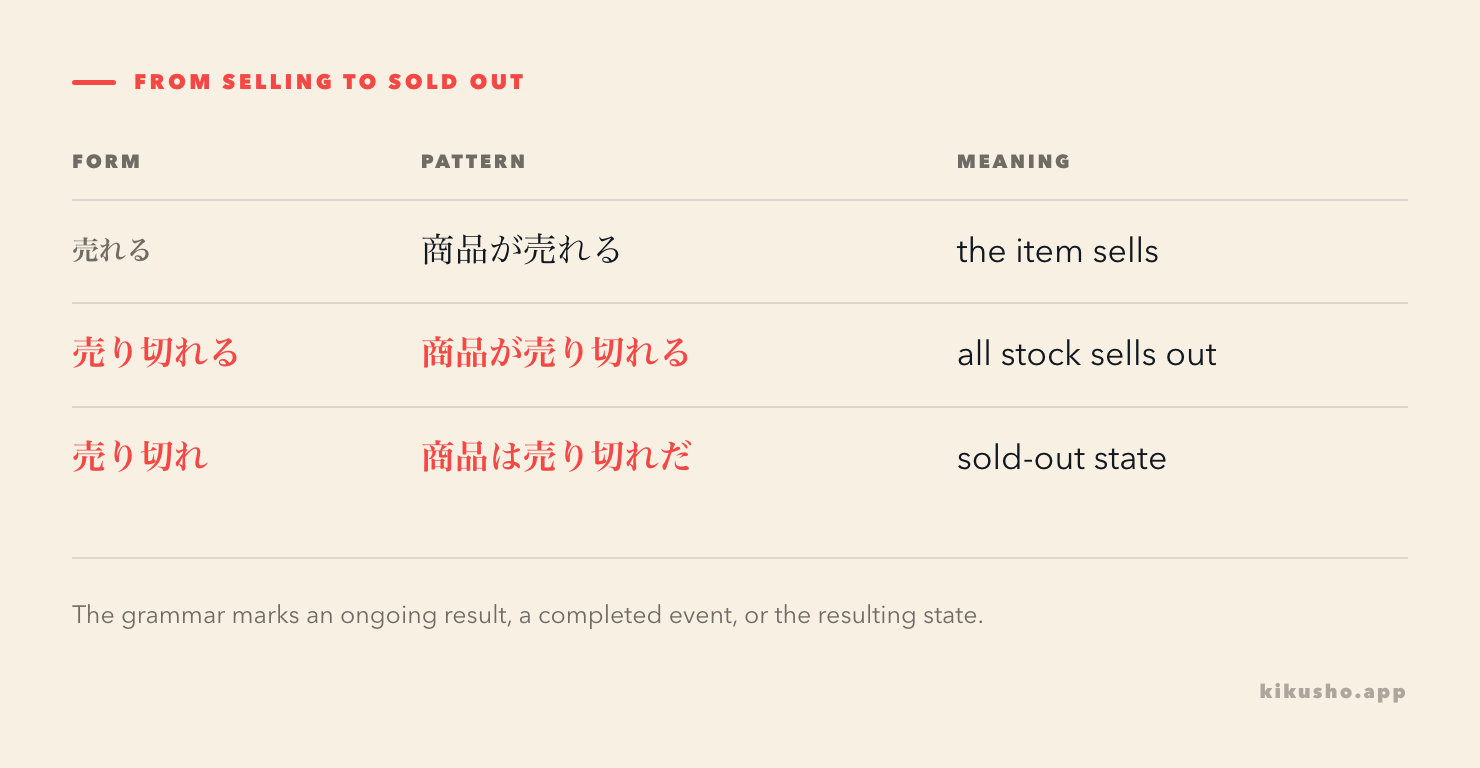
The earlier N3 shopping and product lesson introduces 売れる. Adding 切る creates a completion meaning: the available supply is sold through. A product that よく売れる sells well, but it is not necessarily 売り切れ.
定価, 送料 and 有料 reveal different costs
定価(ていか) is an established or list price. It provides a reference amount, but a discount can make the amount actually charged lower.
この辞書の定価は四千円ですが、今は二割引きです。
このじしょのていかはよんせんえんですが、いまはにわりびきです。
This dictionary's list price is 4,000 yen, but it is currently 20 percent off.
送料(そうりょう) is the charge for sending goods, mail or freight. 送料込み says that shipping is included; 送料別 says that it is separate; 送料無料 says that the customer is not charged for it.
商品の定価に送料は含まれていません。
しょうひんのていかにそうりょうはふくまれていません。
Shipping is not included in the product's list price.
有料(ゆうりょう) says that a fee applies. It is the opposite of 無料(むりょう), but it does not identify the amount. Look elsewhere for a number or rate.
ギフト包装は有料です。料金は一個につき三百円です。
ぎふとほうそうはゆうりょうです。りょうきんはいっこにつきさんびゃくえんです。
Gift wrapping costs extra. The charge is 300 yen per item.
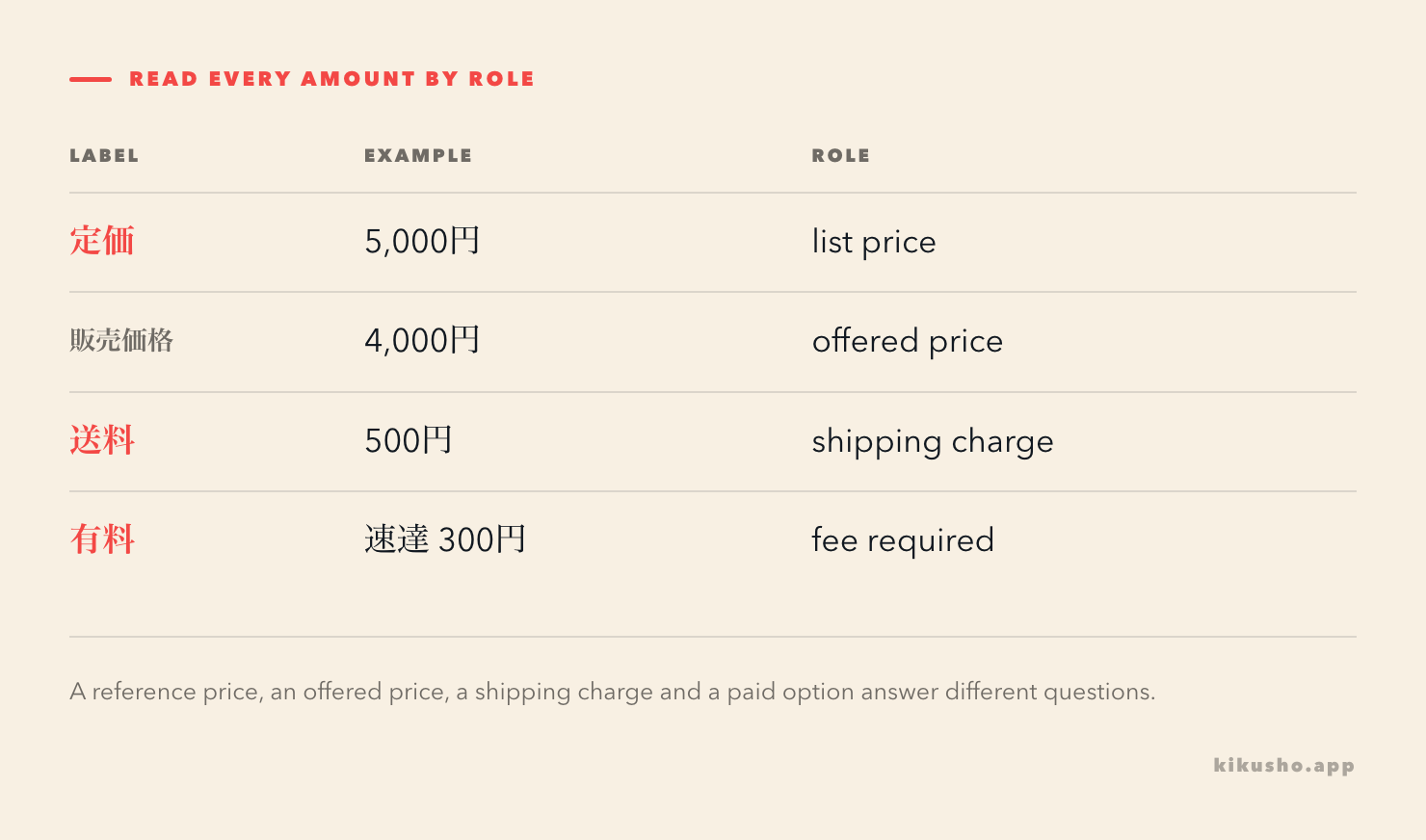
Japan's Consumer Affairs Agency requires mail-order advertising to show the selling price and, when postage is not included, to state the shipping charge separately. Its advertising Q&A also distinguishes the actual transaction price from reference labels such as 定価. This gives you a practical reading rule: never assume that 定価 is the final total or that 有料 tells you how much something costs.
The N2 money and personal-finance lesson supplies the wider vocabulary for income, expenses and payments. Here the scope stays on amounts shown around one purchase.
郵送 is the postal action, not the charge
郵送(ゆうそう) means sending something through the postal service. It works as a noun or with する.
申込書と領収書を事務所へ郵送してください。
もうしこみしょとりょうしゅうしょをじむしょへゆうそうしてください。
Please mail the application form and receipt to the office.
The dictionary entry for 郵送 defines it through sending by mail. Keep the method separate from the money:
- 郵送する: send it through the postal system
- 送料を払う: pay the shipping or postage charge
- 発送する: dispatch or send it out
- 配達する: deliver it to the destination
A shop can 商品を郵送する, charge 送料, mark the parcel 発送済み, and still wait for it to be 配達される. These expressions describe method, cost and different stages of movement.
客席 and 客間 show what kind of 客 is present
The kanji 客(きゃく) does not always mean a buyer. The compound tells you what role the person has.
客席(きゃくせき) is the area or set of seats for customers, spectators or an audience. You see it in theaters, concert halls, restaurants and other venues. The dictionary definition especially highlights seating for spectators in places such as theaters.
開演五分前までに客席にお入りください。
かいえんごふんまえまでにきゃくせきにおはいりください。
Please enter the audience seating area by five minutes before the performance.
客間(きゃくま) is a room in a private home prepared for receiving guests. Its dictionary entry describes a room in a residence used to welcome or entertain visitors.
祖父はお客様を客間に通し、お茶を出しました。
そふはおきゃくさまをきゃくまにとおし、おちゃをだしました。
My grandfather showed the guests into the parlor and served tea.
Do not confuse either word with 客室(きゃくしつ). 客室 commonly means a hotel guest room or a passenger compartment in a train or ship, although it can also refer to a reception room. The dictionary entry for 客室 records those accommodation and transport senses.
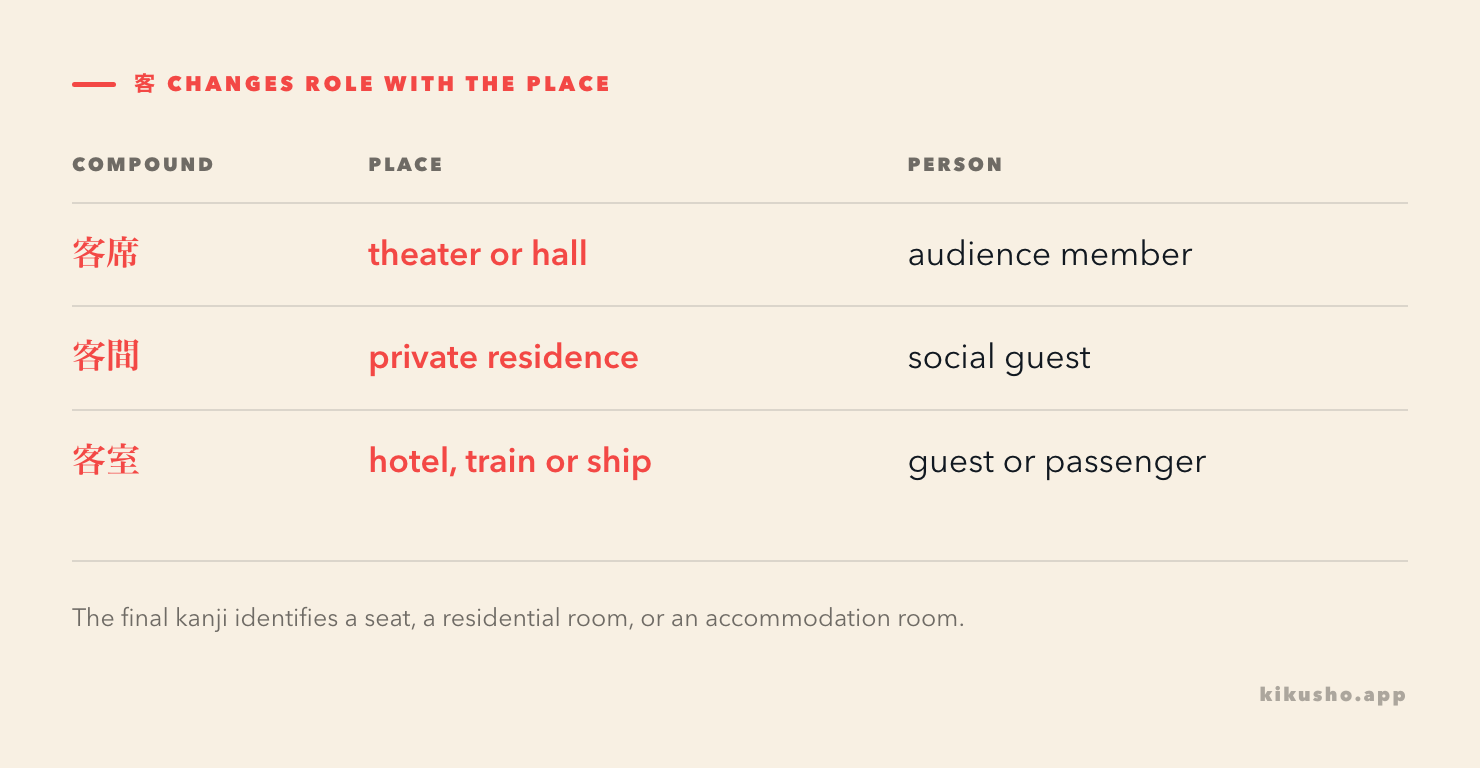
| Compound | Place | Typical 客 |
|---|---|---|
| 客席 | theater, hall, restaurant | audience member or customer |
| 客間 | private residence | social guest |
| 客室 | hotel, train or ship | staying guest or passenger |
The final kanji carries the physical clue: 席 is a seat, 間 is a room or space, and 室 is a defined chamber or room.
苦情 is a complaint, not every customer question
苦情(くじょう) is a complaint or grievance about a problem, disadvantage or unsatisfactory treatment. It is stronger and more specific than 問い合わせ, an inquiry.
送料が二重に請求されたという苦情が寄せられました。
そうりょうがにじゅうにせいきゅうされたというくじょうがよせられました。
A complaint was received that the shipping charge had been billed twice.
Useful institutional patterns include:
- 苦情を言う: make or voice a complaint
- 苦情が寄せられる: complaints are received
- 苦情に対応する: respond to a complaint
- 苦情を受け付ける: accept complaints
The dictionary definition of 苦情 ties the word to dissatisfaction arising from harm or disadvantage. The noun itself does not tell you whether the speaker is polite or rude. A calm written report can still be a 苦情.
送料について質問したいのですが。
I have a question about the shipping charge.
This is an 問い合わせ unless the speaker also reports a problem. By contrast, 説明のない送料を請求された gives a concrete reason for a 苦情.
A theater shop connects eight words; the guest room keeps one distinct
Read the notice as a connected piece of customer information.
劇場のオンラインショップでは、定価三千円の記念品を二千四百円で販売しています。人気商品のため、売り切れになる場合があります。商品が売り切れた後は予約できません。パンフレットの郵送もできますが、送料は別です。速達は有料サービスです。料金について苦情がある場合は、注文番号を確認して窓口へご連絡ください。公演当日は、係員が客席までご案内します。
The souvenir's 定価 is ¥3,000, while its actual offered price is ¥2,400. 売り切れになる presents the state and 売り切れた presents the completed event. 郵送 is available, 送料 is separate, and express service is 有料. A problem with the charge may lead to a 苦情. At the performance, 客席 is the audience area.
Now change the setting:
公演の翌日、出演者は友人を自宅の客間に招きました。
こうえんのよくじつ、しゅつえんしゃはゆうじんをじたくのきゃくまにまねきました。
The day after the performance, the performer invited a friend into the guest room at home.
客間 does not fit the theater shop merely because customers are present there. It identifies the residential guest room. This setting change is the semantic contrast to remember.
N2 is a study placement, not an official exhaustive list
Kikusho's September 2026 inventory places these nine spelling-and-reading records in this N2 lesson. The retained baseline lists agree on the placement, although two of those lists share the Waller/Tanos source family and therefore do not count as fully independent evidence.
Current study materials support the cluster without defining an official exam list. GyanMirai's N2 shopping and money lesson includes 定価, while The Japan Times Publishing's N2 vocabulary book page uses 売り切れ among its sample shopping vocabulary. Official consumer guidance explains price and postage displays, but no current authoritative source assigns every Japanese word to one JLPT level.
Use N2 here as a study sequence. On the exam, recognize each word from its grammar and context rather than from a memorized topic label.
Test the boundaries across ten questions
Keep your choices hidden on paper until you have reached Question 10, then open the explanation panel once.
Question 1 — kanji reading. Write 売り切れ, 送料 and 客間 in kana, in that order.
Question 2 — orthography. Which spelling means “to send by post”?
- ア. 郵走する
- イ. 郵送する
- ウ. 有送する
- エ. 優送する
Question 3 — word formation. Complete the sentence with the noun form: 人気の商品は、午前中に( )になった。
- ア. 売り切れ
- イ. 売り切れる
- ウ. 売れる
- エ. 売った
Question 4 — context. A product page shows 定価 5,000円/販売価格 4,000円/送料 500円. Which statement is accurate?
- ア. 定価 is ¥4,000 and postage is free.
- イ. The listed reference price is ¥5,000, the selling price is ¥4,000, and shipping adds ¥500.
- ウ. 有料 means the final total is ¥5,000.
- エ. 郵送 means the shop must discount the product.
Question 5 — paraphrase. Which sentence is closest to 限定版は一時間で売り切れた?
- ア. The shop began selling the limited edition one hour late.
- イ. All available limited editions were sold within one hour.
- ウ. The limited edition was mailed after one hour.
- エ. The list price changed every hour.
Question 6 — usage. Choose the natural pair.
- ア. 劇場の客間/家の客席
- イ. 劇場の客席/家の客間
- ウ. 劇場の送料/家の定価
- エ. 劇場の郵送/家の売り切れ
Question 7 — context. A customer politely asks when a parcel will arrive but reports no problem. What most directly describes the message?
- ア. 苦情
- イ. 問い合わせ
- ウ. 客席
- エ. 定価
Question 8 — usage. Which sentence separates method from cost correctly?
- ア. 書類を送料して、郵送を払った。
- イ. 書類を郵送して、送料を払った。
- ウ. 送料を客間にして、郵送を座った。
- エ. 定価を郵送して、客席を払った。
Question 9 — word formation. Complete the sign: ロッカーは( )です。一回二百円かかります。
- ア. 無料
- イ. 売り切れ
- ウ. 有料
- エ. 客間
Question 10 — full notice. Which conclusion follows from all four sentences?
記念品の定価は三千円です。オンラインで注文した場合、普通郵便の送料は無料ですが、速達は有料です。商品が売り切れた後は注文できません。料金の間違いに関する苦情は、窓口で受け付けます。
- ア. Express mail is free, even after the product sells out.
- イ. Every complaint must be mailed and costs ¥3,000.
- ウ. Ordinary postage is free, express service costs extra, and orders close after the item sells out.
- エ. The notice explains where the audience should sit.
Answers and explanations
Answer 1. うりきれ, そうりょう, きゃくま. The first is the sold-out state, the second is the sending charge, and the third is a residential guest room.
Answer 2. イ, 郵送する. 郵 marks postal service, and 送 carries the idea of sending. The other spellings are not the assigned word.
Answer 3. ア, 売り切れ. になる follows the noun. You could instead use the verb in 商品が売り切れた, but 売り切れるになった is ungrammatical.
Answer 4. イ. 定価 is the ¥5,000 reference price, 販売価格 is the ¥4,000 offered price, and 送料 is the separate ¥500 charge. The three labels cannot be collapsed into one amount.
Answer 5. イ. 売り切れた is the past form of 売り切れる and means the available supply sold out. It says nothing about mailing or a changing list price.
Answer 6. イ. A theater has 客席 for its audience. A private home can have a 客間 for receiving social guests.
Answer 7. イ, 問い合わせ. A request for information is an inquiry. It becomes a 苦情 when the customer reports dissatisfaction, harm or a concrete service problem.
Answer 8. イ. 郵送する names the act of mailing the documents; 送料を払う names payment of the postage or shipping charge.
Answer 9. ウ, 有料. The second sentence states the fee, so the locker requires payment. 無料 would contradict the ¥200 charge.
Answer 10. ウ. 普通郵便の送料は無料 removes the ordinary-post charge, while 速達は有料 says express service costs extra. 売り切れた後は注文できません closes orders after sellout.
Review the contrasts as pairs: 売り切れ / 売り切れる, 定価 / actual selling price, 送料 / 郵送, 客席 / 客間, and 苦情 / 問い合わせ. Those boundaries make the nine records usable in notices, product pages and service conversations.
Common questions
What is the difference between 売り切れ and 売り切れる?
売り切れ is a noun describing a sold-out state, as in 売り切れになる. 売り切れる is an intransitive ichidan verb meaning that an item sells out, as in 商品が売り切れる. Both indicate that no stock remains.
How do 客席, 客間 and 客室 differ?
客席 is the seating area for an audience or customers in a theater, restaurant or similar venue. 客間 is a room in a private residence for receiving guests. 客室 usually means a hotel guest room or a passenger compartment on a train or ship.
What is the difference between 送料 and 郵送?
送料 is the money charged to send goods or mail. 郵送 is the act or method of sending something through the postal service. A document can be 郵送 even when the recipient pays no 送料.
Is 定価 always the price a customer pays?
No. 定価 is an established or list price. A shop may sell the item at a discount or another actual selling price, so read the complete price display and check whether shipping is separate.