On this page
A Japanese purchase moves through several vocabulary roles: a product gets a 価格, the customer places a 注文, the shop arranges 包装 and 配達, and a problem may lead to 修理 or 交換. This N3 set teaches 16 words for that path, including two readings of 品 and three ways to talk about price.
Treat the words as roles: item, price level, wrapping, container, delivery action and after-sales promise.
The 16 words occupy different stages of a purchase
Keep each headword with the phrase that reveals its role.
| Word | Kana and rōmaji | Grammar role | Use in this lesson | Anchor phrase |
|---|---|---|---|---|
| 売れる | うれる, ureru | intransitive ichidan verb | to sell; to be bought; to become popular | よく売れる製品: a product that sells well |
| 価格 | かかく, kakaku | noun | price or monetary value | 価格を設定する: set a price |
| 交換 | こうかん, kōkan | noun; suru verb | exchange, replacement or swap | 新品と交換する: replace with a new item |
| サービス | サービス, sābisu | noun; suru verb | service or customer care; sometimes a free extra | アフターサービス: after-sales service |
| 品 | しな, shina | noun | item, goods or quality | この品: this item |
| 修理 | しゅうり, shūri | noun; suru verb | repair or mending | 製品を修理する: repair a product |
| 製品 | せいひん, seihin | noun | manufactured or finished product | 新製品を発売する: launch a new product |
| 注文 | ちゅうもん, chūmon | noun; suru verb | order or request | 商品を注文する: order goods |
| 値 | ね, ne | noun | price or value | 値が上がる: rise in price |
| 配達 | はいたつ, haitatsu | noun; suru verb | delivery to a specified address | 荷物を配達する: deliver a parcel |
| 品 | ひん, hin | noun; suffix | refinement or quality; item or dish counter | 品がある: have refinement |
| 袋 | ふくろ, fukuro | noun | bag or sack | 紙袋に入れる: put into a paper bag |
| 物価 | ぶっか, bukka | noun | the general price level | 物価が上がる: prices rise generally |
| 包装 | ほうそう, hōsō | noun; suru verb | wrapping or packaging | 商品を包装する: wrap a product |
| 保証 | ほしょう, hoshō | noun; suru verb | guarantee, assurance or warranty | 保証期間を確認する: check the warranty period |
| 容器 | ようき, yōki | noun | container or vessel | 容器に入れる: put into a container |
売れる describes a product's result. 価格 and 値 can concern one price; 物価 spans many. 包装 wraps, 容器 holds, and 袋 names one container shape.
売れる describes the product's result
売る(うる) is transitive: a shop sells an item.
店が新しい製品を売っています。
みせがあたらしいせいひんをうっています。
The shop sells a new product.
売れる(うれる) presents the result from the product's side. The item normally takes が, and no seller needs to be named.
この製品は価格が高いのに、よく売れています。
このせいひんはかかくがたかいのに、よくうれています。
Although this product is expensive, it is selling well.
The dictionary entry for 売れる also records the extended senses “become well known” and “be popular.” A singer can 売れる even though nobody buys the person. In a shop notice, however, 商品が売れる usually describes goods finding buyers.
| Viewpoint | Pattern | Meaning |
|---|---|---|
| seller acts | 店が製品を売る | the shop sells the product |
| product moves | 製品が売れる | the product sells |
| product is gone | 製品が売り切れる | the product sells out |
売り切れる describes completion; 売れる alone does not say that stock is gone.
価格, 値 and 物価 answer different price questions
価格(かかく) is a neutral or formal word for the monetary price of a good or service. It fits product pages, reports and business explanations.
原材料の価格が上がったため、製品の価格を変更しました。
げんざいりょうのかかくがあがったため、せいひんのかかくをへんこうしました。
Because the price of raw materials rose, we changed the product's price.
値(ね) is a shorter noun for price or value. It appears naturally in compact expressions such as 値が上がる, 値が下がる, 値を付ける, 高値 and 安値. Digital Daijisen gives both the sale price and the worth of something as central senses.
古い時計に思ったより高い値が付きました。
ふるいとけいにおもったよりたかいねがつきました。
The old watch was valued at a higher price than expected.
物価(ぶっか) zooms out. It describes the general level of prices across goods and services, not the sticker on one bottle. The Statistics Bureau explains its Consumer Price Index as measuring average price changes for the goods and services households buy in its current CPI guide.
この地域では物価が上がり、食料品の価格も高くなりました。
このちいきではぶっかがあがり、しょくりょうひんのかかくもたかくなりました。
The general price level rose in this area, and food prices also became higher.
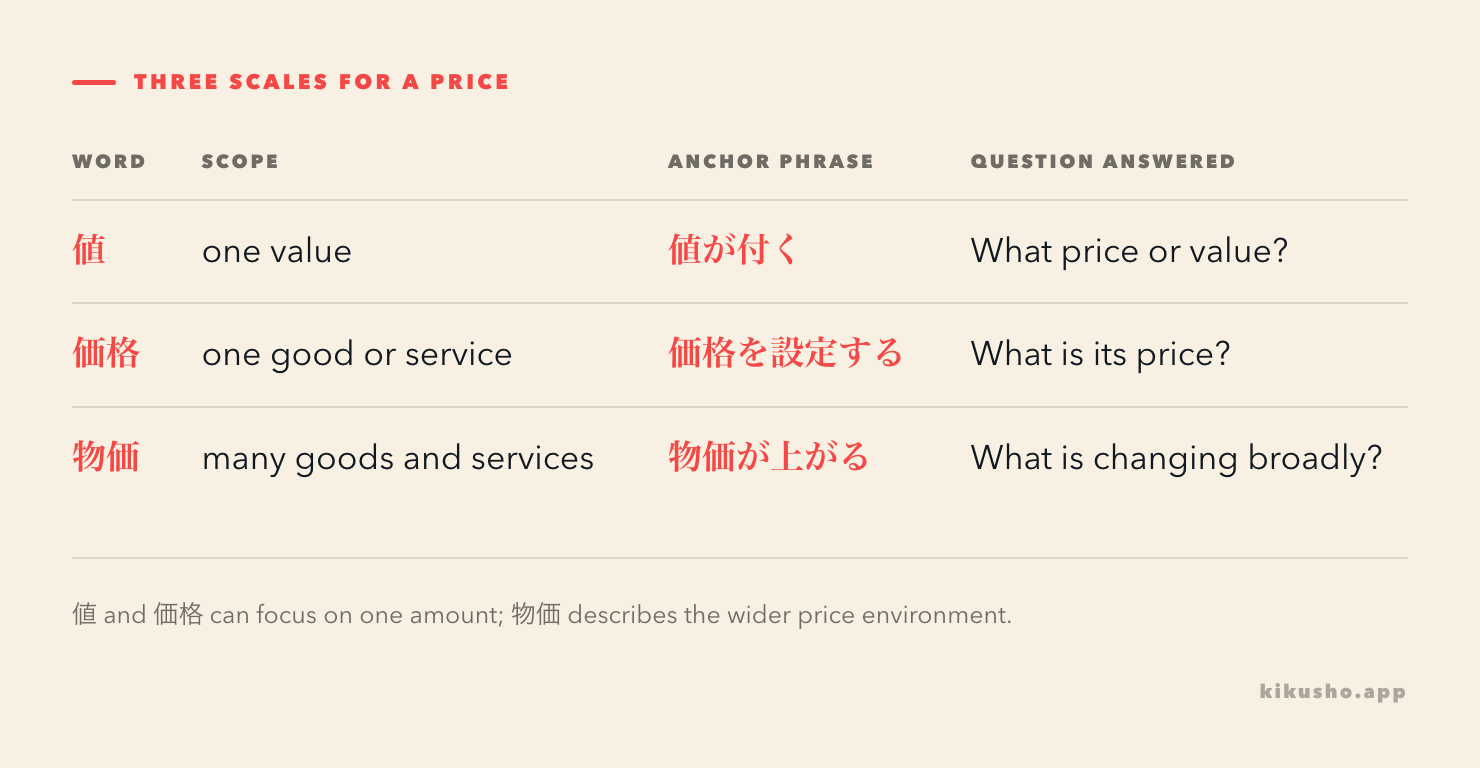
The earlier N4 shopping lesson teaches everyday 値段(ねだん). N3 adds 価格 for product information, 値 for compact expressions and 物価 for economic context. The N3 money set continues with cash, income, spending and savings.
品 changes reading before it changes role
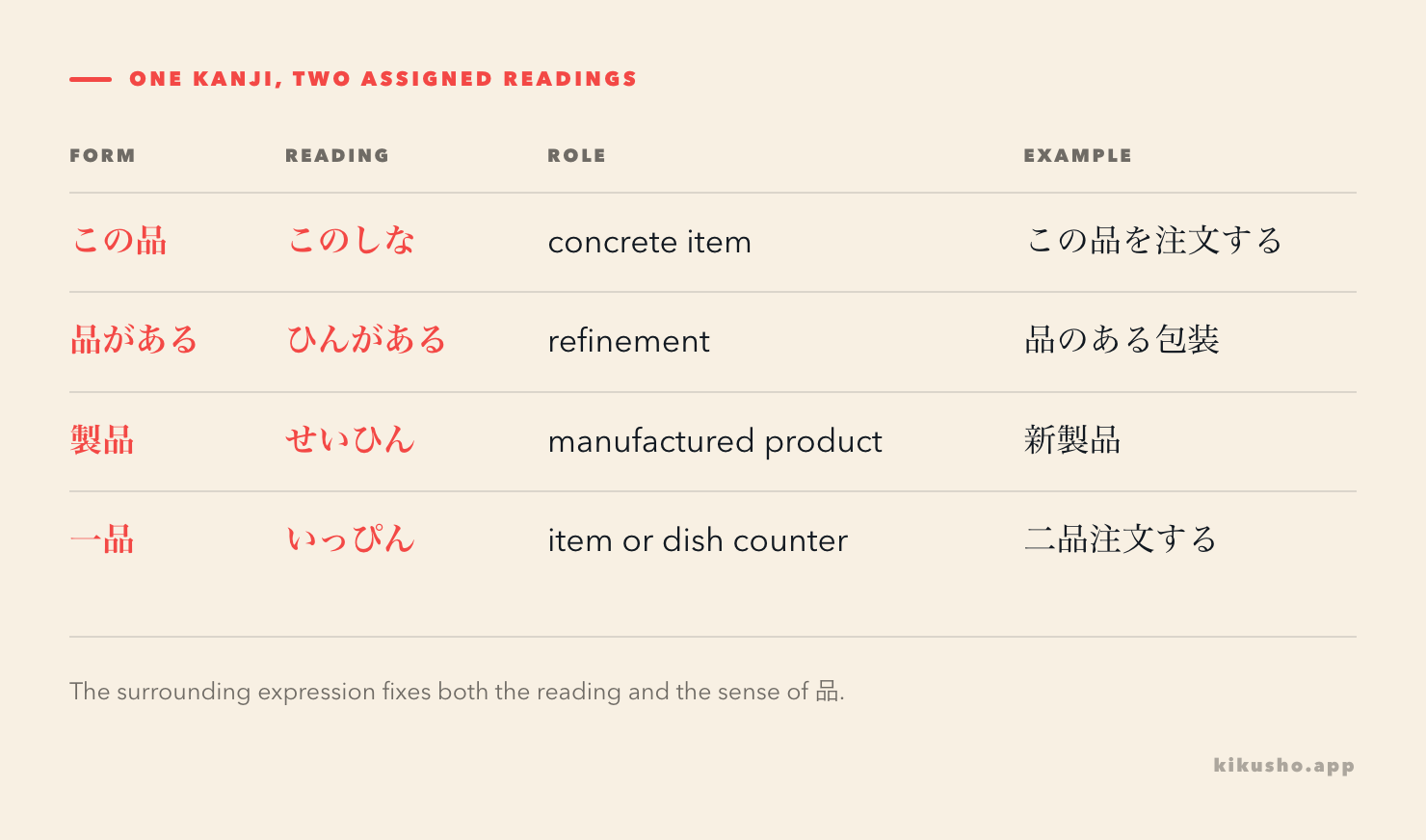
The inventory assigns 品 twice because the reading distinguishes two vocabulary records.
品(しな) can name a concrete item or goods. It also appears in 品物(しなもの), 品切れ(しなぎれ) and 品ぞろえ.
この品は手作りなので、一つずつ形が違います。
このしなはてづくりなので、ひとつずつかたちがちがいます。
This item is handmade, so each one has a different shape.
品(ひん) can mean refinement or quality, as in 品がある and 品がない. It is also an on-reading inside many compounds: 製品(せいひん), 商品(しょうひん), 品質(ひんしつ) and 不良品(ふりょうひん). As a suffix it counts dishes or items; sound changes produce 一品(いっぴん) and 三品(さんぴん).
品のある包装は、派手でなくても丁寧に見えます。
ひんのあるほうそうは、はででなくてもていねいにみえます。
Refined packaging can look carefully made even when it is not flashy.
製品(せいひん) foregrounds manufacture. Digital Daijisen defines it as an item made for sale or made from a material. A handmade cup can be この品, while a company's appliance line is naturally 製品.
注文 starts a chain through 包装 and 配達
注文(ちゅうもん) is an order or request. In shopping, the customer 商品を注文する. The noun also appears in 注文番号, order number, and 注文内容, order details. In a restaurant, 注文 names the food or drink order; the core idea is still requesting that something be supplied.
オンラインで二つ注文し、配達日時を指定しました。
オンラインでふたつちゅうもんし、はいたつにちじをしていしました。
I ordered two online and selected a delivery date and time.
包装(ほうそう) is wrapping or packaging, as an action and as the resulting outer covering. 容器(ようき) is a container that holds something. 袋(ふくろ) is a bag or sack, one concrete kind of container.
店員はガラスの容器を紙で包装し、丈夫な袋に入れました。
てんいんはがらすのようきをかみでほうそうし、じょうぶなふくろにいれました。
The clerk wrapped the glass container in paper and put it in a sturdy bag.
The sentence cannot freely swap the three nouns. The glass 容器 holds the contents. 包装 names what the clerk does around it. The 袋 carries the wrapped object. The dictionary definitions of 包装, 容器 and 袋 preserve those roles while allowing real objects to serve more than one purpose.
配達(はいたつ) means taking mail or goods to a specified destination. It focuses on the final delivery, as confirmed by the dictionary entry. 発送(はっそう), which is outside this set, focuses on sending the parcel out. An order can therefore be 発送済み, shipped, before it has been 配達済み, delivered.
サービス continues after the sale
サービス does not automatically mean “free.” Its dictionary entry includes customer care, non-material services and, in shop talk, a discount or free extra.
この店は配達サービスがあります。
このみせははいたつさーびすがあります。
This shop offers a delivery service.
この小さな袋はサービスです。
このちいさなふくろはさーびすです。
This small bag is complimentary.
The second sentence uses the “on the house” sense. By contrast, サービス料 is a service charge. Learn the full phrase rather than translating サービス as “free” every time.
After purchase, 保証(ほしょう) is the promise or assurance that establishes what support applies. Product language often uses 保証書, warranty document, and 保証期間, warranty period. A guarantee does not mean that every kind of damage receives free work; the actual terms decide.
修理(しゅうり) means working on a damaged or broken object so it can be used again. 交換(こうかん) means replacing it with another item or exchanging one thing for another.
保証期間内なので、店が無料で修理してくれました。
ほしょうきかんないなので、みせがむりょうでしゅうりしてくれました。
Because it was within the warranty period, the shop repaired it free of charge.
修理できない場合は、新しい製品と交換します。
しゅうりできないばあいは、あたらしいせいひんとこうかんします。
If it cannot be repaired, we will replace it with a new product.
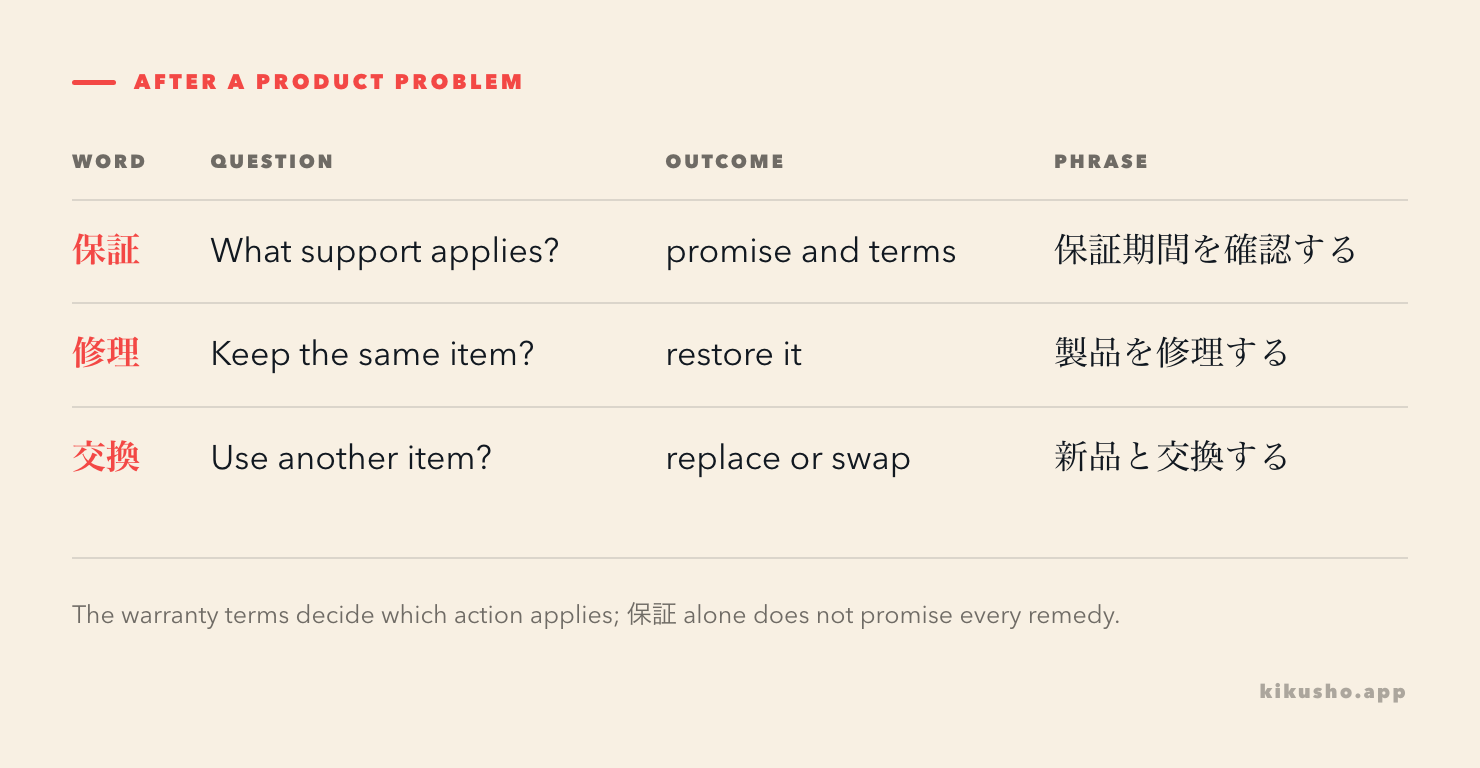
Japan's Ministry of Economy, Trade and Industry groups continuing support after a product sale with installation, 保証, service, 修理 and replacement parts in its product-safety guidance. The Consumer Affairs Agency's mail-order advertising guide separately shows why return conditions must be stated clearly. These sources support the vocabulary relationship, not a promise that every shop applies the same remedy.
One order connects all sixteen records
Read the following as a sequence of roles rather than a translation test.
最近は物価が上がっていますが、この店の新製品は価格が手ごろで、よく売れています。私はその品を二つ注文しました。一品は自宅用で、もう一品は贈り物です。店員はガラスの容器を丁寧に包装し、それぞれ別の袋に入れて配達してくれました。贈り物の包装は品があり、無料のサービスとは思えないほどきれいでした。ところが、自宅用の製品は動かなかったので、保証書を確認して店に連絡しました。店は「まず修理し、直せなければ新品と交換します」と説明しました。買ったときより値が上がっていても、追加料金は必要ないとのことでした。
The first 品 is しな, the ordered item. Both instances of 一品 use the counter reading いっぴん. 品があり uses ひん for refinement. The passage then moves from 注文 through 容器, 包装, 袋 and 配達 to 保証, 修理 and 交換. The price words keep separate scales: 物価 is general, 価格 belongs to the product, and 値 is the compact expression in 値が上がる.
An order confirmation groups 注文, 価格 and 配達; a warranty notice groups 保証, 修理 and 交換. Capture the notice in Kikusho and save the full phrase so its role stays visible in review.
The N3 label is a study placement
Kikusho's September 2026 inventory places the 16 spelling-and-reading records in this N3 lesson. The retained baseline lists agree on fourteen entries, but they share the Waller/Tanos source family. 包装 and 容器 each also occur in the N2 baseline, creating a real N3/N2 placement disagreement.
Independent current materials still support this study cluster. Japanese Compass's N3 index groups 価格, 注文, 製品, 保証, 交換 and 配達 under town and shopping, while 日本語NET's shopping list independently includes 価格, 包装する, shopping bags, products and warranty documents.
No authoritative current exam list assigns every word to one level. Here N3 marks the study sequence, while the packaging terms remain useful even when another list postpones them to N2.
Ten attempts before the explanations
Write all ten answers before opening the disclosure.
Question 1 — reading pair. Write 売れる first and 価格 second, both in kana.
Question 2 — orthography. Which spelling means a product warranty or guarantee?
- ア. 補償
- イ. 保障
- ウ. 保証
- エ. 保章
Question 3 — context. Complete the sentence: この一年で( )が上がり、食料品や電気代が高くなった。
- ア. 容器
- イ. 物価
- ウ. 注文
- エ. 品
Question 4 — paraphrase. What does この製品はよく売れている mean here?
- ア. The company is selling the product by hand right now.
- イ. Customers are buying the product frequently.
- ウ. The product has already been repaired.
- エ. The product's price is unknown.
Question 5 — usage. Which sentence uses the assigned words naturally?
- ア. 全国の物価を一枚の値札に書いた。
- イ. この時計に高い値が付いた。
- ウ. 容器が客を注文した。
- エ. 価格を住所まで配達した。
Question 6 — three readings. Give the readings of the bold forms: この品は品質のよい製品です。
Question 7 — roles. Complete with two different words: 液体を入れる(甲)を紙で(乙)した。
Question 8 — context. Which sentence describes the normal order-to-delivery sequence?
- ア. 商品を注文し、翌日に配達された。
- イ. 商品が客を配達し、店を注文した。
- ウ. 包装を修理してから物価を届けた。
- エ. 値が袋を注文して製品を保証した。
Question 9 — repair or replacement. A shop works on your broken camera and returns the same camera in working condition. Which word names that action most directly?
- ア. 交換
- イ. 修理
- ウ. 包装
- エ. 配達
Question 10 — connected notice. Read the notice and choose the accurate statement.
保証期間内に製品が故障した場合は、まず無料で修理します。修理できない場合に限り、新品と交換します。店まで持って来られないお客様には、有料の配達サービスもあります。
- ア. Every customer automatically receives a new item and free delivery.
- イ. The shop charges for every repair during the warranty period.
- ウ. The shop first attempts a free repair, then replaces an unrepairable item; delivery service costs extra.
- エ. The notice concerns price inflation and product packaging only.
Answers and explanations
Answer 1. うれる, then かかく. 売れる is an ichidan verb; 価格 is the two-kanji noun for a price or monetary value.
Answer 2. ウ, 保証. In product language, 保証 names a guarantee or warranty. 補償 means compensation for loss or damage, and 保障 protects rights, safety or livelihood. 保章 is not the target spelling.
Answer 3. イ, 物価. The sentence describes a general rise across food and electricity rather than one item's amount. That broad price level is 物価.
Answer 4. イ. 売れる presents the product as selling or finding buyers. It does not identify a seller's current action, a repair or missing price information.
Answer 5. イ. 値が付く means that a price or valuation is assigned. The other sentences give human actions to containers or prices, or compress the nationwide price level into one price tag.
Answer 6. この品 is このしな; 品質 is ひんしつ; 製品 is せいひん. The same kanji takes the native reading in the standalone item sense and the on-reading inside the two compounds.
Answer 7. 甲=容器、乙=包装. A 容器 holds the liquid; 包装する describes wrapping the container in paper. A 袋 could be one kind of container, but the sentence requires the assigned general holder and the wrapping action as two different roles.
Answer 8. ア. A customer orders goods, after which the goods can be delivered. The remaining choices reverse agents and objects or combine unrelated roles.
Answer 9. イ, 修理. The shop restores the same camera to working order. 交換 would supply another item; 包装 wraps it and 配達 takes it to an address.
Answer 10. ウ. The notice gives repair first during the warranty period, replacement only when repair is impossible, and a paid delivery option. It does not promise automatic replacement or free delivery.
For review, rebuild the path instead of memorising sixteen English labels: 価格を見る → 品を注文する → 容器を包装する → 袋に入れて配達する → 保証を確認する → 修理か交換を依頼する. The sequence keeps every word attached to the decision it helps you make.
Common questions
What is the difference between 売る and 売れる?
売る is transitive: a person or shop sells something, so the product takes を. 売れる is intransitive: an item sells or is bought, so the item normally takes が. 売れる can also describe someone becoming popular or well known.
How do 価格, 値 and 物価 differ?
価格 is a neutral or formal price assigned to a particular good or service. 値 is a shorter word for price or value in expressions such as 値が上がる. 物価 describes the general level of prices across many goods and services.
How are 品(しな) and 品(ひん) different?
品(しな) can name an item, goods or their quality. 品(ひん) can mean refinement or quality and supplies the sound in compounds such as 製品 and 商品; as a suffix it also counts dishes or items, with sound changes such as 一品.
Does サービス always mean something is free?
No. サービス can mean service, customer care or work provided to users. In shop talk it can also mean a free extra or a price concession, but compounds such as サービス料 refer to a charge. The surrounding phrase decides the sense.