On this page
These four words let you interpret a measured result rather than merely read its number. 誤差 tells you how far a value misses a reference, 比率 compares quantities, 比例 describes how two quantities change together, and 密度 states how much is packed into a unit of space.
Four terms move from a number to a scientific claim
| Term | Sound | What it names | Anchor construction |
|---|---|---|---|
| 誤差 | ごさ, gosa | error; the difference between a measured or approximate value and a true or accepted value | 誤差が生じる |
| 比率 | ひりつ, hiritsu | ratio, proportion or percentage comparing two or more quantities | 比率を求める |
| 比例 | ひれい, hirei | proportionality; a relationship in which quantities vary together; balanced proportions | Aに比例する |
| 密度 | みつど, mitsudo | density; amount per unit volume, area or length; degree of concentration or substance | 密度が高い |
Kikusho's September 2026 inventory assigns N1 to all four exact spelling-and-reading records, and its recorded level fields agree. Both imported rows trace back to one Waller lineage, so that agreement is inherited rather than independent. Current material places 誤差 at N1, while Bunpro places 比例 and 密度 at N2. The JLPT organisers publish no exhaustive current vocabulary list. For study purposes, learn the words here as an advanced measurement set without treating the N1 label as an official border.
誤差 names a difference, not simply a mistake
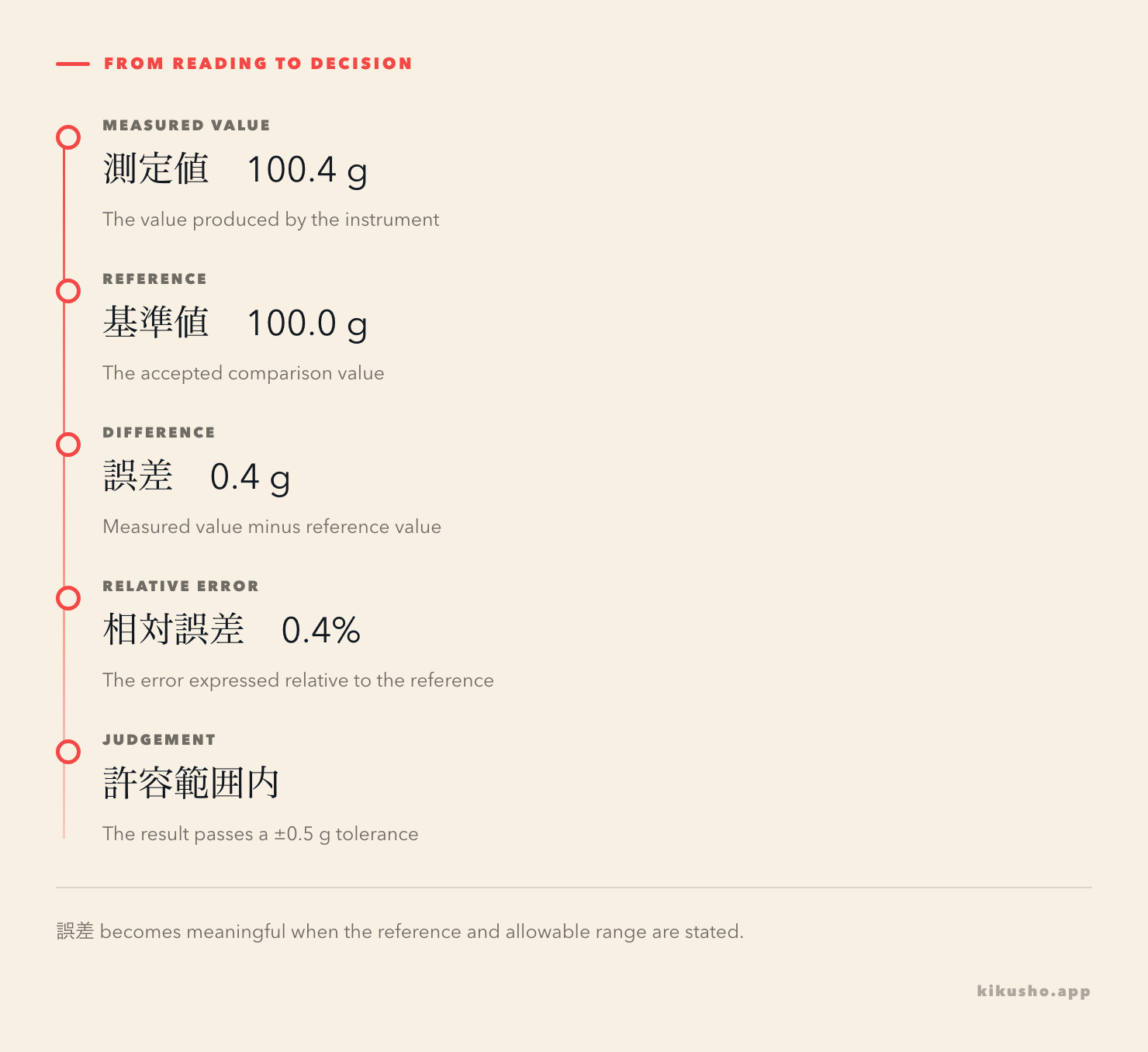
In measurement and calculation, 誤差 is the difference between the value obtained and the true, exact or accepted value. The dictionary entry for 誤差 also records a broader discrepancy sense, as in a gap between a plan and reality.
測定値と基準値の間に〇・四グラムの誤差がありました。
そくていちと きじゅんちの あいだに れいてんよんグラムの ごさが ありました。
There was an error of 0.4 grams between the measured value and the reference value.
The word does not automatically accuse the researcher of careless work. A measurement can contain a small 誤差 even when the procedure was followed correctly. Use ミス for a human mistake such as copying the wrong digit; use 誤差 for the quantitative difference produced by measurement, approximation or calculation.
Useful combinations include:
- 測定誤差: measurement error
- 許容誤差: permissible error or tolerance
- 相対誤差: relative error
- 誤差が生じる: an error arises
- 誤差を含む: contain an error
- 誤差の範囲内: within the margin of error
- 誤差を補正する: correct or compensate for an error
二つの結果の差は、装置の許容誤差の範囲内です。
ふたつの けっかの さは、そうちの きょようごさの はんいないです。
The difference between the two results is within the instrument's tolerance.
Repeated readings may also show ばらつき, scatter or variation. That visible spread is evidence about measurement quality, but it is not identical to the error of each reading. In careful technical prose, 不確かさ expresses quantified uncertainty about the measurement result. At N1, the safe habit is to read the surrounding noun: 測定誤差, 標準誤差, 許容誤差 and 誤差範囲 belong to different technical conversations.
比率 freezes a comparison; 比例 describes a changing relationship
比率 compares two or more quantities. It answers questions such as “what share?”, “in what ratio?” and “what percentage?” The comparison can be written as 三対二, 40%, or a fraction, depending on what the report needs.
反応が確認された試料の比率は、全体の八〇パーセントでした。
はんのうが かくにんされた しりょうの ひりつは、ぜんたいの はちじゅっぱーせんとでした。
The proportion of samples in which a reaction was confirmed was 80 percent.
The Statistics Bureau glossary defines 比率 as a proportion obtained by comparing two or more quantities. Natural patterns are AとBの比率, the ratio of A to B; Aに対するBの比率, the ratio of B relative to A; 比率を求める, calculate a ratio; and 比率が高い/低い, the proportion is high or low.
比例 shifts attention from one comparison to a relationship across changing values. The central frame is:
容積が一定なら、物質の質量の増加に比例して密度も高くなります。
ようせきが いっていなら、ぶっしつの しつりょうの ぞうかに ひれいして みつども たかく なります。
If the volume is constant, density increases in proportion to the mass of the material.
The grammar carries the direction of the relationship:
- BはAに比例する: B is proportional to A
- Aに比例してBが増える: B increases in proportion to A
- 比例関係にある: be in a proportional relationship
- 正比例: direct proportion
- 反比例: inverse proportion
- 比例しない: not be proportional
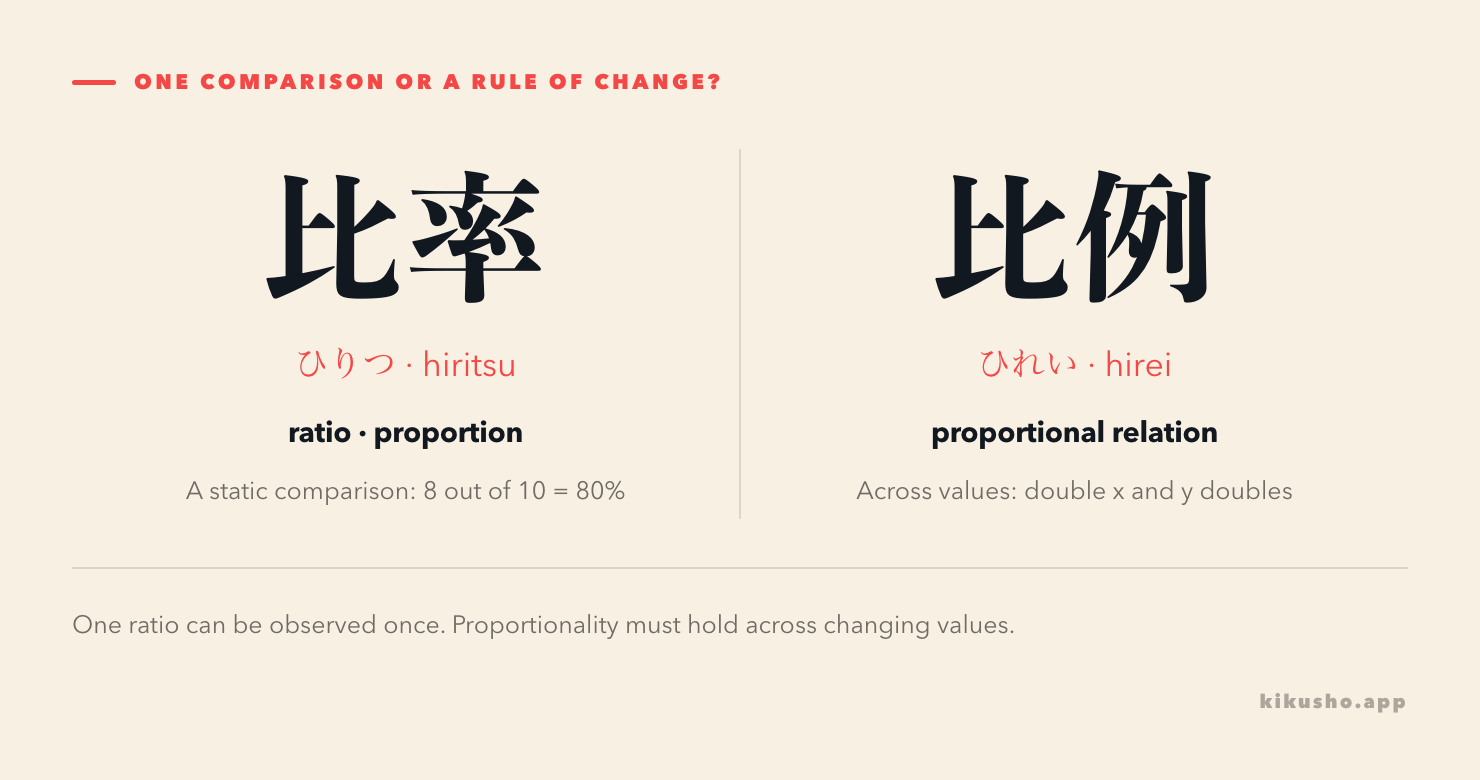
Mathematically, a direct proportion has the form y = ax: when x doubles, y doubles, and their ratio stays constant. The dictionary definition of 比例 also records the broader everyday relation in which one quantity rises or falls along with another. That looser use does not prove a strict law. 売上は広告費に比例して伸びた may be a practical summary, while a scientific claim of proportionality requires data supporting a constant ratio.
This is the test that keeps the pair separate:
- A single result such as “successful samples were 8 out of 10” gives a 比率.
- Several results in which doubling x consistently doubles y support 比例.
- Two variables rising together may show a tendency, but do not automatically prove strict 比例.
密度 makes the denominator visible
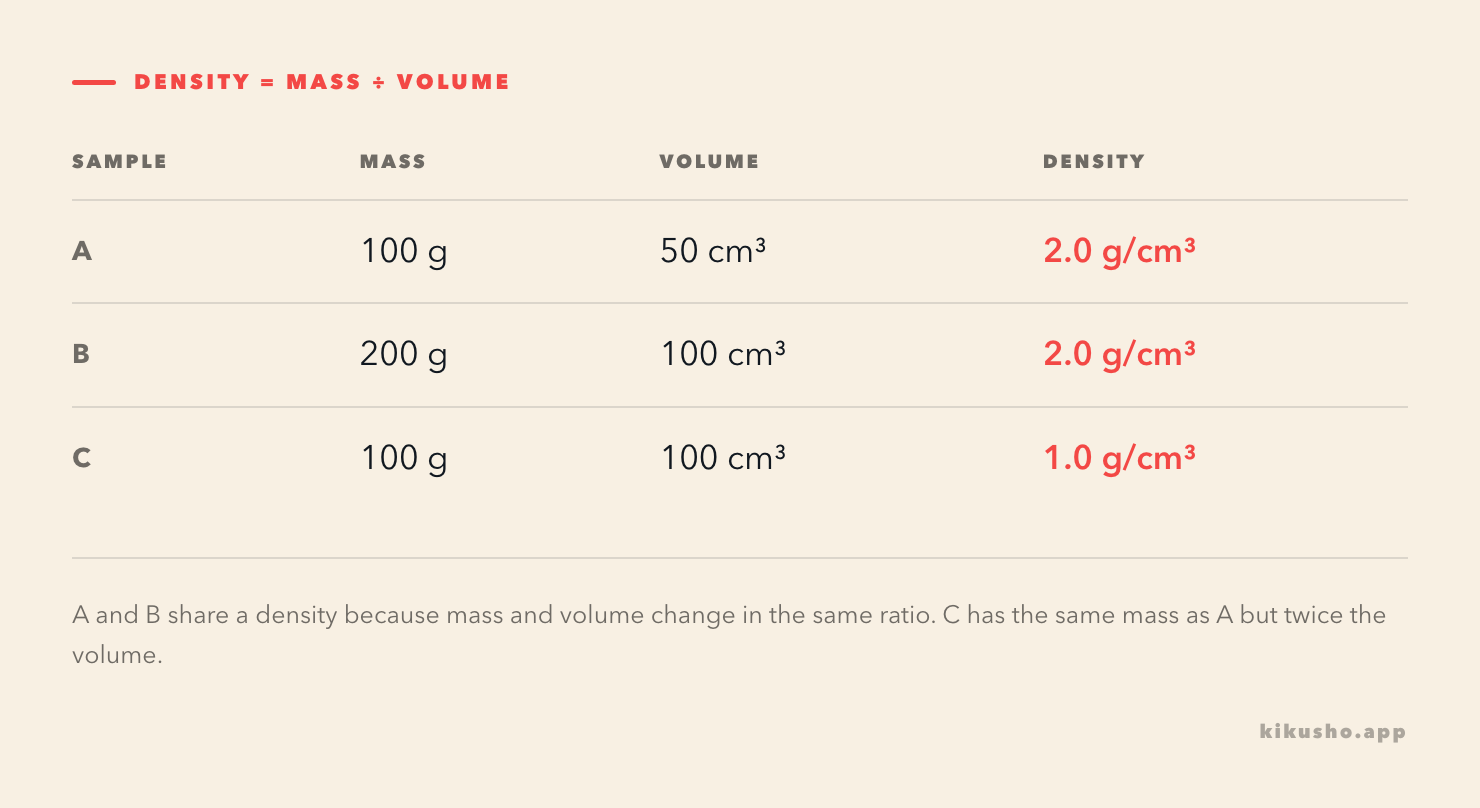
密度 describes how much of something is distributed within a unit of space. In physics, it normally means mass per unit volume. The formula is 密度 = 質量 ÷ 体積.
この金属は、同じ体積の木材より密度が高い。
この きんぞくは、おなじ たいせきの もくざいより みつどが たかい。
This metal has a higher density than wood of the same volume.
The Japanese Pharmacopoeia's official density measurement method defines density as mass per unit volume and distinguishes it from 比重, the ratio between the mass of a substance and the mass of an equal volume of a reference substance. 密度 has a unit such as g/cm³ or kg/m³; 比重 is a ratio and has no unit.
The word extends naturally beyond laboratory matter:
- 人口密度: population density, usually people per unit area
- 交通密度: traffic density
- 情報密度: information density
- 密度の高い議論: a discussion rich in substance
- 密度が低い: sparse or low in density
The dictionary entry for 密度 covers unit volume, area and length, as well as the figurative degree to which content is substantial. The usual adjective is 高い/低い. In physical prose, avoid translating “dense” mechanically as 濃い.
濃度 asks a different question: how concentrated a component is within a solution or mixture. Salt water can have a high 塩分濃度, while the liquid also has a measurable 密度. Temperature or composition can change both, but the nouns do not become interchangeable.
One report can use all four without repeating an idea
試料Aの質量は一〇〇・四グラム、体積は五〇立方センチメートルでした。基準値との差は〇・四グラムで、相対誤差は〇・四パーセントです。この誤差は許容範囲内でした。次に、同じ材質で体積の異なる五つの試料を測定したところ、質量は体積に比例して増加しました。各試料の質量と体積の比率はほぼ一定で、計算した密度は約二・〇グラム毎立方センチメートルでした。
Sample A had a mass of 100.4 grams and a volume of 50 cubic centimetres. The difference from the reference value was 0.4 grams, and the relative error was 0.4 percent. This error was within the permitted range. Next, we measured five samples of the same material with different volumes and found that mass increased in proportion to volume. The ratio of mass to volume remained nearly constant, and the calculated density was about 2.0 grams per cubic centimetre.
Each term answers a separate question. 誤差 asks how far the result is from the reference. 比率 expresses the mass-to-volume comparison for a sample. 比例 states the pattern across several samples. 密度 names the physical quantity represented by that stable mass-to-volume ratio.
This lesson continues the N2 measurement vocabulary lesson, where 測定 produces the value, 統計 organises repeated results, and 推定 draws a conclusion. The N1 words sharpen the mathematical interpretation of those results. Save them with their constructions: 誤差が生じる, 比率を求める, Aに比例する, and 密度が高い.
Practice
1 · Identify the sound of 誤差. Which pronunciation is standard?
- A. ごさく
- B. ごさ
- C. あやまりさ
- D. ござ
2 · A comparison at one point. Ten of forty samples changed colour. Which noun best names 25 percent as a share of the total?
- A. 比率
- B. 比例
- C. 密度
- D. 誤差
3 · A relationship across values. Complete the sentence: 容積が一定なら、質量の増加に( )して密度も高くなる。
- A. 誤差
- B. 比率
- C. 比例
- D. 密度
4 · Mass per unit volume. Which quantity is calculated by 質量 ÷ 体積?
- A. 比率だけ
- B. 許容誤差
- C. 濃度
- D. 密度
5 · Within tolerance. Which sentence says that the difference is acceptable for the instrument?
- A. 差は装置の許容誤差の範囲内だ。
- B. 装置は比率に比例している。
- C. 誤差の密度を二倍にした。
- D. 許容範囲が質量に比例を求めた。
6 · Density or concentration. Which combination is most natural?
- A. 人口濃度 and 塩分密度
- B. 人口密度 and 塩分濃度
- C. 人口比例 and 塩分比率 only
- D. 人口誤差 and 塩分比例
7 · One ratio does not prove a rule. Which statement is accurate?
- A. A single 3対2 comparison proves that two variables are proportional.
- B. 比例 and 比率 are interchangeable in every mathematical sentence.
- C. A 比率 compares quantities; 比例 describes a relationship across changing quantities.
- D. 比率 can only be written as a percentage.
8 · Technical word formation. Which compound means relative error?
- A. 相対誤差
- B. 比例密度
- C. 誤差比重
- D. 相対比例
9 · Reading a trend. What does 売上は広告費に比例して伸びた mean?
- A. Sales contained an error equal to advertising costs.
- B. Sales grew in proportion to advertising spending.
- C. Sales and advertising had the same physical density.
- D. Advertising represented a fixed percentage of all sales.
10 · Interpret the report. A sample's mass is 100.4 g, its accepted value is 100.0 g, and the tolerance is ±0.5 g. Which conclusion is supported?
- A. The density must be 0.4 g/cm³.
- B. The variables have been proven proportional.
- C. The error is 0.4 g and lies within the tolerance.
- D. The ratio of successful samples is 0.4 percent.
Check all ten answers
- B, ごさ is the standard reading of 誤差.
- A. 比率 names the share obtained by comparing the ten successful samples with all forty samples.
- C. The fixed construction is Aに比例してBが変化する.
- D. Physical 密度 is mass per unit volume.
- A. 許容誤差の範囲内 states that the difference falls inside the instrument's allowed tolerance.
- B. Population is distributed across an area, giving 人口密度; salt has a concentration within a solution, giving 塩分濃度.
- C. 比率 is a comparison, while 比例 is a relationship supported across changing values.
- A, 相対誤差 means relative error, commonly expressed as a ratio or percentage of the reference value.
- B. The sentence says sales increased in step with advertising expenditure; in strict analysis, further data would be needed to prove exact proportionality.
- C. The difference is 100.4 − 100.0 = 0.4 g, which is smaller than the permitted 0.5 g.
Common questions
What is the difference between 比率 and 比例?
比率 is a ratio or proportion that compares quantities at a given point, such as 3対2 or 40 percent. 比例 is a relationship in which one quantity changes in step with another. A table can show one 比率 without proving that the variables are 比例する.
What is 誤差 in a Japanese measurement report?
誤差 is the difference between a measured or approximate value and the true or accepted value. Common phrases include 測定誤差, 許容誤差, 誤差が生じる and 誤差の範囲内.
How is 密度 different from 濃度?
密度 describes how much of something is distributed within a unit of space; in physics it usually means mass per unit volume. 濃度 describes the concentration of one component in a mixture or solution. Both can be high or low, but they answer different questions.
Are all four words officially assigned to JLPT N1?
No exhaustive official JLPT vocabulary list exists. Kikusho's inherited reference inventory places all four at N1, while current independent material places 誤差 at N1 and often places 比例 and 密度 at N2. Treat the label as a study placement rather than an official boundary.