On this page
These nine N3 words follow information from a form to its destination: you 記入 a 姓名, 印刷 a document, send it by 郵便 or electronic 通信, and 受け取る the result. The important distinctions are between the delivery system 郵便 and personal news 便り, and between the electronic property 電子, the information データ, and the act or channel of transmission 通信.
Nine entries describe the document and its journey
| Entry | Reading | Role and central sense | Natural combination |
|---|---|---|---|
| 印刷 | いんさつ, insatsu | noun; transitive する verb; printing | 資料を印刷する |
| 受け取る | うけとる, uketoru | transitive godan verb; receive, accept or take | 荷物を受け取る |
| 記入 | きにゅう, kinyū | noun; transitive する verb; entering information in a form or field | 申込書に記入する |
| 姓名 | せいめい, seimei | noun; family name and given name together | 姓名を記入する |
| 便り | たより, tayori | noun; news, correspondence or a letter | 友人からの便り |
| 通信 | つうしん, tsūshin | noun; する verb; communication or transmission over a distance | 通信状態がよい |
| 電子 | でんし, denshi | noun; の modifier; electron or electronic | 電子データ |
| データ | でーた, dēta | noun; data or recorded information | データを送信する |
| 郵便 | ゆうびん, yūbin | noun; mail, postal matter or the postal service | 郵便で送る |
The September 2026 Kikusho snapshot groups all nine exact written-form and reading pairs under N3. Both baseline files descend from the Waller family, so they provide one independent source family, and they conflict over 姓名 and データ: one observation puts each at N3 and another at N1. Current outside lists also vary. Pass Japanese Test includes this vocabulary in its N3 list, and Japanesetest4you has N3 pages for 印刷, 受け取る, 通信 and 郵便. Bunpro currently places 通信 earlier. The JLPT organisers publish no exhaustive official vocabulary list, so N3 is a study destination rather than a claim about a fixed exam list.
記入 creates the record; 印刷 puts it on paper
記入する is more specific than 書く. It means putting requested information into a prepared form, register, answer space or field. The container often takes に, and the information takes を.
申込書に姓名と住所を記入してください。
もうしこみしょに せいめいと じゅうしょを きにゅうしてください。
Please enter your full name and address on the application form.
You can also name the field: この欄に電話番号を記入する, enter a telephone number in this field. 記入漏れ is an omitted entry, and 記入例 is a completed example. Bunpro's current 記入 entry shows the same form-and-field use.
印刷する reproduces text or an image on paper or another physical surface. A person can print a document with 資料を印刷する. A document produced by the process can be called 印刷物, and passive 印刷されている describes what is printed.
記入した申込書を二部印刷しました。
きにゅうした もうしこみしょを にぶ いんさつしました。
I printed two copies of the completed application form.
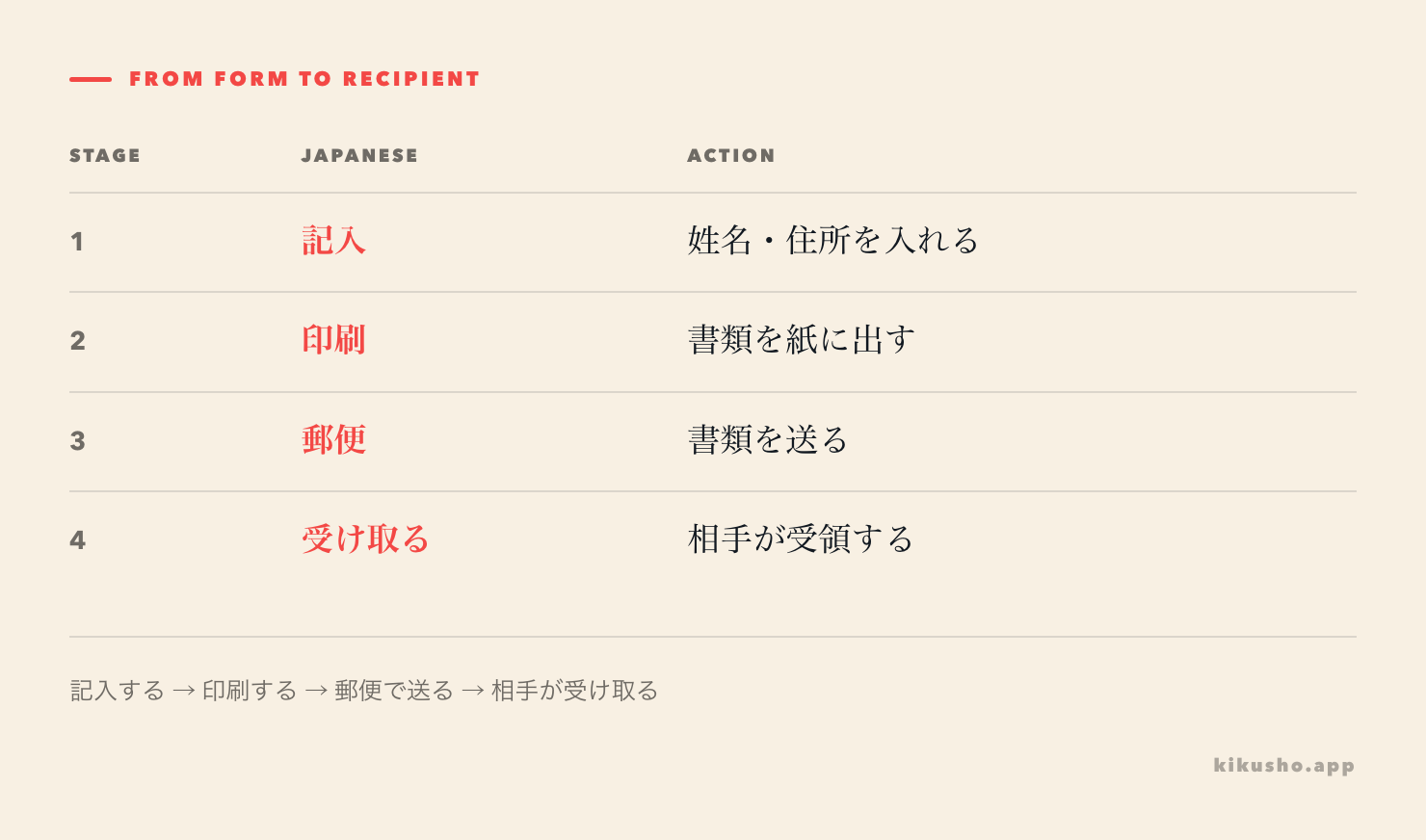
The order matters in instructions: データを記入する → 書類を印刷する → 郵便で送る → 相手が受け取る. Japan Post's computer mail service shows a real variation on this path: customers submit print data online or on electronic media, and the service prints, encloses and sends the postal item.
姓名 is the full name; the form may say 氏名
姓名 combines 姓, family name, and 名, given name. The Daijisen definition gives “family name and given name” and treats 氏名 as its equivalent.
受取人の姓名が読みにくかったので、確認しました。
うけとりにんの せいめいが よみにくかったので、かくにんしました。
The recipient's full name was hard to read, so I checked it.
In practical instructions, 氏名 is very common. Japan Post tells users of its post-office pickup service to enter the recipient's address and 氏名. That does not make 姓名 incorrect; it means the printed label controls what you copy. 名前 can refer to a full name in ordinary speech, but it can also mean only a given name in a contrast such as 姓と名前.
郵便 is the system; 便り is the news that reaches you
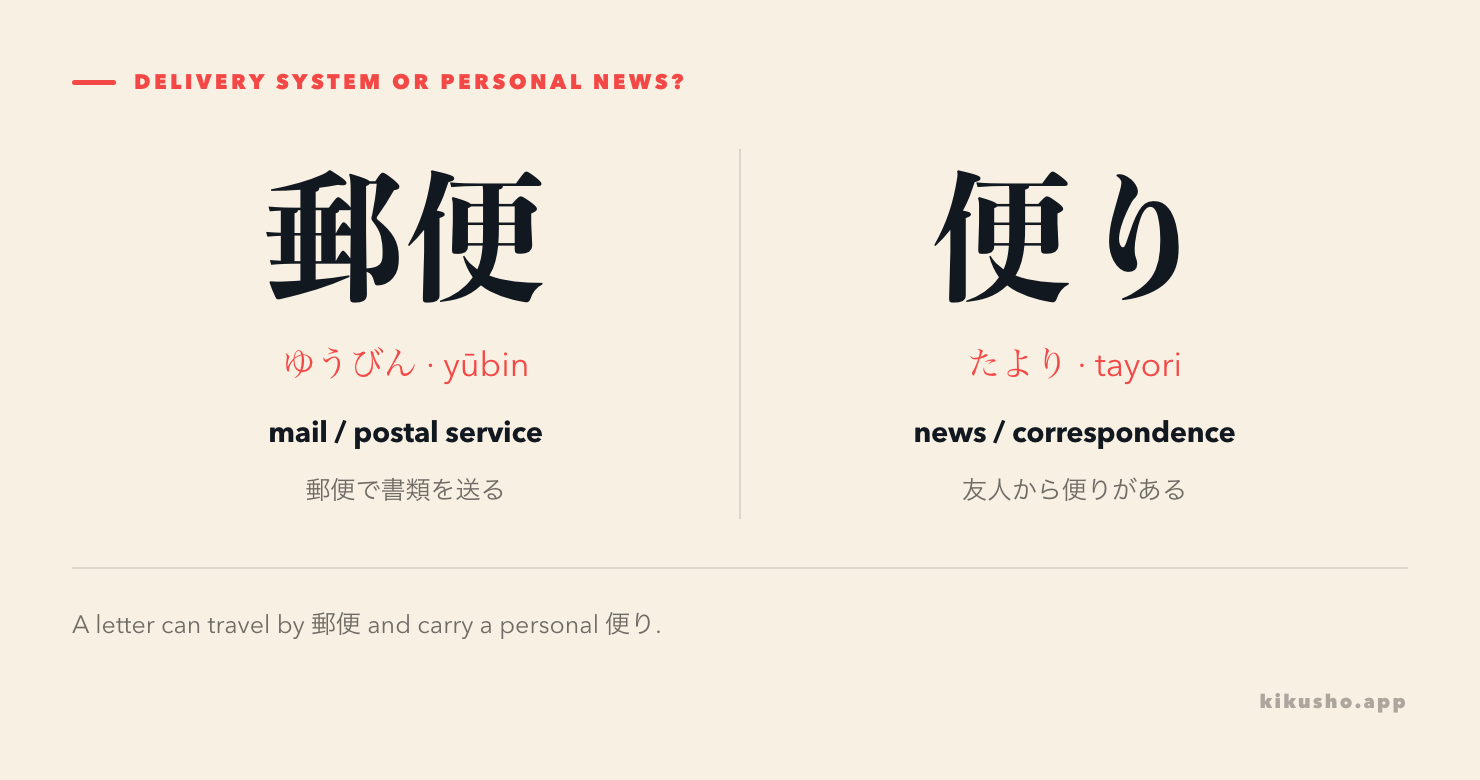
郵便 names the postal service, mail as a delivery method, or postal matter. Use 郵便で送る for sending something by post, 郵便が届く for mail arriving, and 郵便局 for a post office.
必要な書類は郵便で送ります。
ひつような しょるいは ゆうびんで おくります。
I will send the necessary documents by post.
便り centres the news or message from someone. A physical letter can be a 便り, but the word carries the human information rather than naming the national delivery system.
海外で暮らす友人から久しぶりに便りがありました。
かいがいで くらす ゆうじんから ひさしぶりに たよりが ありました。
I heard from a friend living abroad for the first time in a while.
Useful patterns include 母からの便り, news from one's mother; 便りを書く, write a letter or message; and 便りがない, receive no news. 頼り, also read たより, instead means reliance, support or a dependable person. The kanji and surrounding particles separate the two.
電子 describes the medium; データ is the information; 通信 moves it
電子 literally means an electron, but learners often meet it as an “electronic” modifier: 電子メール, email; 電子版, electronic edition; 電子辞書, electronic dictionary; and 電子データ, electronic data. It tells you what kind of medium or technology a noun uses.
データ is the information itself when represented for reference, calculation or computer processing. It can be collected, saved, deleted, printed or sent.
申込書のデータをパソコンに保存しました。
もうしこみしょの データを パソコンに ほぞんしました。
I saved the application-form data on the computer.
通信 is communication or transmission across a distance. It can describe correspondence between people, telecommunications technology, a network connection or the act of transmitting a signal. Common compounds include 通信手段, means of communication; 通信技術, communications technology; and 通信状態, connection condition.
山の中では通信状態が悪く、データを送れませんでした。
やまの なかでは つうしんじょうたいが わるく、データを おくれませんでした。
The connection was poor in the mountains, so I could not send the data.
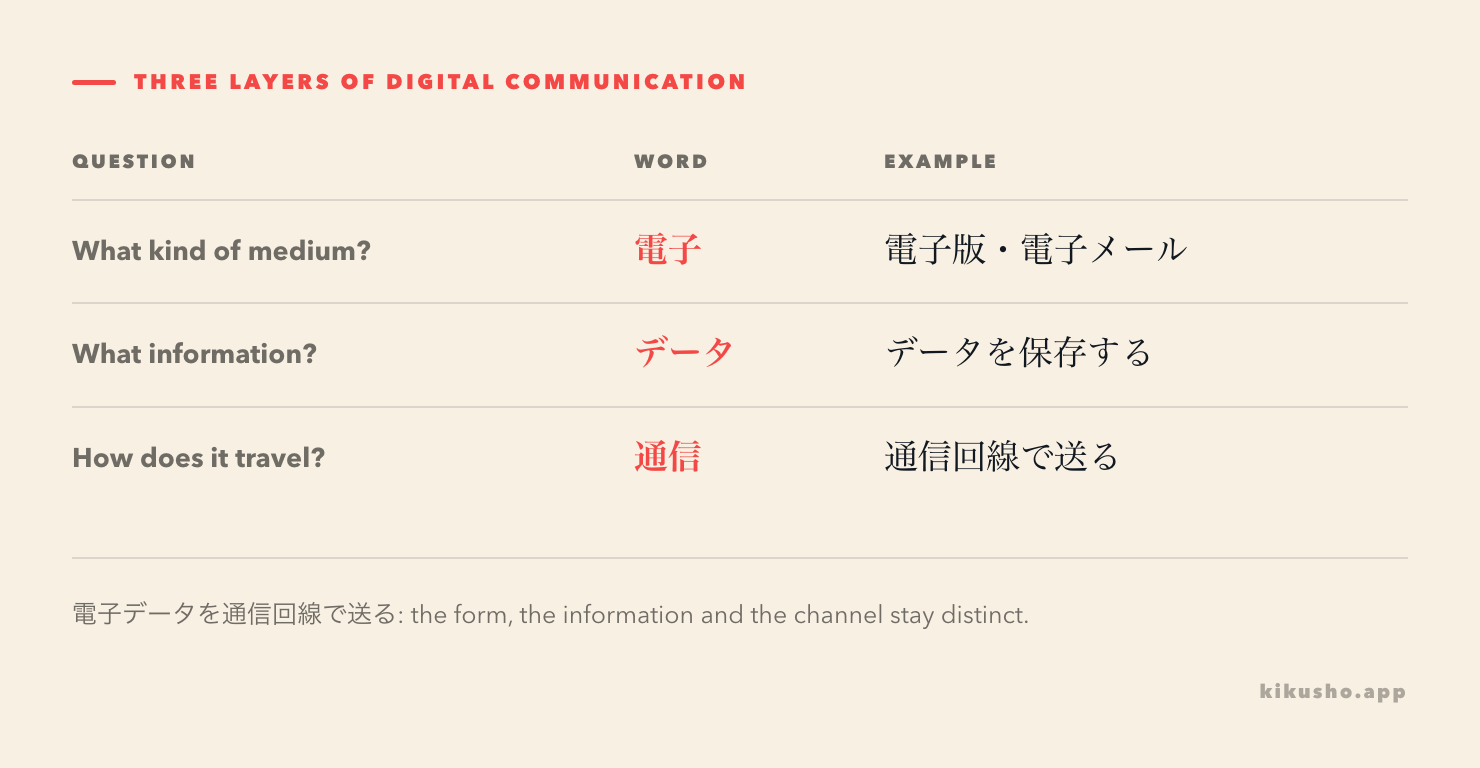
These words can appear together without becoming synonyms: 電子データを通信回線で送る means send electronic data over a communications line. The information is データ, its form is 電子, and its movement relies on 通信.
受け取る marks the receiver and the source
受け取る is a transitive verb. The thing received takes を, while the source can take から.
大学から入学書類を受け取りました。
だいがくから にゅうがくしょるいを うけとりました。
I received the enrolment documents from the university.
It can also mean accepting something handed over or interpreting words in a certain way: 冗談として受け取る, take it as a joke. In this lesson's document workflow, the concrete object stays visible. Do not confuse it with 届く, an intransitive verb that presents the item as arriving: 郵便が届いた versus 郵便を受け取った.
One application moves through paper and digital channels
Read the office message:
申込書に姓名を記入し、電子データを保存してください。自宅で印刷できない場合は、データを事務所へ送ってください。通信状態が悪くて送れないときは、紙の書類を郵便で提出してもかまいません。事務所が書類を受け取った後、確認の便りを送ります。
Enter your full name on the application form and save the electronic data. If you cannot print it at home, send the data to the office. If a poor connection prevents you from sending it, you may submit the paper documents by post. After the office receives the documents, it will send a confirmation message.
Every noun has a separate role. 姓名 is the content entered; 電子 describes the saved form; データ is what may travel through 通信; 印刷 creates the paper version; 郵便 is the alternative route; 受け取る presents the office as receiver; and 便り is the confirmation news returned to the applicant.
The N2 mail and document layer continues with addressee labels, registered and express services, receipt records, document copies and telephone handsets.
The formal connectors lesson helps with instructions that add conditions or exceptions. For preparing files before a deadline, the ~ておく lesson explains forms such as 保存しておく and 印刷しておく. Formal correspondence later expands into the openings and closings taught in the advanced letter vocabulary lesson.
Practice
1 · Communication reading. How is 通信 read?
- A. とうしん
- B. つうじん
- C. つうしん
- D. でんしん
2 · Form workflow. Which sequence is natural when preparing a paper application from a computer file?
- A. 受け取る → 姓名 → 通信
- B. 記入する → 印刷する → 郵便で送る
- C. 郵便する → 電子する → 印刷を受け取る
- D. 便りする → データで姓名する
3 · Receiver and source. Complete the sentence: 大学( )入学書類( )受け取りました。
- A. から/を
- B. を/から
- C. に/が
- D. で/に
4 · Personal news. Which sentence means “I received news from a friend” rather than “I used the postal service”?
- A. 友人を郵便しました。
- B. 友人に通信を印刷しました。
- C. 友人で郵便を記入しました。
- D. 友人から便りがありました。
5 · Electronic modifier. Which compound naturally means “electronic edition”?
- A. データ版
- B. 電子版
- C. 通信版する
- D. 郵便電子
6 · Information or channel. The file is ready, but a poor network connection prevents it from being sent. Which pair fits?
- A. 姓名/便り
- B. 郵便/印刷
- C. データ/通信状態
- D. 電子/受け取り
7 · Full name. What does 姓名 refer to?
- A. A family name and given name together
- B. A postal address only
- C. An electronic signature only
- D. The name of a company department
8 · No correspondence. What does 兄から便りがない most naturally mean?
- A. My older brother has no post office nearby.
- B. My older brother cannot print the form.
- C. The mail service rejected my older brother.
- D. I have had no news or message from my older brother.
9 · Correct collocation. Which expression is natural?
- A. 姓名を郵便する
- B. 通信状態が悪い
- C. データを便りする
- D. 電子を受け取っている状態
10 · Office message. What happens after the office receives the documents?
- A. It deletes the applicant's name.
- B. It requires every applicant to print at home.
- C. It sends a confirmation message.
- D. It stops accepting postal submissions.
Finish all ten decisions before revealing the explanations.
Answers and explanations
1 · C, つうしん. 通信 combines 通, つう, with 信, しん. 電信 is a different word.
2 · B. You enter the required information, print the completed document and send the paper by post. The other choices attach particles or する to nouns unnaturally.
3 · A, から/を. The university is the source marked by から, and the enrolment documents are the direct object of 受け取る marked by を.
4 · D, 友人から便りがありました. 便り presents personal news or correspondence, while から identifies the friend as its source.
5 · B, 電子版. 電子 modifies 版 to identify an electronic edition. データ is information, and 通信 names communication or transmission.
6 · C, データ/通信状態. The file's information is データ; the network condition that allows or blocks transmission is 通信状態.
7 · A. 姓名 combines the family name and given name. A form may label the same information 氏名.
8 · D. 兄から便りがない means no news, message or letter has come from one's older brother. It does not evaluate the postal infrastructure.
9 · B, 通信状態が悪い. 通信状態 describes the quality of a connection. The remaining choices force unrelated nouns into invalid verb patterns.
10 · C. The final sentence says 事務所が書類を受け取った後、確認の便りを送ります: after receiving the documents, the office sends a confirmation message.
Common questions
What is the difference between 郵便 and 便り?
郵便 means mail as a delivery system or postal matter sent through that system. 便り means news or a message from someone, often a letter but not necessarily a postal service. 郵便で送る describes the method; 友達からの便り focuses on the personal news received.
How do 電子, データ and 通信 differ?
電子 commonly modifies a noun to mean electronic, as in 電子版 and 電子メール. データ is the information represented or stored, while 通信 is the exchange or transmission of information across a distance. 電子データ can therefore be sent by a 通信 service.
What is the difference between 記入する and 書く?
書く is the broad verb to write. 記入する means entering required information in a form, register, field or similar prepared place. A form commonly takes に, the information takes を, and a specific field can take に: 申込書に姓名を記入する.
Does 姓名 mean the same thing as 氏名?
Both can mean a person's family name and given name together. 姓名 is the assigned headword here; official forms and instructions very often use 氏名. Read the label printed on the actual form instead of replacing it automatically.