On this page
Fifteen N1 words cluster around one question: how much of what is real is actually showing. They sort into three groups — the real thing itself (真実, 真相, 実態, 実質, 本質, ありのまま), how plainly it shows (明白, 明瞭, 露骨, あからさま), and when it will not come into focus (漠然, 不明, ぼやける) — with 体裁 for the surface kept up in its place, and 誤る for getting the matter wrong.
That axis is the lesson. A dictionary lists these words in alphabetical order, so 真実 and 真相 land three pages apart and both read "truth". Put them on one line and the difference is the point of contact you can learn. The N3 set on the same theme handles the everyday tier — 本当, 真理, 誤り. These fifteen are the register a news report or an editorial runs on.
Why these fifteen belong together
Each word answers the same question at a different distance from the surface. Furthest under it are the nouns for the real thing: what is true, what the facts behind an event were, what the essence is. Closer to the surface are the words for exposure: how clearly the real thing shows, from plain fact to blunt display. At the surface, and refusing to resolve, are the words for haze and the unknown. And on the surface itself sits 体裁, the show a person keeps up regardless of what is underneath.
Read the set as a table first, then take the groups one at a time.
| Word | Reading | Type | What it points at |
|---|---|---|---|
| 真実 | しんじつ | noun, な-adj | truth, as against falsehood |
| 真相 | しんそう | noun | the real facts behind a matter |
| 実態 | じったい | noun | the actual state of things |
| 実質 | じっしつ | noun, adverb | substance; in effect |
| 本質 | ほんしつ | noun | essence, true nature |
| ありのまま | ありのまま | noun, adverb | as it is, unvarnished |
| 明白 | めいはく | な-adj | obvious, evident |
| 明瞭 | めいりょう | な-adj, noun | clear, distinct |
| 露骨 | ろこつ | な-adj | blatant, undisguised |
| あからさま | あからさま | な-adj | open, undisguised, frank |
| 漠然 | ばくぜん | adverb (と), たる-adj | vague, hazy |
| 不明 | ふめい | な-adj, noun | unknown, unclear |
| ぼやける | ぼやける | verb (intransitive) | to blur, to go dim |
| 体裁 | ていさい | noun | outward form, appearances |
| 誤る | あやまる | verb (transitive) | to make a mistake, to err |
The words for the real thing under the surface
Six nouns all translate to some flavour of "truth" or "reality", and they are not interchangeable. The difference is what each one is the truth of.
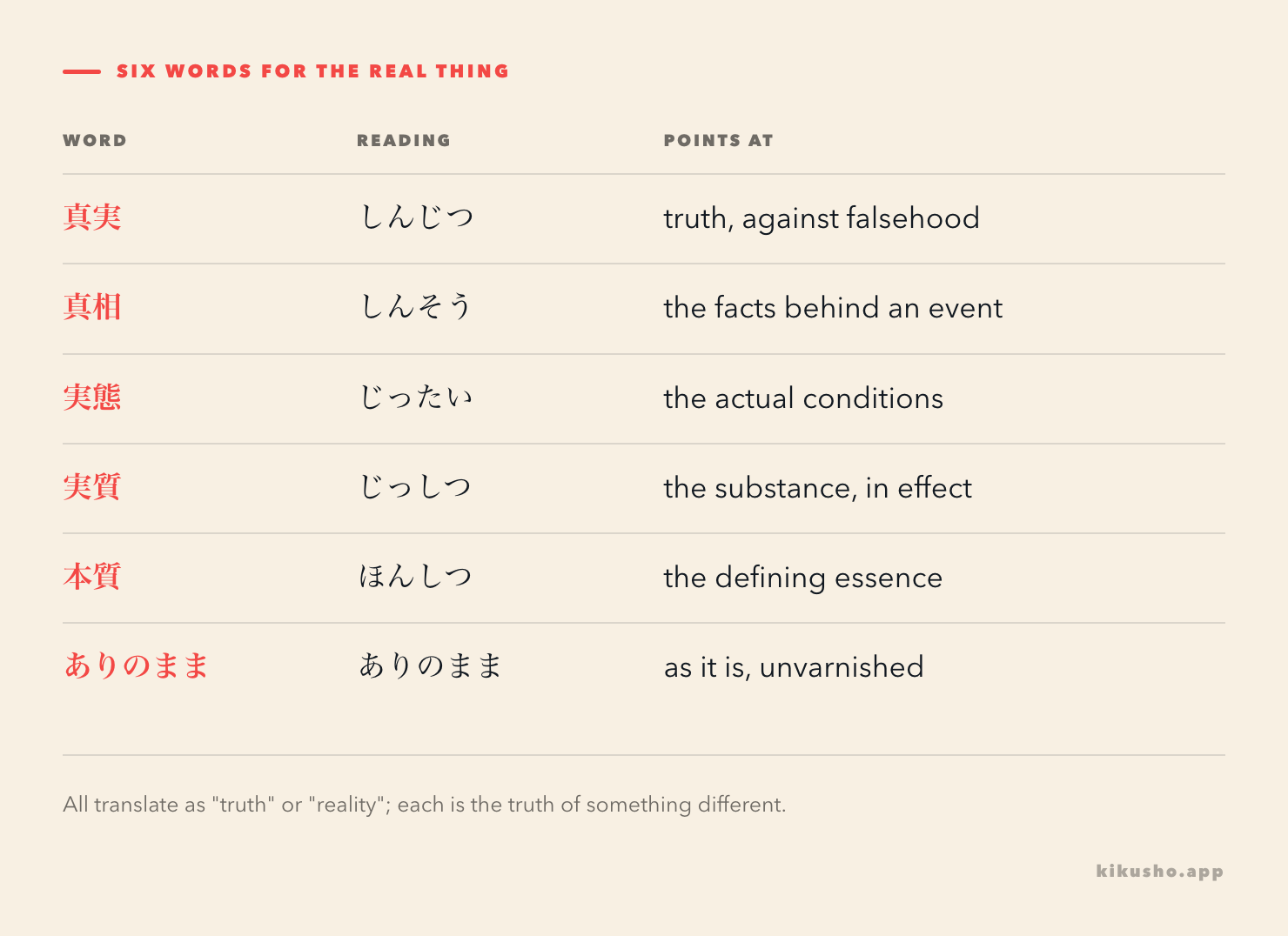
真実(しんじつ) is truth against falsehood, the moral and abstract kind. 真実を語る, to tell the truth; 真実の愛, true love. It carries weight and sincerity, and it is the word a witness swears to.
真相(しんそう) is narrower and colder: the real facts behind one specific matter, hidden under rumour or a cover story. 事件の真相, the truth behind the incident; 真相を究明する, to get to the bottom of it. Where 真実 is a value, 真相 is an answer.
実態(じったい) is the actual state of affairs, set against the official or nominal picture. 実態調査, a survey of real conditions; 制度が実態とかけ離れている, the system is far removed from how things actually work. It is the word for the gap between the brochure and the site.
実質(じっしつ) is the substance or content of a thing, and it doubles as an adverb: 実質的に, in effect; 実質ゼロ, effectively zero; 実質的な変化, a substantive change. It measures what a thing amounts to once the packaging is removed.
本質(ほんしつ) is the essence, the defining nature without which the thing would not be itself. 問題の本質, the heart of the problem; 本質的に異なる, different in essence. It answers "what is this, fundamentally".
ありのまま is the manner word of the group: things as they are, with nothing added or hidden. ありのままの自分, yourself as you are; ありのままに話す, to tell it straight. It is normally written in kana.
The clean test for a scandal: its 真相 is what happened, its 実態 is how the system really runs, its 本質 is what the affair fundamentally is, and 真実 is whether the account of it is true at all.
How plainly the truth is showing
Four words describe exposure, and they climb from neutral clarity to blunt display. The step between them is register, not degree of light.
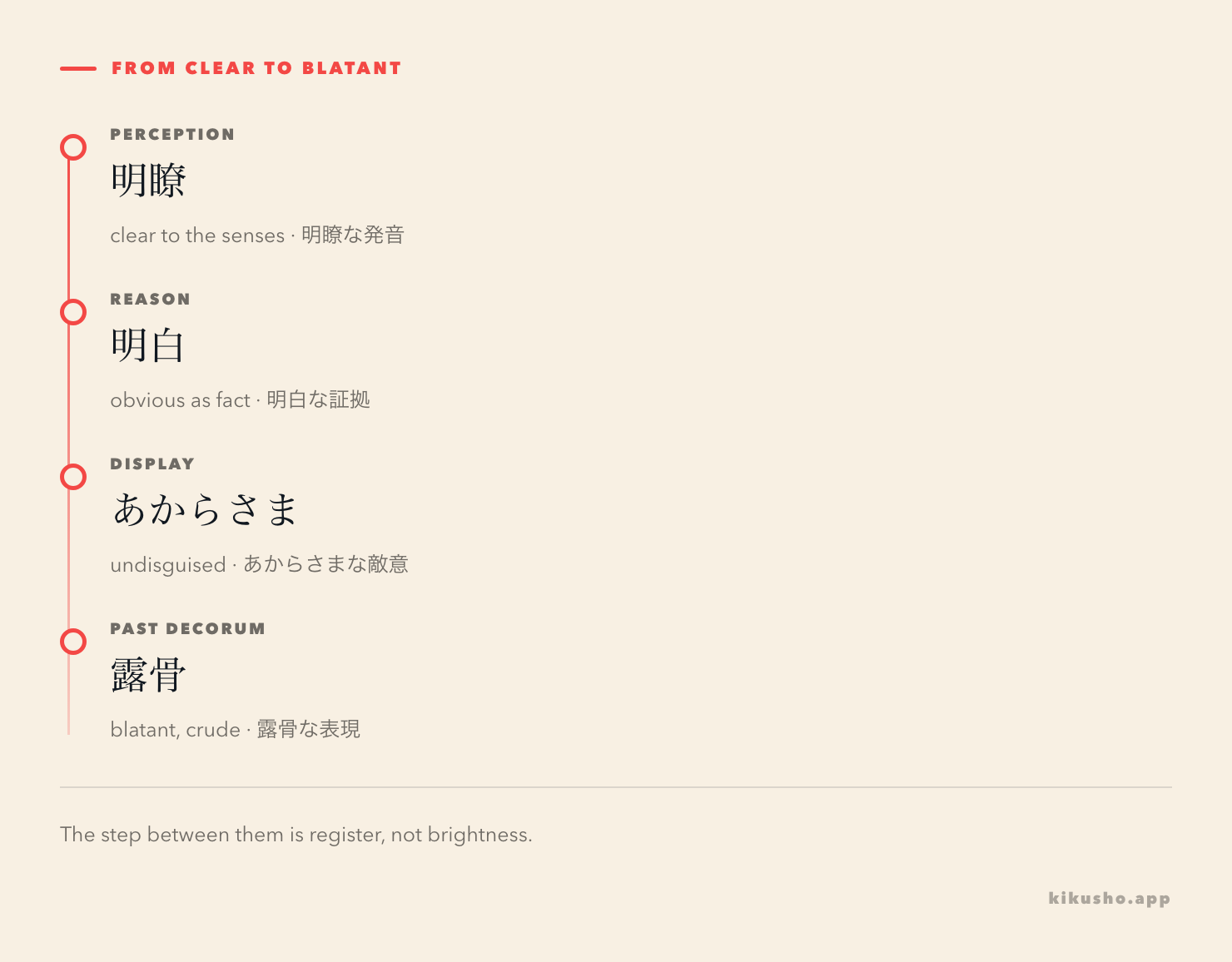
明瞭(めいりょう) is clarity to the senses: distinct, easy to make out. 明瞭な発音, clear pronunciation; 不明瞭, indistinct. It is about perception.
明白(めいはく) is clarity to reason: obvious, evident as a matter of fact. 明白な事実, an obvious fact; 明白な証拠, clear evidence. Nobody could reasonably dispute it.
あからさま moves from clear to undisguised: shown openly, with no attempt to hide. あからさまに嫌な顔をする, to show open distaste; あからさまな敵意, blatant hostility. The adverb あからさまに is where you will meet it most.
露骨(ろこつ) is the same openness pushed past decorum: blatant, showing what tact would keep covered. 露骨な表現, a crude or explicit expression; 露骨に嫌がる, to show dislike blatantly. It usually carries disapproval.
明白 is two words, and only one of them is written in kanji
Two entries in this set share a spelling or a sound, and both are ready-made traps.
The characters 明白 hold two different words, because a reading travels with the word, not the character. Read on the page, 明白 is めいはく, the な-adjective for "obvious". The word あからさま (blatant, undisguised) is filed under those same characters on some lists, but Japanese writes it in kana, and a dictionary of Japanese lists it in kana alone. So the rule is one-directional: when you see 明白, read めいはく; when you mean "undisguised", write あからさま. The kanji spelling of あからさま is a curiosity, not something you produce.
The second trap is a sound. 誤る is read あやまる, and so is 謝る, but they do opposite work.
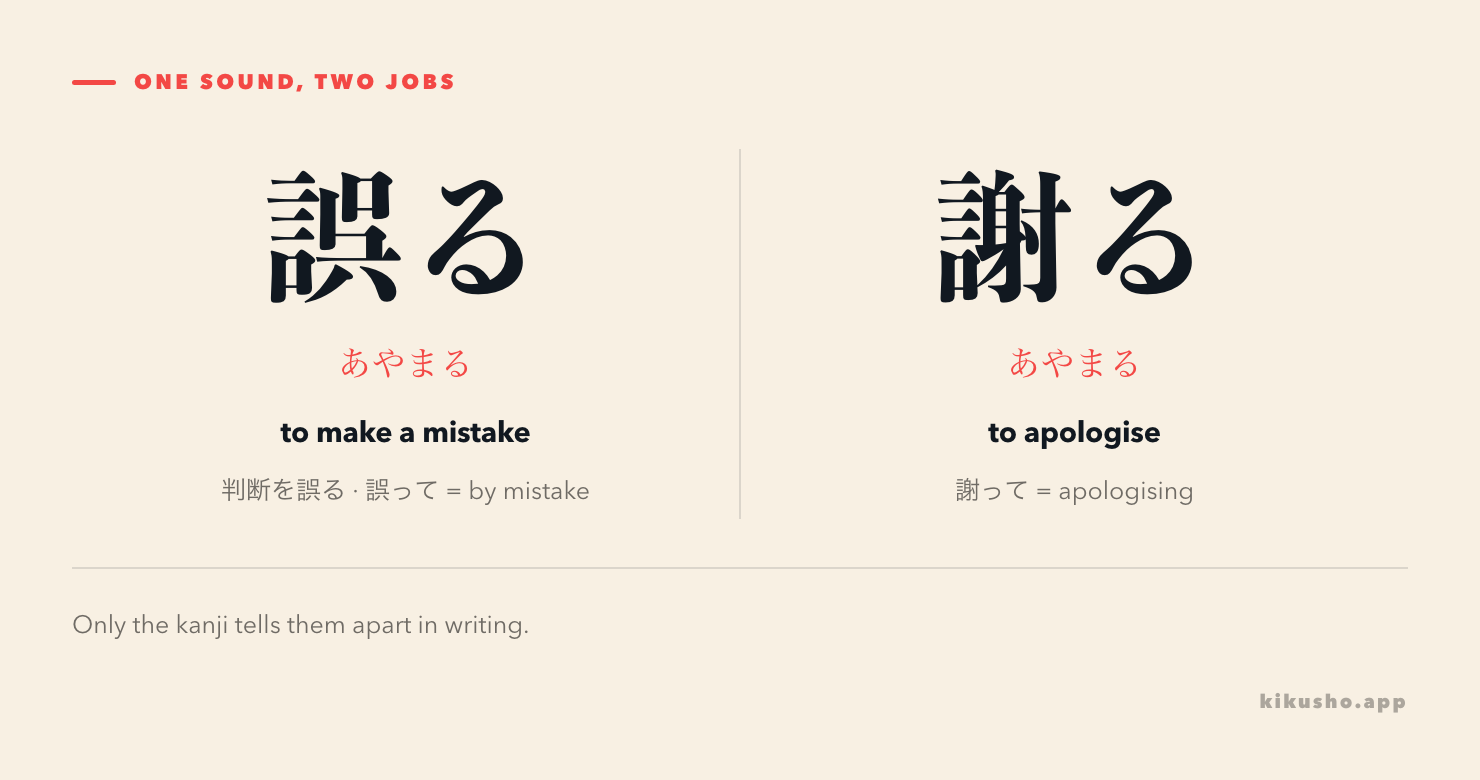
誤る(あやまる) means to make a mistake or be wrong. 判断を誤る, to misjudge; 道を誤る, to take the wrong road or go astray; 誤った情報, incorrect information. The adverbial 誤って means "by mistake". 謝る(あやまる) means to apologise, and its 謝って means "apologising". The kanji is the only thing that tells them apart in writing, and the context is the only thing that tells them apart aloud.
When the truth will not come into focus
The last group is for what stays out of reach: vague, unknown, or literally blurred.
漠然(ばくぜん) is vagueness about something abstract, a feeling or an idea with no clear edges. It almost always appears as 漠然と or 漠然とした: 漠然とした不安, a vague unease; 漠然と考える, to think about something loosely. The literary 漠然たる also exists.
不明(ふめい) is factual: unknown, unidentified, unclear. 原因不明, cause unknown; 行方不明, whereabouts unknown; 意味不明, unintelligible. It also names one's own lack of insight in the set phrase 不明を恥じる, to be ashamed of one's ignorance.
ぼやける is the blur itself, and it is intransitive: 写真がぼやける, the photo goes blurry; 記憶がぼやける, the memory grows dim; 論点がぼやける, the point loses focus. When someone blurs a thing on purpose, the transitive partner is ぼかす: 表現をぼかす, to make an expression deliberately vague.
体裁 is the appearance you keep instead
体裁(ていさい) is the odd word out, and it is why "appearance" is in the title. It is the outward form a thing presents and the social decency of that form. 体裁を整える, to put something into presentable shape; 体裁が悪い, to be awkward or unseemly; 体裁を気にする, to care about how it looks to others. It also means the plain format of a document: レポートの体裁, the layout of a report.
Set it against the rest and the whole lesson snaps together. 真相, 実態 and 本質 all look through the surface to what is underneath. 体裁 is the surface, the show maintained regardless of what is beneath it. It is the thing the other fourteen words are trying to see past.
These words travel in pairs a glossary prints side by side, so the difference only sets once you meet it in a live sentence: an editorial that says 事件の真相, a report that measures the 実態, a colleague being 露骨. When you hit one in something you are reading, Kikusho builds the card from the sentence in front of you — paste the text or photograph the page — and keeps the word with the example that taught you the distinction, its reading and a natural sentence, so 真相 and 真実 stop collapsing into a single "truth". The audio plays offline when you review.
Practice
Answer all five, then open the solutions. No peeking between questions.
Question 1. Choose the correct reading of the underlined word: 証拠は明白だった。 ① あからさま ② めいはく ③ みょうはく ④ めいばく
Question 2. Choose the word that best fits the blank: 政府は制度の( )を調査した。表向きの説明と現場の状況がどれほど違うかを知るためだ。 ① 真実 ② 体裁 ③ 実態 ④ 明瞭
Question 3. Choose the word that best fits the blank: 彼は( )に不快感を示した。隠す気などまるでなかった。 ① 漠然 ② 不明 ③ ありのまま ④ あからさま
Question 4. Choose the option closest in meaning to the underlined part: その議論は問題のいちばん大事なところをとらえていた。 ① 真相 ② 本質 ③ 体裁 ④ 実質
Question 5. Choose the sentence that uses 露骨 correctly. ① 今日は空が露骨に晴れている。 ② 彼女の発音は露骨で、とても聞き取りやすい。 ③ 彼は露骨に興味のなさそうな態度を取った。 ④ 警察は事件の露骨を調べている。
Answers and explanations
Answer 1: ② めいはく. In running text the characters 明白 are read めいはく, the な-adjective for "obvious, evident". ① あからさま is a real word, but a separate one normally written in kana, not the reading you give these characters here. ③ uses みょう, the wrong on-reading of 明 for this compound, and ④ めいばく applies a rendaku that does not occur.
Answer 2: ③ 実態. The clue is the contrast between the 表向きの説明 (official account) and the 現場の状況 (situation on the ground): 実態 is exactly the actual state set against the nominal one. ① 真実 is truth against falsehood, too abstract for a survey of conditions. ② 体裁 is the outward show, the opposite of what is being investigated. ④ 明瞭 is an adjective for clarity and cannot be the object of 調査する.
Answer 3: ④ あからさま. 隠す気などまるでなかった (no intention at all of hiding it) points to an undisguised display, which is あからさまに. ① 漠然 means vague, the reverse of showing something plainly. ② 不明 means unknown. ③ ありのまま is close in spirit but describes reporting something as it is, not the open display of an emotion; ありのままに不快感を示す does not sit naturally.
Answer 4: ② 本質. いちばん大事なところ, the single most important part, is the essence: 本質. ① 真相 is the hidden facts behind an incident, not the core of an argument. ③ 体裁 is outward form. ④ 実質 is the substance or effective content of a thing, close but not the same as its defining core; 本質 is what "the most important part" names here.
Answer 5: ③. 露骨 means blatant or undisguised, which fits 露骨に興味のなさそうな態度 (an openly uninterested manner). ① weather clarity takes 快晴 or 明瞭, not 露骨. ② clear pronunciation is 明瞭, not 露骨. ④ the facts behind a case are its 真相; 露骨 is not a noun for that.
If two of these words still feel like one, the fix is not another list. It is the next sentence you read that uses only one of them, where the context does the disambiguating that a gloss never could.
Common questions
Is 明白 read めいはく or あからさま?
In running text 明白 is almost always めいはく, a な-adjective meaning obvious or evident. あからさま (blatant, undisguised) is a separate word, normally written in kana; some vocabulary lists file it under the kanji 明白, but you will rarely see it written that way, so treat 明白 on the page as めいはく.
What is the difference between 真実, 真相 and 本質?
真実 (しんじつ) is truth as opposed to falsehood. 真相 (しんそう) is the real facts behind a particular incident, beneath conflicting accounts. 本質 (ほんしつ) is the essence or defining nature of something. A scandal has a 真相, what actually happened, while its 本質 is what it fundamentally reveals.
Is 誤る the same word as 謝る?
No. Both are read あやまる, but 誤る means to make a mistake or be wrong (道を誤る, 判断を誤る), while 謝る means to apologise. 誤って means "by mistake"; 謝って means "apologising". Same sound, different character, opposite job.