On this page
The first N1 trap in this set is visible before a sentence begins: 気質 can be きしつ or かたぎ, and the reading changes the way the character is being described. The other words distinguish social character from individuality, sincere conduct from fidelity, sustained effort from rash action, and innocence from simple lack of thought.
These are not ten interchangeable labels for “personality.” Their usual partners reveal whether the sentence is describing a disposition, evaluating an action, or measuring faithfulness to a duty or source.
Ten records divide into description, conduct and evaluation
| Entry | Grammar | Use in this lesson | Phrase worth saving |
|---|---|---|---|
| 気質(かたぎ) | Noun / suffix-like use | Characteristic ethos or type of a group, trade or era | 職人気質 |
| 頑固(がんこ) | Noun / な-adjective | Stubborn; resistant to change | 頑固な考え |
| 気質(きしつ) | Noun | Temperament; underlying disposition | 穏やかな気質 |
| 勤勉(きんべん) | Noun / な-adjective | Diligent in work or study | 勤勉な学生 |
| 軽率(けいそつ) | Noun / な-adjective | Rash; acting without enough thought | 軽率な判断 |
| 個性(こせい) | Noun | Distinctive individuality | 個性を生かす |
| 誠実(せいじつ) | Noun / な-adjective | Sincere; acting with integrity | 誠実な対応 |
| 忠実(ちゅうじつ) | Noun / な-adjective | Faithful to a duty, source or model | 原文に忠実だ |
| 人柄(ひとがら) | Noun | A person's character or personal quality | 温かい人柄 |
| 無邪気(むじゃき) | Noun / な-adjective | Innocent; unaffected; sometimes naive | 無邪気な笑顔 |
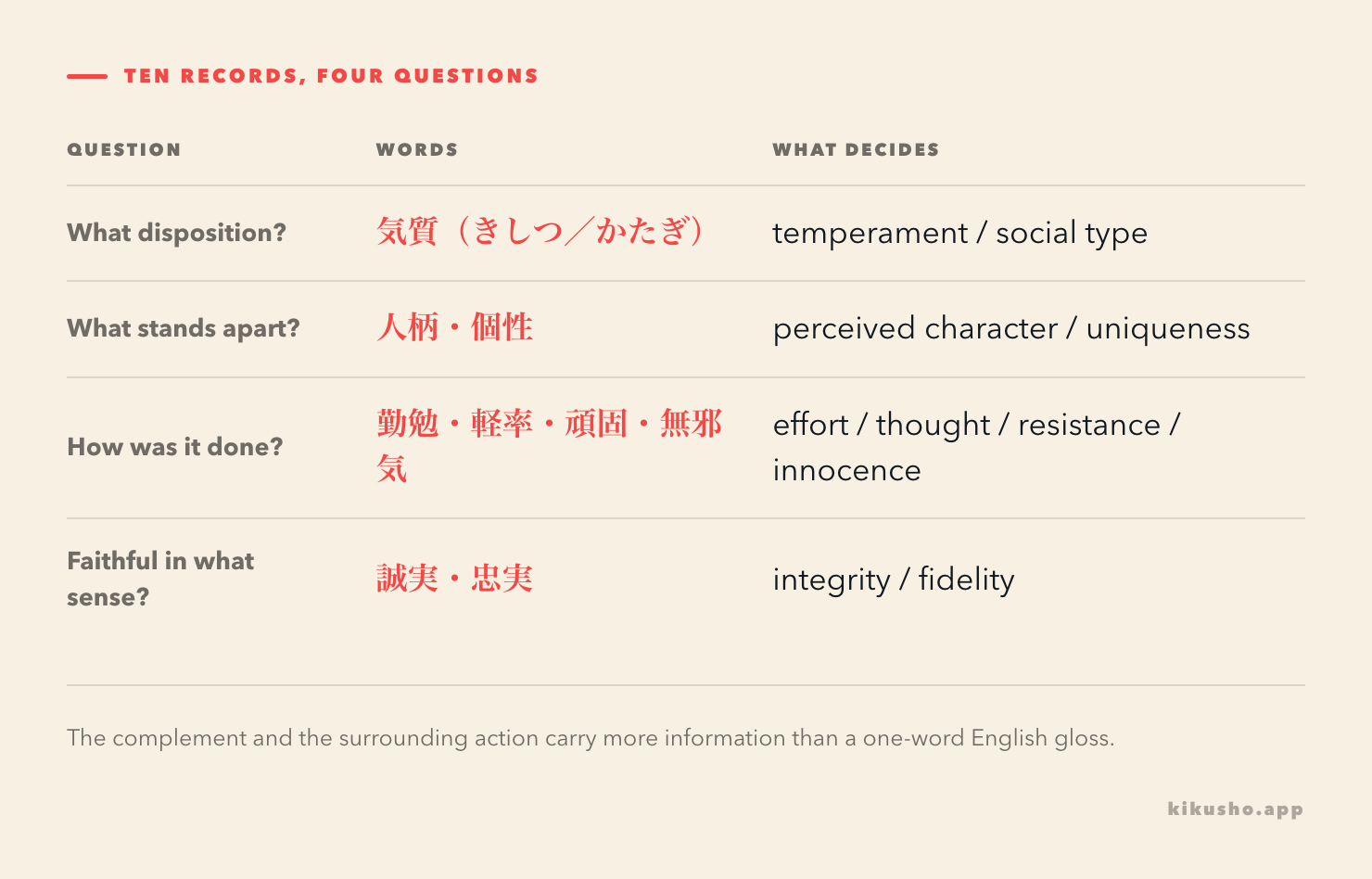
Five entries are な-adjectives as well as nouns. They take な before a noun and に before a verb: 勤勉な人/勤勉に働く, 軽率な発言/軽率に判断する. The remaining nouns depend more heavily on a verb or particle, such as 個性を生かす and 人柄が表れる.
気質 changes its reading with the kind of disposition
気質(きしつ) is a person's temperament or underlying emotional disposition. It can sound more analytical than 性格, especially when the writer treats the disposition as persistent or partly inborn.
彼女は穏やかな気質で、意見が対立しても声を荒らげない。
かのじょは おだやかな きしつで、いけんが たいりつしても こえを あららげない。
She has a calm temperament and does not raise her voice even when opinions conflict.
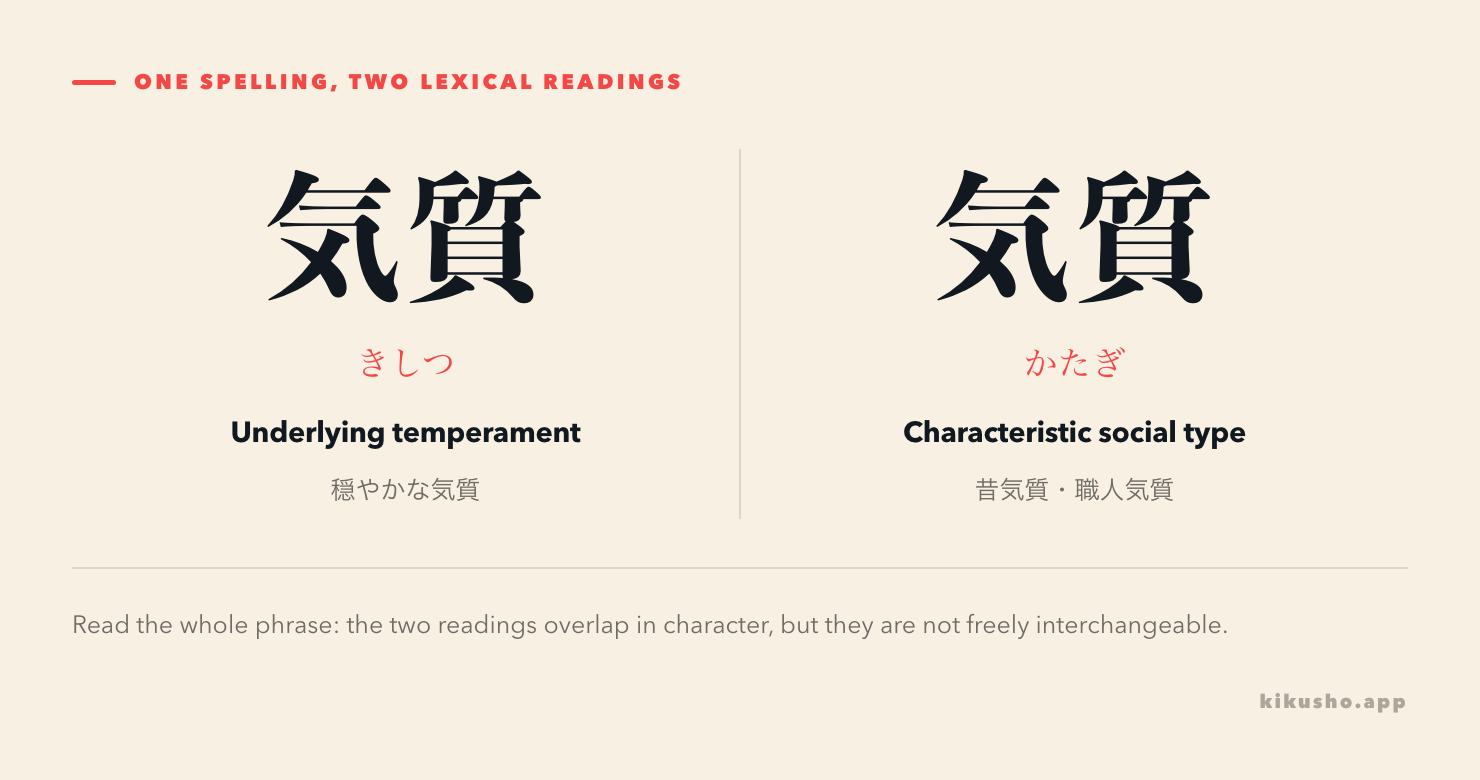
The dictionary entry for 気質 defines きしつ as an innate disposition and also records its technical psychological sense. It is broader in ordinary use, but 生まれながらの気質 and 芸術家気質 can still present a durable bent rather than a passing mood.
気質(かたぎ) has a different center. It commonly follows a profession, social group or era and names the recognizable ethos associated with that type.
祖父は昔気質で、一度交わした約束は必ず守った。
そふは むかしかたぎで、いちど かわした やくそくは かならず まもった。
My grandfather was old-fashioned in character and always kept a promise once made.
Common forms include 職人気質(しょくにんかたぎ), 学者気質(がくしゃかたぎ) and 昔気質(むかしかたぎ). The same dictionary entry explains that かたぎ can work almost like a suffix after a word for status, occupation or age. Do not select the reading from the kanji alone; read the whole compound.
人柄 is socially perceived character; 個性 is distinctiveness
人柄(ひとがら) names the character or personal quality that people perceive through someone's manner and conduct.
面接では、経歴だけでなく、応募者の人柄も見られる。
めんせつでは、けいれきだけでなく、おうぼしゃの ひとがらも みられる。
In an interview, the applicant's character is considered as well as their experience.
Natural patterns include 人柄がいい, 温かい人柄, 人柄が表れる and 人柄にひかれる. Shogakukan's entry includes both the person's nature and the quality or dignity perceived in it. This explains why 人柄 often carries an evaluation rather than serving as a neutral inventory of traits.
個性(こせい) identifies what is distinctive about an individual person, object or work.
全員を同じ型に合わせるより、それぞれの個性を生かしたほうがよい。
ぜんいんを おなじ かたに あわせるより、それぞれの こせいを いかした ほうが よい。
Rather than fitting everyone into the same mold, it is better to make use of each person's individuality.
The 個性 definition centers on a quality that distinguishes one person or thing from others. 個性が強い can be praise, neutral description or mild criticism. The evaluation comes from context. The N3 character lesson separates 性格, 性質 and 特徴; 個性 builds on that foundation by making distinctiveness the point.
誠実 concerns sincerity; 忠実 concerns fidelity
誠実(せいじつ) evaluates the way someone faces a person or matter. The person acts with sincerity and without mixing in selfish deception.
会社は苦情に対して、事実を隠さず誠実に対応した。
かいしゃは くじょうに たいして、じじつを かくさず せいじつに たいおうした。
The company responded to the complaint with integrity and without concealing the facts.
The dictionary definition gives 誠実な人柄 and focuses on approaching people or matters with sincerity rather than self-interest. 誠実な態度, 誠実に答える and 誠実さを示す all preserve that moral evaluation.
忠実(ちゅうじつ) needs an object of fidelity. A person may be faithful to a duty, and a representation may stay close to a source or fact.
この翻訳は、読みやすさよりも原文に忠実であることを優先している。
この ほんやくは、よみやすさよりも げんぶんに ちゅうじつで あることを ゆうせんしている。
This translation prioritizes fidelity to the original text over ease of reading.
The 忠実 entry records both 職務に忠実な人 and exact reproduction without alteration, as in 原文に忠実な翻訳. Its common reading here is ちゅうじつ. The same spelling has the separate native reading まめ, but that is not the assigned record.
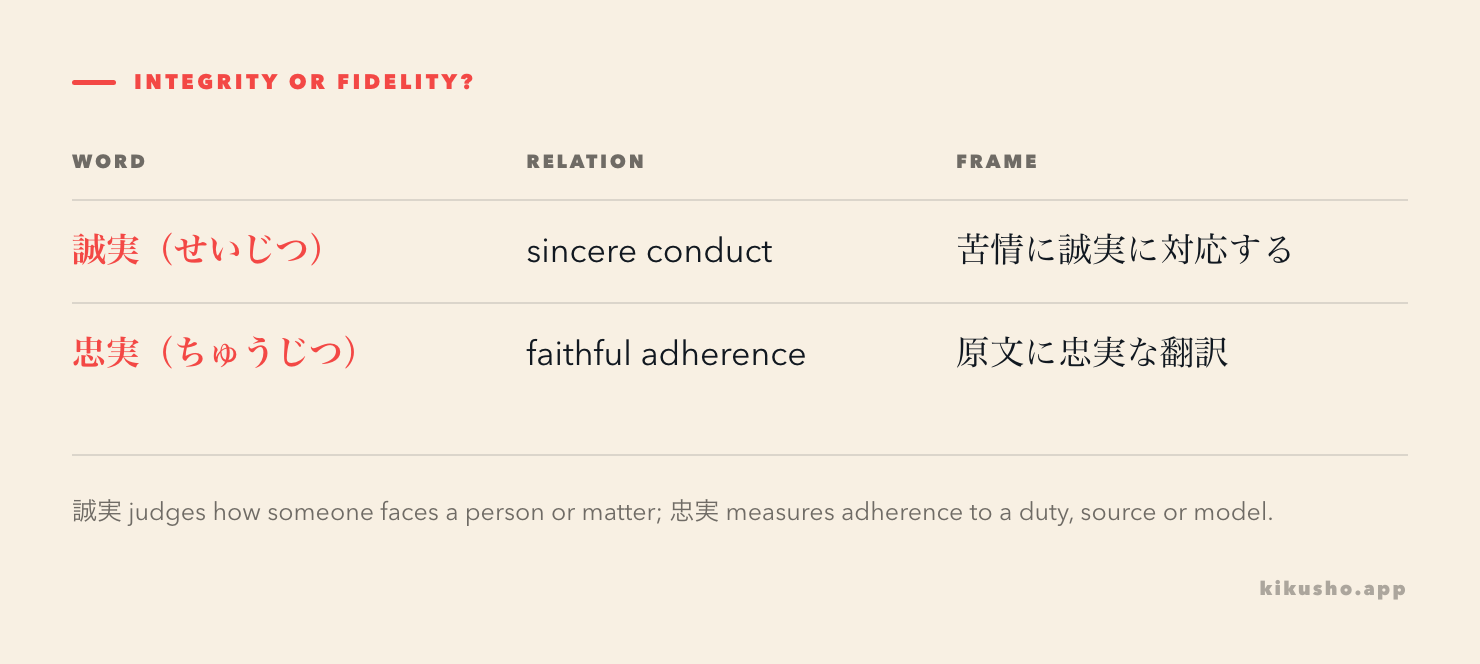
The N1 storytelling vocabulary lesson uses 原作に忠実 for an adaptation that follows its source. Calling that film 誠実 would judge its makers' sincerity, not its closeness to the original work.
勤勉 sustains effort; 軽率 skips necessary thought
勤勉(きんべん) describes steady application to work or study.
彼は勤勉な研究者で、毎日の観察記録を欠かさない。
かれは きんべんな けんきゅうしゃで、まいにちの かんさつきろくを かかさない。
He is a diligent researcher who never fails to keep a daily observation record.
The dictionary entry defines it through sustained effort in work or study and gives 勤勉な学生. It does not mean that every result is good; it evaluates the continuing effort.
軽率(けいそつ) evaluates an act performed without enough thought.
事実を確認せずに名前を公表したのは、軽率な判断だった。
じじつを かくにんせずに なまえを こうひょうしたのは、けいそつな はんだんだった。
Publishing the name without checking the facts was a rash decision.
Shogakukan gives 軽率な判断 and explicitly sets the word against 慎重. This makes 軽率 the negative counterpart to the careful process taught at N3. It targets insufficient consideration, not a person's speed by itself.
頑固 resists change, even when resistance is costly
頑固(がんこ) describes a person who does not readily alter an idea or attitude.
新しい証拠を示されても、彼は頑固に自説を変えなかった。
あたらしい しょうこを しめされても、かれは がんこに じせつを かえなかった。
Even after being shown new evidence, he stubbornly refused to change his position.
The word often criticizes inflexibility. It is not a neutral substitute for 意志が強い, which can praise determination. A National Diet Library reference answer summarizes dictionary evidence that 頑固 pushes one idea or attitude through despite outside influence.
The adjective also extends beyond people. 頑固な汚れ is grime that resists removal, and 頑固な症状 can describe a persistent symptom. The common thread is resistance to change, not a human personality in every sentence.
無邪気 can praise innocence or expose naivety
無邪気(むじゃき) first suggests an absence of ill intent or artifice.
子どもたちは結果を気にせず、無邪気に雪の中で遊んでいた。
こどもたちは けっかを きにせず、むじゃきに ゆきの なかで あそんでいた。
The children played innocently in the snow without worrying about the outcome.
It can also describe a childlike, unaffected charm: 無邪気な笑顔. Yet the same word may criticize insufficient thought.
その技術には危険もあるのに、便利さだけを無邪気に信じるべきではない。
その ぎじゅつには きけんも あるのに、べんりさだけを むじゃきに しんじるべきでは ない。
The technology also carries risks, so we should not naively believe only in its convenience.
The 無邪気 entry records all three directions: no malice or artifice, childlike charm, and lack of sufficient thought. The subject and consequences decide whether the tone is affectionate or critical.
One recommendation reveals all ten distinctions
Read this recommendation for a craft workshop. Notice that the writer can value a person's integrity while criticizing one decision.
佐藤さんは昔気質の職人で、やや頑固な面もあるが、穏やかな気質と温かい人柄で周囲から信頼されている。勤勉で、仕事には常に誠実に向き合い、伝統的な技法にも忠実だ。一方、以前は若手の個性を十分に生かさず、無邪気な提案を軽率に退けてしまうことがあった。最近はその点を反省し、まず理由を聞くようにしている。
さとうさんは むかしかたぎの しょくにんで、やや がんこな めんも あるが、おだやかな きしつと あたたかい ひとがらで しゅういから しんらいされている。きんべんで、しごとには つねに せいじつに むきあい、でんとうてきな ぎほうにも ちゅうじつだ。いっぽう、いぜんは わかての こせいを じゅうぶんに いかさず、むじゃきな ていあんを けいそつに しりぞけてしまうことが あった。さいきんは その てんを はんせいし、まず りゆうを きくようにしている。
Sato is an old-school craftsperson. Although somewhat stubborn, Sato is trusted for a calm temperament and warm character. Sato works diligently, approaches the work with integrity and stays faithful to traditional techniques. In the past, however, Sato did not make enough use of younger workers' individuality and sometimes dismissed their innocent proposals rashly. Recently, Sato has reflected on that and now asks for the reasoning first.
The passage does not flatten Sato into a single trait. 人柄 reports the character perceived by others, 個性 belongs to the younger workers, 誠実 evaluates Sato's stance toward work, and 忠実 measures adherence to a technique. 頑固 and 軽率 identify limitations that can change.
N1 placement is supported but remains editorial
Kikusho's September 2026 inventory places all ten spelling-and-reading records at N1, with no disagreement inside its two related Waller-derived snapshots. That agreement is useful but not independent confirmation. Current N1 character lessons from JNews and PassJapanese confirm recurring study demand for this field, while current N1 indexes independently include several assigned headwords.
The JLPT official FAQ does not offer a current exhaustive word list. Treat N1 as a study placement. What the exam can test is the reading that the sentence selects, the collocation that makes the meaning precise, and the difference between near neighbors.
In Kikusho, keep the complement on the card. Save 原文に忠実, not just 忠実; 昔気質, not an isolated かたぎ; and 軽率に退ける, not only “rash.” The phrase preserves the exact judgment you will need to recall.
Practice: read the relationship around the word
Complete all ten questions before opening the answer panel.
1 · Two readings. Which reading completes 昔気質?
- カ むかしきしつ
- キ むかしかたぎ
- ク むかししつ
- ケ むかしがたき
2 · Temperament. Which sentence naturally uses 気質 with the reading きしつ?
- カ 彼は穏やかな気質の持ち主だ。
- キ この翻訳は原文の気質だ。
- ク 申請書を気質に提出した。
- ケ その汚れは気質で落ちない。
3 · Character or individuality. Fill both blanks in order.
手紙には彼女の温かい( 前 )が表れ、独特な言葉選びには作家としての( 後 )が出ている。
- カ 前:個性 / 後:人柄
- キ 前:人柄 / 後:個性
- ク 前:気質 / 後:勤勉
- ケ 前:忠実 / 後:軽率
4 · Sincerity or fidelity. Which sentence evaluates closeness to a source rather than moral integrity?
- カ 顧客の不安に誠実に答えた。
- キ 誤りを認める誠実な態度だった。
- ク 原文に忠実な翻訳を目指した。
- ケ 彼女の誠実な人柄が伝わった。
5 · Work and study. Which form completes the sentence?
毎日欠かさず資料を整理する( )な学生だ。
- カ 勤勉
- キ 軽率
- ク 無邪気
- ケ 忠実に
6 · Insufficient thought. A spokesperson releases an unverified name and later apologizes. Which word evaluates the decision itself?
- カ 個性
- キ 人柄
- ク 勤勉
- ケ 軽率
7 · Resistance to revision. Which continuation best matches 頑固?
- カ 新しい証拠を見て、すぐ考えを改めた。
- キ 説明を聞かず、自分の考えを変えなかった。
- ク 毎日同じ時間に研究を続けた。
- ケ 子どものように悪気なく笑った。
8 · Tone in context. In 危険を考えず、技術の便利さを無邪気に信じている, how is 無邪気 being used?
- カ As praise for accurate reproduction
- キ As a neutral label for temperament
- ク As criticism of naive, insufficient thought
- ケ As praise for diligent work
9 · Correct frame. Which phrase is grammatically and semantically natural?
- カ 個性に生かす
- キ 人柄を忠実する
- ク 軽率の判断
- ケ 職務に忠実な人
10 · Read the recommendation. Which sequence matches the writer's judgments?
彼は毎日努力を続け、苦情には真心をもって対応したが、確認前に結論を公表した。
- カ 勤勉 → 誠実 → 軽率
- キ 無邪気 → 忠実 → 頑固
- ク 個性 → 人柄 → 気質
- ケ 軽率 → 勤勉 → 誠実
Answers and explanations
キ, むかしかたぎ. 気質 takes the lexical reading かたぎ in 昔気質. The expression describes an old-fashioned ethos or type.
カ. 穏やかな気質 uses きしつ for a calm underlying temperament. The other sentences assign 気質 an unsuitable grammatical or semantic role.
キ, 人柄 / 個性. Warm character revealed through conduct is 人柄. Distinctive word choice that marks one writer off from others is 個性.
ク. 原文に忠実 measures fidelity to the original text. The other three sentences evaluate sincere conduct with 誠実.
カ, 勤勉. It is a な-adjective before 学生: 勤勉な学生. The daily sustained effort supplies the meaning.
ケ, 軽率. Publishing before verification is a rash decision made without sufficient thought. The prompt evaluates the act rather than a permanent personality.
キ. Refusing to hear an explanation or revise one's view is the resistance central to 頑固. Steady study is closer to 勤勉, and the last choice points to 無邪気.
ク. The risks make the lack of thought consequential, so 無邪気 is critical here. No malice is implied, but innocence does not excuse the missing caution.
ケ, 職務に忠実な人. 忠実 takes the target of fidelity with に. The other phrases need 個性を生かす, 人柄が表れる and 軽率な判断.
カ, 勤勉 → 誠実 → 軽率. Continuing daily effort is 勤勉, responding with sincerity is 誠実, and announcing a conclusion before checking is 軽率.
Common questions
Why does 気質 have the readings きしつ and かたぎ?
気質(きしつ) means temperament or an underlying emotional disposition. 気質(かたぎ) usually follows a group, profession or era and means its characteristic ethos or type, as in 職人気質 and 昔気質. The readings are established lexical uses and cannot be exchanged freely.
What is the difference between 人柄 and 個性?
人柄 is the character or personal quality that others perceive through someone's conduct. 個性 is the distinctive quality that separates a person, work or style from others. 人柄 often invites a social evaluation, while 個性 foregrounds uniqueness.
What is the difference between 誠実 and 忠実?
誠実 describes dealing with a person or matter sincerely and without selfish deception. 忠実 describes faithful service to a duty or accurate adherence to a source, fact or model, as in 原文に忠実な翻訳.
Is 無邪気 always positive?
No. It can warmly describe innocence, lack of ill intent or a child's unaffected charm. It can also criticize someone for lacking sufficient thought about consequences, so the surrounding evaluation matters.