On this page
Nine N3 words turn on one question: is a thing what it appears to be? Three of them name what is real — 本当(ほんとう), 真理(しんり)and 本物(ほんもの)— at three different sizes. 姿(すがた)names how something looks before you have decided. 誤り(あやまり)and 間違い(まちがい)name getting it wrong. And 明確(めいかく), 微妙(びみょう)and 確かめる(たしかめる)are the words for how sure you are and how you find out.
Learned one flashcard at a time, these scatter into unrelated lists. Learned together, they line up along a single scale, from a claim that is perfectly clear down to one that is plainly wrong, and the scale is what tells you which word a sentence wants.
Why these nine belong together
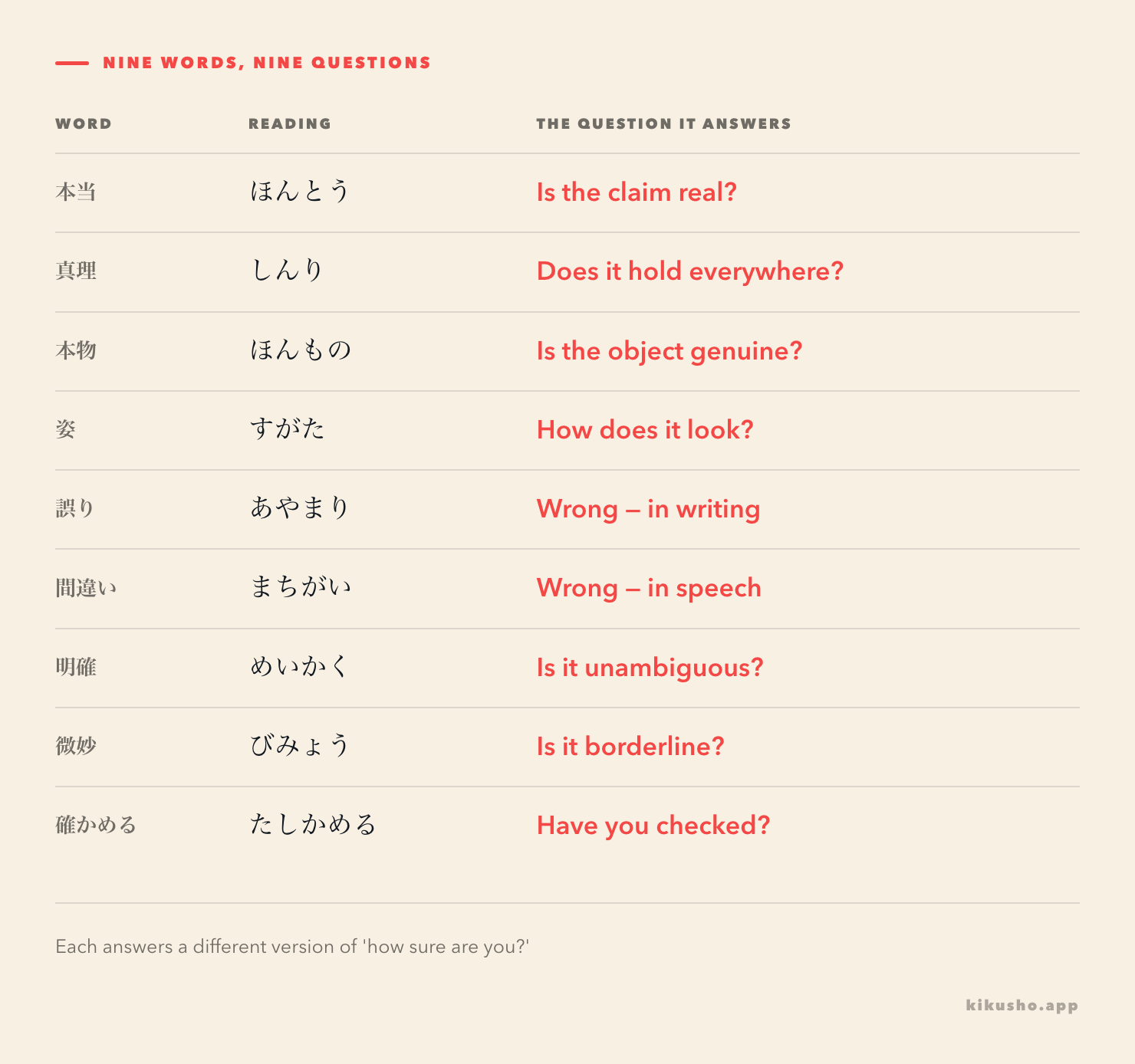
Read the set as answers to different versions of "how certain?" 本当 asks whether a claim is real. 真理 asks whether something holds everywhere, not just here. 本物 asks whether an object is genuine rather than a copy. 明確 asks whether a statement is unambiguous. 微妙 marks the place where you cannot yet say. 確かめる is the action that moves a doubt toward an answer, and 誤り and 間違い name where the answer came out wrong. 姿 sits slightly apart: it is the visible form you are judging, before any verdict at all.
| Word | Reading | Part of speech | Core sense | A collocation to learn |
|---|---|---|---|---|
| 本当 | ほんとう | noun, な-adjective | true, real (of a claim or fact) | 本当のことを言う, tell the truth |
| 真理 | しんり | noun | a truth that holds universally | 真理を追求する, pursue the truth |
| 本物 | ほんもの | noun | the genuine article | 本物のダイヤ, a genuine diamond |
| 姿 | すがた | noun | figure, form, appearance | 姿が見えない, be nowhere in sight |
| 誤り | あやまり | noun | error, incorrectness (written) | 誤りを認める, admit an error |
| 間違い | まちがい | noun | mistake, mix-up (everyday) | 間違いを直す, fix a mistake |
| 明確 | めいかく | な-adjective, noun | clear, unambiguous | 明確な答え, a clear answer |
| 微妙 | びみょう | な-adjective, noun | subtle; (spoken) iffy | 微妙な違い, a subtle difference |
| 確かめる | たしかめる | transitive verb | to make sure, to check | 事実を確かめる, verify the facts |
Two of the nine carry a level dispute worth naming. 本当 is tagged N5 on some lists and N3 on others, because the plain "really?" is beginner Japanese while its fuller range is not. 真理 is placed at N1 by several lists and at N3 by this one; it is the most formal word in the group, and you will read it long before you say it.
The three words that all land on "real"
English reaches for true, real or genuine here, and Japanese keeps three separate words that do not swap.
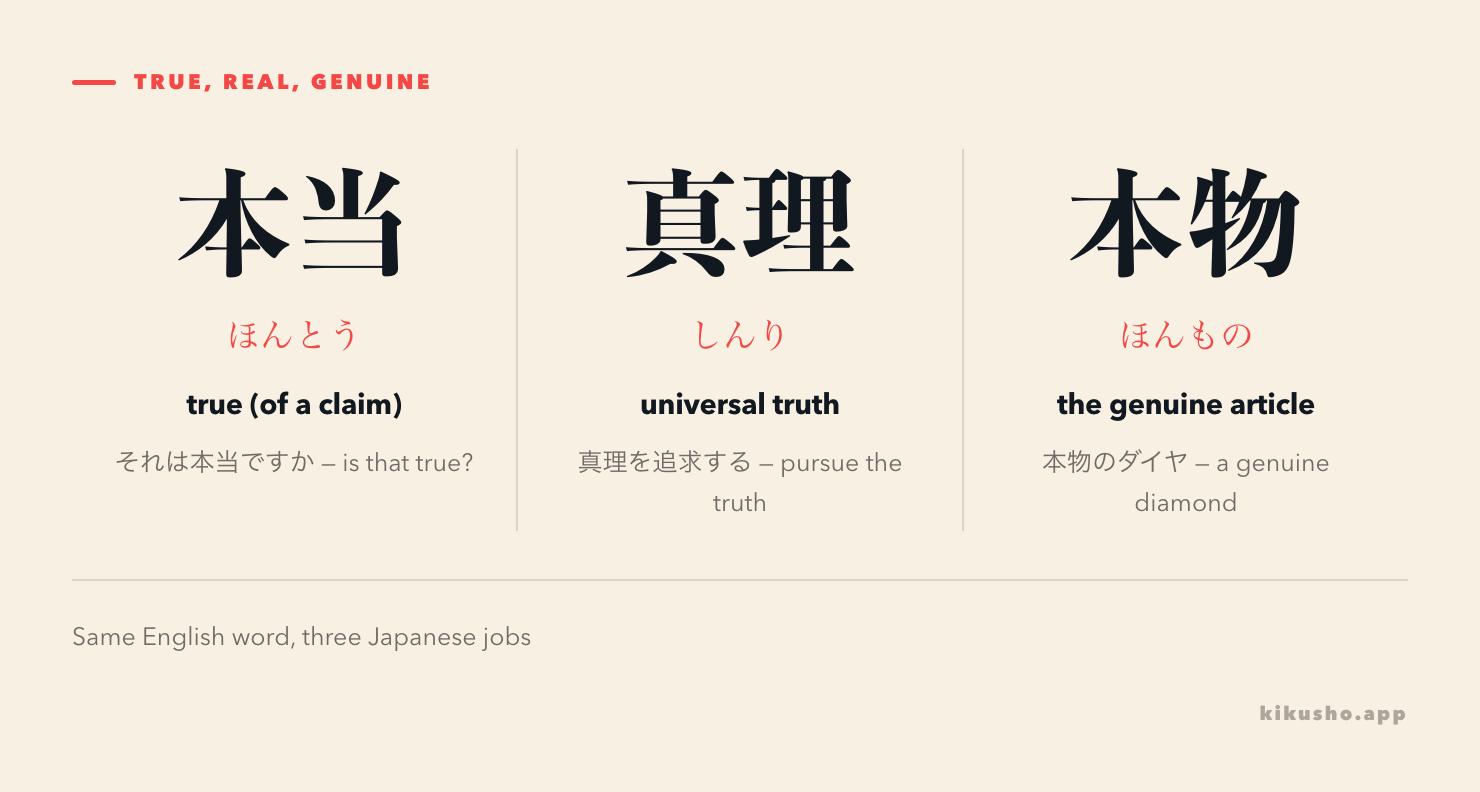
本当 is the everyday one, for whether a claim or a situation is real. それ、本当ですか is "is that true?"; 本当のことを言う is "tell the truth". As a な-adjective it gives 本当の気持ち, one's real feelings. In speech the reading often shortens to ほんと, as in ほんと? or ほんとに, though you write ほんとう.
真理 is a truth that holds beyond the moment: the kind science or philosophy pursues. 真理を追求する is "to pursue the truth"; 普遍の真理 is "a universal truth". You would never ask a friend 「今の話、真理?」— that job belongs to 本当. This abstract weight is why some lists file 真理 at N1.
本物 is about objects, not claims. 本物のダイヤ is a genuine diamond, as opposed to a fake, 偽物(にせもの). It stretches to people and skills — 本物の実力 is "the real deal" — but the test is always whether the thing is genuine rather than a copy.
姿 is the appearance, before any verdict
姿(すがた)is the visible form of a person or thing: the figure you see. 姿が見えない means someone is nowhere in sight; 姿を消す is "to disappear"; 後ろ姿 is a figure seen from behind. Attached to clothing it says how someone is dressed — 着物姿 is "in a kimono".
The reason it belongs with the truth words is that 姿 carries no claim about what is real. It is only how a thing presents itself, which is exactly the thing you then check against reality. A convincing 姿 can be a 本物 or a fake; the word itself stays neutral, and Japanese has whole grammar patterns for judging how something looks against what it is.
誤り and 間違い are one mistake in two registers
Both words nominalise a verb — 誤り from 誤る, 間違い from 間違う — and both translate as "mistake". What separates them is register, not meaning.
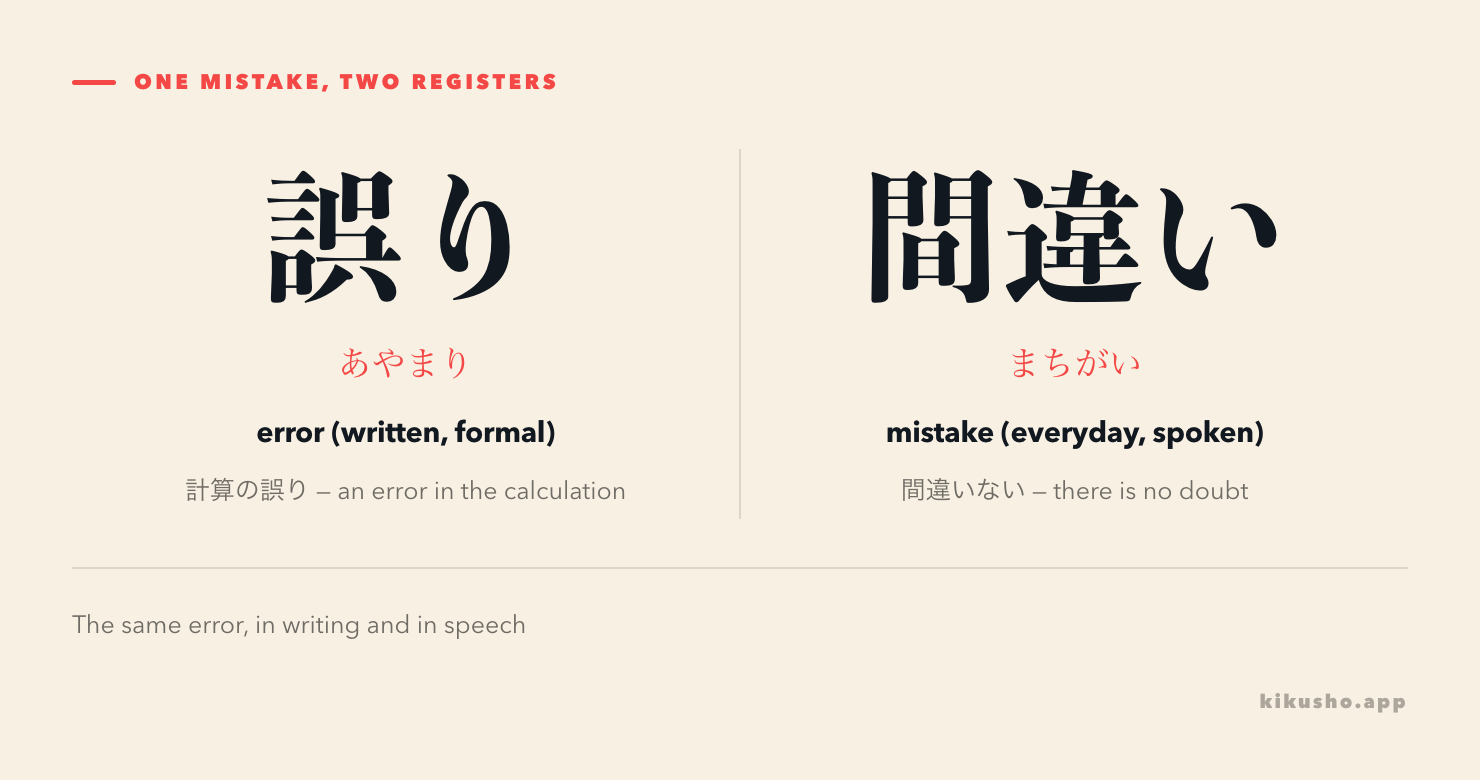
誤り is the written word. It suits an error of fact, calculation or logic, and the settings where those are discussed: reports, papers, technical work. 誤りを認める is "to admit an error"; 計算の誤り is "an error in the calculation"; 誤りを正す is "to correct a mistake". A Japanese usage guide sums the split up as 間違い for the spoken language and 誤り for the written, with 誤り leaning toward the abstract and the formal.
間違い is the everyday word, for concrete mix-ups, and it is what you say out loud. 間違いを直す is "to fix a mistake"; 計算間違い is "a miscalculation". It also owns a fixed phrase 誤り cannot take: 間違いない, "there is no doubt", and its adverb 間違いなく, "without fail" — the same "no mistake" that runs through にちがいない for near-certainty.
One caution that has nothing to do with either: 誤り shares its reading, あやまり, with 謝り, from 謝る, "to apologise". Same sound, unrelated word, decided entirely by the kanji.
明確, 微妙, and the verb between them
Two adjectives mark the ends of the certainty scale, and one verb is how you travel it.
明確 is clear, unambiguous, well-defined. It is a な-adjective: 明確な指示 is "clear instructions", 目標を明確にする is "to make a goal clear", 明確に答える is "to answer clearly". Its opposite is 不明確. Note that 明確 never means "to clarify" as a verb on its own; that idea is carried by the する-noun 明確化. Some word lists gloss it loosely as "clarify", but the word you learn is the adjective.
微妙 starts as subtle, delicate, fine: 微妙な違い is "a subtle difference", 微妙なバランス is "a delicate balance". In casual speech it has become a soft, negative verdict as well — close to "iffy" or "not great". Ask a friend how a new restaurant was and 「微妙だった」means it did not impress them, without their having to say so outright. The two senses do not clash; both describe something that resists a clean yes.
確かめる is the transitive verb that moves a matter from 微妙 to 明確. 事実を確かめる is "to verify the facts"; 予約が取れているか確かめる is "to check whether the booking went through". It takes を or a か-clause, and it is the deliberate act of checking, not the passive state of being sure. It grows out of 確か, the N4 adjective for being certain, from the same theme one level down, where 間違える and 正しい also live. How sure you end up is then a matter for the adverbs of probability, which grade the answer once you have it.
These are context words more than list words. 微妙 flips its meaning with the situation; the 誤り-or-間違い choice is a read on register; 本当 shortens to ほんと the moment you speak it. A flashcard can hold the reading, but the pull of the word lives in the sentence you met it in. This is the case Kikusho is built for: point the camera at a line, say it, or paste it, and the card comes back with the reading, the meaning and the nuance a dictionary skips, plus a played example — so 微妙 arrives attached to the message where a friend actually used it, not stranded on a blank field. The scheduling and the audio then work offline, on the five free captures a day you keep for the words you truly meet.
Which of the nine you will meet first
They do not arrive at the same rate. 本当 and 間違い are constant in speech from your first week, and 微妙 is close behind in any casual message. 明確 and 確かめる belong to instructions and work — a task made 明確, a fact you 確かめる before acting. 本物 shows up the moment something might be fake. 誤り and 真理 you will mostly read before you ever say them, one in reports and the other on the page of an argument. And 姿, the odd one out, hides in set phrases and description: a person whose 姿 you cannot find, a figure seen from behind. Learn them in that order of encounter and the scale teaches itself, one real sentence at a time.
Practice
Attempt all five before opening the answers.
1. Reading. 「目標を明確にする。」The reading of 明確 is: ① めいかく ② めいがく ③ みんかく ④ めいこく
2. Choose the word for the blank. 「博物館で( )の土器を見た。二千年前のものだそうだ。」 ① 本当 ② 真理 ③ 本物 ④ 姿
3. Closest in meaning. A friend says of a new shop, 「あそこ、微妙だったよ。」Here 微妙 is closest to: ① とてもおいしい ② 細かい点まで正確だ ③ あまりよくない ④ 値段が高い
4. Which sentence uses 確かめる naturally? ① 空が急に確かめて、雨が降ってきた。 ② 予約が取れているか、窓口で確かめた。 ③ 明日の予定はまだ確かめだ。 ④ 星が夜空で確かめている。
5. Closest in meaning. 「彼が来ることは間違いない。」 ① 来るかどうかわからない ② きっと来る ③ 来ないだろう ④ 来てほしい
Answers and explanations
1. ① めいかく. 明 takes めい and 確 takes かく, giving めいかく. The other options mis-voice or mis-read one of the two characters; 明確 has no reading with が, みん or こく.
2. ③ 本物. 本物の土器 is "a genuine pot", the real thing rather than a reproduction, which the second sentence confirms. 本当 marks a claim as true, not an object as genuine; 真理 is abstract universal truth; 姿 is a visible figure or form, not authenticity.
3. ③ あまりよくない. In casual speech 微妙 is a soft negative verdict, so 「微妙だった」means the shop did not impress. ② 細かい点まで正確だ leans on the literal "subtle/precise" idea, but that is not what the friend means here. ① and ④ invent a positive review or a price the sentence never states.
4. ②. 確かめる is a transitive verb meaning "to make sure", taking を or a か-clause: 予約が取れているか確かめる, check whether the booking went through. ① and ④ use it as if it described weather or stars acting on their own, which it cannot; ③ treats it as a な-adjective, where Japanese would use 未定 or 不確か.
5. ② きっと来る. 間違いない means "there is no doubt", so the sentence asserts he will certainly come. ① states the opposite by making it uncertain; ③ denies it; ④ turns a statement of certainty into a wish.
Common questions
Is 本当 an N5 word or an N3 word?
Both. Everyday 本当 (ほんとう) — "really?", "is that true?" — is met very early, and vocabulary lists tag it N5. Its fuller range as a noun and な-adjective meaning genuine, proper or correct is where lists also place it at N3, which is why you see the same word on two levels.
What is the difference between 誤り and 間違い?
They share a meaning, "mistake" or "error", but not a register. 誤り (あやまり) is the written, formal word for an incorrectness of fact, calculation or logic; 間違い (まちがい) is the everyday spoken word for a mix-up, and it owns the fixed phrase 間違いない, "there is no doubt".
Does 微妙 mean "subtle" or "not good"?
Both, depending on register. The dictionary sense of 微妙 (びみょう) is subtle, delicate or fine, as in 微妙な違い, a subtle difference. In casual speech it is also a soft, negative verdict close to "iffy" or "not great", as in answering 「どう?」with just「微妙…」.
Why is 真理 sometimes listed as N1 rather than N3?
真理 (しんり) is the abstract, universal kind of truth that science or philosophy pursues, and it is more formal and literary than everyday 本当. Some vocabulary lists place it at N1 for that reason; this lesson follows the N3 placement while noting the disagreement.