On this page
拝啓 at the top of a letter and 敬具 near its end tell you how the document addresses its reader. Advanced keigo vocabulary also includes ご無沙汰 for a lapse in contact, 賜る for respectful giving or humble receiving, and 拝借 for humble borrowing: five expressions whose setting matters as much as their English gloss.
This N1 vocabulary set assumes you can already follow respectful and humble actions. It adds letter conventions and particular lexical choices to that foundation. None of the five is an adverb, and they do not all work as replacements for a plain verb.
Five expressions that place the writer in a relationship
A greeting can acknowledge a past relationship. A verb can present support as something received with deference. An opening formula can identify a document as a letter before its first complete sentence. Those are different jobs, even when they occur on the same page.
| Expression | Reading | Part of speech | Sense and useful combination |
|---|---|---|---|
| 拝啓 | はいけい | Noun used as a fixed opening formula | Respectful letter opening; commonly paired with 敬具 |
| 敬具 | けいぐ | Noun used as a fixed closing formula | Respectful letter ending; commonly follows an opening 拝啓 |
| ご無沙汰 | ごぶさた | Noun; combines with する | A lapse in visits or correspondence; ご無沙汰しております |
| 賜る | たまわる | Transitive godan verb | Bestow, respectfully; receive, humbly; 褒美を賜る / ご支援を賜る |
| 拝借 | はいしゃく | Noun; transitive する-verb | Borrowing, humbly; 辞書を拝借する |
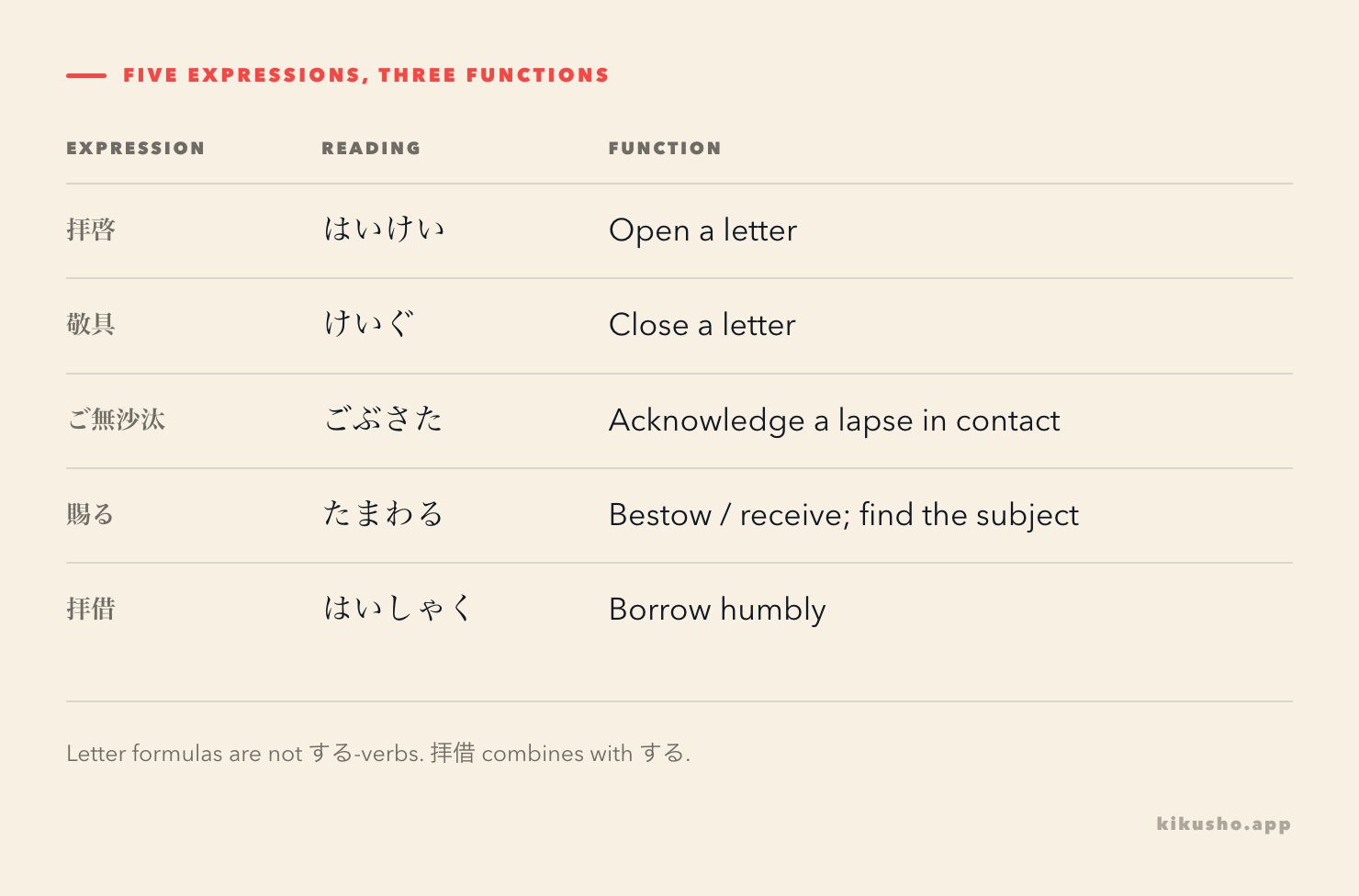
The noun labels for 拝啓 and 敬具 describe dictionary classification. On the page, learn them as independent formulas rather than trying to attach です or する. Their placement carries their function.
The planning inventory places all five at N1, using Jonathan Waller's vocabulary family. Its two adapted lists share ancestry. Bunpro's 拝啓 entry and 拝借 entry instead show N2; 敬具 shows N1. The lesson's N1 category is a study destination, not evidence that these words first become useful at N1. There is no exhaustive official JLPT vocabulary syllabus.
The letter frame and the contact history do different work
拝啓 and 敬具
拝啓(はいけい) opens the letter respectfully. 敬具(けいぐ) supplies its closing formula. Japan Post's opening-and-closing guide lists this familiar pairing; other suitable pairings exist, so “the only possible combination” would be too strong.
Here is a shortened teaching excerpt, not a complete postal layout:
拝啓
その後、お元気でお過ごしでしょうか。
……
敬具
Reading of the complete sentence: そのご、おげんきでおすごしでしょうか。
“Have you been keeping well since then?”
The two formulas function roughly like an English salutation and “Yours sincerely.” They do not themselves name the recipient. Keep the recipient's name and address separate from learning what these formulas mean. This excerpt also leaves out the main message, date, signature and other layout elements.
The Kyoiku Shuppan letter guide distinguishes the opening, introductory greetings, main message, concluding greeting and closing formula. That separation helps you read a long letter: an opening greeting has not yet told you its business.
Ordinary business email usually skips 拝啓・敬具. A formal letter attached to an email can still follow a letter's conventions. Indeed Japan's editorial guide makes this distinction. Do not add the pair to a brief scheduling reply solely because the recipient is senior.
ご無沙汰
ご無沙汰(ごぶさた) acknowledges that you have not visited, written or otherwise kept in touch for a while. 御無沙汰 is another spelling. The lapse belongs to an existing relationship; it is not a generic word for being busy or a substitute for introducing yourself.
長らくご無沙汰しております。来月、そちらに伺う予定です。
ながらくごぶさたしております。らいげつ、そちらにうかがうよていです。
“It has been a long time since I was last in touch. I plan to visit you next month.”
Here, 長らく emphasizes the long interval, ご無沙汰 names the neglected contact, and しております supplies the deferential ending. The next sentence finally gives the new information. Shogakukan's dictionary entry verifies the reading, noun-plus-する pattern and apologetic greeting use.
If you have never contacted the person, there is no previous correspondence to resume. A direct introduction such as 初めてご連絡いたします(はじめてごれんらくいたします), “I am contacting you for the first time,” fits that history instead. This contrast concerns the relationship, not a contest between more and less elaborate endings.
Two action words require you to identify the actor
賜る
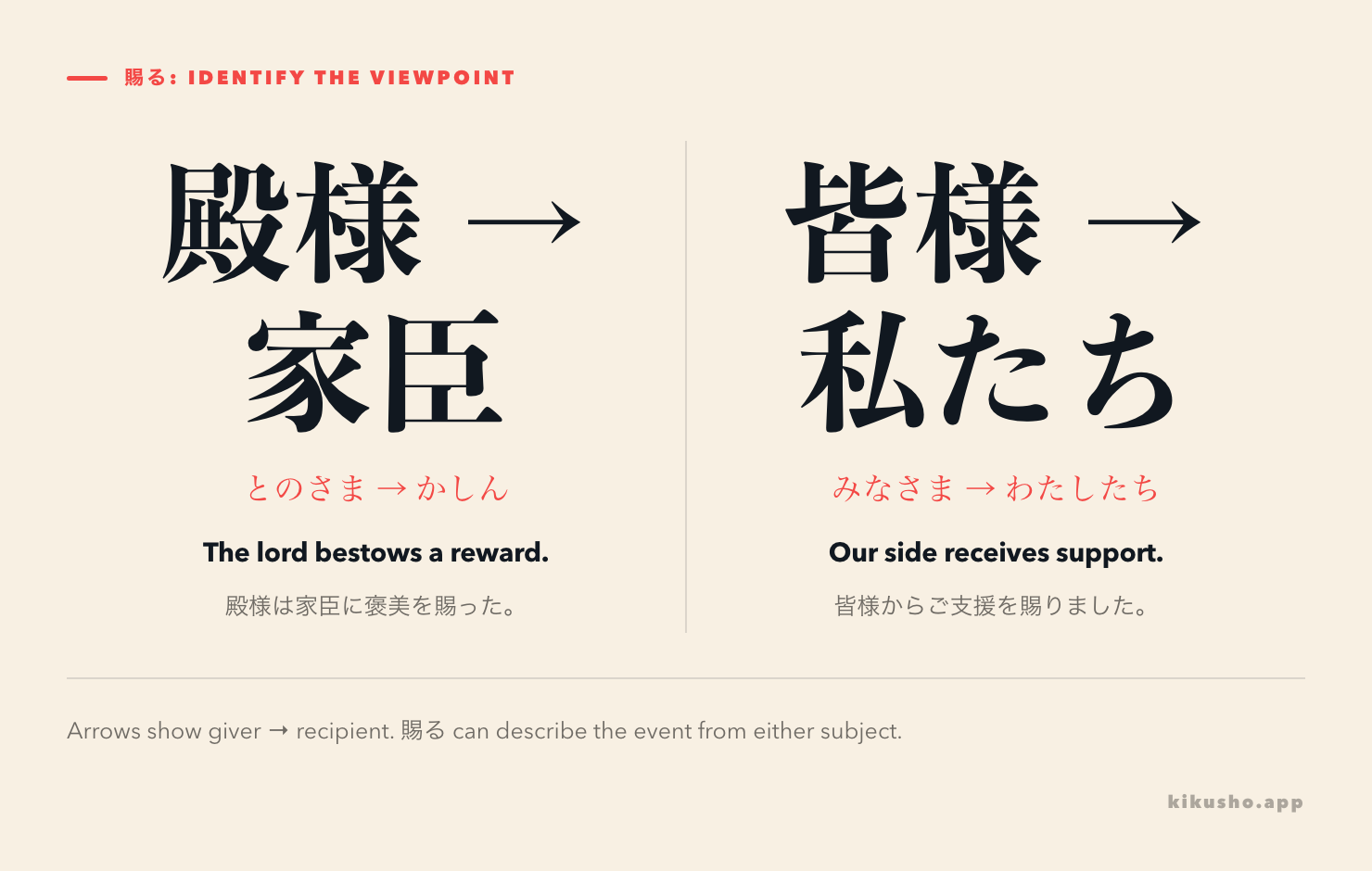
賜る(たまわる) has two directions. The respectful bestow sense takes a respected giver as its subject. In a constructed elevated narrative about a lord and retainer:
殿様は家臣に褒美を賜った。
とのさまはかしんにほうびをたまわった。
“The lord bestowed a reward on his retainer.”
殿様 gives; 家臣 receives. This is the “grant, bestow” sense retained in the inventory. Recognize its elevated narrative setting rather than replacing every everyday あげる with 賜る. Shogakukan's 賜る entry distinguishes this respectful giving sense from humble receiving and identifies a godan verb.
The humble receive sense puts the recipient in the subject position. A formal acknowledgment can say:
皆様からご支援を賜り、心より感謝申し上げます。
みなさまからごしえんをたまわり、こころよりかんしゃもうしあげます。
“We are deeply grateful for the support we have received from you all.”
The omitted subject is the writer's side. 皆様から identifies the source, and ご支援 names what that side received. Shueisha's independently published dictionary entry confirms the たまわる reading and receiving sense. Compare the familiar direction of くださる and いただく before tackling the same surface form with two viewpoints.
Keep these inflected forms beside the dictionary form: 賜ります(たまわります), 賜り(たまわり), 賜った(たまわった), 賜って(たまわって). The る ending does not make it ichidan. In particular, the connective 賜り in a thank-you sentence is not a separate noun for “gift.”
拝借
拝借(はいしゃく) names borrowing with humility. Add する for the action; the borrowed thing takes を. A respectful request to use someone's dictionary can be:
こちらの辞書を拝借してもよろしいでしょうか。
こちらのじしょをはいしゃくしてもよろしいでしょうか。
“May I borrow this dictionary?”
The speaker would be the borrower. The request seeks permission; humility alone does not establish that permission has already been given. Shogakukan's 拝借 entry identifies the humble borrowing sense and noun-plus-する pattern. It can also be figurative, as when asking for someone's wisdom.
This word is usable in a formal spoken request as well as writing. It does not respectfully describe a teacher borrowing from you merely because a teacher appears in the sentence. Start by finding the borrower, then decide whose action you intend to present humbly.
Which expressions to collect from your own correspondence
For a letter, notice the opening and closing together. For a renewed contact, preserve the previous relationship in your note. For 賜る, preserve enough surrounding text to identify the giver and recipient. A one-word translation would discard the distinction the verb asks you to recover.
In Kikusho, a copied sentence from a formal message can become a text capture. Before saving the resulting card, use its editable register note to record “our side receives support” or “the lord grants a reward,” whichever the sentence says. That gives a future review a concrete direction to retrieve.
A ところを preface adds a different detail: it acknowledges the other person's circumstances before a request or thanks. It remains a separate construction rather than a sixth member of this word set.
Practice questions
Attempt the whole exercise before scrolling to the solutions. These six questions are original practice for readings, contextual meaning, paraphrase and usage; they are not official exam items.
Question 1
Select the reading of 拝借 in this request: この本を拝借してもよろしいでしょうか。
A. はいけい
B. はいしゃ
C. はいしゃく
D. けいぐ
Question 2
A former colleague writes after several years: 長らくご無沙汰しております。 What does the opening acknowledge?
A. A long interval without keeping in contact.
B. A first introduction to an unknown recipient.
C. An intention to borrow an object.
D. The end of a formal letter.
Question 3
Choose the closest paraphrase of 皆様からご支援を賜りました in a message from an organization to its supporters.
A. 私たちは皆様に支援を与えました。
B. 私たちは皆様の支援を断りました。
C. 私たちは皆様の支援を待っています。
D. 私たちは皆様から支援をいただきました。
Question 4
A writer chooses 拝啓 as the opening of an ordinary formal letter. Which of this set's expressions supplies its matching closing formula?
A. 拝借
B. 敬具
C. ご無沙汰
D. 賜る
Question 5
An elevated story says 殿様は家臣に褒美を賜った。 Which account matches this action?
A. The retainer lent a reward to the lord.
B. The lord received a reward from the retainer.
C. The lord bestowed a reward on the retainer.
D. The retainer resumed correspondence with the lord.
Question 6
A student asks a professor for permission to borrow the professor's dictionary. Select the sentence that presents the student's borrowing humbly.
A. 先生の辞書を拝借してもよろしいでしょうか。
B. 先生が私の辞書を拝借してもよろしいでしょうか。
C. 先生の辞書を拝啓してもよろしいでしょうか。
D. 先生の辞書を敬具してもよろしいでしょうか。
Answers and explanations
Answer 1
Reading: はいしゃく, choice C. Retain the final く when pronouncing 拝借. A is 拝啓's reading, D belongs to 敬具, and B omits 拝借's final く. The sentence requests permission to borrow the book.
Answer 2
A. ご無沙汰 acknowledges a lapse in contact with someone already known. B contradicts the former-colleague setting. C concerns 拝借; D describes 敬具's function. 長らく emphasizes the interval without specifying an exact number of years.
Answer 3
D. The organization received support from 皆様. いただきました preserves that direction and the completed action. A reverses the giver and recipient; B turns receipt into refusal; C says support is still awaited. The から phrase is decisive here.
Answer 4
B. 敬具. This is the conventional closing paired with 拝啓. The other three choices are taught elsewhere in the set, but none is a letter-closing formula. Suitable alternatives outside this exercise exist; the question does not claim 敬具 is the only possible closing in Japanese.
Answer 5
C. 殿様 is the subject, 家臣に identifies the recipient, and 褒美 is the reward bestowed. This sentence uses 賜る's respectful giving sense. B describes the opposite direction. A invents borrowing, and D introduces a contact history absent from the sentence.
Answer 6
A. The student's omitted “I” is the borrower, and 先生の辞書 is the borrowed object. B changes the actor to the professor and the dictionary's owner to the student; it also uses the humble borrowing term for the wrong action in this setting. C and D turn letter formulas into invented する-verbs.
Common questions
Are 拝啓 and 敬具 required in Japanese business emails?
They are opening and closing formulas for a letter. Ordinary business email usually omits them, although an attached formal letter can retain its letter format. A polite message does not automatically need this pair.
Does 賜る mean to give or to receive?
Both senses exist. With a respected giver as subject, it can mean to bestow. With the recipient as subject, it humbly means to receive from someone respected. Identify the subject and the source or recipient before translating it.
Are these words exclusively N1 vocabulary?
No. This lesson uses the N1 placement of the Waller-family reference inventory. Bunpro places 拝啓 and 拝借 at N2 and 敬具 at N1. These are study estimates, and the JLPT does not publish an exhaustive official vocabulary syllabus.