On this page
Japanese cooking instructions distinguish 揚げる (fry), 炒める (stir-fry), 茹でる (boil food in water), 煮る (cook in liquid), 蒸す (steam) and 炊く (cook rice or other grains). Pair those methods with ingredient names and flavour descriptions, and a recipe becomes a sequence of actions rather than a collection of translations of “cook”.
These words connect the ingredients, preparation and meal
This N3 vocabulary set teaches 22 spelling-and-reading entries. Some name what goes into a dish, some specify what you do to it, and others describe its flavour or your appetite. Three reading boundaries also matter: 注ぐ has two readings for pouring, 生 has separate なま and せい entries, and 辛い(つらい) does not describe spicy flavour.
Start from the N4 kitchen words 米, 味噌, 味, 苦い and 焼く. Those remain prerequisites, rather than additional words claimed by this lesson. The N5 ingredients and taste lesson supplies the culinary 辛い(からい) and 薄い that help with comparisons below.
Level boundaries: Kikusho's September 2026 inventory places these entries in its N3 section, but its retained lists disagree. 揚げる, 酢, 炊く, 煮る, 混ぜる, 剥く and 蒸す also appear at N2; 炒める and 茹でる also appear at N1. The two baseline lists descend from Jonathan Waller's vocabulary collection and count as one source family. Agreement between them is not independent confirmation. A separately published JapaneseTest4You page labels 辛い(つらい) N3, but that does not establish every word's placement or the provenance of its list. The JLPT has no official exhaustive vocabulary syllabus.
Retain the word class and a phrase you can use
The tables separate the senses taught here from broader dictionary entries. A liquid oil in a pan is the intended 油 sense; an aroma from dinner is the intended 香り sense. None of those choices claims to exhaust the word.
Ingredients, flavour and appetite
| Word | Reading | Class | Meaning here | Useful phrase |
|---|---|---|---|---|
| 油 | あぶら | noun | oil | 油を入れる: add oil |
| 栄養 | えいよう | noun | nutrition, nourishment | 栄養のバランス: nutritional balance |
| 香り | かおり | noun | aroma, pleasant scent | チーズの香り: the aroma of cheese |
| 濃い | こい | i-adjective | strong or concentrated in flavour | 味が濃い: the flavour is strong |
| 材料 | ざいりょう | noun | ingredients; materials more broadly | 材料を用意する: prepare the ingredients |
| 食欲 | しょくよく | noun | appetite | 食欲がある: have an appetite |
| 酢 | す | noun | vinegar | 酢を少し入れる: add a little vinegar |
| チーズ | ちーず | noun | cheese | チーズを切る: cut the cheese |
| 豆 | まめ | noun | beans or peas | 豆を煮る: cook beans in liquid |
材料 does not mean only food: the same noun can name materials for making something. In a recipe, its surrounding actions select “ingredients”. Likewise, 豆 is a category, not the name of one particular bean. チーズ keeps its long vowel: チズ loses a sound from the word.
栄養 and 食欲 answer different questions. 栄養のバランスを考えます。(えいようのバランスをかんがえます。) means “I consider nutritional balance.” 今日は食欲がありません。(きょうはしょくよくがありません。) means “I have no appetite today.” One concerns nourishment; the other concerns wanting to eat. Neither sentence diagnoses an illness or makes a claim about how nutritious a particular food is.
Preparation and pouring
All the verbs below are taught in their transitive kitchen senses: someone acts on a food or liquid. An ichidan verb drops its final る for the polite stem; a godan verb changes its final syllable.
| Word | Reading | Class | Meaning here | Useful phrase |
|---|---|---|---|---|
| 揚げる | あげる | ichidan verb | fry in hot oil | 鶏肉を揚げる: fry chicken |
| 炒める | いためる | ichidan verb | stir-fry, sauté | 野菜を炒める: stir-fry vegetables |
| 炊く | たく | godan verb | cook grains, especially rice | ご飯を炊く: cook rice |
| 煮る | にる | ichidan verb | cook in liquid; simmer, stew | 豆を煮る: simmer beans |
| 混ぜる | まぜる | ichidan verb | mix, stir together | 酢と油を混ぜる: mix vinegar and oil |
| 剥く | むく | godan verb | peel; remove a skin or shell | じゃがいもの皮を剥く: peel potatoes |
| 蒸す | むす | godan verb | steam food | 野菜を蒸す: steam vegetables |
| 茹でる | ゆでる | ichidan verb | boil food in water | 麺を茹でる: boil noodles |
| 注ぐ | そそぐ | godan verb | pour liquid | カップにお湯を注ぐ: pour hot water into a cup |
| 注ぐ | つぐ | godan verb | pour into a container, often when serving | お茶をつぐ: pour tea |
With polite endings, compare 煮ます(にます), 蒸します(むします) and 注ぎます(そそぎます/つぎます). The shared kanji in the last pair does not make the spoken forms identical. Writing つぐ in kana can preserve the intended reading when context would allow either.
The cooking method selects the verb
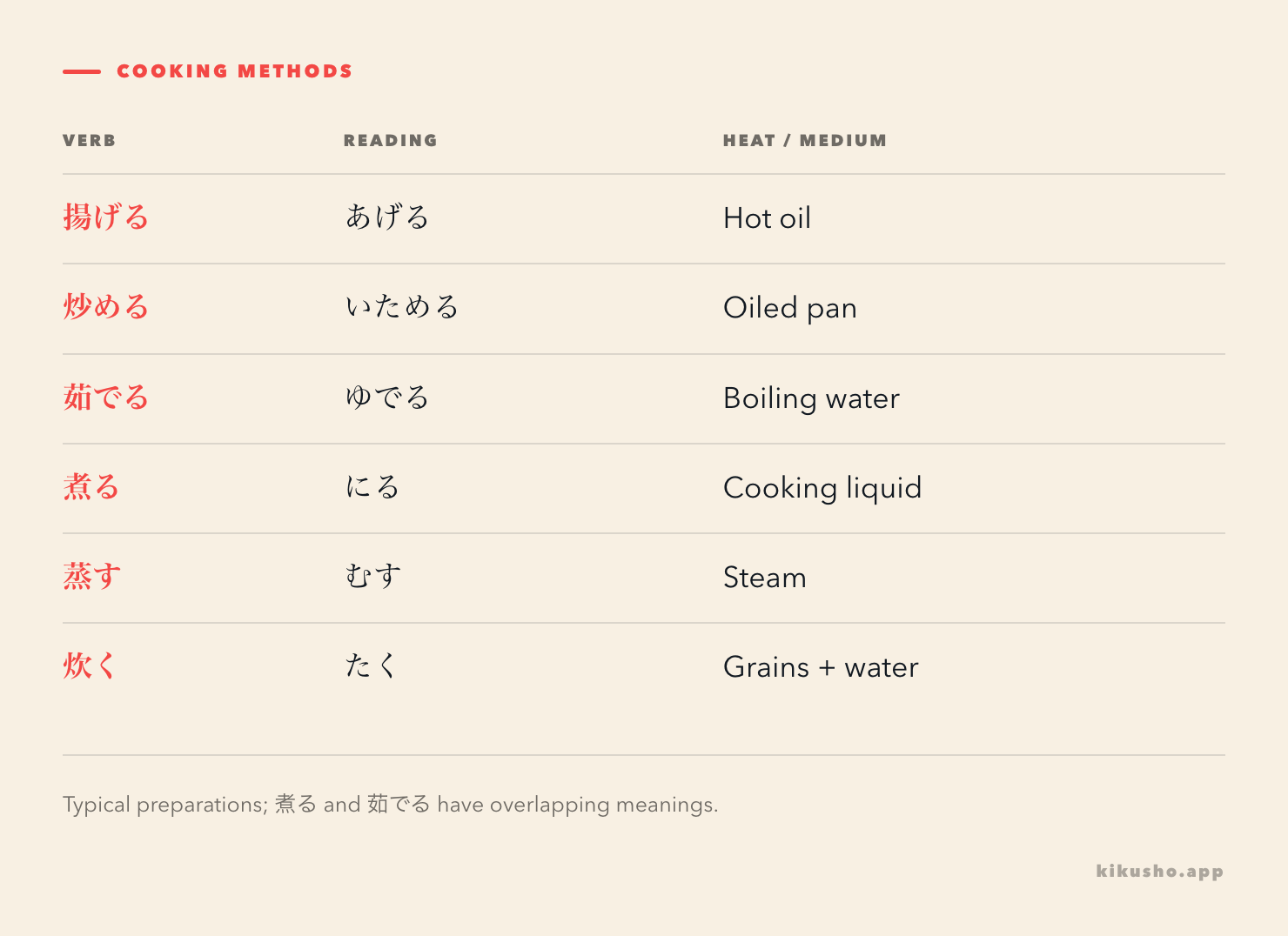
揚げる and 炒める both use oil, but a stir-fry is not the same preparation as deep-fried chicken. 混ぜる supplies mixing without promising heat: you can mix a dressing in a cold bowl. 蒸す puts steam to work rather than immersing the food in water.
茹でる and 煮る overlap in the broad idea of heating food in liquid. A noodle instruction typically uses 茹でる; a recipe for fish simmered with soy sauce typically uses 煮る. Treat that as a practical recipe distinction. Do not turn it into “茹でる never involves salt” or “煮る always takes longer”. The source definitions do not support those absolutes.
炊く is especially useful with rice. ご飯を炊きます。(ごはんをたきます。) means “I cook rice.” Daijisen also records a western Japanese use for simmering vegetables, so “炊く can only have rice as its object” would be too strict. Learn the central collocation first, then recognise the regional extension when it appears.
One dressing gives several of the nouns a sentence:
材料は酢と油です。よく混ぜます。
ざいりょうはすとあぶらです。よくまぜます。
The ingredients are vinegar and oil. Mix them well.
For the flavour, このソースは味が濃いです。(このソースはあじがこいです。) means “This sauce has a strong flavour.” 濃い describes intensity or concentration here, rather than automatically calling something spicy, delicious or physically thick. A thin liquid can still have a strong flavour.
Three reading boundaries prevent the wrong meaning
生(なま) and 生(せい) are separate entries
| Word | Reading | Class | Sense and collocation |
|---|---|---|---|
| 生 | なま | noun / descriptive word | raw, unprocessed: 生の野菜, raw vegetables; 生で食べる, eat raw |
| 生 | せい | noun | life, living: 生を受ける, be born; 生と死, life and death |
| 辛い | つらい | i-adjective | painful, distressing, hard to endure: 辛い経験, a painful experience |
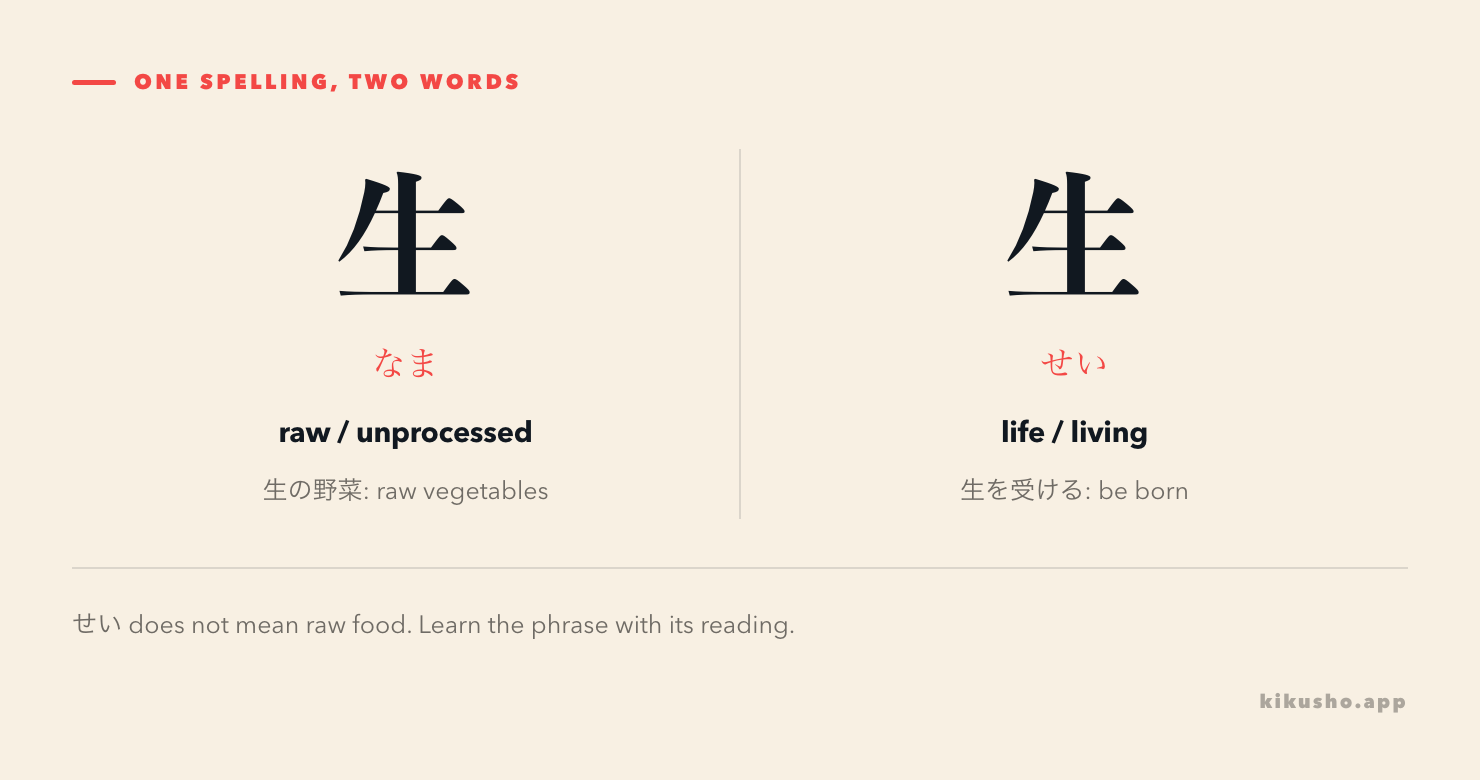
生の野菜が好きです。(なまのやさいがすきです。) means “I like raw vegetables.” なま is the food reading in this phrase. In an appropriate drinks context, 生 can also abbreviate draft beer; it does not make every appearance of the character a beer order.
せい belongs outside the culinary pattern. この町で生を受けました。(このまちでせいをうけました。) means “I was born in this town.” 生を受ける is a more literary expression than ordinary 生まれる. This entry appears in the assigned set, so its genuine sense is shown rather than replaced with a convenient food translation. One retained source row attaches the raw/draft gloss to せい incorrectly; Daijisen's separate なま and せい definitions resolve the reading and sense.
辛い(つらい) describes difficulty, not spicy flavour
毎日の長い通勤が辛いです。(まいにちのながいつうきんがつらいです。) means “The long commute every day is hard on me.” The adjective describes a burdensome experience. It does not turn 通勤 into a flavour.
For spicy curry, the familiar reading is からい: 辛いカレー(からいカレー). The dictionary distinguishes these adjective readings. The つらい entry is taught here as a boundary; からい remains the earlier lesson's food adjective. English “bitter” can describe emotional suffering, but that does not make つらい interchangeable with the taste adjective 苦い.
注ぐ(そそぐ/つぐ) overlaps when serving drinks
カップにお湯を注ぎます。(カップにおゆをそそぎます。) means “I pour hot water into the cup.” 父にお茶をつぎます。(ちちにおちゃをつぎます。) means “I pour tea for my father.” Here カップに names the destination, while 父に names the recipient.
Both readings can express pouring a drink into a container. Do not invent a water-versus-tea rule. そそぐ has broader meanings, including a river flowing into a bay and directing effort toward something; the dictionary's つぐ entry is narrower. Those broader uses cannot all be transferred merely because the two verbs share a spelling. The N3 lesson on polysemous verbs develops the habit of retaining an object and sense together with other headwords.
A recipe and a package give you different words to keep
On your next recipe, look for the preparation verb and its food object: 麺を茹でる or 野菜を蒸す gives you an action you can picture. On a shopping package, look instead for the ingredient and its reading. A dinner comment may add 香り, 濃い or 食欲. The menu-reading guide helps separate dish details from portion and price information.
A recipe photo in Kikusho can preserve the exact preparation phrase. Before saving the drafted card, check whether its meaning says frying, steaming or mixing, and whether the reading matches the phrase you photographed. Keeping 生の野菜 together is especially useful: the surrounding noun protects なま from being replaced by an unrelated reading during review.
Practice
Attempt the eight questions as one exercise. The solutions follow the final prompt.
Question 1. In the cooking instruction 野菜を蒸す, how is 蒸す read?
A. むく
B. むす
C. にる
D. たく
Question 2. A recipe's ざいりょう list names what you need to make the dish. Which spelling represents that word?
A. 資料
B. 食欲
C. 材料
D. 栄養
Question 3. You are deep-frying chicken in hot oil, rather than sautéing it in a lightly oiled pan. Complete 鶏肉を__.
A. 揚げる
B. 炒める
C. 茹でる
D. 混ぜる
Question 4. A recipe asks you to simmer fish in a seasoned cooking liquid. Which phrase best states that preparation?
A. 魚の皮を剥く
B. 魚を蒸す
C. 魚を切る
D. 魚を煮る
Question 5. After smelling dinner, you want to eat. Complete いい香りで、__が出てきました with the word for appetite.
A. 酢
B. 食欲
C. 栄養
D. チーズ
Question 6. このソースは味が濃いです most directly says which of the following?
A. The sauce has a strong flavour.
B. The sauce contains raw vegetables.
C. The sauce is necessarily spicy.
D. The sauce has been steamed.
Question 7. Which sentence uses 生 read せい in the life/birth sense?
A. 生の野菜を買いました。
B. この魚は生で食べます。
C. 生を一杯注文しました。[draft beer]
D. 私はこの町で生を受けました。
Question 8. Which reading and meaning fit 辛い in 毎日の長い通勤が辛いです?
A. からい: spicy
B. にがい: bitter in flavour
C. つらい: hard to endure
D. こい: concentrated
Answers and explanations
Answer 1: B. 蒸す is むす, steaming the vegetables. むく is the peeling verb 剥く, にる is 煮る and たく is 炊く. Similar short readings still belong to different preparations.
Answer 2: C. 材料 is ざいりょう, ingredients in this recipe. 資料 is しりょう, reference material or data. 食欲 names appetite, and 栄養 names nutrition. They are real words, but neither spells the requested headword.
Answer 3: A. 揚げる identifies frying in hot oil. 炒める would describe the pan preparation explicitly excluded by the prompt. 茹でる uses boiling water, while 混ぜる says mix without establishing any cooking method. The stated technique makes one answer fit.
Answer 4: D. 魚を煮る matches simmering fish in liquid. 剥く removes a skin, 蒸す cooks with steam and 切る means cut. The question describes the preparation, rather than asking which actions could ever be performed on fish.
Answer 5: B. 食欲が出てきました says an appetite has developed. 香り supplies the pleasant smell in the opening phrase. 栄養 concerns nourishment; 酢 and チーズ are ingredients. None of those three names the desire to eat.
Answer 6: A. 味が濃い describes strong flavour. That can accompany sweetness, saltiness or other flavours; it does not force the spicy reading of option C. Rawness and steaming are separate claims the sentence does not make.
Answer 7: D. 生を受ける reads せいをうける and expresses being born. In A and B, raw food takes なま; in C the stated draft-beer context also takes なま. The spelling alone does not choose the sense. Option D is a life expression, not a culinary use of せい.
Answer 8: C. A burdensome commute is 辛い(つらい), hard to endure. からい supplies the spicy food reading in the comparison, while にがい and こい are readings of different adjectives. The context is about the experience of commuting.
Common questions
How are 煮る and 茹でる different?
茹でる describes cooking food in boiling water, as with noodles. 煮る describes heating food in liquid and commonly appears in simmering or stewing recipes. Their meanings overlap; the recipe helps identify the intended preparation. Cooking time or salt alone supplies no absolute rule.
Does 生 always mean raw and read なま?
No. 生(なま) can describe raw or unprocessed food, but 生(せい) is a separate noun meaning life or living. 生を受ける uses せい and means to be born. Other compounds have further readings.
Are these words officially assigned to JLPT N3?
N3 is the lesson's study placement. The JLPT publishes no exhaustive vocabulary syllabus, and the dated reference lists disagree on several words here. Dictionaries verify readings and meanings, rather than exam placement. This page identifies its scope and the level disagreements.