
On this page
差し支える, 取り組む, 控える and 踏まえる become much easier when you learn the noun and particle beside each verb. The useful unit is not an English gloss such as “handle” or “consider,” but a frame such as 仕事に差し支える, 課題に取り組む or 結果を踏まえる.
These four verbs appear in reports, meetings, notices and careful conversation. Their kanji look concrete: support, combine, hold back, step on. Current use has carried each one into an abstract pattern that the surrounding phrase makes visible.
Why these four verbs belong together
Each verb asks you to identify a relationship. Something interferes with an activity. A person engages with a task. Someone holds back an action, records a detail or has an event close ahead. A decision rests on evidence.
The table gives the bounded senses taught here. Godan and ichidan identify conjugation classes. “Intransitive” matters for 差し支える because the hindrance is the subject, while the affected activity is marked by に.
| Headword | Reading and class | Frame to retrieve | Meaning in that frame |
|---|---|---|---|
| 差し支える | さしつかえる; ichidan, intransitive | A は B に差し支える | A interferes with B |
| 取り組む | とりくむ; godan, intransitive | 課題に取り組む | tackle or work seriously on a task |
| 控える | ひかえる; ichidan, transitive or intransitive | 酒を控える / 要点を控える / 試験を来週に控える | limit; note; have close ahead |
| 踏まえる | ふまえる; ichidan, transitive | 結果を踏まえる | use results as a basis; take them into account |
This is a context lesson, not a claim that these are the only senses. The broader guide to learning words in sentences explains why a particle and a partner noun deserve space on the same card.
The set itself: four relationships, not four loose translations
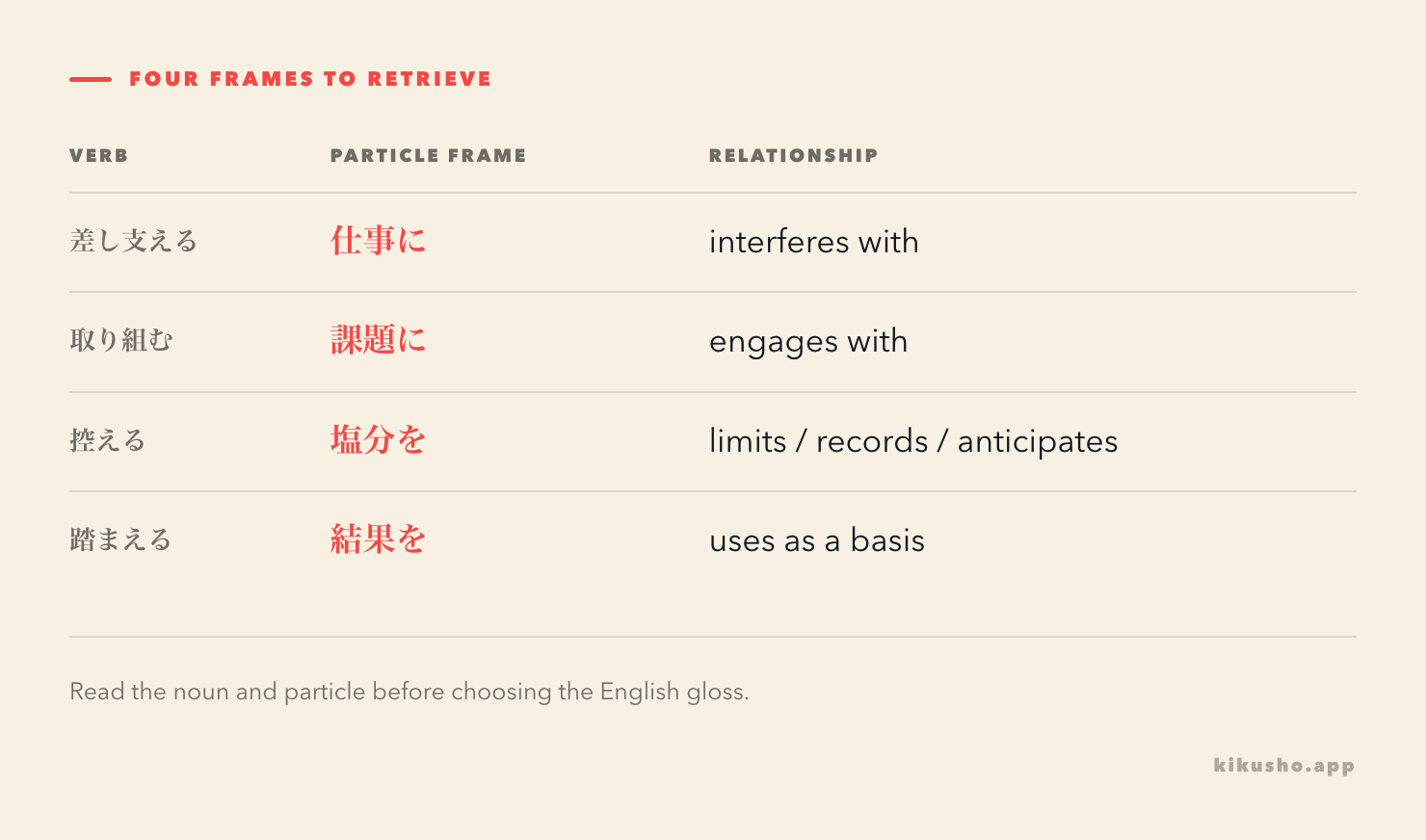
Do not begin by matching the verbs to four English words. Begin with the grammar around the blank. に after a task strongly supports 取り組む. に差し支える needs something that will be negatively affected. を踏まえて needs evidence before it and a reasoned response after it. を控える requires more context because the same shape can express restraint, recording or an approaching event.
The method is small enough to use while reading:
- Find the particle attached to the nearby noun.
- Name the relationship expressed by the whole clause.
- Test the collocation, rather than translating the verb alone.
差し支える: one thing gets in the way of another
差し支える(さしつかえる) is an intransitive verb. A cause is marked with は or が, and the activity that suffers takes に.
夜更かしは明日の仕事に差し支える。
よふかしは あしたの しごとに さしつかえる。
Staying up late will interfere with tomorrow's work.
The National Institute for Japanese Language and Linguistics entry records this N1 が N2 に pattern and defines the relation as one action causing a bad effect on another. Its example also uses 夜更かし and work. The lexical subject is the hindrance; Japanese does not need to turn it into a person “hindering” somebody.
The negative form often softens a request:
差し支えなければ、お名前を教えてください。
さしつかえなければ、おなまえを おしえてください。
If you do not mind, please tell me your name.
Literally, the condition asks whether giving the name would cause a problem. In careful service language, 差し支えありません likewise means that something presents no obstacle. This polite pattern is useful, but the verb itself is not inherently honorific.
取り組む: engage seriously with a task
取り組む(とりくむ) takes a task, problem or subject with に. It describes active engagement, usually sustained enough to deserve attention.
研究チームは海洋汚染の問題に取り組んでいる。
けんきゅうチームは かいようおせんの もんだいに とりくんでいる。
The research team is tackling the problem of marine pollution.
Shogakukan's Daijisen entry separates the older physical sense of grappling with an opponent from the abstract sense of applying oneself fully to a matter. That physical image helps explain the commitment, but it does not make every modern use dramatic.
Common partners include 課題に取り組む, work on a task; 問題に取り組む, tackle a problem; and 改革に取り組む, pursue reform. Compare 問題について話す, talk about a problem. Talking about it may be brief. 問題に取り組む says that the person or group is trying to deal with it.
控える: the nearby noun selects one of three paths
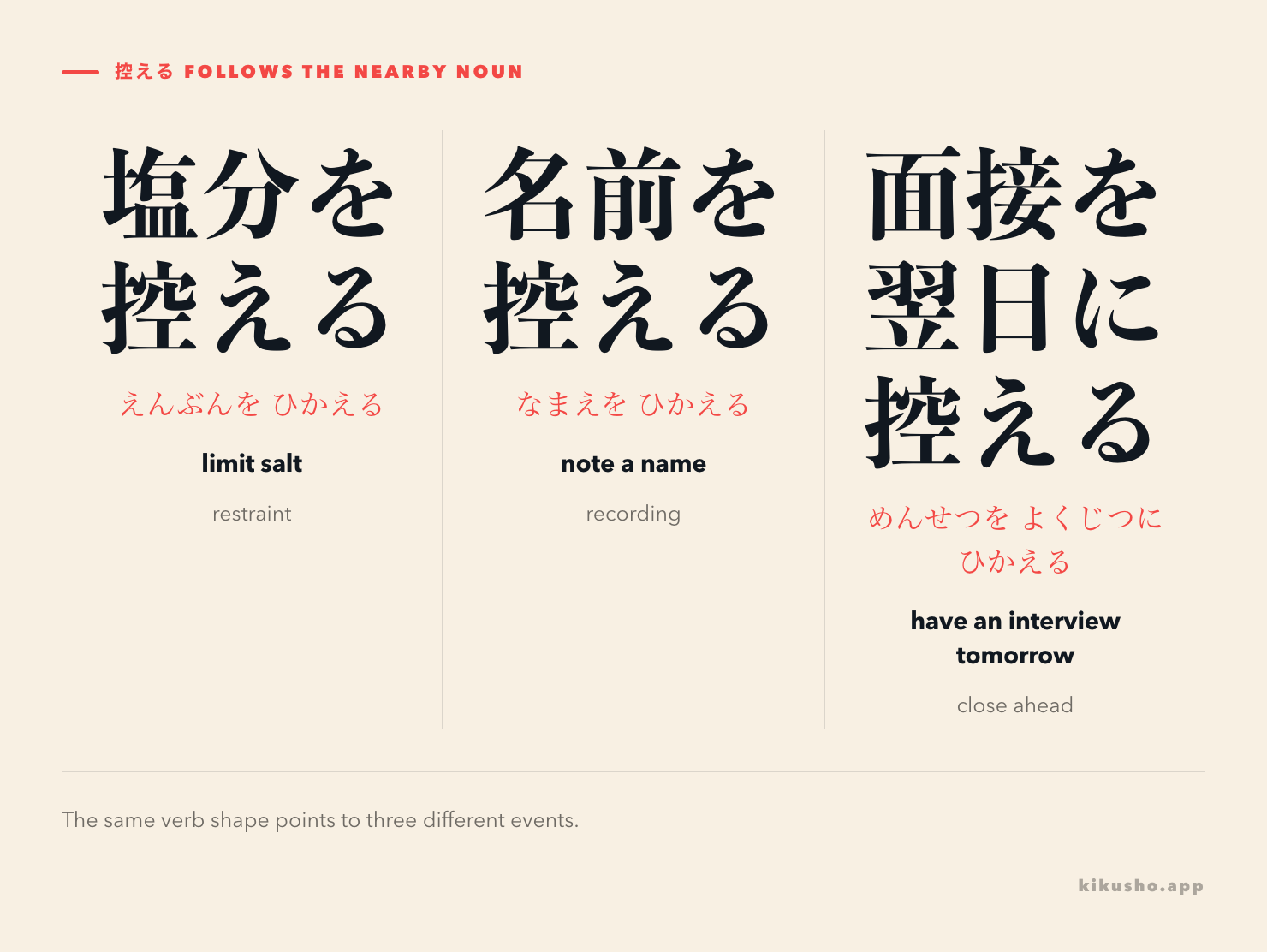
控える(ひかえる) is the member of this set that most resists a one-line translation. Kanjipedia lists four broad ideas: waiting nearby, writing something down, limiting or refraining, and being close in space or time. Three occur often in modern informational prose.
Limit or refrain
医者に勧められて、塩分を控えている。
いしゃに すすめられて、えんぶんを ひかえている。
On my doctor's advice, I am limiting my salt intake.
With food, drink, outings or comments as its object, 控える can mean reducing them or choosing not to do them. Context decides whether the instruction allows a smaller amount or calls for complete abstention. The Daijisen usage note specifically warns that a medical instruction such as お酒を控えてください is normally understood as do not drink, rather than permission to drink a little.
Write down for reference
念のため、担当者の名前を手帳に控えた。
ねんのため、たんとうしゃの なまえを てちょうに ひかえた。
I noted the staff member's name in my notebook, just in case.
The object is information. The destination can appear with に. Nothing is being reduced; the detail is kept so it can be retrieved later.
Have something close ahead
面接を翌日に控え、彼女は早めに帰宅した。
めんせつを よくじつに ひかえ、かのじょは はやめに きたくした。
With the interview the next day, she went home early.
Here the interview is scheduled in the near future. The compact written form N を time に控え often supplies background for the main event. It does not mean she postponed, avoided or wrote down the interview.
踏まえる: let evidence shape what comes next
踏まえる(ふまえる) literally includes a physical sense of planting or pressing a foot. In formal modern prose, N を踏まえる more often means taking N as a basis for a judgment, explanation or action.
利用者の意見を踏まえて、案内表示を改善した。
りようしゃの いけんを ふまえて、あんないひょうじを かいぜんした。
Taking users' comments into account, we improved the signs.
The comments affected the improvement. Daijisen defines this sense as making something a basis for judgment; Kanjipedia independently gives facts and ideas as the grounds for a later action.
This is stronger than merely mentioning a topic. 調査結果について説明した means “explained the survey results.” 調査結果を踏まえて計画を修正した means those results informed the revision. The form ~を踏まえた上で makes the sequence especially explicit: first take the evidence into account, then decide or act.
The pattern that runs through the set
The abstract sense does not live inside the kanji alone. It lives in a recurring relationship:
- A は B に差し支える: A harms the progress or condition of B.
- person が task に取り組む: the person engages seriously with the task.
- person が N を控える: the noun decides whether the person limits, records or anticipates N.
- person が evidence を踏まえる: the evidence becomes a basis for what follows.
That makes particles diagnostic, though never sufficient on their own. 差し支える and 取り組む both appear with に, but the clause around them distinguishes negative impact from deliberate engagement. 控える and 踏まえる both take を, but only 踏まえる requires the object to function as grounds for a later judgment.
If you capture one of these phrases in Kikusho, keep the clause that resolves the sense. A card for 控える with only “hold back” cannot explain an interview scheduled for tomorrow. Save 面接を翌日に控える or paste the complete sentence, then check the editable meaning and example before keeping it.
Which uses you will meet first
In workplace and public writing, 課題に取り組む and 結果を踏まえて are especially productive. They connect a problem or evidence to an institutional response. 差し支えなければ appears in polite requests, while 差し支える also describes practical consequences in ordinary speech.
The three 控える paths reward separate cards because they predict different continuations. A health notice supplies an item to limit. Meeting notes supply information to record. News and formal narration often place an event shortly ahead with N を time に控え.
The Kikusho inventory assigns all four words to N1 using two Waller-derived preparation lists. Those lists belong to one source family, so their agreement is not two independent level judgments. Bunpro currently labels 差し支える and 控える N1, and teaches を踏まえて at N1. These are preparation estimates. The JLPT publishes no exhaustive official word list, and familiar forms may appear before a learner reaches N1.
Practice: seven questions
Complete all seven before checking the answers. These original questions test readings, context, paraphrase and usage; they are not copied from an exam.
Question 1
Choose the reading of the bold word.
睡眠不足は翌日の仕事に差し支える。
- A. さしささえる
- B. さしつかえる
- C. さしひかえる
- D. さしこたえる
Question 2
Select the natural verb for sustained work on the problem.
市はごみの削減という課題に( )。
- A. 踏まえている
- B. 差し支えている
- C. 取り組んでいる
- D. 控えている
Question 3
What does 控える mean in this sentence?
会議中に出た数字を手帳に控えた。
- A. I reduced the figures.
- B. I postponed the meeting.
- C. I noted the figures in my notebook.
- D. I waited behind the notebook.
Question 4
Choose the best completion for a decision based on evidence.
専門家の報告を( )、避難計画を見直した。
- A. 踏まえて
- B. 差し支えて
- C. 控えて
- D. 取り組んで
Question 5
Which paraphrase preserves the meaning?
大会を一週間後に控え、選手たちは練習時間を増やした。
- A. The athletes cancelled the tournament and practised less.
- B. With the tournament one week away, the athletes increased practice time.
- C. The athletes wrote the tournament date in a notebook.
- D. The tournament interfered with every athlete's work.
Question 6
Choose the sentence in which 差し支える is used naturally.
- A. 会社は新しい制度を差し支えている。
- B. 調査結果を差し支えて方針を決めた。
- C. この程度の遅れなら、計画には差し支えない。
- D. 重要な点をノートに差し支えた。
Question 7
Which sentence means that the person is limiting alcohol?
- I. 健康のため、酒を控えている。
- II. 健康のため、酒に取り組んでいる。
- III. 健康のため、酒を踏まえている。
- IV. 健康のため、酒に差し支えている。
Answers and explanations
Answer 1: B. 差し支える is read さしつかえる. 睡眠不足 is the cause and 翌日の仕事に names what will suffer. A replaces つかえる with the separate verb 支える, while C resembles 控える and D invents a reading.
Answer 2: C. 課題に取り組んでいる describes sustained engagement with the waste-reduction task. 踏まえる would need evidence marked with を, 差し支える would describe interference, and 控える does not mean tackle a task.
Answer 3: C. 数字を手帳に控えた means writing the figures down for reference. The notebook phrase makes the recording sense clear. Nothing in the sentence says that the figures were reduced or that the meeting was postponed.
Answer 4: A. 報告を踏まえて makes the expert report the basis for reviewing the evacuation plan. 取り組む would take a task with に. 差し支える expresses a harmful effect, while 控える would require a different relationship.
Answer 5: B. 大会を一週間後に控え places the tournament one week ahead as background for the increased practice. It does not say the event was cancelled, merely recorded or interfering with work.
Answer 6: C. 計画には差し支えない means the delay will not interfere with the plan. A needs 取り組む for working on a system, B needs 踏まえる for using results as grounds, and D needs 控える for noting an important point.
Answer 7: I. 酒を控えている means reducing or abstaining from alcohol for health. II frames alcohol as a task to tackle. III treats it as evidence for a judgment. IV has neither the correct particle frame nor the intended meaning.
Common questions
What is the difference between 差し支える and 控える?
差し支える is intransitive and describes one thing interfering with another, as in 夜更かしは仕事に差し支える. 控える has several patterns: 酒を控える means limit or avoid alcohol, 要点を控える means note the main points, and 試験を来週に控える places an exam in the near future.
Which particle does 取り組む take?
A task normally takes に: 問題に取り組む means tackle a problem. The verb implies sustained, serious engagement, so it is stronger than merely touching or mentioning a topic.
What does ~を踏まえて mean?
~を踏まえて means using a fact, result or experience as a basis for what follows. 調査結果を踏まえて計画を修正した means the survey results informed the revision; it does not merely say that the results were mentioned.
Are these four verbs officially assigned to JLPT N1?
No official exhaustive JLPT vocabulary list exists. The Kikusho reference inventory places all four at N1 because two Waller-derived preparation lists agree, while the usage claims on this page are checked against Japanese dictionaries and teaching references.