On this page
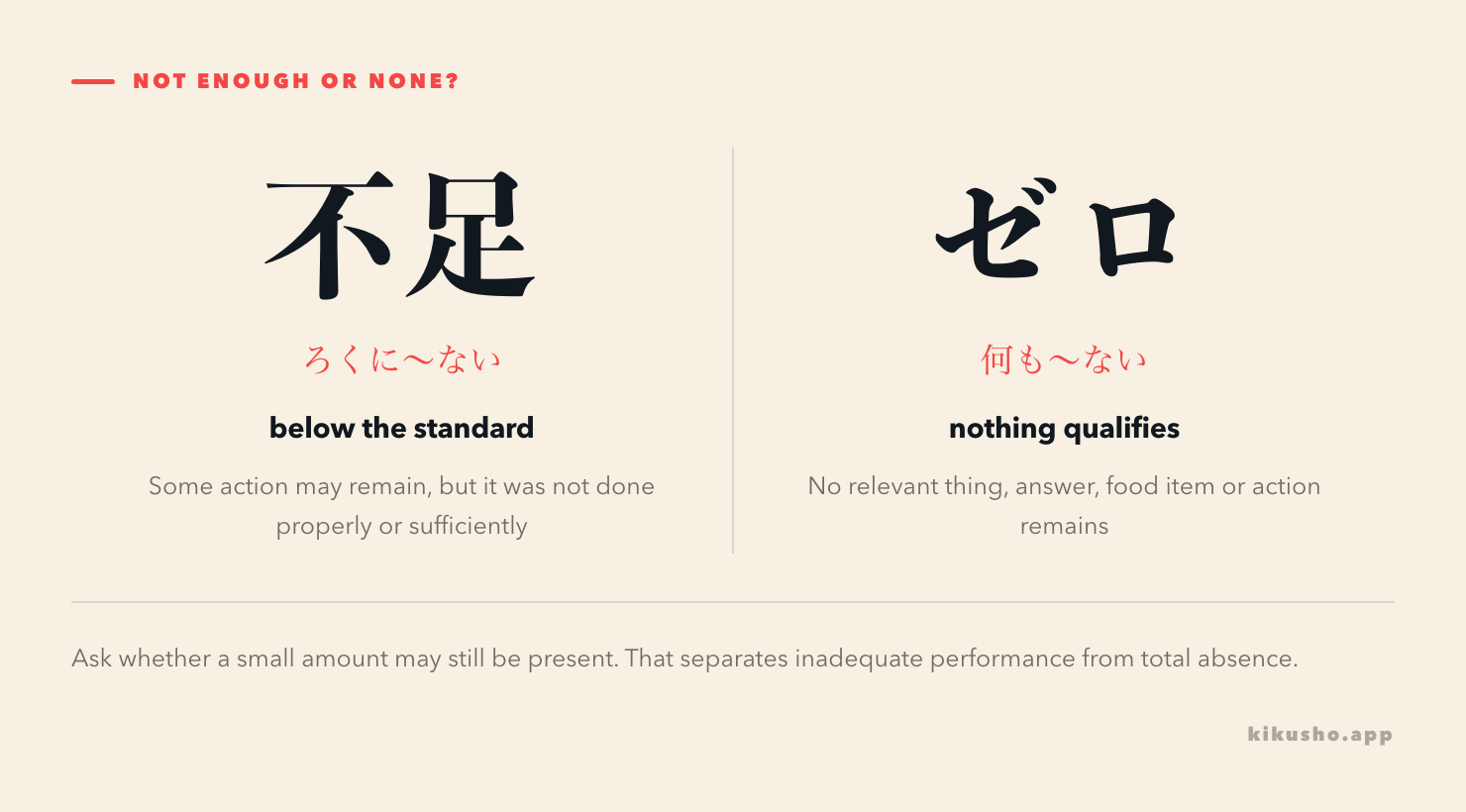
Use ろくに~ない when something happened too poorly or too little to meet a reasonable standard. Use 何も~ない when the action or its object is completely absent.
The quickest test is to ask whether a small amount may still remain. If the answer is yes, ろくに can judge it insufficient. If the intended answer is zero, 何も closes the set completely.
One breakfast makes the contrast visible
昨日は忙しくて、朝ご飯をろくに食べられなかった。
きのうは いそがしくて、あさごはんを ろくに たべられなかった。
I was busy yesterday and could not eat a proper breakfast.
The speaker may have taken two bites or swallowed a cup of yogurt. Breakfast existed, but it did not reach the expected amount or quality. ろくに evaluates how well the action was completed.
昨日は忙しくて、朝は何も食べなかった。
きのうは いそがしくて、あさは なにも たべなかった。
I was busy yesterday and ate nothing in the morning.
Now there is no food item to count. 何も is the object of 食べなかった, and も combines with the negative to make the set empty.
| Ask this | ろくに~ない | 何も~ない |
|---|---|---|
| Could some action still have occurred? | yes | no, for the relevant set |
| What is negated? | adequate degree or quality | every relevant thing or action |
| Does the speaker evaluate the result? | usually | not necessarily |
| Breakfast example | did not eat properly | ate nothing |
Both English translations may contain “hardly,” but English hides the decision. ろくに食べなかった means the eating was not enough. 何も食べなかった means no eating object existed.
ろくに~ない measures against an expected standard
The adverb ろくに means satisfactorily, properly or sufficiently, but it normally appears with a negative phrase. The speaker has a standard in mind and says reality did not reach it.
説明書をろくに読まずに、機械を動かしてしまった。
せつめいしょを ろくに よまずに、きかいを うごかしてしまった。
I started the machine without properly reading the manual.
The manual was probably read to some degree. The criticism is that the reading was careless or incomplete. The literary negative connective 読まずに supplies the negative required by the pattern.
隣の工事がうるさくて、昨夜はろくに眠れなかった。
となりの こうじが うるさくて、さくやは ろくに ねむれなかった。
The construction next door was noisy, so I could hardly sleep last night.
This does not accuse the speaker of poor effort. It judges the amount and quality of sleep as insufficient. Context decides whether ろくに criticizes a person or simply describes an inadequate result.
基本的な挨拶もろくにできないのに、接客の仕事を任された。
きほんてきな あいさつも ろくに できないのに、せっきゃくの しごとを まかされた。
I was put in charge of customer service even though I cannot even greet people properly.
Potential negatives such as できない, 読めない and 話せない are common because ability can fall below a standard. An extra も may mark the very task that should have been manageable: 挨拶もろくにできない.
Bunpro places the pattern at N2, gives ろくに + negative phrase, and distinguishes inadequate performance from the rarity expressed by めったに~ない. The Goo thesaurus entry independently describes an expected degree that is not met. That expected standard is the part an English gloss such as “hardly” can lose.
何も~ない empties the relevant set
何も is built from the question word 何 and the focus particle も. With a negative predicate it means that not one relevant thing qualifies.
冷蔵庫には何も入っていない。
れいぞうこには なにも はいっていない。
There is nothing in the refrigerator.
会議では何も決まらなかった。
かいぎでは なにも きまらなかった。
Nothing was decided at the meeting.
質問されたが、何も答えられなかった。
しつもんされたが、なにも こたえられなかった。
I was asked, but I could not answer anything.
The missing item may be a physical object, a decision, information or an action. The form remains total: no member of the relevant set survives the negative.
When 何も acts as the object, を normally disappears. Say 何も買わなかった, not 何もを買わなかった. The Japan Foundation’s 疑問詞+も…否定 teaching material states that が and を are omitted in this construction, while other case particles can remain before も, as in どこへも行かなかった and だれにも会わなかった.
The negative can be polite:
詳しいことは何も分かりません。
くわしい ことは なにも わかりません。
I do not know any of the details.
Politeness lives in 分かりません. The logic of 何も stays the same.
何もVることはない adds “there is no need”
At N2, you may also meet 何も before a dictionary-form verb followed by ことはない:
何もそこまで謝ることはない。
なにも そこまで あやまる ことは ない。
There is no need to apologize that much.
まだ時間はあるから、何も急ぐことはない。
まだ じかんは あるから、なにも いそぐ ことは ない。
There is still time, so there is no need to rush.
Here 何も does not stand for a missing object. It reinforces the judgment that the proposed action is unnecessary. The structure is:
| Use | Form | Meaning |
|---|---|---|
| total absence | 何も + negative predicate | nothing; not anything |
| unnecessary action | 何も + V dictionary + ことはない | there is no need to V |
Tone decides whether the second use reassures or criticizes. Said gently, 何も心配することはない comforts someone. Said sharply, 何も怒ることはないだろう tells them their reaction is excessive.
JLPT Sensei’s 何も~ない entry includes both total negation and the no-need use and labels the page N2. The Japan Foundation material places the foundational 疑問詞+も + negative system at the old fourth grade. The level difference is real: the basic quantifier pattern is an early prerequisite, while the pragmatic 何もVることはない extension and its comparison with degree negatives deserve later attention. The JLPT itself publishes no exhaustive grammar list.
Attachment reveals which meaning is active
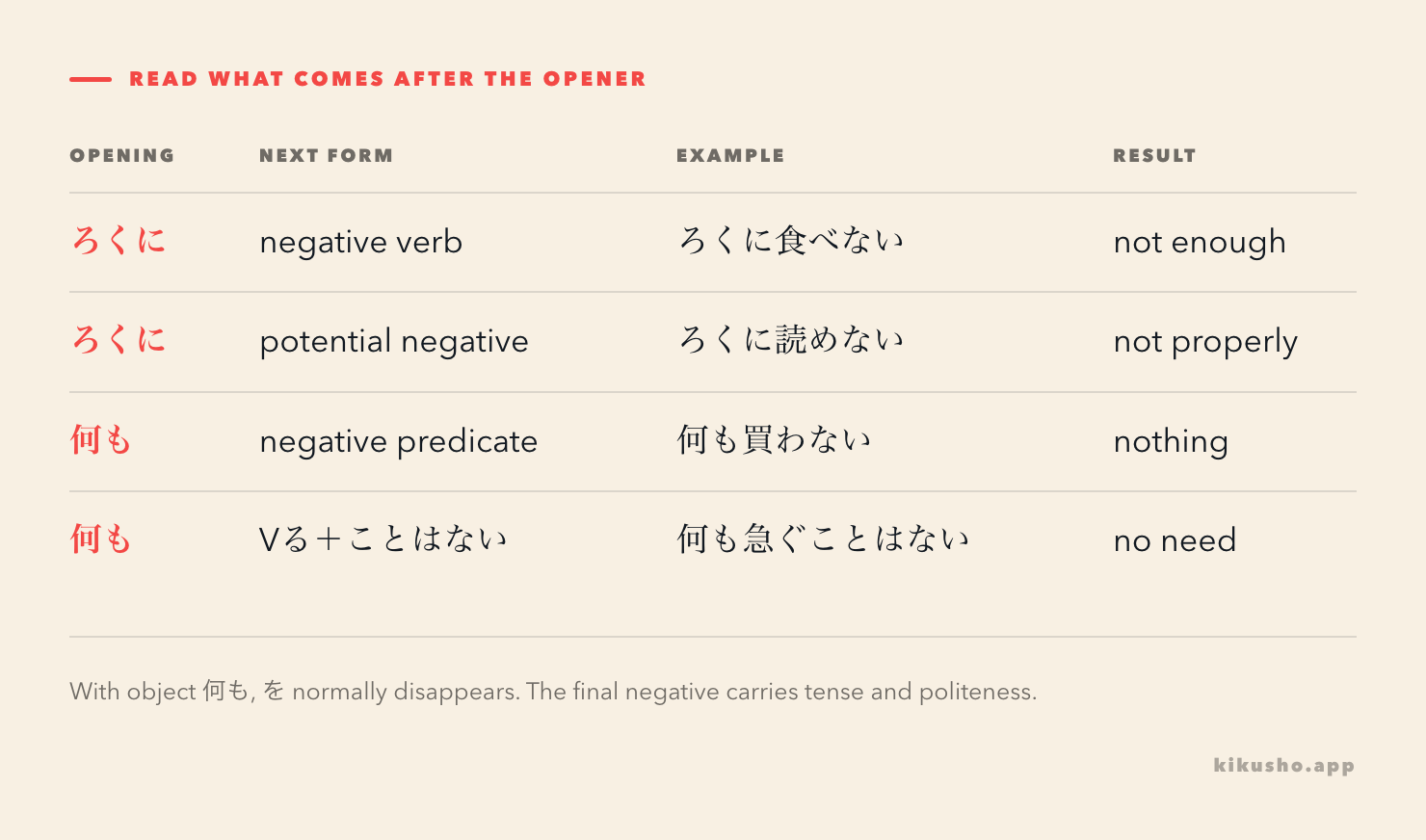
| Opening | What follows | Example |
|---|---|---|
| ろくに | negative verb or phrase | ろくに準備していない |
| ろくに | potential negative | ろくに読めない |
| ろくに | ずに connective | ろくに考えずに答えた |
| 何も | negative predicate; object を omitted | 何も買わなかった |
| 何も | V dictionary + ことはない | 何も恐れることはない |
The spelling ろくに is the safest choice. You may encounter 碌に or 陸に in dictionaries and teaching resources, whose historical explanations do not fully agree. The kana spelling avoids turning a usage decision into a kanji argument.
Do not replace ろくに~ない with めったに~ない just because both can become “hardly” in English. ろくに運動していない says the exercise is insufficient. めったに運動しない says exercise happens rarely. Amount or quality and frequency are different questions.
The same boundary separates this pair from the negative-degree comparison of ちっとも, 全く and 少しも~ない. Those forms measure zero degree or complete denial. ろくに leaves room for an inadequate attempt, while 何も quantifies over things or actions.
Practice: decide whether anything remains
Question 1 — a few bites
A nurse says the patient took only two bites of breakfast. Which sentence preserves that fact?
ア. 患者は朝ご飯をろくに食べなかった。
イ. 患者は朝、何も食べなかった。
ウ. 患者は朝ご飯をめったに食べなかった。
Question 2 — an empty answer
Complete the sentence: 質問されたが、緊張して( )答えられなかった。
ア. 何も
イ. ろくな
ウ. 何でも
Question 3 — quality or frequency?
Which sentence means “I have not been able to sleep properly lately,” rather than “I rarely sleep”?
ア. 最近、ろくに眠れていない。
イ. 最近、めったに眠らない。
ウ. 最近、何でも眠れない。
Question 4 — the object particle
Which sentence correctly says “I bought nothing”?
ア. 何も買わなかった。
イ. 何もを買わなかった。
ウ. 何でも買わなかった。
Question 5 — compose an inadequate action
Rebuild the sentence using every element: 説明書を / ろくに / 読まずに / 使い始めた.
Question 6 — read the reassurance
Read the exchange and choose the phrase that best completes it.
A: 小さな入力ミスをしてしまって、部長に謝りに行こうと思います。
B: もう直したんでしょう? それなら、( )。
ア. 何もそこまで謝ることはないよ
イ. ろくに謝らないよ
ウ. 何も謝ったよ
Answers and explanations
Question 1: ア. Two bites are more than zero, so 何も食べなかった would contradict the prompt. ろくに食べなかった judges the amount as insufficient while allowing some eating. めったに describes frequency across occasions, not the amount eaten at this breakfast.
Question 2: ア. 何も答えられなかった means no answer could be produced. ろくな must modify a noun, as in ろくな答えができなかった. 何でも normally pairs with an affirmative predicate and means anything or everything.
Question 3: ア. ろくに眠れていない evaluates recent sleep as insufficient in amount or quality. めったに眠らない makes an odd frequency claim that the person rarely sleeps. The last option does not form the required negative quantifier pattern.
Question 4: ア. In the basic 疑問詞+も + negative pattern, object を is omitted, giving 何も買わなかった. 何でも with a negative does not mean “nothing”; in a natural affirmative sentence, 何でも買う means “buy anything.”
Question 5: 説明書をろくに読まずに、使い始めた。 The negative connective 読まずに completes ろくに~ない and says the manual was not read properly before use began.
Question 6: ア. 何もそこまで謝ることはないよ reassures the speaker that such an extensive apology is unnecessary. It uses dictionary-form 謝る before ことはない. The other choices either express inadequate apologizing or combine 何も with an affirmative past verb.
The contrast is not simply “a little” against “nothing.” ろくに compares reality with the standard the situation called for; 何も checks every candidate and finds none.
Common questions
What is the difference between ろくに~ない and 何も~ない?
ろくに~ない judges an action, ability or amount as inadequate: it was not done properly or enough. 何も~ない makes a total negative statement about things, content or actions: nothing was done, eaten, heard or known.
Does ろくに~ない mean that the action never happened?
Not necessarily. ろくに食べなかった can allow a few bites while saying the person did not eat enough or properly. Use 何も食べなかった when the amount eaten was literally zero.
Why is 何も~ない listed at N2 if learners meet it earlier?
The basic 疑問詞+も+negative pattern is foundational and is taught at an early level. Some N2 lists group it with the pragmatic 何もVることはない extension, which means there is no need to do something.
Must both patterns end in a negative form?
Yes for the uses taught here. The negative may be ない, ません, a potential negative, or a connective such as ずに. Read the complete predicate because the negative does not have to sit directly beside the opening expression.