On this page
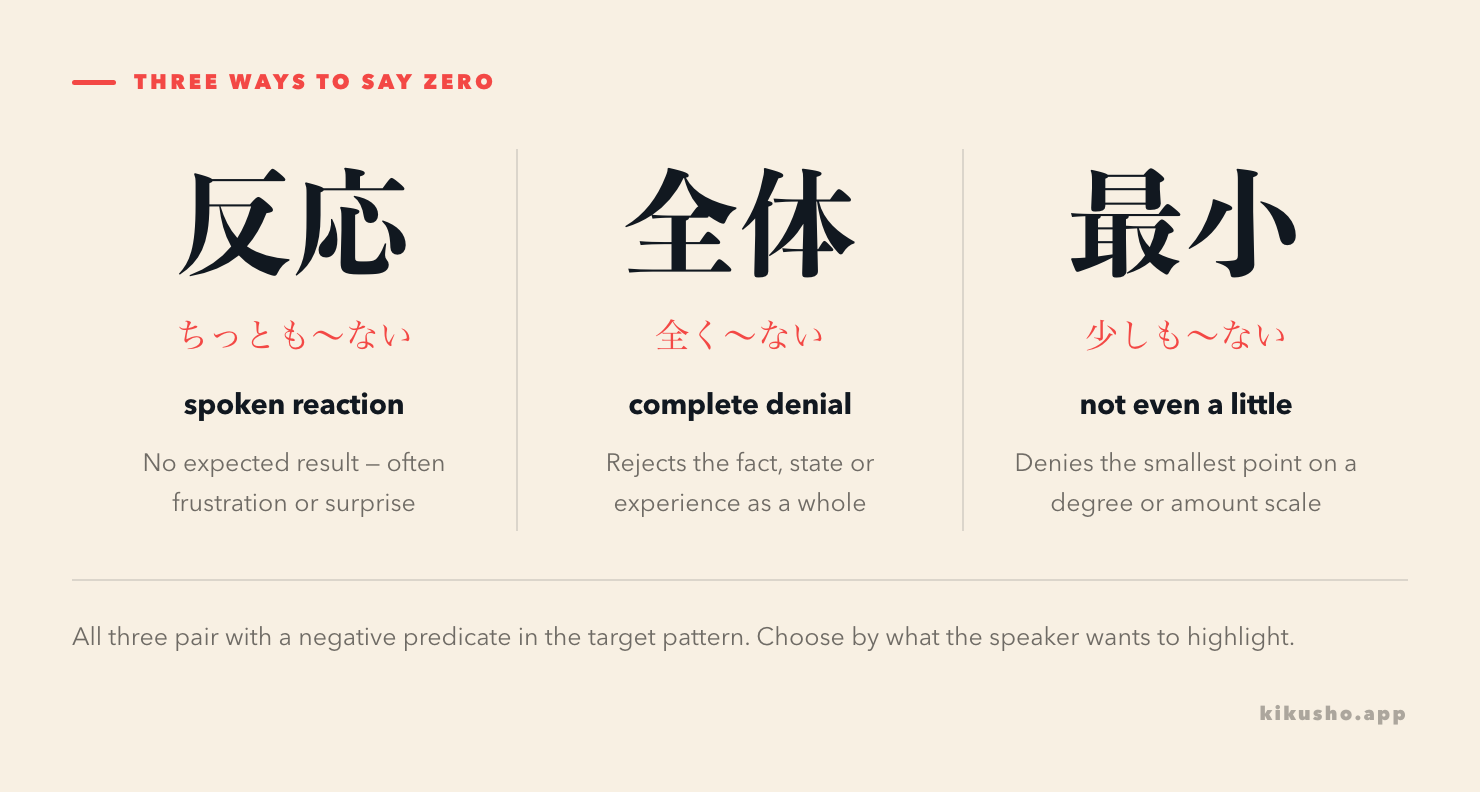
Use ちっとも~ない for a spoken, often frustrated “not at all,” 全く~ない for a broad and firm denial, and 少しも~ない for “not even a little” on a scale. All three can point to zero, but they differ in what the speaker puts under the spotlight.
That difference matters more than the English translation. If you memorize all three as “not at all,” you can make a grammatical sentence that sounds too emotional, too formal or oddly focused on quantity.
Three routes to the same zero
Start with one situation: a medicine has produced no improvement.
薬を飲んだのに、ちっとも良くならない。
くすりを のんだのに、ちっとも よく ならない。
I took the medicine, but I’m not getting any better at all.
The speaker sounds personally affected. ちっとも fits a complaint about an expected improvement that has failed to appear.
薬を飲んだが、症状は全く改善しなかった。
くすりを のんだが、しょうじょうは まったく かいぜんしなかった。
I took the medicine, but the symptoms did not improve at all.
This version makes a firm report about the whole result. 全く works comfortably in a more objective explanation.
薬を飲んでも、痛みは少しも減らなかった。
くすりを のんでも、いたみは すこしも へらなかった。
Even after taking the medicine, the pain did not decrease in the slightest.
Here 少しも selects a scale: the amount of pain reduction was zero. The sentence explicitly denies even the smallest movement along that scale.
| Form | Core focus | Typical feel | Natural example |
|---|---|---|---|
| ちっとも~ない | no expected change or result | conversational, often emotional | ちっとも上手にならない |
| 全く~ない | complete denial of a fact or state | broad, firm, standard | その話は全く知らない |
| 少しも~ない | not even the minimum degree or amount | precise, emphatic | 少しも不安ではない |
The columns describe tendencies, not three sealed boxes. 全く減らない and 少しも減らない are both natural. The table tells you what each choice makes most visible.
ちっとも~ない carries the speaker’s reaction
ちっとも is especially natural in conversation when reality disappoints an expectation. Someone has studied but still cannot understand, a bus still has not arrived, or repeated practice has produced no visible improvement.
三か月練習したのに、ちっとも上手にならない。
さんかげつ れんしゅうしたのに、ちっとも じょうずに ならない。
I’ve practiced for three months, but I’m not getting any better at all.
The sentence does more than measure progress. のに establishes the expectation and ちっとも lets the frustration show. In a neutral report, 全く上達していない would sound more detached.
何度説明しても、弟はちっとも聞いてくれない。
なんど せつめいしても、おとうとは ちっとも きいてくれない。
No matter how many times I explain, my younger brother won’t listen at all.
This conversational coloring is useful, but it can be a poor match for an impersonal research result or an official notice. In those contexts, 全く is usually the safer choice.
The Japanese teaching site Edewakaru explains ちっとも~ない through 全く~ない and 少しも~ない, confirming the semantic overlap. A Japanese-language comparison of negative adverbs also describes ちっとも as conversational and prone to carrying dissatisfaction. The useful lesson is therefore not a new dictionary meaning, but a register and attitude choice.
全く~ない denies the proposition as a whole
全く means “completely” or “entirely.” Before a negative predicate, it rejects the state, fact or experience in full.
私はその計画を全く知らなかった。
わたしは その けいかくを まったく しらなかった。
I knew nothing at all about that plan.
この二つの方法は全く違う。
この ふたつの ほうほうは まったく ちがう。
These two methods are completely different.
The second sentence is easy to misread. 違う is grammatically affirmative, but its meaning already expresses non-identity. Here 全く is the general adverb “completely,” not the specific 全く~ない pattern. The same applies to 全く同じ, “exactly the same.” Do not invent a hidden ない; simply recognize that 全く has a wider life outside this lesson.
That wider range is why 全く handles whole propositions well:
北海道には全く行ったことがない。
ほっかいどうには まったく いった ことが ない。
I have never been to Hokkaido at all.
There is no obvious quantity called “a little experience of going.” The sentence denies the experience itself, so broad 全く is more natural than scalar 少しも.
Bunpro’s 全く~ない entry describes the form as a standard, serious “completely not” and notes that it can sit at the start of the sentence or directly before the negative predicate. It places the construction at N3. JLPT Sensei places it at N2. Kikusho keeps the N2 curriculum position while recording that disagreement rather than pretending the boundary is official.
少しも~ない denies the smallest point on a scale
少し means “a little.” Adding も and a negative predicate produces the logic “not even a little.” This makes 少しも~ない especially clear with degree, amount, change and mental states that can be imagined as scales.
試験の結果について、少しも心配していない。
しけんの けっかについて、すこしも しんぱいしていない。
I’m not worried in the slightest about the exam result.
新しい制度で、待ち時間は少しも短くならなかった。
あたらしい せいどで、まちじかんは すこしも みじかく ならなかった。
The new system did not shorten the waiting time even a little.
彼の説明には少しも疑問を感じなかった。
かれの せつめいには すこしも ぎもんを かんじなかった。
I did not feel the slightest doubt about his explanation.
In each case, you can picture a scale whose lowest positive point is denied: no worry, no shortening, no doubt. 全く would remain grammatical, but 少しも makes that minimum-point test explicit.
Teaching material from The Japan Forum groups 少しも~ない and ちっとも~ない as expressions of zero and gives contexts where both can describe degree. JLPT Sensei’s 少しも~ない entry likewise presents “not even a little” as the central meaning.
The negative appears in the predicate
For the target constructions, the adverb modifies a negative predicate. The ending changes with the kind of predicate and the level of politeness.
| Predicate type | Pattern | Example |
|---|---|---|
| verb | adverb + Vない / Vません | 全く分からない / 全く分かりません |
| i-adjective | adverb + Aくない | 少しも痛くない |
| na-adjective | adverb + Aではない | ちっとも静かではない |
| noun | adverb + Nではない | 全く問題ではない |
| existence | adverb + ない / ありません | 時間が少しもない |
The adverb does not need to touch the negative ending. In その説明は私には全く分かりやすくなかった, the negative arrives at the end of the predicate. Read the complete clause before deciding whether the required negative is missing.
A two-question decision test
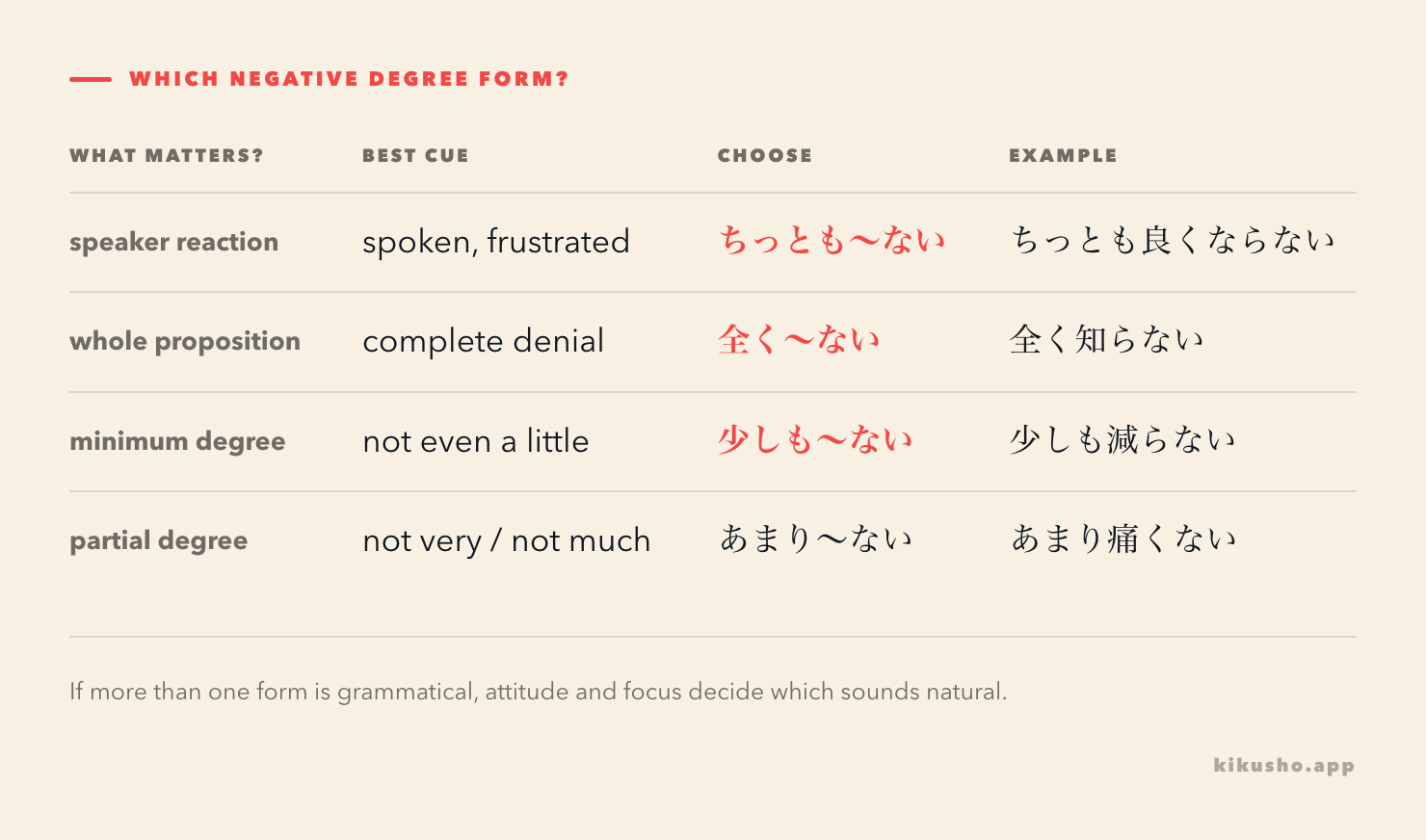
First ask whether the sentence denies a measurable degree or amount. Pain, improvement, change, interest, doubt and spare time all support a scale. If “not even a little” is the point, choose 少しも~ない.
If the sentence denies a whole fact, state or experience, choose 全く~ない. Knowledge and experience frequently belong here: 全く知らない, 全く聞いたことがない.
When both are possible, ask whether the speaker’s personal reaction matters. A conversational complaint about a missing expected result favors ちっとも~ない.
This also separates the trio from two nearby forms. あまり~ない lowers the degree without necessarily reaching zero: あまり痛くない means “not very painful.” なかなか~ない says a result is difficult to reach: なかなか治らない means “it is taking a long time to heal.” The earlier あまり~ない and 全然~ない lesson develops partial versus total negation, while the とても~ない comparison separates zero degree from impossibility. When an action occurred but failed to reach an acceptable standard, the relevant choice is ろくに~ない rather than 何も~ない.
Practice: choose what the zero means
Question 1 — an expected result
You have restarted the router three times and your frustration is obvious. Which sentence best fits?
ア. 三回再起動したのに、ちっとも速くならない。
イ. 三回再起動したのに、少し速くならない。
ウ. 三回再起動したのに、なかなか速い。
Question 2 — the smallest measurable change
Complete the sentence: 新しい薬を飲んだが、熱は( )下がらなかった。
ア. 少しも
イ. あまりに
ウ. まったくと
Question 3 — a whole experience
Which form is the most natural neutral choice? 私は能を( )見たことがない。
ア. 全く
イ. ちっとも
ウ. 少しずつ
Question 4 — partial or zero?
Which sentence means “This room is not very quiet,” without saying the noise level is at the absolute maximum?
ア. この部屋は少しも静かではない。
イ. この部屋はあまり静かではない。
ウ. この部屋は全く静かだ。
Question 5 — build a scalar denial
Rewrite 新しい制度でも待ち時間は短くならなかった with 少しも to say the waiting time did not become even slightly shorter.
Question 6 — follow the discourse
Read the short exchange and choose the best form for the blank.
A: 三か月も毎日練習しているんでしょう?
B: うん。でも、( )上手にならなくて、もう嫌になってきた。
ア. ちっとも
イ. 少しずつ
ウ. あまりに
Reveal the five answers
Question 1: ア. The failed restarts create an expectation, and のに makes the speaker’s frustration salient. ちっとも速くならない is a natural spoken complaint: “it hasn’t become any faster at all.”
Question 2: ア. Temperature provides a measurable scale. 少しも下がらなかった denies even the smallest decrease. あまり下がらなかった would mean it did not fall much, which still allows a small decrease.
Question 3: ア. 全く見たことがない denies the experience as a whole and sounds neutral. A speaker could use ちっとも in a strongly conversational context, but it would add an attitude the prompt does not supply.
Question 4: イ. あまり静かではない is a partial negative: not very quiet. 少しも静かではない says it is not quiet in the slightest, which is stronger. The last option is affirmative and means “completely quiet.”
Question 5: 新しい制度でも、待ち時間は少しも短くならなかった。 Waiting time provides a measurable scale, and 少しも denies the smallest improvement. The adverb does not need to sit immediately beside the final negative ending.
Question 6: ア. The long practice period creates an expected result, and もう嫌になってきた reveals the speaker’s frustration. ちっとも上手にならなくて connects that disappointed reaction to the following clause. 少しずつ means “little by little” and would reverse the intended result; あまりに needs a following degree expression such as あまりに難しくて and cannot fill this negative-degree frame.
The shared translation is the starting point, not the choice rule. Find the scale, the whole proposition or the speaker’s reaction, and the natural form usually becomes clear.
Common questions
What is the difference between ちっとも~ない, 全く~ない and 少しも~ない?
All three can express total negation. ちっとも~ない is conversational and often conveys frustration or surprise, 全く~ない broadly denies a fact or state, and 少しも~ない emphasizes that not even the smallest amount or degree exists.
Do these adverbs require a negative predicate?
In the target patterns, yes. They combine with negative verbs, adjectives and noun predicates, including ない, ません, くない and ではない. 全く also has other adverbial uses, such as 全く同じ, which are outside this pattern.
Can 少しも~ない and 全く~ない always replace each other?
They often overlap when a degree or amount is at zero, but 全く is broader. 全く行ったことがない naturally denies an experience as a whole, while 少しも sounds best when a scale such as pain, change, interest or doubt is available.
Are these forms really N2 grammar?
Study resources disagree. Kikusho follows the N2 inventory used for this lesson while recording that Bunpro places 全く~ない at N3 and treats related items at other levels. The JLPT does not publish an official grammar list.