On this page
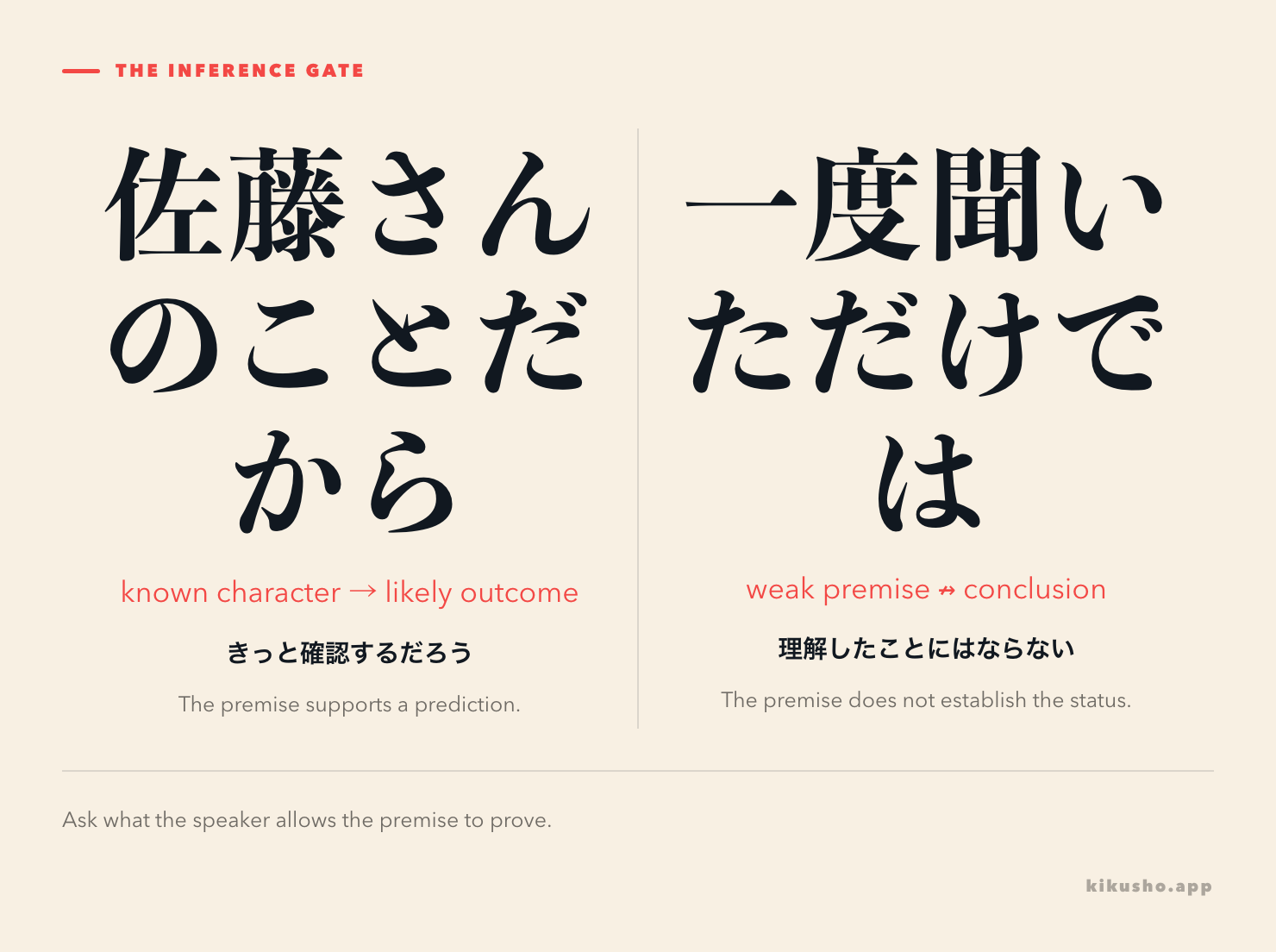
Use Nのことだから when what you know about a person or familiar group makes a prediction reasonable. Use Aからといって、B(という)ことにはならない when A is too weak to establish B.
The two N2 patterns move an argument in opposite directions. ことだから lets a likely inference through. ことにはならない stops a conclusion, even when the premise before it is true.
One form lets the inference through; the other blocks it
Imagine a careful colleague named Sato. Her usual behavior gives you grounds for a prediction:
慎重な佐藤さんのことだから、提出前にもう一度確認するだろう。
しんちょうな さとうさんの ことだから、ていしゅつまえに もういちど かくにんするだろう。
Knowing how careful Sato is, she will probably check once more before submitting.
Now imagine someone has heard an explanation once. That fact alone does not prove understanding:
説明を一度聞いただけでは、内容を理解したことにはならない。
せつめいを いちど きいただけでは、ないようを りかいした ことには ならない。
Hearing the explanation once does not count as understanding the content.
| Pattern | What the premise does | Speaker's move |
|---|---|---|
| Nのことだから、Bだろう | known character makes B likely | allows a prediction |
| Aからといって、B(という)ことにはならない | A fails to establish B | blocks a conclusion |
These forms are compared here because both ask what a premise permits you to conclude. They are not replacements for each other in the same blank. Their attachment and sentence roles differ.
Known character is the premise before のことだから
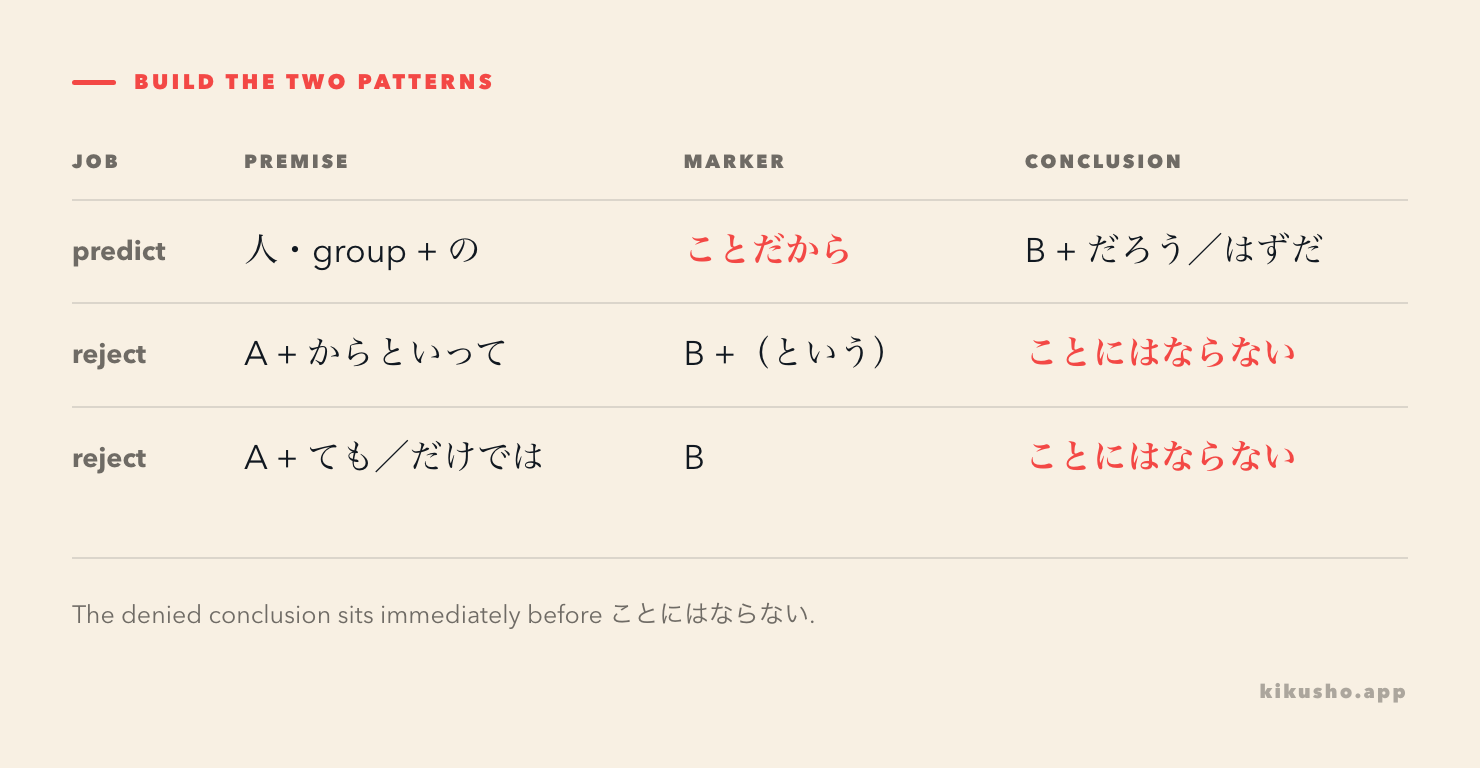
The most useful productive pattern is:
person or familiar group + のことだから、likely outcome
The speaker and listener already know something about the person's habits, ability or character. That shared knowledge supports the second clause. Words such as きっと, だろう and はずだ often make the prediction visible.
約束を大切にする彼のことだから、遅れても必ず来るはずだ。
やくそくを たいせつにする かれの ことだから、おくれても かならず くる はずだ。
Knowing how seriously he takes promises, he is sure to come even if he is late.
経験豊富な森さんのことだから、急な変更にも対応できるだろう。
けいけんほうふな もりさんの ことだから、きゅうな へんこうにも たいおうできるだろう。
Knowing how experienced Mori is, she will probably be able to handle a sudden change.
The phrase before のことだから identifies the person and can also describe the relevant trait: 慎重な佐藤さん, 約束を大切にする彼, 経験豊富な森さん. The result remains a judgment, not proof. The speaker could still be wrong.
The Japan Foundation's grammar guidance presents person noun + のことだから as the central form and explains that known nature or habits provide the grounds for the judgment. Bunpro also places the pattern at N2 and notes broader verb and adjective attachments. For reliable production, start with the person-based form that directly expresses this inference.
Do not read のことだから as a neutral “because this is person X.” The sentence depends on a relevant characteristic. Without shared knowledge of Sato's carefulness, 佐藤さんのことだから gives the listener no useful basis for the prediction.
ことにはならない rejects a result, status or conclusion
ことにはならない looks back at a proposed conclusion and denies that it follows. Two common frames are:
Aからといって、B(という)ことにはならない
Aても/Aだけでは、Bことにはならない
資格を持っているからといって、実務ができるということにはならない。
しかくを もっているからといって、じつむが できるという ことには ならない。
Having the qualification does not by itself mean that someone can do the practical work.
毎日机に向かっていても、集中して勉強したことにはならない。
まいにち つくえに むかっていても、しゅうちゅうして べんきょうした ことには ならない。
Even sitting at a desk every day does not amount to studying with concentration.
The premise is not called false. The person may really have the qualification or sit at the desk every day. The speaker denies only the step from that fact to 実務ができる or 集中して勉強した.
という can package the proposed conclusion before ことにはならない, especially when the conclusion is being quoted as a claim: 実務ができるということにはならない. It is often omitted after a verb phrase when the relationship is already clear: 理解したことにはならない.
Bunpro's N2 entry highlights both からといって and ても frames. JLPT Sensei likewise places the construction at N2 and records the optional という before it. “N2” is the shared study-guide placement used here; the exam maker does not issue a complete grammar syllabus.
The two forms do not occupy the same slot
The quickest decision is to find the conclusion and ask what the speaker does with it.
In 森さんのことだから、対応できるだろう, the conclusion is 対応できる. Knowledge of Mori supports that prediction. The speaker lets it pass, while keeping it probabilistic with だろう.
In 資格があるからといって、対応できることにはならない, the conclusion is again 対応できる. The qualification is insufficient evidence. The speaker blocks it.
This produces a useful pair:
経験豊富な森さんのことだから、対応できるだろう。
Knowing how experienced Mori is, she can probably handle it.
経験が一年あるからといって、どんな問題にも対応できることにはならない。
Having one year of experience does not mean someone can handle every problem.
The first premise is a rich body of shared knowledge about one person. The second is a single fact presented as inadequate grounds for a sweeping conclusion.
Nearby こと patterns solve different problems
ことから begins with an observed fact and draws an inference from it. The ことから and なぜなら lesson compares evidence-first and claim-first explanations. ことだから instead characteristically predicts from what is known about a person.
とは限らない means “is not always necessarily true.” It challenges a generalization. ことにはならない focuses on whether the stated premise establishes a particular consequence or status. The certainty and exceptions lesson develops that boundary.
Do not reverse the pieces into ないことには~ない. That pattern marks an indispensable condition: if A does not happen, B cannot happen. The ないことには~ない lesson treats that separate structure.
When saving either form in Kikusho, keep the whole premise and conclusion. A card containing only ことだから = because loses the known-character inference. A card containing only ことにはならない = does not mean loses the premise whose force is being rejected.
Practice: decide whether the premise is enough
Question 1 — choose the prediction pattern
Complete the sentence about a colleague whose careful habits are well known:
慎重な木村さん( )、数字をもう一度確認するだろう。
A. のことだから
B. からといって
C. ことにはならない
Question 2 — block the unsupported conclusion
Choose the natural completion:
本を一冊読んだからといって、専門家になった( )。
A. のことだから
B. ことにはならない
C. ことからだ
Question 3 — identify the attachment
Which phrase naturally comes before のことだから in the central inference pattern?
A. 彼は親切
B. 親切な彼
C. 親切だから彼
Question 4 — assemble the rejection
Use every chunk to build a sentence that refuses the conclusion:
合格できる / 毎日勉強している / からといって / ということにはならない
Question 5 — choose the intended reasoning
You know that Yamada always prepares early. Which sentence predicts his likely action from that knowledge?
A. 山田さんのことだから、もう資料を用意しているはずだ。
B. 山田さんだからといって、資料を用意したことにはならない。
Question 6 — follow the two conclusions
Track what each premise permits in this short passage:
中村さんは何度もこの道を走っている。中村さんのことだから、地図がなくても着けるだろう。ただし、一度走ったことがあるからといって、その人が道を覚えていることにはならない。
Which conclusion is allowed by knowledge of Nakamura, and which broader conclusion is rejected?
Question 7 — distinguish the nearby pattern
Which sentence means that one fact does not establish the claimed status, rather than saying a generalization has exceptions?
- 値段が高ければ、品質がいいとは限らない。\
- 値段が高いからといって、品質が保証されたことにはならない。
Answers and explanations
Answer 1. A. 慎重な木村さんのことだから uses Kimura's known carefulness as the basis for 確認するだろう, a likely prediction.
Answer 2. B. The complete frame is 本を一冊読んだからといって、専門家になったことにはならない. Reading one book is accepted as true but rejected as sufficient grounds for the status “expert.”
Answer 3. B. The noun phrase is 親切な彼, followed by のことだから: 親切な彼のことだから. A is a complete clause, while C joins the words in the wrong order.
Answer 4. 毎日勉強しているからといって、合格できるということにはならない。 Daily study alone does not guarantee passing. という packages 合格できる as the proposed conclusion being denied.
Answer 5. A. The known person comes before のことだから, and はずだ marks the prediction. B says being Yamada does not itself establish that he prepared the materials; it does not use his known habit as positive grounds.
Answer 6. 中村さんのことだから allows the prediction that Nakamura can arrive without a map because he has driven the route many times. ことにはならない rejects the broader conclusion that anyone who has driven it once necessarily remembers the route.
Answer 7. 2. The high price is the premise, and 品質が保証されたことにはならない denies that it establishes guaranteed quality. Sentence 1 uses とは限らない to say the general rule “expensive means good quality” has exceptions.
Common questions
What is the difference between ことだから and ことにはならない?
Nのことだから uses what is known about a person or group as grounds for a likely prediction. AからといってB(という)ことにはならない says that A is not enough to establish B as a conclusion, status or result.
What comes before ことだから?
The central N2 inference pattern is a person or familiar group followed by のことだから, as in 慎重な佐藤さんのことだから. The prediction often contains きっと, だろう or はずだ.
What comes before ことにはならない?
It follows the conclusion or status being denied. Common frames are Aからといって、B(という)ことにはならない and Aても、Bことにはならない.
Is ことにはならない the same as とは限らない?
They overlap but focus differently. ことにはならない denies that the stated premise establishes a particular conclusion or status; とは限らない says a general claim is not true in every case.