On this page
Use も構わず when someone acts while disregarding a concern. Use ままに when a wish, impulse, instruction or natural course determines how the action unfolds.
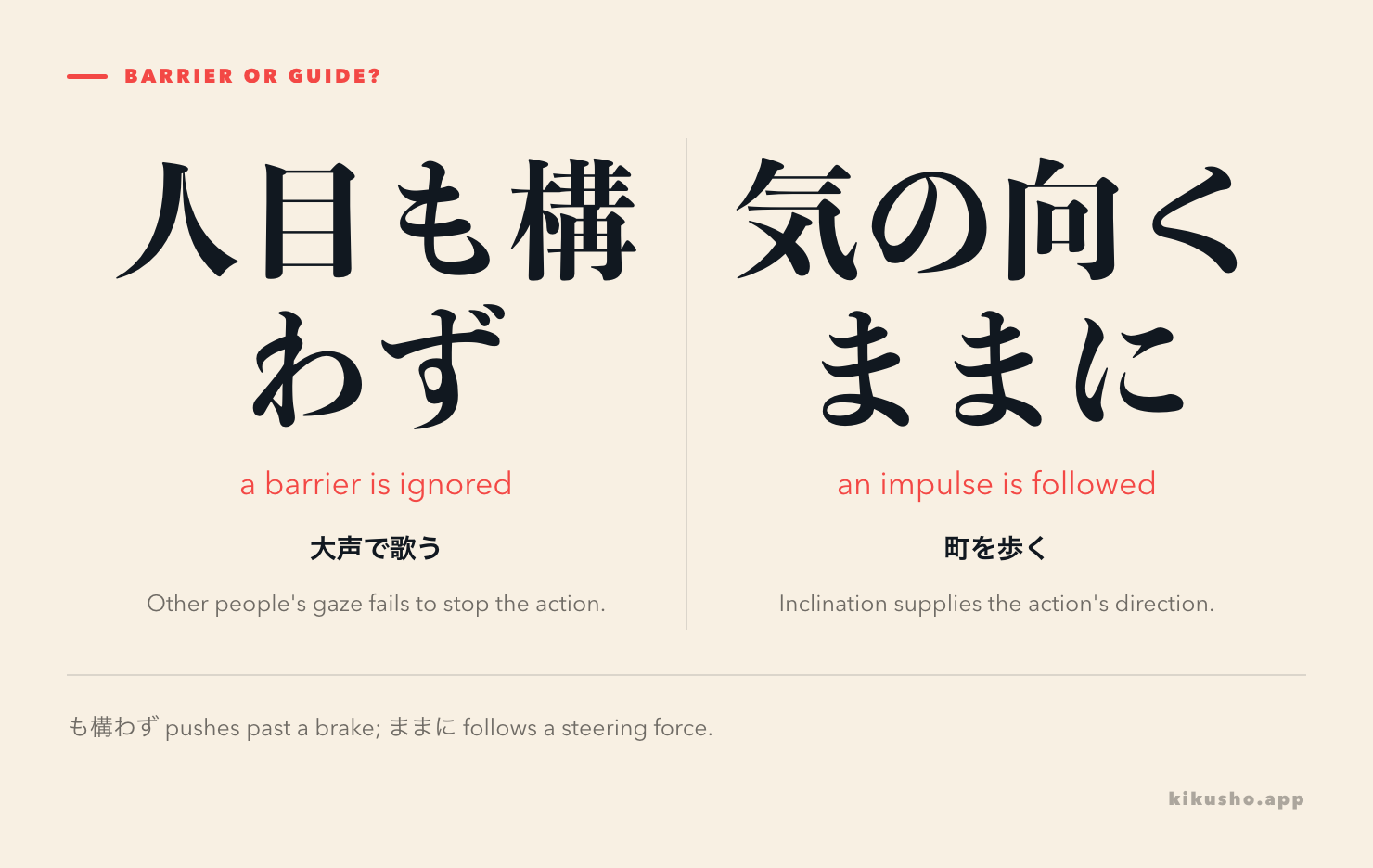
Both can describe action with little restraint, but the missing restraint comes from a different place. With も構わず, the actor pushes past something. With ままに, the actor follows something.
Ask whether the first phrase is a barrier or a guide
Compare these two scenes:
彼は人目も構わず、駅で大声で歌い始めた。
かれは ひとめも かまわず、えきで おおごえで うたいはじめた。
Without caring who was watching, he began singing loudly at the station.
彼は気の向くままに、知らない町を歩いた。
かれは きの むく ままに、しらない まちを あるいた。
He walked through an unfamiliar town wherever his interest took him.
人目 is a social restraint that he ignores. 気の向く方向 is the guide that chooses his route. That gives a practical test:
| Ask about the first phrase | If the answer is yes | Form |
|---|---|---|
| Should this normally make the actor hesitate? | the actor disregards it | も構わず |
| Does this determine the manner or direction of the action? | the actor follows it | ままに |
The first form puts the ignored concern in the background. The second hands control to the feeling, command or force named before it.
も構わず puts the ignored concern before the action
構う can mean to mind or care about something. Its literary negative connective 構わず means “without minding.” The particle も gives the concern focus: even that does not stop the action.
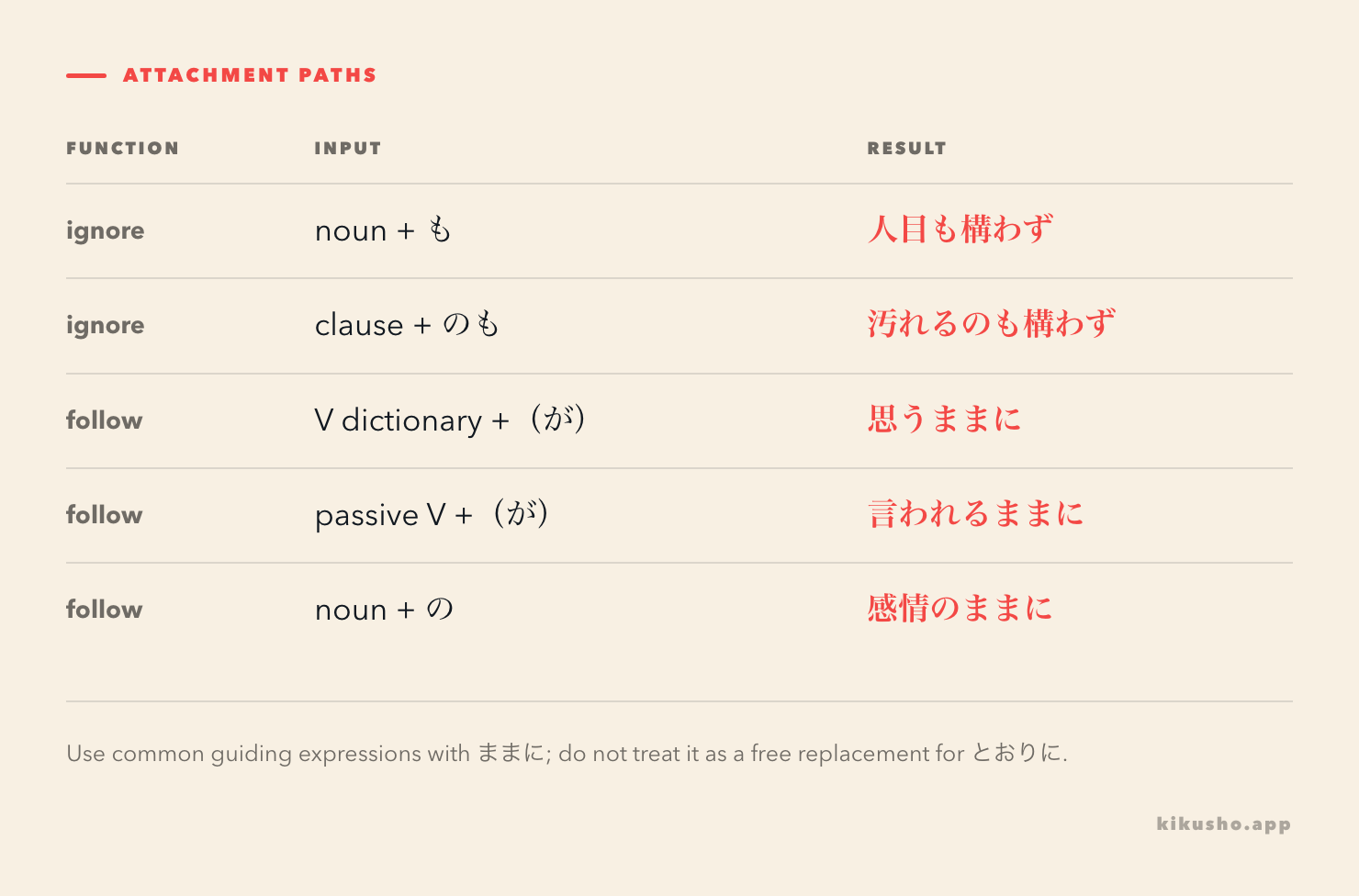
Common attachments are:
| What is disregarded | Attachment | Example phrase |
|---|---|---|
| noun | N + も構わず | 人目も構わず |
| noun, with に | N + にも構わず | 雨にも構わず |
| plain clause | clause + のも構わず | 服が汚れるのも構わず |
| plain clause, with に | clause + のにも構わず | 周囲が止めるのにも構わず |
店員は制服が汚れるのも構わず、床にこぼれた飲み物を拭いた。
てんいんは せいふくが よごれるのも かまわず、ゆかに こぼれた のみものを ふいた。
The employee wiped up the spilled drink without worrying about getting the uniform dirty.
二人は冷たい雨にも構わず、作業を続けた。
ふたりは つめたい あめにも かまわず、さぎょうを つづけた。
The two continued working without being deterred by the cold rain.
Bunpro and JLPT Sensei both place も構わず at N2 and describe the ignored-risk or ignored-concern relationship. Mainichi Nonbiri's Japanese-language explanation independently records the noun and nominalized-clause attachments and notes fixed phrases such as 人目も構わず, 所構わず and なりふり構わず.
The form does not decide whether the action deserves blame or praise. Ignoring onlookers to make a scene can sound inconsiderate. Ignoring dirty clothes to help someone can sound admirable. The sentence supplies the evaluation through the concern and the action.
ままに gives the action to a wish, command or current
In this advanced use, ままに does more than preserve a state. The phrase before it guides the following action. Sometimes the person acts freely according to an inner wish. Sometimes another person's command takes control.
| Source of direction | Attachment | Example phrase |
|---|---|---|
| wish or impulse | V dictionary +(が)ままに | 思うままに |
| another person's direction | passive V +(が)ままに | 言われるままに |
| feeling or natural tendency | N + のままに | 感情のままに |
子どもたちは思うままに色を選び、自由に絵を描いた。
こどもたちは おもう ままに いろを えらび、じゆうに えを かいた。
The children chose colors as they pleased and drew freely.
私たちは案内役に言われるままに、細い山道を進んだ。
わたしたちは あんないやくに いわれる ままに、ほそい やまみちを すすんだ。
We followed the narrow mountain path just as the guide told us.
感情のままに返事をすると、相手を傷つけるかもしれない。
かんじょうの ままに へんじを すると、あいてを きずつける かもしれない。
If you answer under the direction of your emotions, you may hurt the other person.
The first example has freedom from outside control. The second has little personal control because the guide's words determine the action. The third warns against letting emotion take over. English may translate all three differently, but ままに keeps the same relationship: the first phrase supplies the course to follow.
JLPT Sensei gives dictionary-form verbs, passive verbs and noun + の as attachments and places the form at N2. PassJapanese also teaches it at N2 and separates “follow the wish or instruction” from unchanged-state まま. Bunpro's ままに entry places the as-one-wishes use at N1, warns that it favors a limited set of verbs and fixed phrases, and records the loss-of-control nuance. The N2 label here follows the two N2 teaching references and the Kikusho inventory while preserving Bunpro's different boundary.
The same scene can change who controls it
Suppose someone makes a harsh reply.
周囲の反応も構わず、彼は思ったことを口にした。
しゅういの はんのうも かまわず、かれは おもった ことを くちに した。
He said what he thought without caring how people around him would react.
Here 周囲の反応 is the ignored consequence. He chooses to speak and accepts that risk.
彼は怒りのままに、きつい言葉を返した。
かれは いかりの ままに、きつい ことばを かえした。
He answered harshly under the sway of his anger.
Here 怒り is the force shaping the reply. The sentence makes the emotion sound like the driver.
Calling both phrases “without restraint” hides this difference. も構わず highlights resistance to a brake. ままに highlights surrender to a steering force.
Three nearby patterns divide the remaining ground
にもかかわらず reports a result that contradicts a circumstance: the rain fell, yet the event continued. It does not by itself say that an actor consciously ignored the rain. The にもかかわらず lesson develops that concession.
にかかわらず and を問わず mean “regardless of” a category or condition, often in rules and eligibility statements. They do not carry the same image of a person pushing past a concern. The regardless-of comparison shows their range.
Plain Vたまま preserves a resulting state:
窓を開けたまま寝た。
I slept with the window left open.
Nothing in that phrase guides the manner of sleeping. The open-window state simply remains. The unchanged-state まま lesson covers that earlier pattern and its た-form, ない-form, adjective and noun attachments.
For a Kikusho card, keep both the guiding or ignored phrase and the final action. 人目も構わず without what the person did cannot show the evaluation. 言われるままに without the following action cannot show what control was surrendered.
Practice: locate the missing restraint
Question 1 — what is being ignored?
Complete the sentence about a runner who continues despite pain:
彼は足の痛み( )、最後まで走った。
ア. のままに
イ. も構わず
ウ. たままで
Question 2 — what guides the action?
Choose the expression that says the speaker wandered wherever inclination led:
気の向く( )、路地を歩き回った。
ア. ままに
イ. のも構わず
ウ. にもかかわらず
Question 3 — attach the full concern
Which completion naturally means “without caring that the clothes might get dirty”?
服が汚れる( )、地面に座った。
ア. ままに
イ. のも構わず
ウ. のままで
Question 4 — assemble one sentence
Use every chunk to say that the customer signed exactly as the employee recommended:
店員に / 勧められるままに / 契約書に / サインした
Question 5 — read the speaker's evaluation
Which statement follows from 人目も構わず踊った alone?
ア. The person danced according to detailed instructions.
イ. The person danced without letting other people's gaze stop them.
ウ. The person maintained the same physical posture while dancing.
Question 6 — trace control through the scene
Read the passage:
美咲は雨にも構わず外へ出た。行き先は決めず、足の向くままに町を歩いた。
What does Misaki disregard, and what determines her route?
Question 7 — keep advanced ままに separate
Which sentence uses まま for an unchanged background state rather than a guiding force?
ア. 彼は思うままに意見を書いた。
イ. 彼はコートを着たまま部屋に入った。
Answers and explanations
Answer 1. イ. 足の痛みも構わず names pain as the concern the runner disregards. It does not guide the manner of running or describe a state kept unchanged.
Answer 2. ア. 気の向くままに gives the person's inclination control over the route. のも構わず would instead nominalize the clause and treat it as a concern being ignored.
Answer 3. イ. A full clause is nominalized with の before も構わず: 服が汚れるのも構わず. The possible dirtying is the risk that fails to stop the person from sitting down.
Answer 4. 店員に勧められるままに、契約書にサインした。 The passive 勧められる identifies the employee's recommendation as the direction the customer follows.
Answer 5. イ. 人目 is other people's gaze, and も構わず says it did not restrain the dancing. The phrase does not identify an instruction or a continuing posture.
Answer 6. Misaki disregards the rain, expressed by 雨にも構わず. Her feet determine the route, expressed by 足の向くままに. The first phrase removes a barrier; the second supplies a guide.
Answer 7. イ. コートを着たまま retains the result of putting on the coat while he enters. Sentence ア uses the advanced target pattern: what he thinks guides the content of his writing.
Common questions
What is the difference between も構わず and ままに?
も構わず names a risk, obstacle or social concern that the actor disregards. ままに names the wish, impulse, instruction or natural force that guides how the action proceeds.
What comes before も構わず?
A noun can attach directly with も構わず or にも構わず. A full plain clause is commonly nominalized with の, giving forms such as Vるのも構わず and Vているのにも構わず.
What comes before the advanced ままに pattern?
Common forms include dictionary-form verb +(が)ままに, passive verb +(が)ままに, and noun + のままに, as in 思うままに, 言われるままに and 気の向くままに.
Is advanced ままに the same as たまま?
No. たまま presents a resulting state that remains unchanged, while the advanced ままに pattern presents something that directs the manner or course of the following action.