On this page
At the door, you put on a コート with 着る, 靴 with はく and a 帽子 with かぶる. This N5 clothes vocabulary set joins twenty names, clothing parts and dressing verbs, with readings and combinations that let you describe an outfit or get dressed.
The nouns tell you what the item is; the verbs tell you how it goes on the body. We will use the everyday clothing senses here. Fabric names and specialist fashion terms need a separate set.
Sixteen nouns cover the outfit and its parts
All sixteen entries in these two tables are nouns in the senses taught here. The reading column gives kana; romaji beside the katakana words makes their pronunciation easier to check. Keep those words in katakana when you write them.
Clothes for the body
| Word | Reading | Meaning here | Learn it in this combination |
|---|---|---|---|
| 服 | ふく | clothes; clothing; an outfit | 服を買う: buy clothes |
| 洋服 | ようふく | Western-style clothing | 洋服の店: a Western-style clothing shop |
| 上着 | うわぎ | jacket; outer or upper-body garment | 上着を脱ぐ: take off a jacket |
| コート | コート / kōto | coat | コートを着る: put on a coat |
| シャツ | シャツ / shatsu | shirt | シャツのボタン: a shirt's buttons |
| ワイシャツ | ワイシャツ / waishatsu | dress or business shirt | ワイシャツを着る: put on a business shirt |
| セーター | セーター / sētā | sweater; jumper | セーターを着る: put on a sweater |
| 背広 | せびろ | men's business suit | 背広を着る: wear a business suit |
Legs, feet, head and small parts
| Word | Reading | Meaning here | Learn it in this combination |
|---|---|---|---|
| ズボン | ズボン / zubon | trousers; pants | ズボンをはく: put on trousers |
| スカート | スカート / sukāto | skirt | スカートをはく: put on a skirt |
| 靴 | くつ | shoes; footwear | 靴を履く: put on shoes |
| 靴下 | くつした | socks; stockings | 靴下をはく: put on socks |
| 帽子 | ぼうし | hat; cap | 帽子をかぶる: put on a hat |
| ネクタイ | ネクタイ / nekutai | tie; necktie | ネクタイを締める: put on or tie a necktie |
| ボタン | ボタン / botan | clothing button | ボタンを留める: fasten a button |
| ポケット | ポケット / poketto | ポケットに入れる: put something in a pocket |
The JMdict entries shown by Jisho supply readings, word classes and clothing senses; the usage distinctions below also draw on NINJAL's independently written dictionary. A word can have meanings outside this set: コート can name a sports court, for example, and ボタン can be a machine's push-button. The surrounding noun and verb tell you which object is meant.
着る, はく and かぶる divide the putting-on job
The four dressing verbs in this set are 着る(きる), 履く(はく), かぶる and 脱ぐ(ぬぐ). Each takes an object with を in its clothing use.
| Verb | Word class | Clothing use | Object and verb together |
|---|---|---|---|
| 着る | transitive ichidan verb | put on or wear an upper-body or full-body garment | シャツを着る: put on a shirt |
| 履く / はく | transitive godan verb | put on or wear footwear or lower-body clothing; see the spelling note below | 靴を履く: put on shoes; ズボンをはく: put on trousers |
| かぶる | transitive godan verb | put on or wear a covering on the head | 帽子をかぶる: put on a hat |
| 脱ぐ | transitive godan verb | take off clothing or shoes | コートを脱ぐ: take off a coat |
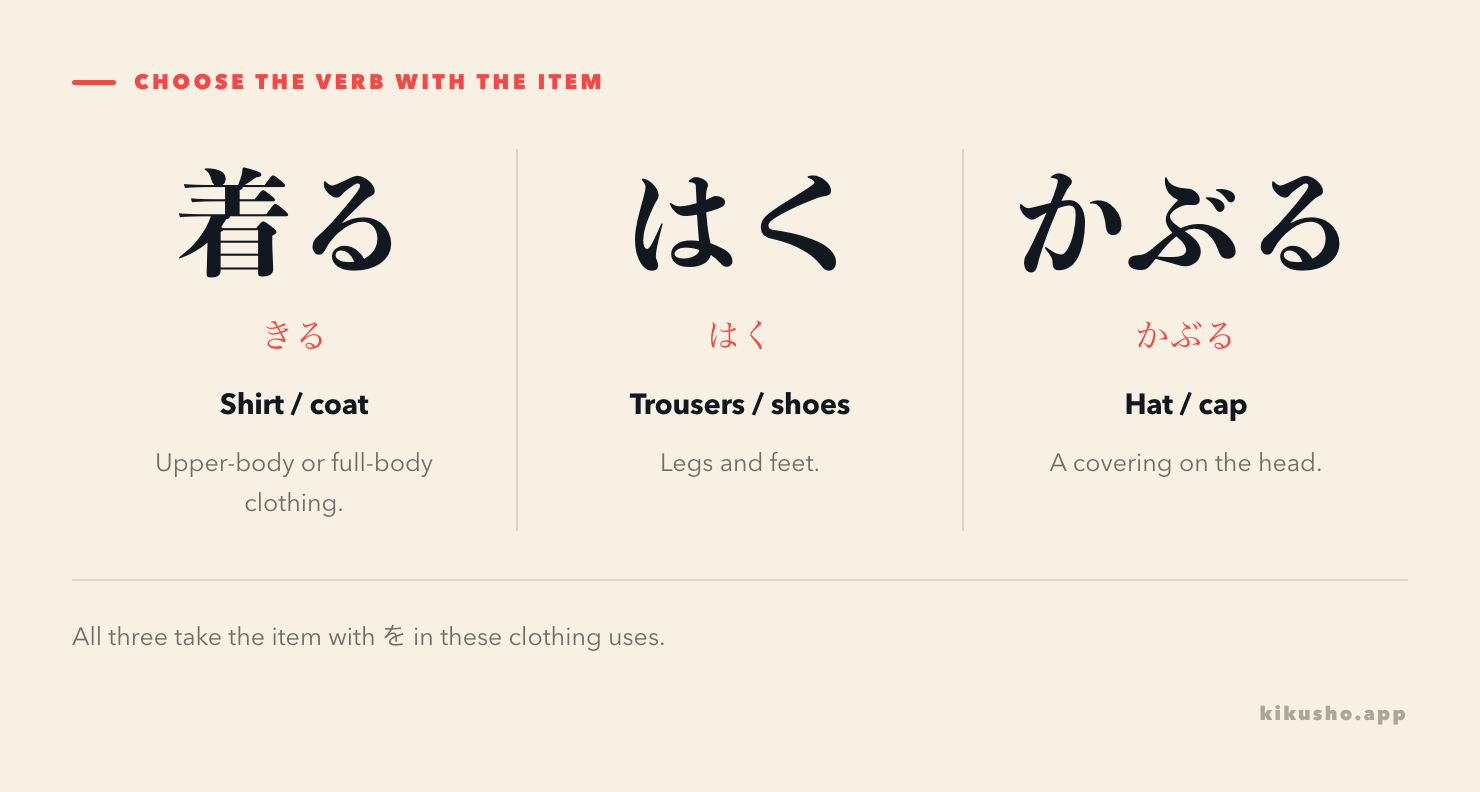
Use 着る with シャツ, ワイシャツ, セーター, 上着, コート and 背広. It also applies to garments covering the whole body, so “above the waist” is only a rough shortcut. Use はく with ズボン, スカート, 靴下 and 靴, and かぶる with 帽子. NINJAL's 着る entry gives this division and separately lists ネクタイをしめる.
寒いので、セーターを着ます。新しい靴をはきます。
さむいので、セーターを きます。あたらしい くつを はきます。
Because it is cold, I will put on a sweater. I will put on my new shoes.
The clothes do not all go on with one Japanese equivalent of English “wear.” A tie normally goes with 締める(しめる), “tie or fasten,” in ネクタイを締める. That is a useful phrase to recognise alongside this set's four verbs.
The clothing use of かぶる concerns a head covering. The かぶる dictionary entry also records senses involving other coverings, water and responsibility.
履く and 穿く share a reading
The spelling distinction is usually 靴を履く for footwear and ズボンを穿く / スカートを穿く for leg garments. Both verbs are pronounced はく. Digital Daijisen's entry separates these footwear and lower-body clothing spellings.
For this N5 lesson, 靴をはく, ズボンをはく, スカートをはく and 靴下をはく are useful written combinations. The hiragana spelling keeps attention on the item–verb pairing. Socks sit near the boundary of the kanji convention: NINJAL's はく entry groups them with clothing in its writing note. We therefore leave socks in hiragana rather than turn a spelling preference into a rigid beginner rule.
The endings change with the verb class
着る loses its final る to make 着ます and 着て. かぶる also ends in る, but it is a godan verb: its polite form is かぶります, not かぶます.
| Dictionary form | Polite form | て-form | Plain negative |
|---|---|---|---|
| 着る(きる) | 着ます(きます) | 着て(きて) | 着ない(きない) |
| はく | はきます | はいて | はかない |
| かぶる | かぶります | かぶって | かぶらない |
| 脱ぐ(ぬぐ) | 脱ぎます(ぬぎます) | 脱いで(ぬいで) | 脱がない(ぬがない) |
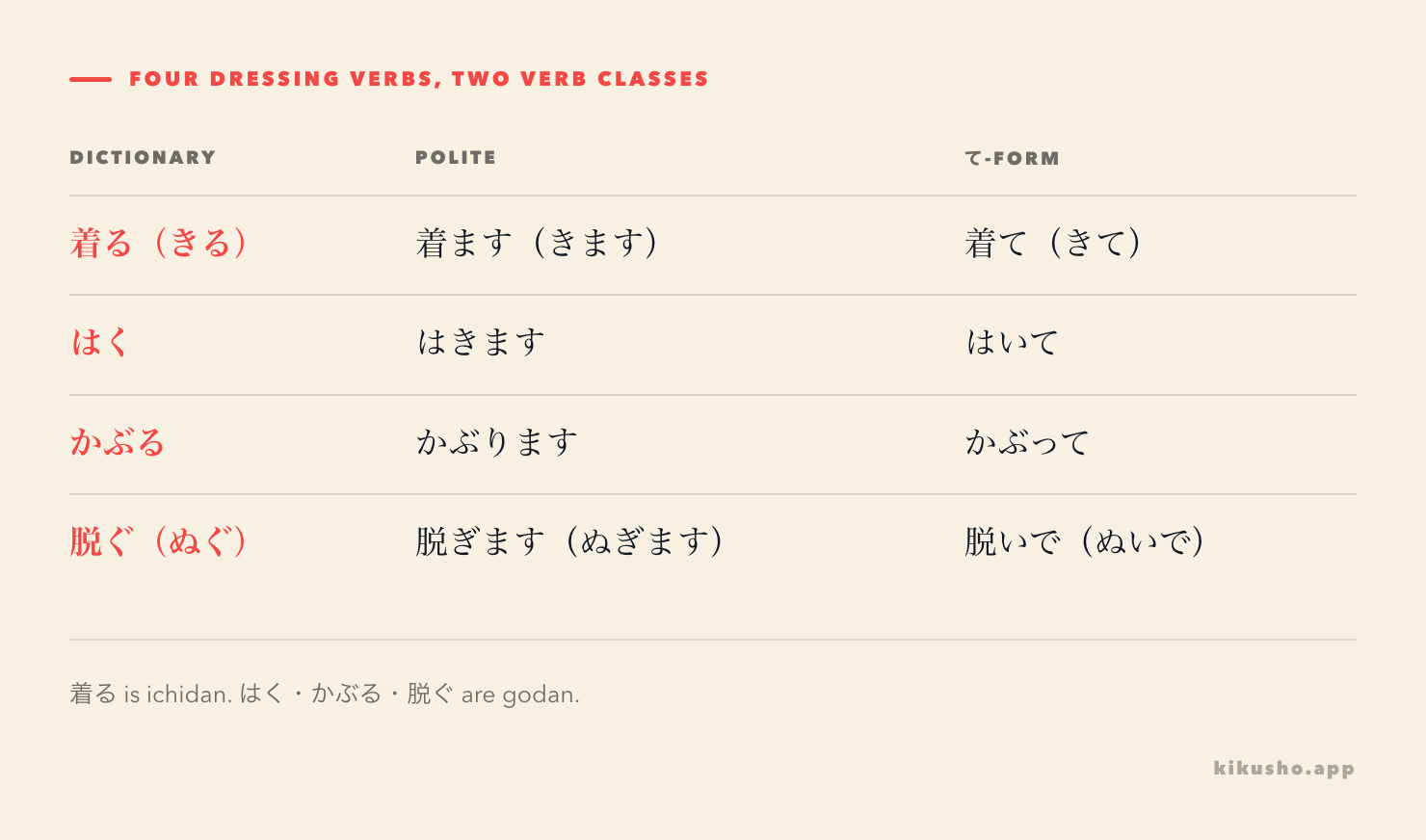
はく → はいて and 脱ぐ → 脱いで show the different て-form endings for these く and ぐ verbs. The N5 guide to making the て-form explains the wider pattern.
To describe someone's current outfit, you can use the resulting state:
兄は青いシャツを着ています。
あには あおい シャツを きています。
My older brother is wearing a blue shirt.
Here 着ています describes the shirt being on him. 着ます can describe putting it on, or wearing it as a habit, depending on context; it does not always mean a future action. For the broader distinction between an action and its resulting state, continue with ている and てある. To change the outfit's colour, the N5 colour-word lesson shows which words take い and which need の.
A business shirt, a jacket and a suit are different objects
服(ふく) is the broad clothing word. 洋服(ようふく) specifically names Western-style clothing, in contrast with traditional Japanese clothing. It describes the style, not a requirement that the item was manufactured abroad.
上着(うわぎ) can name a jacket or an outer or upper-body garment. コート names a coat more specifically. A セーター underneath a コート takes 着る just as the coat does; the verb does not tell you whether the garment is the outside layer.
背広(せびろ) is a men's business suit. NINJAL's 背広 entry describes a jacket-and-trousers set, with a waistcoat in a three-piece suit. Do not use 背広 as a general label for every formal outfit.
シャツ is a shirt; ワイシャツ identifies the dress or business-shirt type, usually with a collar and buttons. The name developed from English white shirt, but it does not require a white colour. Shogakukan's Japanese dictionary and encyclopedia entries explicitly include coloured and patterned shirts.
ボタンを留める(とめる) means to fasten a button; the とめる dictionary entry includes this fastening use. ポケットに入れる(いれる) means to put something in a pocket: に marks the destination, while the thing you put there takes を.
シャツのボタンを留めて、ポケットにかぎを入れます。
シャツの ボタンを とめて、ポケットに かぎを いれます。
I fasten my shirt's buttons and put my key in my pocket.
When you take off a jacket or shoes, 脱ぐ works with both 上着を脱ぐ and 靴を脱ぐ. It does not extend to every accessory: NINJAL's 脱ぐ entry excludes items such as a necktie from that use. You will also hear ネクタイを外す(はずす), “take off a tie.”
Shop labels make the katakana worth reading carefully
Notice the long-vowel bar in コート, スカート and セーター. ポケット has a small ッ, which gives the consonant a brief hold; ポケト drops that part of the word. シャツ uses small ャ in シャ, rather than the separate syllables シヤ.
These names fit department signs, garment labels and simple outfit descriptions. The katakana loanword guide explains why a familiar-looking borrowed word still needs its Japanese meaning and sound checked.
On an iPhone, Kikusho can turn a photo of a clothing sign into an editable vocabulary card. For this set, the useful edit is often the phrase: 帽子をかぶる preserves the verb that a card saying only “hat” would lose. Saved cards and their audio remain available for offline review.
The N5 label is a study-list estimate. The planning lists place these twenty words at N5, but they descend from Jonathan Waller's Tanos vocabulary lists and therefore share one source family. The official JLPT FAQ explains why there is no exhaustive published current vocabulary syllabus. Basic particles and verb forms are prerequisites; keep the extra verbs in phrases such as ネクタイを締める attached to their clothing context.
Vocabulary selection adapts the licensed N5 data in Jonathan Waller's original list, preserved by stephenmk and James Sinclair's Open Anki JLPT deck, under CC BY-SA 4.0. Readings and senses were checked separately; explanations, examples and questions below are original.
Practice questions
Make one choice for each numbered question. The explanation section follows the entire exercise, so you can work through all seven before checking.
Question 1
Choose the reading of the bold word.
この上着は少し大きいです。
ア. うわぎ
イ. うえき
ウ. じょうぎ
エ. じょうちゃく
Question 2
Choose the kanji for the bold word.
外に出るので、ぼうしをかぶります。
ア. 靴下
イ. 背広
ウ. 帽子
エ. 上着
Question 3
Choose the word that fits the context.
このズボンには( )が二つあります。そこにかぎを入れます。
ア. ネクタイ
イ. ポケット
ウ. シャツ
エ. 靴
Question 4
Complete the sentence to say you will put on the hat before going out.
出かける前に、この帽子を( )。
ア. 着ます
イ. はきます
ウ. 脱ぎます
エ. かぶります
Question 5
Choose the closest meaning of the bold phrase.
帰ってから、上着を脱ぎます。
ア. I will buy a jacket.
イ. I will take off my jacket.
ウ. I will put on my jacket.
エ. I will put my jacket in a pocket.
Question 6
Which spelling correctly represents the clothing word sweater?
ア. セタ
イ. セータ
ウ. セーター
エ. セッター
Question 7
Choose the closest description of ワイシャツ.
ア. A dress or business shirt, which may have a colour or pattern.
イ. Any piece of white clothing, including white trousers.
ウ. A winter overcoat worn outside a suit.
エ. A necktie worn with a shirt.
Answers and explanations
Answer 1
ア: うわぎ. 上着 is read うわぎ in this clothing sense. うえき is a different reading, familiar from 植木, “garden tree”; じょうぎ is the reading of 定規, “ruler.” じょうちゃく does not read this word. The sentence says, “This jacket is a little big.”
Answer 2
ウ: 帽子. 帽子 is ぼうし, a hat or cap. 靴下 is くつした, socks; 背広 is せびろ, a business suit; 上着 is うわぎ, a jacket or upper garment. The speaker is putting on a hat because they are going outside.
Answer 3
イ: ポケット. The trousers have two pockets, and the speaker puts a key there. A ネクタイ is a tie, a シャツ is a shirt, and 靴 are shoes; none names the trousers' small storage compartments. ポケットが二つあります describes two pockets; ポケットにかぎを入れます puts the key in one.
Answer 4
エ: かぶります. 帽子 takes かぶる for the putting-on meaning requested: “I will put on this hat before going out.” 着ます goes with body garments and はきます with legs or feet. 脱ぎます is taking something off, the opposite direction of the action in the prompt.
Answer 5
イ: I will take off my jacket. 脱ぎます is the polite form of 脱ぐ, “take off.” Buying would require 買う; putting on a jacket would use 着る. The phrase says nothing about a pocket. 帰ってから sets the time: after coming home.
Answer 6
ウ: セーター. The long-vowel bar occurs after both セ and タ. セタ drops both long vowels; セータ loses the final long vowel. セッター introduces a small ッ and represents a different word, setter, not sweater.
Answer 7
ア: a dress or business shirt. ワイシャツ names the shirt type, so a blue or patterned one can still be a ワイシャツ. White trousers are ズボン, an overcoat is コート, and a tie is ネクタイ. The word's history is a reason to check its present meaning rather than translate the English-looking parts literally.
Common questions
Which Japanese verb means to put on clothes?
着る(きる)is used for upper-body and full-body garments, such as a shirt or coat. はく is used for trousers, skirts, socks and shoes. かぶる is used for a hat. Learn the item together with its verb.
Does ワイシャツ always mean a white shirt?
ワイシャツ means a dress or business shirt, typically with a collar and buttons. Its name comes from white shirt, but coloured and patterned business shirts are also called ワイシャツ.
How are 履く and 穿く different?
Both are read はく. The conventional kanji distinction uses 履く for footwear and 穿く for clothing such as trousers and skirts. Writing はく in hiragana lets you use the same verb without choosing between these kanji. This lesson uses hiragana for socks too.