On this page
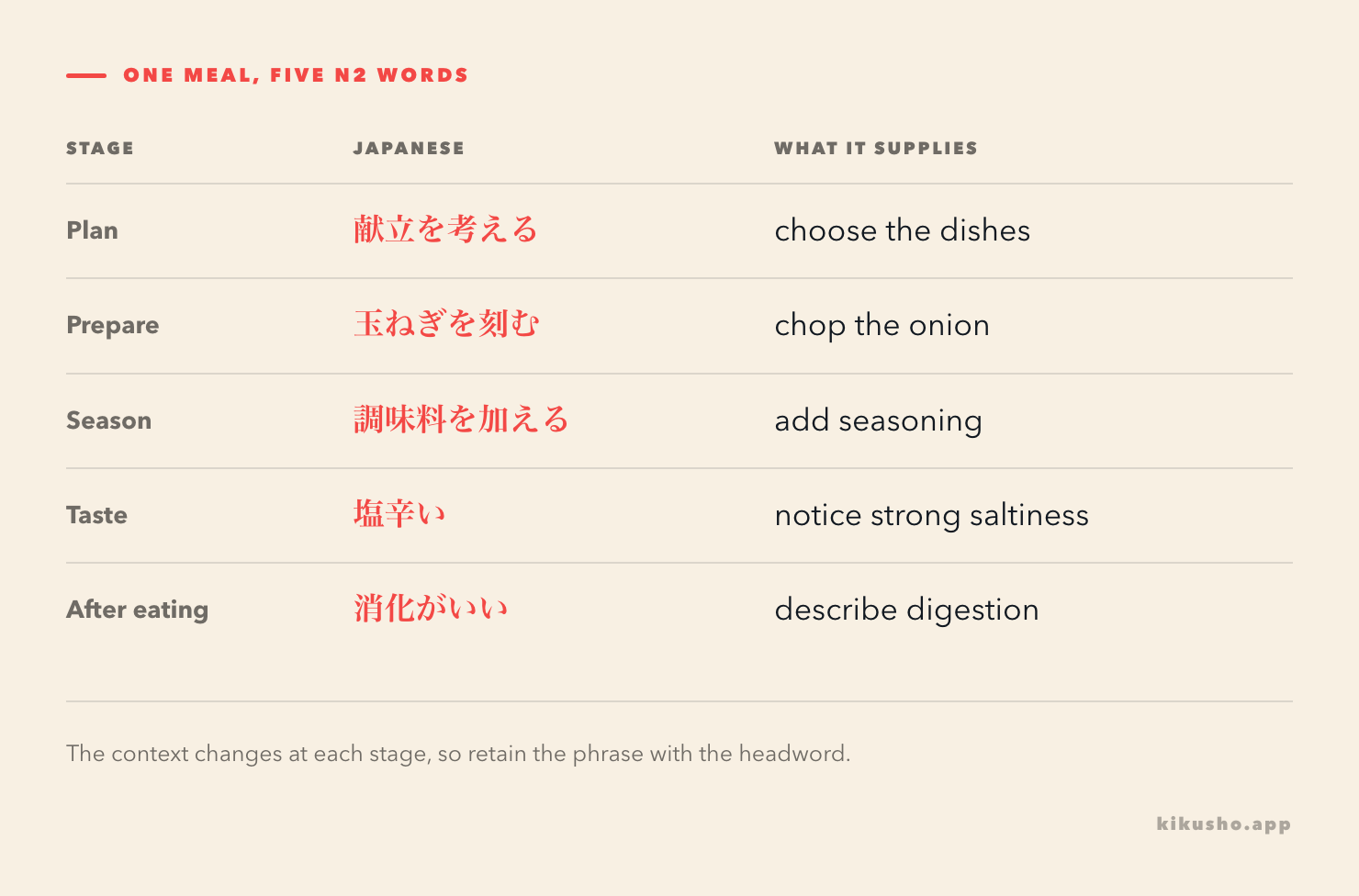
The five new words in this N2 vocabulary set take a meal from planning to its effect on the body: choose a 献立(こんだて), 刻む(きざむ)ingredients, add 調味料(ちょうみりょう), notice if the result is 塩辛い(しおからい), and talk about 消化(しょうか)after eating. A sixth assigned row, 蒸す(ふす), contains a bad reading; the correct cooking verb is 蒸す(むす), already taught in Kikusho's N3 cooking lesson.
Learn the five new words as one meal
| Word | Reading | Class | Meaning here | Phrase to retain |
|---|---|---|---|---|
| 献立 | こんだて | noun | meal plan; menu | 献立を考える: plan a menu |
| 刻む | きざむ | godan verb | chop or mince finely | 玉ねぎを細かく刻む: finely chop an onion |
| 調味料 | ちょうみりょう | noun | seasoning; condiment | 調味料を加える: add seasoning |
| 塩辛い | しおからい | i-adjective | salty; strong in salt | スープが塩辛い: the soup is salty |
| 消化 | しょうか | noun / suru verb | digestion; digesting | 消化がいい: easy to digest |
The readings are part of the words, not guesses made from one character. 献立 begins with こん, not けん. 調味料 keeps the long sequence ちょう・み・りょう. 塩辛い is しおからい even though 辛い alone has readings such as からい and つらい in other contexts.
These are the senses this lesson practises. 刻む can also mean carve or engrave, as in words or a design carved into a surface, and figuratively it can describe impressing something on the memory. 献立 can extend from a meal plan to an arrangement or plan for an activity. Keep the cooking phrase with the word first; it prevents a broad dictionary gloss from replacing the sense you actually met.
Level boundary: Kikusho's September 2026 reference inventory places all six assigned rows at N2, drawing on two retained lists from the same Tanos-Waller source family. That is a study placement, not an official syllabus: the JLPT publishes no exhaustive vocabulary list. Kanjipedia and Kotobank verify readings and meanings, while neither proves an official JLPT level.
Start with 献立: the dishes belong together
献立を考えます。(こんだてをかんがえます。) means “I plan the menu.” 献立 is more than one isolated dish: it can describe which dishes will be served and how they form a meal. Kotobank also records the combination and order of dishes, as well as the act of planning them.
野菜が多い献立を考えました。
やさいがおおいこんだてをかんがえました。
I planned a menu with plenty of vegetables.
At a restaurant, メニュー often names the document or list from which a customer chooses. 献立 can also mean “menu,” especially when attention falls on the planned contents of the meal. That is a useful tendency, not a rule that makes one of the words impossible in the other's setting.
The menu-reading guide teaches the repeated words that help you order, such as 定食, 単品 and 大盛り. This lesson instead gives you the language for discussing how dishes are combined and prepared.
刻む and 調味料 connect preparation to taste
Once the plan is set, a recipe may tell you to 玉ねぎを細かく刻んでください(たまねぎをこまかくきざんでください), “Please chop the onion finely.” 刻む focuses on cutting into small pieces. It does not merely say that a knife touched the ingredient.
The adverb 細かく makes the intended result explicit. Compare:
- 玉ねぎを切る: cut the onion.
- 玉ねぎを細かく刻む: chop the onion finely.
- 名前を石に刻む: engrave a name in stone.
The third example preserves the dictionary's broader “engrave” sense without pretending that it is a cooking action. The object selects the likely interpretation.
Next comes 調味料. Kanjipedia defines it as an ingredient used to adjust the taste of food and gives familiar examples such as soy sauce, salt and sugar. The word names the category; a recipe still needs to tell you which seasoning and how much.
玉ねぎを刻んでから、調味料を加えます。
たまねぎをきざんでから、ちょうみりょうをくわえます。
After chopping the onion, add the seasoning.
調味料で味を調えます。(ちょうみりょうであじをととのえます。) means “Adjust the flavour with seasoning.” The repeated 調 is a useful memory link: 調味料 helps you 調える, put the flavour in order. It is still better to retain the full phrases than to infer a new word's reading from that visual connection.
塩辛い reports salt, not chilli heat
このスープは少し塩辛いです。(このスープはすこししおからいです。) means “This soup is a little salty.” The adjective reports a strong salt taste. Kotobank also lists a hoarse voice as a separate, less central sense; food context selects saltiness here.
Do not reduce 塩辛い to 辛い. In 辛いカレー(からいカレー), 辛い can mean spicy-hot. In 辛い経験(つらいけいけん), the same spelling describes a painful or difficult experience. 塩辛い supplies しお explicitly and names saltiness.
The ending behaves like another i-adjective:
| Form | Japanese | Meaning |
|---|---|---|
| affirmative | 塩辛いです | it is salty |
| negative | 塩辛くないです | it is not salty |
| past | 塩辛かったです | it was salty |
| excessive | 塩辛すぎます | it is too salty |
If the dish is too salty, 調味料を入れすぎました(ちょうみりょうをいれすぎました), “I added too much seasoning,” may explain what happened. It does not prove that every seasoning is salt or that all seasoning makes food saltier.
消化 works as a noun and with する
After the meal, 消化 names digestion: the process by which food is broken down so that the body can absorb it. It appears as a noun in 消化がいい and as a suru verb in 食べ物を消化する.
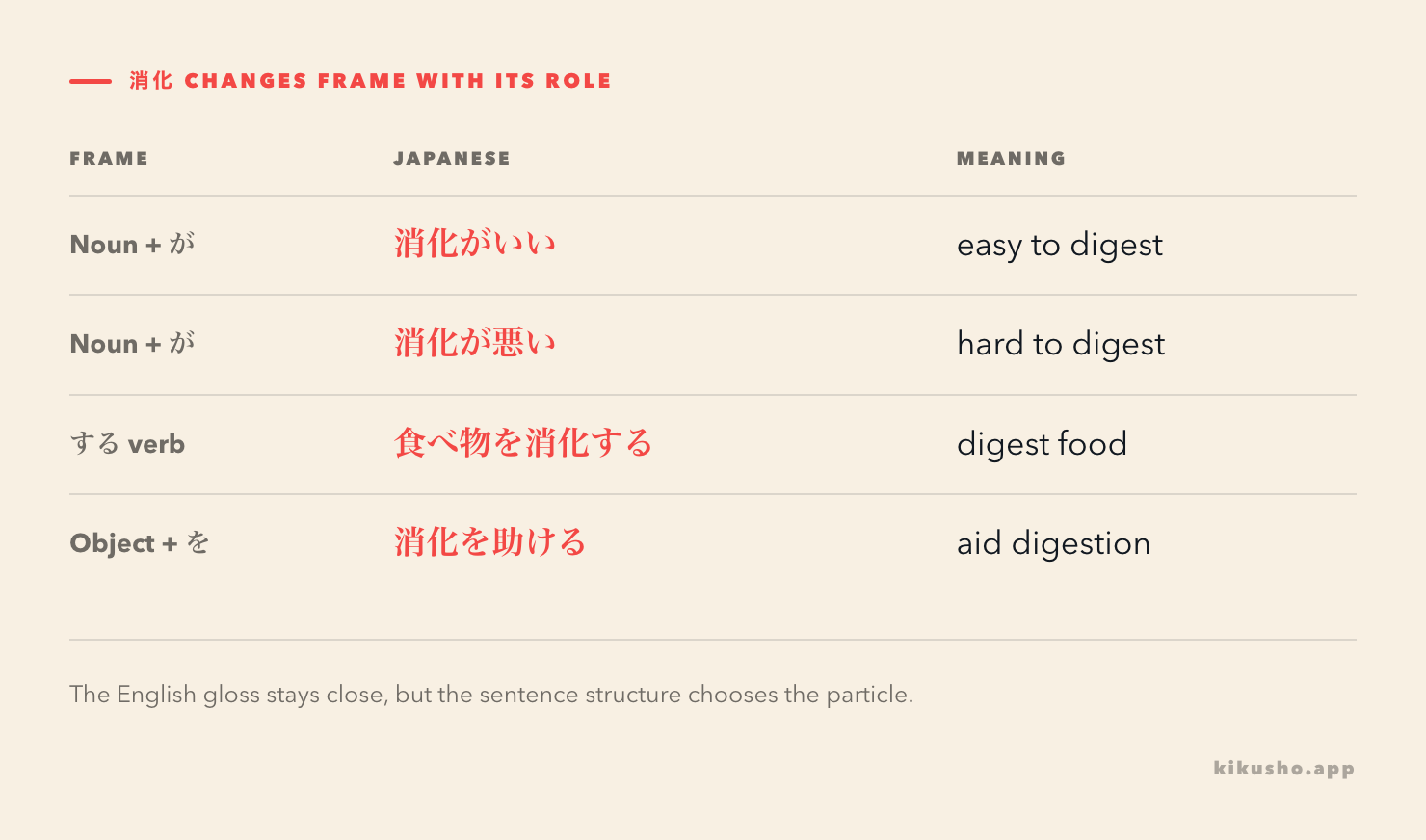
- この料理は消化がいいです。 This dish is easy to digest.
- 脂っこい物は消化が悪いことがあります。 Greasy food can be hard to digest.
- 胃で食べ物を消化します。 Food is digested in the stomach.
- 消化を助ける働きがあります。 It has a function that aids digestion.
In the first two frames, 消化 is the subject of いい or 悪い, so it takes が. In the last frame, it is what another action helps, so it takes を. Memorising “消化 equals digestion” does not choose the particle; the sentence frame does.
消化 also has extended meanings. A reader can 内容を消化する, fully absorb or make knowledge one's own, and a market can “absorb” goods. Those meanings share the idea of processing something, but a health or meal context normally selects bodily digestion.
Correct the 蒸す row instead of memorising it
One assigned N2 source row spells 蒸す and gives the reading ふす. Current dictionary evidence does not support that pair. Kanjipedia gives 蒸す as むす, including the cooking sense “heat with steam,” and Kotobank independently gives the same reading and sense.
The valid phrase is:
野菜を蒸す。
やさいをむす。
Steam the vegetables.
This is a source-data correction, not a second N2 headword. Do not study 蒸す(ふす). Kikusho's N3 cooking-method lesson already teaches 蒸す(むす) beside 揚げる, 炒める, 茹でる and 煮る. Use that lesson when you need to compare cooking methods; keep this page focused on the five new N2 items.
Read the whole chain in context
今週の献立を考えて、必要な材料を買いました。まず玉ねぎを細かく刻み、調味料を加えました。しかし、味見をすると少し塩辛かったので、作り方を変えました。次は、消化がいい料理になるように、油を減らすつもりです。
こんしゅうのこんだてをかんがえて、ひつようなざいりょうをかいました。まずたまねぎをこまかくきざみ、ちょうみりょうをくわえました。しかし、あじみをするとすこししおからかったので、つくりかたをかえました。つぎは、しょうかがいいりょうりになるように、あぶらをへらすつもりです。
I planned this week's menu and bought the necessary ingredients. First I finely chopped an onion and added seasoning. However, when I tasted it, it was a little salty, so I changed the method. Next time, I intend to use less oil so that the dish is easier to digest.
Each target word performs a different job. 献立 is the plan, 刻む is the preparation, 調味料 is what is added, 塩辛い evaluates the result, and 消化 describes what happens after eating. Reconstructing that sequence gives you more retrieval cues than rehearsing five unrelated English glosses.
When you capture one of these words from a recipe or package in Kikusho, retain the nearby object or predicate: 玉ねぎを刻む, 調味料を加える, or 消化がいい. Check the drafted reading before saving, especially when the source itself may contain an error.
Practice
Answer all seven questions before opening the explanations below.
Question 1
A family plans which dishes to serve for the week. Which word best names that plan?
A. 献立
B. 調味料
C. 消化
D. 塩辛い
Question 2
Which reading correctly completes 玉ねぎを細かく刻む?
A. たたむ
B. きざむ
C. はさむ
D. つつむ
Question 3
Which spelling represents ちょうみりょう, an ingredient used to adjust flavour?
A. 長味料
B. 調未料
C. 調味料
D. 超味量
Question 4
After tasting a soup, you say 塩辛すぎます. What is the problem?
A. It is too sweet.
B. It is too spicy-hot.
C. It is too salty.
D. It is too cold.
Question 5
Choose the most natural completion: この料理は__がいいので、体調が悪い日にも食べやすいです.
A. 献立
B. 消化
C. 刻む
D. 調味料
Question 6
Which entry should not be memorised as a valid cooking word?
A. 献立(こんだて)
B. 刻む(きざむ)
C. 蒸す(むす)
D. 蒸す(ふす)
Question 7
Read the sentence:
料理人は新しい献立を考え、野菜を細かく刻んだ。調味料を加えたが、味見をすると塩辛かった。
Which statement is supported?
A. The cook steamed the vegetables.
B. The cook found the dish salty after adding seasoning.
C. The cook could not digest the meal.
D. The cook engraved the menu in stone.
Answers and explanations
Answer 1
A. 献立. 献立(こんだて) names the planned combination or order of dishes. 調味料 is seasoning, 消化 is digestion, and 塩辛い is an adjective describing strong saltiness.
Answer 2
B. きざむ. 刻む is read きざむ. With 玉ねぎ and 細かく, it means finely chop the onion. The same verb can mean carve or engrave with a different object, but none of the other readings spells 刻む.
Answer 3
C. 調味料. The three parts are 調(ちょう), 味(み)and 料(りょう). The distractors imitate the sound or shape but are not the target spelling. 調味料を加える means “add seasoning.”
Answer 4
C. It is too salty. 塩辛い(しおからい) reports a strong salt taste, and すぎる marks excess. Spicy-hot food can be 辛い(からい), but the explicit 塩 distinguishes saltiness here.
Answer 5
B. 消化. 消化がいい means easy to digest. 献立がいい could praise a menu in another sentence, but the clause about being easy to eat when unwell selects digestion. 刻む is a verb and 調味料 names seasoning.
Answer 6
D. 蒸す(ふす). The retained source row's reading is malformed. The cooking verb is 蒸す(むす), “steam.” Current Kanjipedia and Kotobank entries agree on むす, and the earlier N3 lesson is its canonical treatment.
Answer 7
B. The sentence says that the cook planned a new menu, finely chopped vegetables, added seasoning and then found the result salty on tasting it. It never says the vegetables were steamed, mentions no digestion problem, and uses 刻む in its culinary sense rather than “engrave.”
Common questions
What is the difference between 献立 and メニュー?
Both can refer to a menu. 献立 commonly focuses on the planned combination or order of dishes in a meal, while メニュー can also mean the printed list of choices at a restaurant. Context determines the natural word.
How do you say that food is too salty in Japanese?
この料理は塩辛すぎます means “This dish is too salty.” 塩辛い describes a strong salt taste. It does not mean spicy-hot, even though its final two characters also appear in 辛い.
Is 蒸す read ふす or むす?
The cooking verb 蒸す is read むす. One retained N2 source row gives ふす, but current dictionary evidence does not support that reading for this word. The lesson corrects the source row rather than teaching it.