On this page
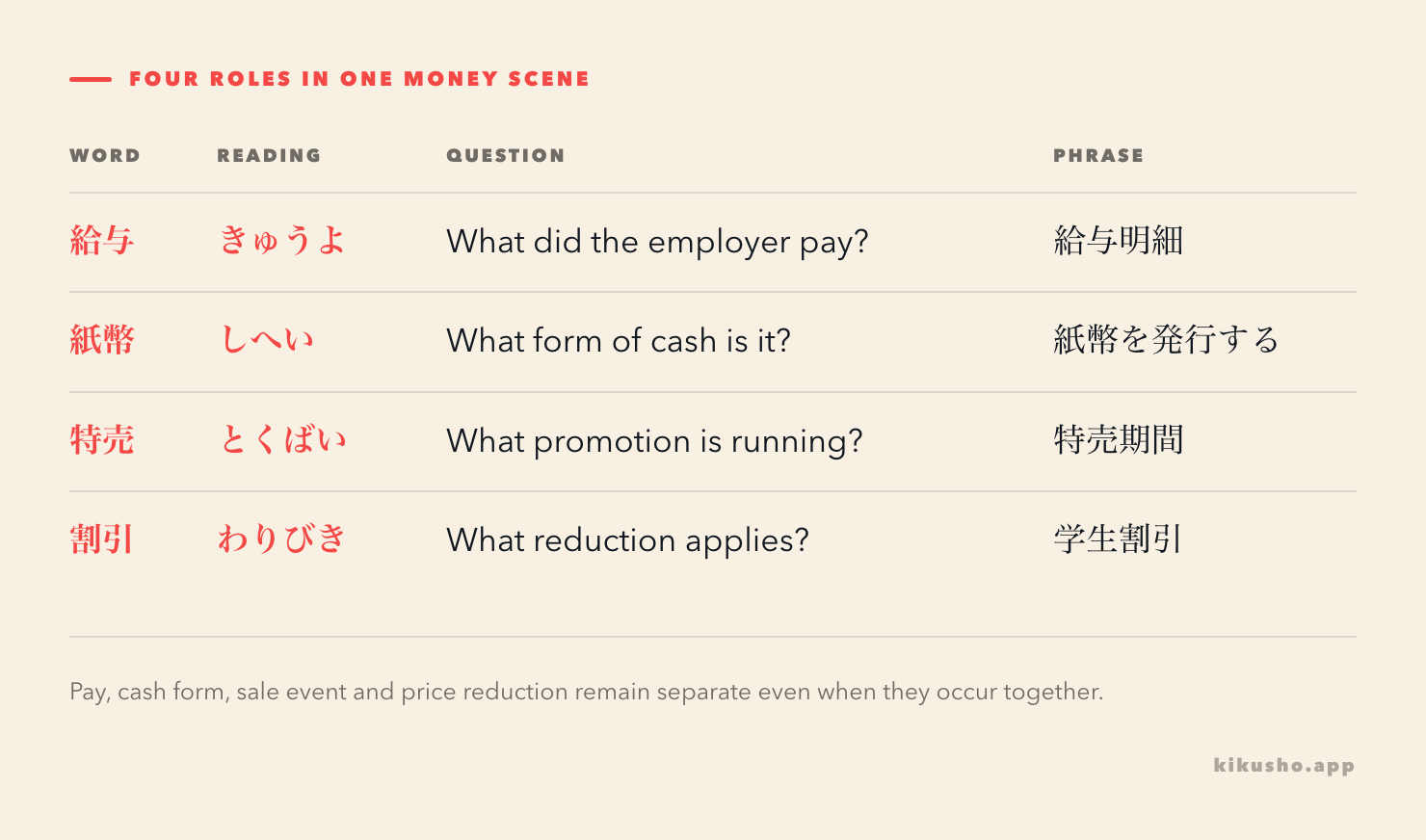
At N2, 給与, 紙幣, 特売 and 割引 divide a money scene into four different jobs: pay from an employer, a banknote, a limited sale and a reduction from a price. Learn the role each noun fills, and a payslip or shop notice becomes easier to read than four isolated English glosses suggest.
The words can meet in one ordinary sequence. 給与 arrives in an account, a shop advertises a 特売, a product receives a 割引, and a customer may still hand over a 紙幣 at the register.
Four nouns answer four different questions
Each word below is a noun. 給与 and 特売 also have dictionary entries as suru verbs, although the pay sense of 給与 is most useful first as a noun in compounds such as 給与明細.
| Word | Reading | Part of speech | Core sense | Phrase to recognise |
|---|---|---|---|---|
| 給与 | きゅうよ, kyūyo | noun; suru verb in its broader supply sense | pay or compensation from an employer | 給与明細: payslip |
| 紙幣 | しへい, shihei | noun | banknote; paper money | 紙幣を発行する: issue banknotes |
| 特売 | とくばい, tokubai | noun; suru verb | limited special sale | 特売品: sale item |
| 割引 | わりびき, waribiki | noun | discount; reduction from a price or rate | 学生割引: student discount |
The kanji help if you keep the complete compounds. 給 concerns supplying, 与 giving; 紙 is paper and 幣 belongs to money or currency; 特売 is special selling; 割引 literally carries the idea of taking a portion away. Those hints support retrieval, but the phrases in the final column show how the words actually enter a sentence.
給与 is the formal pay category around 給料
給与(きゅうよ) appears in employment conditions, payroll systems, tax language and documents. Digital Daijisen's 給与 entry gives the workplace sense as the collective name for salary and allowances paid by a company or public body.
来月から給与が銀行口座に振り込まれます。
らいげつからきゅうよがぎんこうこうざにふりこまれます。
Starting next month, my pay will be deposited into my bank account.
The everyday 給料(きゅうりょう) from the N3 money lesson names salary or wages received for work. The words overlap, so replacing every 給料 with 給与 does not create a new factual meaning. The main difference is viewpoint and register: 給料 sounds at home in a conversation about payday, while 給与 sounds at home on the page that calculates and records compensation.
| Conversation or personal experience | Payroll or employment record |
|---|---|
| 給料をもらう | 給与を支給する |
| 給料日 | 給与明細 |
| 給料が上がった | 給与所得 |
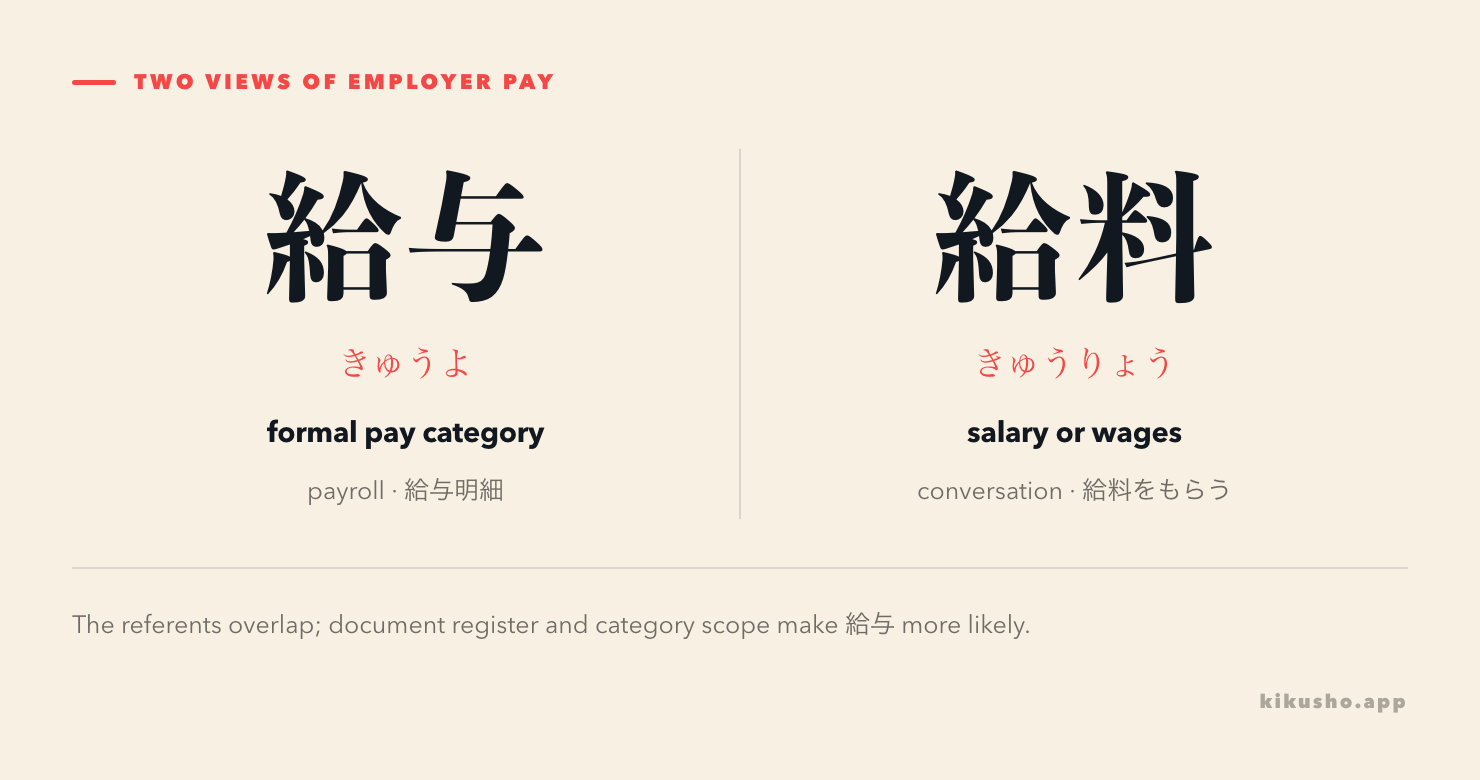
給与を支給する takes the employer or institution as the giver. From the employee's side, 給与を受け取る or 給与が振り込まれる is natural. The broader dictionary sense of 給与 can also mean supplying goods or equipment, as in 制服を給与する, but a payslip context selects employer compensation.
紙幣 names the cash category, not one denomination
紙幣(しへい) is the formal category word for a banknote or paper currency. It contrasts with 硬貨(こうか), a coin:
財布には紙幣が一枚と硬貨が数枚入っています。
さいふにはしへいがいちまいとこうかがすうまいはいっています。
There is one banknote and several coins in the wallet.
Count individual banknotes with 枚. A denomination can modify the category, as in 一万円紙幣, but conversation more often uses 一万円札. お札, 千円札 and 紙幣 can point to the same physical object; 紙幣 classifies it, while 札 is the everyday banknote word in a concrete amount.
In Japan, the formal name printed on the notes is 日本銀行券. The Bank of Japan's account of issuance and circulation explains that banknotes enter circulation through financial institutions and are used to buy goods and services. This gives 紙幣を発行する, 紙幣が流通する and 紙幣を交換する their institutional setting.
新しい紙幣はいつ発行されましたか。
あたらしいしへいはいつはっこうされましたか。
When were the new banknotes issued?
お金 is wider than 紙幣: it can include coins, account balances and money considered abstractly. 現金 names cash as a payment form and can contain both 紙幣 and 硬貨. Asking which layer the sentence needs prevents all four nouns from collapsing into “money.”
特売 is the event; 割引 is the reduction
特売(とくばい) describes selling selected goods cheaply for a limited period. Digital Daijisen explicitly includes both the time limit and the specially low price in its ordinary retail sense.
スーパーでは今週末、果物を特売します。
スーパーではこんしゅうまつ、くだものをとくばいします。
The supermarket will hold a special sale on fruit this weekend.
Useful compounds make the event visible:
- 特売日(とくばいび): special-sale day
- 特売期間(とくばいきかん): special-sale period
- 特売品(とくばいひん): an item offered in the special sale
- 本日特売(ほんじつとくばい): on special sale today
割引(わりびき) names the reduction itself. Kotobank's usage entry records price, cash-purchase and group-discount patterns. It can apply inside a 特売, but it also appears in standing rules that are not special-sale events: student discounts, group discounts, early-booking discounts and reduced fares.
会員はこの商品を二割引で買えます。
かいいんはこのしょうひんをにわりびきでかえます。
Members can buy this product at 20 percent off.
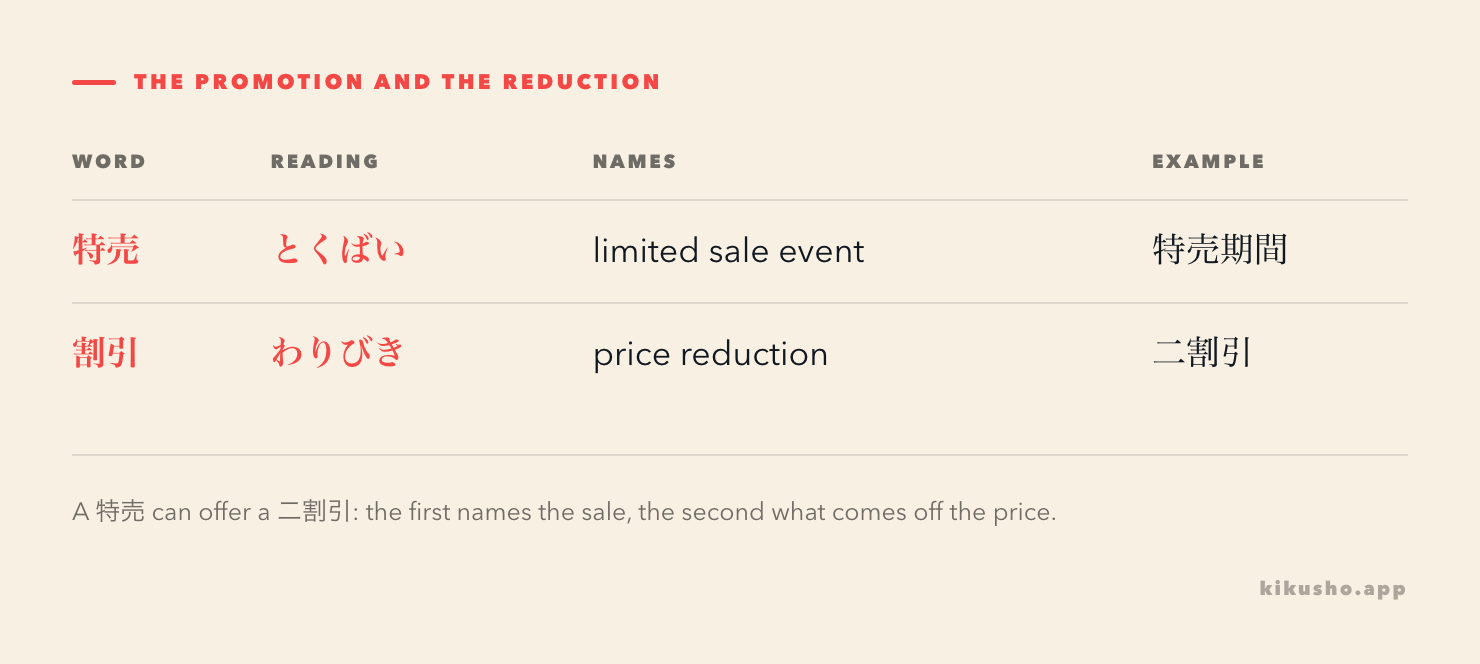
The relationship can be written in one sentence:
特売期間中は、対象商品が二割引になります。
とくばいきかんちゅうは、たいしょうしょうひんがにわりびきになります。
During the special-sale period, eligible products will be 20 percent off.
Here 特売期間 supplies the event and 二割引 supplies the reduction. A notice saying 特売 does not, by itself, tell you the exact percentage. A notice saying 学生割引 can describe a continuing eligibility rule without announcing a 特売.
割引 signs require one small calculation
Japanese uses 割(わり) for tenths. One 割 is 10 percent, so the amount before 割引 tells you how much is removed from the original price:
| Sign | Amount removed | Amount paid |
|---|---|---|
| 一割引 | 10% | 90% |
| 二割引 | 20% | 80% |
| 三割引 | 30% | 70% |
| 五割引 | 50% | 50% |
For a ¥10,000 product, 三割引 removes ¥3,000 and leaves ¥7,000 to pay. The grammar lesson on ということは as an inference uses this same calculation as a premise leading to a conclusion.
The noun is normally written 割引 in compounds and signs: 割引券, 割引率, 団体割引. The corresponding verb is 割り引く: 料金を二割割り引く, “reduce the fee by 20 percent.” Keep 値引き nearby but separate. It also means a price reduction, often one made on a particular item or through negotiation; 割引 is especially productive in named rates and eligibility schemes.
One payslip and one shop notice connect the set
給与明細を確認したあと、週末の特売に行きました。会員割引でかばんが二割引になったので、一万円紙幣で支払いました。
きゅうよめいさいをかくにんしたあと、しゅうまつのとくばいにいきました。かいいんわりびきでかばんがにわりびきになったので、いちまんえんしへいでしはらいました。
After checking my payslip, I went to the weekend sale. A member discount made the bag 20 percent off, so I paid with a 10,000-yen banknote.
The sentence moves through four roles in order. 給与 appears inside the employment document 給与明細. 特売 names the weekend promotion. 割引 first names the membership rule and then the rate applied. 紙幣 identifies the physical cash handed over.
The same event could be described more casually with 給料 and 一万円札. That register change does not alter the transaction. It changes how the speaker packages pay and cash for the setting.
N2 is a study placement, not an official word list
Kikusho's September 2026 reference inventory assigns all four spelling-and-reading records to N2 and records no placement disagreement for them. Both planning inputs ultimately reuse Waller/Tanos data, so their identical N2 labels amount to one source-family observation.
Current independent teaching pages also place the words in N2 material: Japanese Compass lists 給与, Benri Japan teaches 紙幣, Bunpro labels 特売, and the inspected Unseen Japan N2 list includes 割引. These placements support a useful study order, but the JLPT publishes no exhaustive current vocabulary syllabus. The readings, senses and sentence roles remain useful even if another course introduces a word earlier or later.
Eight attempts before the explanations
Answer every item before opening the solution block.
Question 1 — reading. What is the reading of 給与?
- ア. きゅうりょう
- イ. きゅうよ
- ウ. きょうよ
- エ. きゅよ
Question 2 — orthography. Choose the spelling read しへい that means a banknote.
- ア. 紙幣
- イ. 紙弊
- ウ. 指幣
- エ. 紙枚
Question 3 — word formation. Which word completes a standard compound meaning “student discount”: 学生( )?
- ア. 特売
- イ. 紙幣
- ウ. 割引
- エ. 給与
Question 4 — context. A supermarket offers selected vegetables cheaply only this weekend. Which noun best names the promotion?
- ア. 給与
- イ. 特売
- ウ. 紙幣
- エ. 割引率
Question 5 — category. Which word completes the contrast: 財布には( )が一枚と硬貨が三枚ある?
- ア. 紙幣
- イ. 給与
- ウ. 特売
- エ. 割引
Question 6 — paraphrase. Which description best matches 給与明細?
- ア. A notice showing a limited shop promotion
- イ. A record showing an employee's pay and related calculations
- ウ. A machine that exchanges banknotes for coins
- エ. A coupon reducing a ticket price
Question 7 — usage. Which sentence uses its bold word naturally?
- ア. 会社は毎月の紙幣を計算します。
- イ. 破れた給与を銀行で交換しました。
- ウ. この商品は今日だけ三割引です。
- エ. 学生なら運賃が特売日になります。
Question 8 — connected text. Read the notice and choose the accurate account.
本日は靴の特売日です。会員のお客様は表示価格から二割引になります。お支払いには紙幣もご利用いただけます。
- ア. Members receive 20 percent of the displayed price and cannot use cash.
- イ. Shoes are on special sale today; members get 20 percent off and may use banknotes.
- ウ. The shop pays members a salary equal to the price of their shoes.
- エ. Every banknote is sold for 20 percent of its face value.
Answers and explanations
Answer 1. イ, きゅうよ. 給与 has two long-vowel morae in きゅう and is followed by よ. きゅうりょう is 給料, the related everyday salary word.
Answer 2. ア, 紙幣. 紙 supplies the paper element and 幣 the currency element. The other choices replace one character with a lookalike or a counter and do not write the assigned word.
Answer 3. ウ, 割引. 学生割引 is a student discount. 特売 is a special sale, while 紙幣 and 給与 belong to banknotes and employer pay.
Answer 4. イ, 特売. A temporary event in which selected goods are sold cheaply is a 特売. 割引率 would name a reduction rate, but the prompt gives no percentage and asks for the promotion itself.
Answer 5. ア, 紙幣. The counter 一枚 and the contrast with 硬貨 select a banknote. None of the other nouns names a physical cash category that can sit in the wallet this way.
Answer 6. イ. 給与明細 is a payroll statement or payslip. It records compensation and related calculations; it is not a shop notice, change machine or discount coupon.
Answer 7. ウ. 三割引です naturally states that the item is 30 percent off. In ア, a company calculates 給与, not a physical cash category. In イ, a damaged 紙幣 can be exchanged, but 給与 cannot fill that role. In エ, a student fare receives a 割引; 特売日 names a special-sale day at a retailer.
Answer 8. イ. 特売日 identifies today's shoe promotion, 二割引 removes 20 percent from the displayed price for members, and 紙幣もご利用いただけます permits banknotes. 二割引 does not mean the customer pays only 20 percent.
When these words appear outside a list, save the frame that chose them: 給与明細 on a document, 新紙幣 in a news report, 本日特売 on a sign or 学生割引 beside a fare. The surrounding noun and number preserve the distinction that an English gloss alone erases.
Common questions
Are 給与 and 給料 the same in Japanese?
Both can refer to pay from an employer. 給料 is the ordinary word for salary or wages, while 給与 is common in payroll, employment and administrative language and can cover salary together with allowances and other pay.
Is 紙幣 the same as お札?
They can refer to the same banknote, but their register differs. 紙幣 is the category term used in explanations and formal writing; お札 and denomination forms such as 千円札 are more conversational.
Does 三割引 mean that the customer pays 30 percent?
No. 三割引 means 30 percent is removed from the original price, so the customer pays 70 percent. A ¥10,000 item therefore costs ¥7,000.
What is the difference between 特売 and 割引?
特売 describes a limited special sale or the act of offering goods cheaply. 割引 describes the reduction applied to a price, fare or fee. A 特売 can use a 割引, but the words do not name the same part of the offer.