On this page
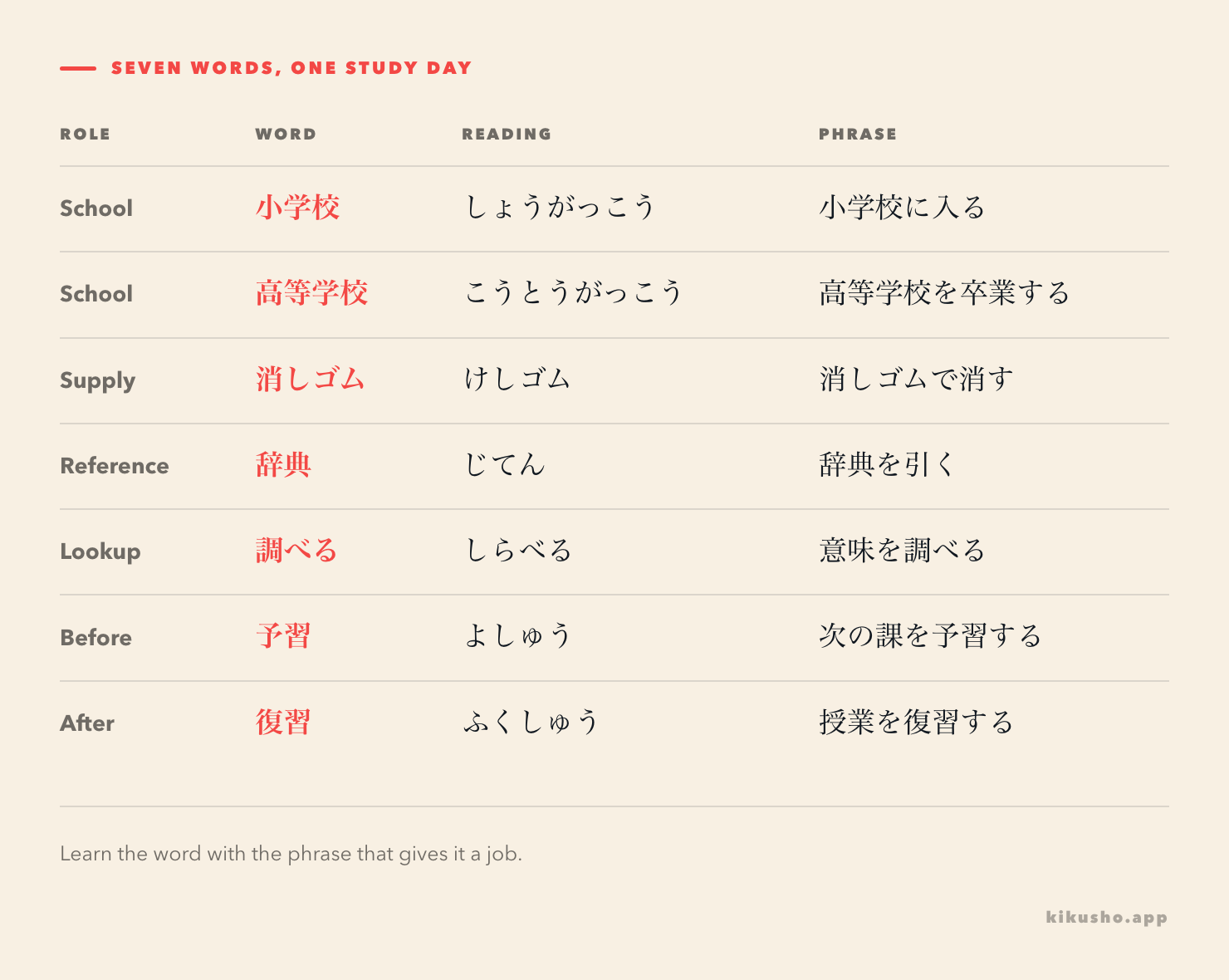
These seven N4 words form one usable study routine. You go to 小学校(しょうがっこう) or 高等学校(こうとうがっこう), bring a 消しゴム(けしゴム), use a 辞典(じてん) to 調べる(しらべる), then divide your work into 予習(よしゅう) before class and 復習(ふくしゅう) afterwards.
The earlier N5 school-and-study lesson teaches 学校, ノート, 宿題, 教える and 習う. Those are prerequisites here. This lesson adds two specific school names, one supply, one reference book, one lookup verb and the two directions of a study cycle.
The N3 continuation moves inside that cycle with 暗記, 学習, 記憶 and 学ぶ, then adds the classroom tools and reading activity used around them.
Seven words arranged around a lesson
The table keeps every assigned spelling and reading visible. Learn the final column as a phrase rather than attaching the word to one English gloss.
| Role | Word | Reading | Meaning and part of speech | Useful phrase |
|---|---|---|---|---|
| School | 小学校 | しょうがっこう | elementary or primary school; noun | 小学校に入る, enter elementary school |
| School | 高等学校 | こうとうがっこう | senior high school; noun | 高等学校を卒業する, graduate from high school |
| Supply | 消しゴム | けしゴム | eraser; noun | 消しゴムで字を消す, erase writing with an eraser |
| Reference | 辞典 | じてん | dictionary, lexicon; noun | 国語辞典を引く, consult a Japanese dictionary |
| Lookup action | 調べる | しらべる | look up, check, investigate; transitive る-verb | 意味を調べる, look up a meaning |
| Before class | 予習 | よしゅう | preparation for a lesson; noun / する-verb | 次の課を予習する, prepare the next lesson |
| After class | 復習 | ふくしゅう | review of learned material; noun / する-verb | 今日の授業を復習する, review today's lesson |
Read the small っ in both school names: しょうがっこう and こうとうがっこう. The first two long vowels also matter. 消しゴム mixes kanji, hiragana and katakana; the usual spelling is not 消しごむ or 消ゴム in ordinary learner writing.
小学校 and 高等学校 name institutions, not students
小学校 is the elementary or primary school itself. A child attending it is a 小学生(しょうがくせい). Compare the endings:
弟は来年、小学校に入ります。
おとうとは らいねん、しょうがっこうに はいります。
My younger brother will enter elementary school next year.
妹は小学生です。
いもうとは しょうがくせいです。
My younger sister is an elementary school student.
学校 ends in こう and names the institution; 学生 ends in せい and names a learner. That same distinction applies when another level comes before the ending.
高等学校 is the full term for senior high school. 高校(こうこう) is its common abbreviation. They do not describe two stages of education. The TKG learner's dictionary entry identifies 高等学校 as the formal or official term and 高校 as the everyday short form. The earlier N4 school-and-work lesson teaches that shorter word in its own assigned set.
申込書に高等学校の名前を書いてください。
もうしこみしょに こうとうがっこうの なまえを かいてください。
Please write the name of your high school on the application form.
An official school name or document is a natural place for the full form. In an ordinary conversation, どこの高校ですか, “Which high school is it?”, is lighter. The difference is one of form and setting, not school type.
辞典で意味を調べる joins a resource to an action
調べる is a transitive る-verb. The unknown fact takes を, while the resource used to find it can take で:
わからない言葉の意味を辞典で調べました。
わからない ことばの いみを じてんで しらべました。
I looked up the meaning of an unfamiliar word in a dictionary.
Here 意味を is what the learner checks and 辞典で is the means. The same verb extends beyond vocabulary: 時間を調べる checks a time, 原因を調べる investigates a cause, and 持ち物を調べる examines someone's belongings. Daijisen's 調べる entry groups looking up uncertain information with checking and investigating. The study context selects the “look up” sense.
辞典 and the N5 word 辞書(じしょ) overlap. Titles commonly use 国語辞典, 英和辞典 and 漢和辞典. In ordinary speech, 辞書を引く and 辞書で調べる are very common, and 電子辞書 naturally names an electronic dictionary. Japan's National Diet Library reference service defines 辞典 as a work explaining words, their readings, meanings and usage. Gakken's dictionary note adds that 辞書 is the broader label and more readily covers digital resources.
Do not turn that tendency into a rigid correction. 辞典で調べる and 辞書で調べる can both be natural. This lesson targets 辞典 because it is the assigned headword; the contrast explains why the familiar 辞書 has not disappeared.
予習 points forward; 復習 points back
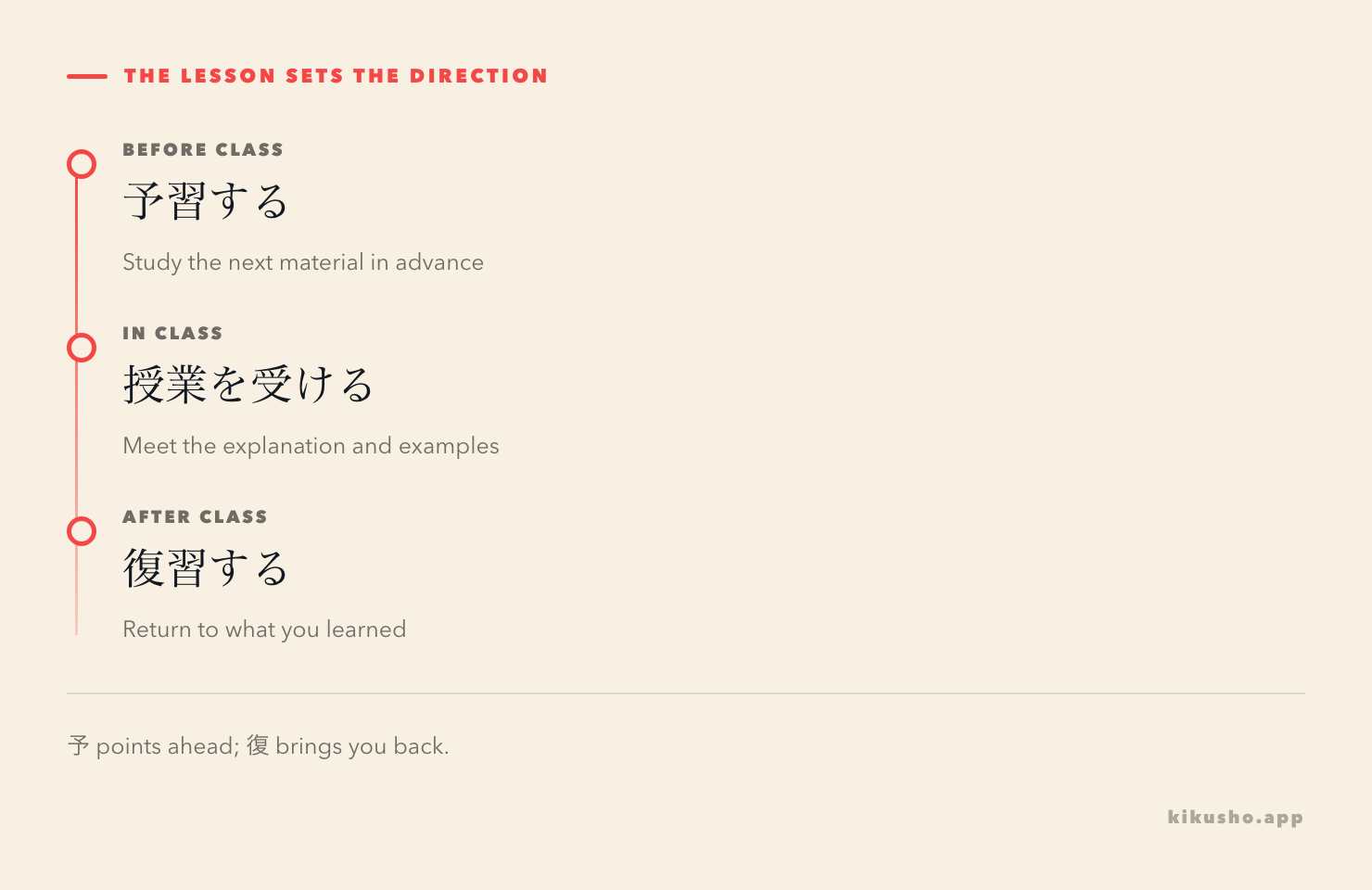
The two study nouns share 習, “learning or practice,” but their first kanji supplies the direction. 予 points ahead, before the lesson. 復 returns to material already encountered.
| When | Action | What the learner does |
|---|---|---|
| Before class | 予習する | Read the next section, check new words, prepare questions |
| During class | 授業を受ける | Meet the explanation and examples |
| After class | 復習する | Return to the lesson, retry examples, correct mistakes |
明日の授業のために、次の課を予習します。
あしたの じゅぎょうの ために、つぎの かを よしゅうします。
I will prepare the next lesson for tomorrow's class.
家に帰ってから、今日の漢字を復習します。
いえに かえってから、きょうの かんじを ふくしゅうします。
After I get home, I will review today's kanji.
Daijisen defines 予習 as studying material in advance and 復習 as studying learned material again. Both entries explicitly contrast the two words. They can take する directly or appear with をする: 授業を復習する and 授業の復習をする are both available patterns.
消しゴム is the tool, so it takes で
消しゴム is an eraser used to remove pencil marks. Daijisen's entry gives the reading けしゴム and defines the object by that use. In a sentence, the eraser is usually the instrument marked by で:
間違えた字を消しゴムで消しました。
まちがえた じを けしゴムで けしました。
I erased the incorrect character with an eraser.
消しゴムを使う makes the eraser the direct object of “use.” 消しゴムで消す instead makes it the means of erasing. The repeated 消し/消す is useful word formation: both point to making a mark disappear, while ゴム identifies the object.
Kikusho's two related Waller-derived inventory snapshots place all seven items at N4. Bunpro independently agrees on N4 for 調べる, 高等学校, 小学校, 辞典, 予習 and 復習, but places 消しゴム at N5. That disagreement is normal for unofficial study lists. The official JLPT FAQ explains why the current test does not publish an exhaustive vocabulary, kanji and grammar list.
Keep the phrase that tells you what happened
A school handout may contain several words from this set at once: 次の課を予習し、わからない言葉は辞典で調べてください, “Prepare the next lesson, and look up unfamiliar words in a dictionary.” The surrounding phrase tells you far more than seven separate translations.
If you photograph that instruction in Kikusho, highlight the complete action 辞典で調べる or 次の課を予習する. Check the generated reading and example before saving the card. Later reviews then return the word with the particle and object that made it understandable in the first place.
Practice: answer all eight before checking
Question 1
Which reading matches 小学校?
- A. しょうかっこう
- B. しょうがっこう
- C. しょがくこう
- D. しょうがくこう
Question 2
Which written form matches けしゴム?
- A. 消しコム
- B. 消ゴーム
- C. 消しゴム
- D. 消すゴム
Question 3
Tomorrow's class will cover Chapter 6. Which action happens before that class?
- A. 第六課を予習します。
- B. 第六課を復習しました。
- C. 消しゴムで調べます。
- D. 小学校を消します。
Question 4
Complete the sentence: わからない言葉の意味を辞典で( )。
- A. 入ります
- B. 卒業します
- C. 消します
- D. 調べます
Question 5
Which sentence naturally says “I erased the mistake with an eraser”?
- A. 間違いを消しゴムに消しました。
- B. 間違いを消しゴムで消しました。
- C. 消しゴムを間違いで消しました。
- D. 消しゴムが間違いを調べました。
Question 6
You returned to today's lesson after class and studied it again. Which word describes that action?
- A. 小学校
- B. 予習
- C. 復習
- D. 辞典
Question 7
An application asks for the full formal name of your senior high school. Which expression fits?
- A. 高等学校
- B. 小学生
- C. 高校生
- D. 小学校
Question 8
Which paraphrase preserves the meaning of 授業の前に新しい言葉を予習しました?
- A. I reviewed old words after the lesson.
- B. I erased new words during the lesson.
- C. I entered elementary school before the lesson.
- D. I studied the new words before the lesson.
Answers and explanations
Answer 1
B. しょうがっこう. 小学校 has the long しょう, voiced が, small っ and final long こう. A changes が to か; C and D lose part of the long-vowel or doubled-consonant pattern.
Answer 2
C. 消しゴム. The usual spelling combines 消, hiragana し and katakana ゴム. A changes ゴ to コ, B invents a long vowel, and D uses the dictionary-form verb 消す instead of the noun-forming stem 消し.
Answer 3
A. 第六課を予習します. 予習 is preparation before material is taught. B names review after learning and is also in the past tense. C gives an eraser the wrong role for looking something up, and D says to erase an elementary school.
Answer 4
D. 調べます. The sentence means “I look up the meaning of an unfamiliar word in a dictionary.” 意味を is the information checked and 辞典で names the resource. The other verbs mean enter, graduate and erase.
Answer 5
B. 間違いを消しゴムで消しました. で marks the eraser as the instrument used to erase the mistake. A uses に where the tool marker is needed. C reverses the tool and object, while D makes an eraser investigate a mistake.
Answer 6
C. 復習. Returning to material after learning it is 復習. 予習 points forward to a lesson that has not happened yet. 小学校 is an institution, and 辞典 is a reference work.
Answer 7
A. 高等学校. This is the full term commonly used in official school names and documents. 高校 is the usual abbreviation, but it is not one of the choices. 高校生 and 小学生 name students; 小学校 is elementary school.
Answer 8
D. I studied the new words before the lesson. 授業の前 fixes the time before class, 新しい言葉 is the material, and 予習しました describes advance preparation. A reverses the time and selects 復習; B and C replace the study action with unrelated meanings.
Common questions
What is the difference between 予習 and 復習?
予習(よしゅう)is study done before a lesson so that you are ready for new material. 復習(ふくしゅう)is study done after learning something, when you return to it. Both are nouns that can combine with する.
Are 高等学校 and 高校 different kinds of school?
No. 高等学校(こうとうがっこう)is the full, formal name for senior high school, while 高校(こうこう)is its common abbreviation. A school may use 高等学校 in its official name even when people say 高校 in conversation.
What is the difference between 辞典 and 辞書?
Both can refer to a dictionary. 辞典(じてん)often appears in the title or name of a reference work such as 国語辞典, while 辞書(じしょ)is the broader, ordinary word and readily includes an electronic dictionary or database. The boundary is not absolute in everyday use.
Are all seven words officially assigned to JLPT N4?
Kikusho's two related source snapshots place the seven entries at N4, but another study resource places 消しゴム at N5 and agrees on several of the others at N4. The JLPT does not publish an exhaustive official vocabulary list, so these labels are study estimates.