On this page
These thirteen N2 words let you read how a result is produced and judged: a quantity is 測定される, organised as 統計, compared with a 基準 or 標準, and used to make a 推定. The same report may use 公式 and 法則 to explain the calculation, then distinguish 面積, 体積, 容積, 重量, 重力 and 加速度 as separate physical quantities.
Thirteen entries connect measurement with interpretation
| Word | Reading | Meaning and grammatical use | Frequent partner |
|---|---|---|---|
| 加速度 | かそくど, kasokudo | noun; acceleration, the rate at which velocity changes | 加速度を測定する |
| 基準 | きじゅん, kijun | noun; criterion, basis, threshold or required standard | 基準を満たす |
| 公式 | こうしき, kōshiki | noun; formula; noun or の modifier meaning official | 公式に当てはめる |
| 重量 | じゅうりょう, jūryō | noun; weight or heaviness; heavyweight class | 重量を測る |
| 重力 | じゅうりょく, jūryoku | noun; gravity | 重力が働く |
| 推定 | すいてい, suitei | noun; する verb; estimation or inference from evidence | 年齢を推定する |
| 測定 | そくてい, sokutei | noun; する verb; measurement of a quantity | 温度を測定する |
| 体積 | たいせき, taiseki | noun; three-dimensional volume occupied by an object | 体積を求める |
| 統計 | とうけい, tōkei | noun; statistics or numerical data about a group | 統計を取る |
| 標準 | ひょうじゅん, hyōjun | noun; standard reference, normal model or typical level | 標準と比較する |
| 法則 | ほうそく, hōsoku | noun; law, rule or regular relationship | 法則に従う |
| 面積 | めんせき, menseki | noun; area of a surface or region | 面積を計算する |
| 容積 | ようせき, yōseki | noun; internal volume or capacity of a container | 容積が大きい |
Kikusho's September 2026 inventory places all thirteen exact spelling-and-reading records at N2 and records no level disagreement. The two baseline files come from the same Waller source family, so they count as one inherited level estimate. Current independent material also presents 加速度 and broad lists containing 公式, 重力 and 重量 at N2. The JLPT organisers publish no exhaustive current vocabulary syllabus, which makes N2 a study placement rather than a prediction about a particular test.
One inherited gloss requires correction. A legacy row describes 統計 as “scattering” or “dispersion,” but its paired source and current dictionaries identify the word as statistics. The record's spelling, reading and JMdict identifier all point to 統計, not 散開 or 分散. This lesson uses the verified statistics sense and does not teach the erroneous gloss.
基準 is a condition for judgement; 標準 is a reference or normal model
基準 supplies the basis on which a decision is made. It often sounds like a criterion or threshold that must be met.
- 安全基準: safety standard or criterion
- 判断基準: criterion for judgement
- 採用基準: hiring criterion
- 基準を満たす: meet the criteria
- 基準を超える: exceed the threshold
この装置は国の安全基準を満たしています。
この そうちは くにの あんぜんきじゅんを みたしています。
This device meets the national safety standards.
標準 can also be a reference, but it frequently describes the normal, typical or specified model.
- 標準サイズ: standard size
- 標準仕様: standard specifications
- 標準より高い: higher than the norm
- 標準試料: reference sample
- 標準と比較する: compare with the standard
標準試料の測定値と比べて、機械のずれを確認します。
ひょうじゅんしりょうの そくていちと くらべて、きかいの ずれを かくにんします。
We compare it with the reference sample's measured value and check the machine's deviation.
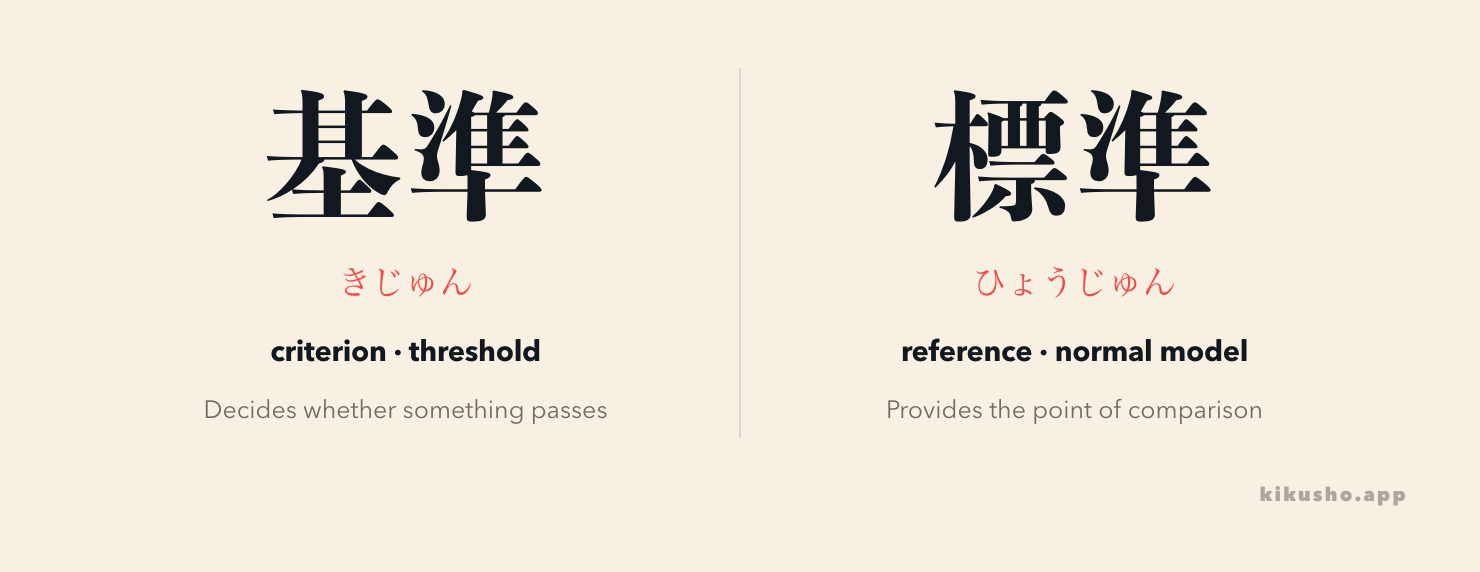
The words overlap because a standard reference can become a criterion. Daijisen's usage note gives the practical tendency: 標準 is common for an average level or ordinary type, while 基準 often marks a requirement or a basis chosen for judgement. Do not force that tendency into an exceptionless translation rule.
公式 expresses a relationship; 法則 states a regularity
In a mathematical or scientific context, 公式 is a formula: a compact expression showing a relationship between quantities.
長方形の面積は、縦と横を掛ける公式で求められます。
ちょうほうけいの めんせきは、たてと よこを かける こうしきで もとめられます。
The area of a rectangle can be found with the formula that multiplies its length and width.
Common patterns include 公式を使う, use a formula; 公式に当てはめる, substitute into a formula; and 公式を導く, derive a formula.
The same spelling also means official. Grammar and neighbours expose the sense:
- 公式発表: official announcement
- 公式サイト: official website
- 公式に認める: recognise officially
- 非公式: unofficial
The dictionary entry for 公式 records both the publicly authorised sense and the mathematical one. A sentence about an organisation, visit or announcement is unlikely to mean “formula.”
法則 is a law or regular relationship that holds under stated conditions. Science discovers or formulates a 法則; mathematics may express that relationship with a 公式.
測定結果は、物体の運動に関する法則と一致しました。
そくていけっかは、ぶったいの うんどうに かんする ほうそくと いっちしました。
The measurement results agreed with the law concerning the object's motion.
Natural partners are 法則を発見する, discover a law; 法則が成り立つ, a law holds; and 法則に従う, follow a law. A 公式 helps you calculate one value. A 法則 claims a stable relationship between phenomena. One law may be represented by several formulas depending on the variables and conditions.
測定 produces data, 統計 organises it, and 推定 goes beyond it
測定する means determining a physical quantity by comparing or relating it to a reference. It is more technical than the everyday verb 測る.
センサーで温度を一分ごとに測定しました。
センサーで おんどを いっぷんごとに そくていしました。
We measured the temperature with a sensor every minute.
The encyclopedia entry for 測定 distinguishes direct measurement from indirect measurement, in which related quantities are measured and a target value is calculated. This is why 加速度を測定する may involve recording distance and time rather than reading acceleration directly from one scale.
統計 can mean numerical data collected about a group or the methods used to organise and analyse such data.
- 人口統計: population statistics
- 統計を取る: compile statistics
- 統計によると: according to the statistics
- 統計的な差: statistical difference
推定する means to estimate or infer an unknown value or fact from available evidence.
十回の測定結果から、平均の加速度を推定しました。
じゅっかいの そくていけっかから、へいきんの かそくどを すいていしました。
We estimated the mean acceleration from ten measurement results.
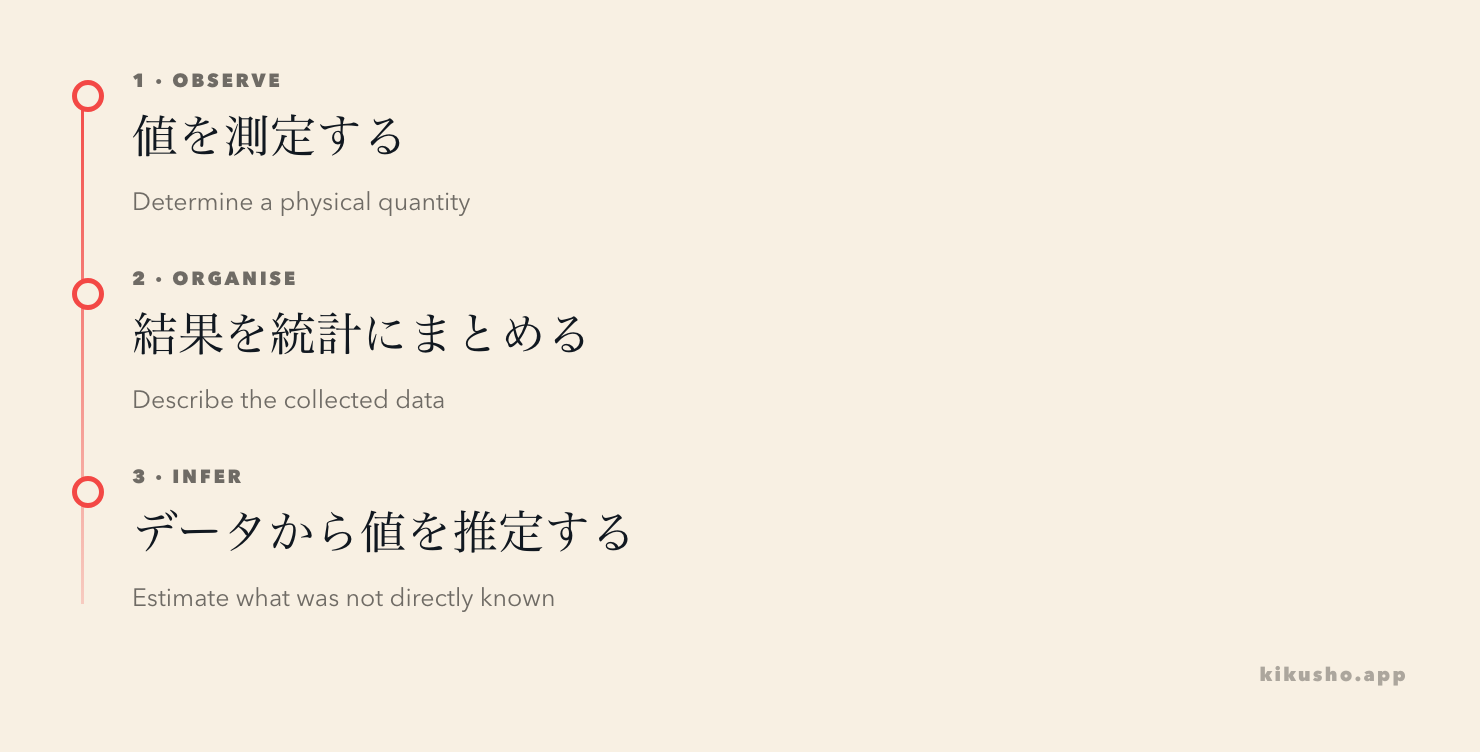
This gives a clean distinction from 仮定, introduced in the N3 science lesson. A 仮定 is an assumption accepted at the start so reasoning can proceed. A 推定 is an estimate reached from clues or data. You can 温度は一定だと仮定する before an experiment and later 測定値から温度を推定する.
面積, 体積 and 容積 answer two-dimensional and three-dimensional questions
面積 is area. It describes the size of a flat surface or region and uses squared units such as 平方メートル, square metres.
底の面積は二十平方センチメートルです。
そこの めんせきは にじゅっへいほうセンチメートルです。
The area of the base is twenty square centimetres.
体積 is the amount of three-dimensional space occupied by an object. Its units are cubic, such as 立方センチメートル, cubic centimetres, or are expressed in litres when appropriate.
この金属の体積と重量を測定して、密度を求めます。
この きんぞくの たいせきと じゅうりょうを そくていして、みつどを もとめます。
We measure the volume and weight of this metal and find its density.
容積 focuses on how much a container can hold: its internal volume or capacity.
タンクの容積は五百リットルですが、外側の体積はそれより大きくなります。
タンクの ようせきは ごひゃくリットルですが、そとがわの たいせきは それより おおきく なります。
The tank's capacity is 500 litres, but its outside volume is larger than that.
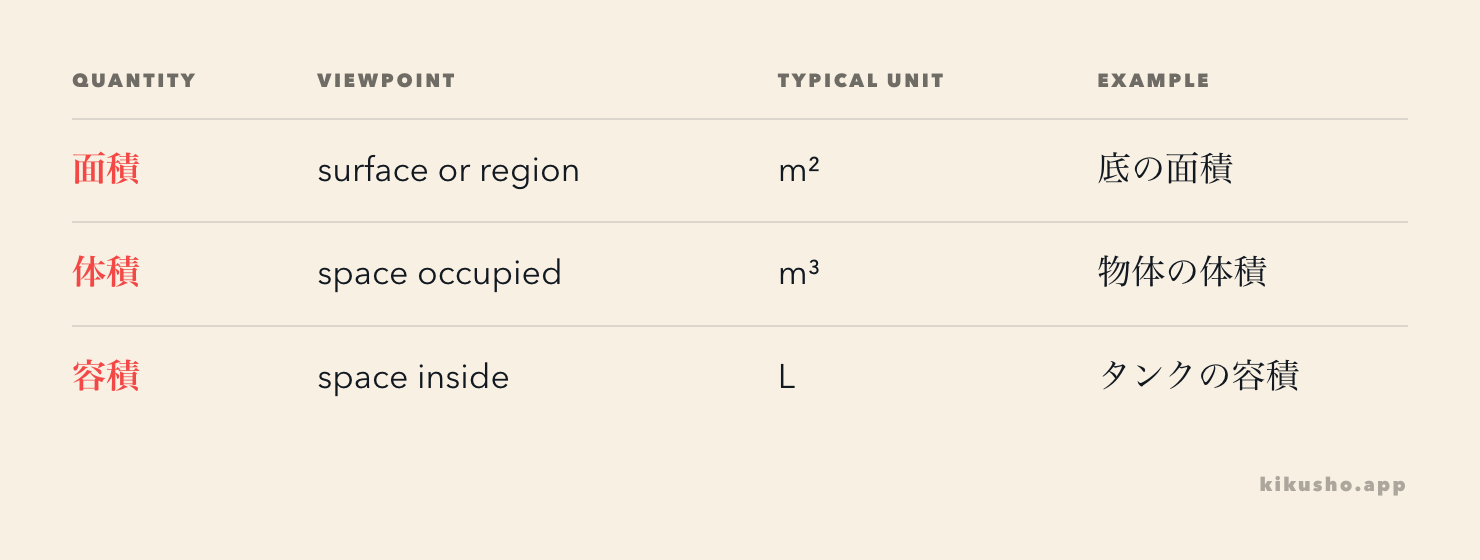
The distinction is a viewpoint, not a ban on overlap. A hollow container occupies space and has a 体積; it also encloses a usable 容積. Daijisen defines 体積 as the size of the space occupied by a solid. In product specifications, 容積 usually directs attention to usable capacity.
重力 changes motion; 加速度 describes the change; 重量 belongs to the object
重力 is gravity. Near Earth, it pulls an object downward and produces 重力加速度, gravitational acceleration.
物体を落とすと、重力によって下向きの加速度が生じます。
ぶったいを おとすと、じゅうりょくによって したむきの かそくどが しょうじます。
When an object is dropped, gravity produces downward acceleration.
加速度 is the rate at which velocity changes. It does not simply mean “high speed.” A car travelling steadily can have high 速度 and zero 加速度; slowing down or changing direction also produces acceleration. The physics definition includes both the technical rate of velocity change and the figurative pattern 加速度がつく, gain momentum or accelerate.
重量 is weight or heaviness. In technical physics it is the gravitational force on an object, related to its mass and the local gravitational acceleration. In ordinary shipping, packaging and product language, it often behaves as the practical “weight” shown in kilograms.
- 荷物の重量: weight of the luggage
- 重量を測る: measure the weight
- 重量制限: weight limit
- 重量級: heavyweight class
装置の重量が基準を超えたため、軽い部品に交換しました。
そうちの じゅうりょうが きじゅんを こえたため、かるい ぶひんに こうかんしました。
Because the device's weight exceeded the limit, we replaced it with lighter components.
Japan's Geospatial Information Authority explains that gravity is expressed through gravitational acceleration and measured against internationally aligned references. The 重量 dictionary entry separately records both ordinary measured heaviness and the technical gravitational-force sense.
A laboratory report assigns every word one job
新しい落下実験では、まず安全基準を確認し、標準の容器を選びました。容器の底面積と外側の体積は公式で計算し、実際の容積と重量は器具で測定しました。物体を落とすと、重力によって速度が変化します。その加速度を十回測定し、結果を統計として整理しました。測定値から誤差の原因を推定し、結果が運動法則と一致するか調べました。研究所の公式発表には、すべての数値と方法を記載しました。
For the new drop experiment, we first checked the safety criteria and selected a standard container. We calculated the area of its base and its outside volume with formulas, then measured its actual capacity and weight with instruments. When the object is dropped, gravity changes its velocity. We measured that acceleration ten times and organised the results as statistics. We estimated the source of error from the measurements and examined whether the results agreed with the laws of motion. Every value and method was included in the laboratory's official announcement.
The two uses of 公式 occupy different parts of the report. The formulas calculate physical quantities; the official announcement communicates the result. 基準 decides whether the procedure is acceptable, while 標準 identifies the reference container. 測定, 統計 and 推定 mark successive stages rather than synonyms for “working with numbers.”
For a durable card, preserve the noun's decision point. 基準を満たす asks whether something passes; 標準と比較する asks how it differs from the reference. 体積を求める measures occupied space; 容積を確認する checks capacity. Kikusho is most useful here when the saved sentence retains that partner, because thirteen isolated English labels would erase the distinctions the report depends on.
Practice
1 · Sound out 加速度. Choose its standard pronunciation.
- A. じゅうそくど
- B. かそくど
- C. かそくたび
- D. ついそくど
2 · Criterion or normal model. Complete the sentence: 製品が安全( )を満たしているか確認する。
- A. 公式
- B. 標準
- C. 統計
- D. 基準
3 · Two senses of 公式. What does 公式発表 mean here: 研究所の公式発表を読んだ。
- A. An official announcement
- B. A formula for the laboratory
- C. A statistical estimate
- D. A law of physics
4 · Law and formula. Which sentence assigns the two terms naturally?
- A. 公式が重力を落として、法則を測定した。
- B. 法則に数字を入れて、公式を発見した。
- C. 自然の法則を、数学の公式で表した。
- D. 公式を容積して、法則が重量になった。
5 · Data workflow. Which order moves from observations to a supported estimate?
- A. 推定 → 測定 → 統計
- B. 測定 → 統計 → 推定
- C. 統計 → 推定 → 測定
- D. 測定 → 推定 → 基準
6 · Three spatial quantities. Which statement is accurate?
- A. 面積 is a container's capacity, and 容積 is a flat surface.
- B. 体積 can only describe liquids, while 面積 can only describe buildings.
- C. 面積 is two-dimensional, 体積 is occupied space, and 容積 is internal capacity.
- D. All three words are interchangeable whenever litres are used.
7 · Gravity and weight. Which sentence gives each word its proper role?
- A. 重量が物体を引き、重力を箱に表示する。
- B. 重力を包装し、重量が加速度を発表する。
- C. 重量が法則を作り、重力を面積で測る。
- D. 重力が物体に働き、その物体の重量を測る。
8 · Measurement spelling. Which word is read そくてい and means measurement?
- A. 測定
- B. 推定
- C. 標定
- D. 想定
9 · Assumption or estimate. The researchers use observed data to infer the animal's age. Which sentence fits?
- A. 年齢を基準した。
- B. 年齢が標準に測定した。
- C. データから年齢を推定した。
- D. データを年齢だと仮定になった。
10 · Reading a result. What does 重量が基準を超えた mean?
- A. Gravity stopped acting on the object.
- B. The weight exceeded the permitted criterion or limit.
- C. The volume was calculated with the wrong formula.
- D. The statistics were below the normal sample.
Answers and explanations
- B, かそくど is the reading of 加速度.
- D, 基準 is a required safety criterion that the product must meet. 標準 can describe the normal model, but 基準を満たす is the fixed collocation here.
- A. The noun 発表 selects the authorised or public sense of 公式: an official announcement.
- C. A 法則 is the regular relationship in nature, and a 公式 can express it mathematically.
- B. Measurements supply observations, statistics organise them, and an estimate is inferred from the resulting evidence.
- C. 面積 measures a surface or region, 体積 the space occupied, and 容積 the capacity inside a container.
- D. 重力 is the gravity acting on the object; 重量 is the object's weight.
- A, 測定 is read そくてい. 推定 is すいてい and means estimation.
- C. 推定 is an inference from evidence. 仮定 would be a condition accepted before or during the reasoning.
- B. The measured weight is beyond the criterion used as the allowable limit.
Common questions
What is the difference between 基準 and 標準?
基準 is a criterion, threshold or basis used to judge something, often a requirement that must be met. 標準 is a standard reference and also the normal or typical model, level or size. They overlap when a reference is used as the basis for comparison.
What is the difference between 体積 and 容積?
体積 is the three-dimensional space occupied by an object. 容積 is the internal volume or capacity of a container. The same container can have an outer 体積 and a smaller usable 容積.
What is the difference between 重量 and 重力?
重力 is gravity, the force or effect that attracts an object. 重量 is the object's weight. Technical physics relates weight to mass and gravitational acceleration; everyday labels also use 重量 for how heavy something is.
Does 公式 mean both formula and official?
Yes. As a noun, 公式 can be a mathematical formula. Before a noun or with に, it can mean official: 公式発表 is an official announcement and 公式に 認める means to recognise officially. Context and grammar separate them.