On this page
These ten N3 words describe a complete investigation: you make a 仮定, conduct an 実験, record what you 観察する, and use 単位 and 計算 to report a 正確な result. 化学 and 物理 name fields of study, while 速度 and 幅 name quantities that can be measured.
Ten entries turn an idea into a measured result
| Entry | Pronunciation | Part of speech and practical meaning | Typical pattern |
|---|---|---|---|
| 化学 | かがく, kagaku | noun; chemistry | 化学を勉強する |
| 仮定 | かてい, katei | noun; する verb; assumption, supposition or condition accepted temporarily | 同じだと仮定する |
| 観察 | かんさつ, kansatsu | noun; する verb; careful observation | 変化を観察する |
| 計算 | けいさん, keisan | noun; する verb; calculation or reckoning | 速度を計算する |
| 実験 | じっけん, jikken | noun; する verb; experiment or experimental work | 実験を行う |
| 正確 | せいかく, seikaku | na-adjective; accurate, exact or correct | 正確に測る |
| 速度 | そくど, sokudo | noun; speed, velocity or rate | 速度を測る |
| 単位 | たんい, tan'i | noun; unit of measurement, grouping, or course credit | 長さの単位 |
| 幅 | はば, haba | noun; width, breadth, range or scope | 幅を測る |
| 物理 | ぶつり, butsuri | noun; physics | 物理の法則 |
Kikusho's September 2026 reference inventory places all ten spelling-and-reading records in N3. 仮定 has one internal disagreement: a Waller-derived row assigns it to N3, while a second row from that same family tags it N2. Their shared ancestry makes this an unstable editorial boundary rather than two independent exam decisions. Current N3 resources separately group 物理, 化学 and 実験 at this level, while Bunpro also presents 実験 as N3. The JLPT organisers do not publish an exhaustive vocabulary syllabus, so treat the level as a practical study placement rather than a guarantee about a future paper.
化学 and 物理 ask different questions about the same world
化学 is chemistry. It studies substances, their structures and properties, and the changes that occur in chemical reactions.
化学の実験で、液体の色が変わる様子を観察しました。
かがくの じっけんで、えきたいの いろが かわる ようすを かんさつしました。
In a chemistry experiment, we observed the liquid changing colour.
Do not confuse 化学 with 科学, science. Both are read かがく, but the first kanji tells you the scope:
- 化学: chemistry; 物質の変化, changes in substances
- 科学: science; a broad method and body of systematic knowledge
In speech, someone may say ばけがく for 化学 when the context does not separate the homophones. The Daijisen entry for 化学 records this disambiguating reading; it is useful conversational repair, not the normal dictionary reading you should supply on a test.
物理 is physics. It concerns matter, motion, forces, energy and other physical phenomena.
物理の授業で、物体が落ちる速度を計算しました。
ぶつりの じゅぎょうで、ぶったいが おちる そくどを けいさんしました。
In physics class, we calculated the speed at which an object falls.
The fields overlap. Physical chemistry is 物理化学, and the same experiment may require chemical knowledge and physical measurement. The point of the pair is not to draw an absolute border. It is to recognise what each noun names in an ordinary school, news or laboratory sentence. The N3 technology lesson continues from the laboratory into the machines, instruments and operations that make such work possible.
仮定 sets a condition before 実験 tests what happens
仮定する means to suppose something for the sake of reasoning. The statement does not have to be proven first.
温度が同じだと仮定して、二つの結果を比べます。
おんどが おなじだと かていして、ふたつの けっかを くらべます。
We assume that the temperature is the same and compare the two results.
The common frames are worth learning intact:
- Aと仮定する: assume A
- Aだと仮定する: assume that it is A
- 仮定の上で: on the assumption that...
- 仮定が正しい: the assumption is correct
仮説 is nearby but more specific. It is an explanatory hypothesis proposed so that evidence can support or reject it. 仮定 can simply be a temporary condition inside a calculation. A researcher may therefore 仮説を立てる, formulate a hypothesis, while 温度は一定だと仮定する, assuming the temperature is constant. The dictionary definitions of 仮定 and 仮説 support this difference in purpose.
実験 is the experiment used to investigate what actually occurs. It works both as a noun and with する, although formal reports often use 実験を行う, conduct an experiment.
条件を一つだけ変えて、実験を三回繰り返しました。
じょうけんを ひとつだけ かえて、じっけんを さんかい くりかえしました。
We changed only one condition and repeated the experiment three times.
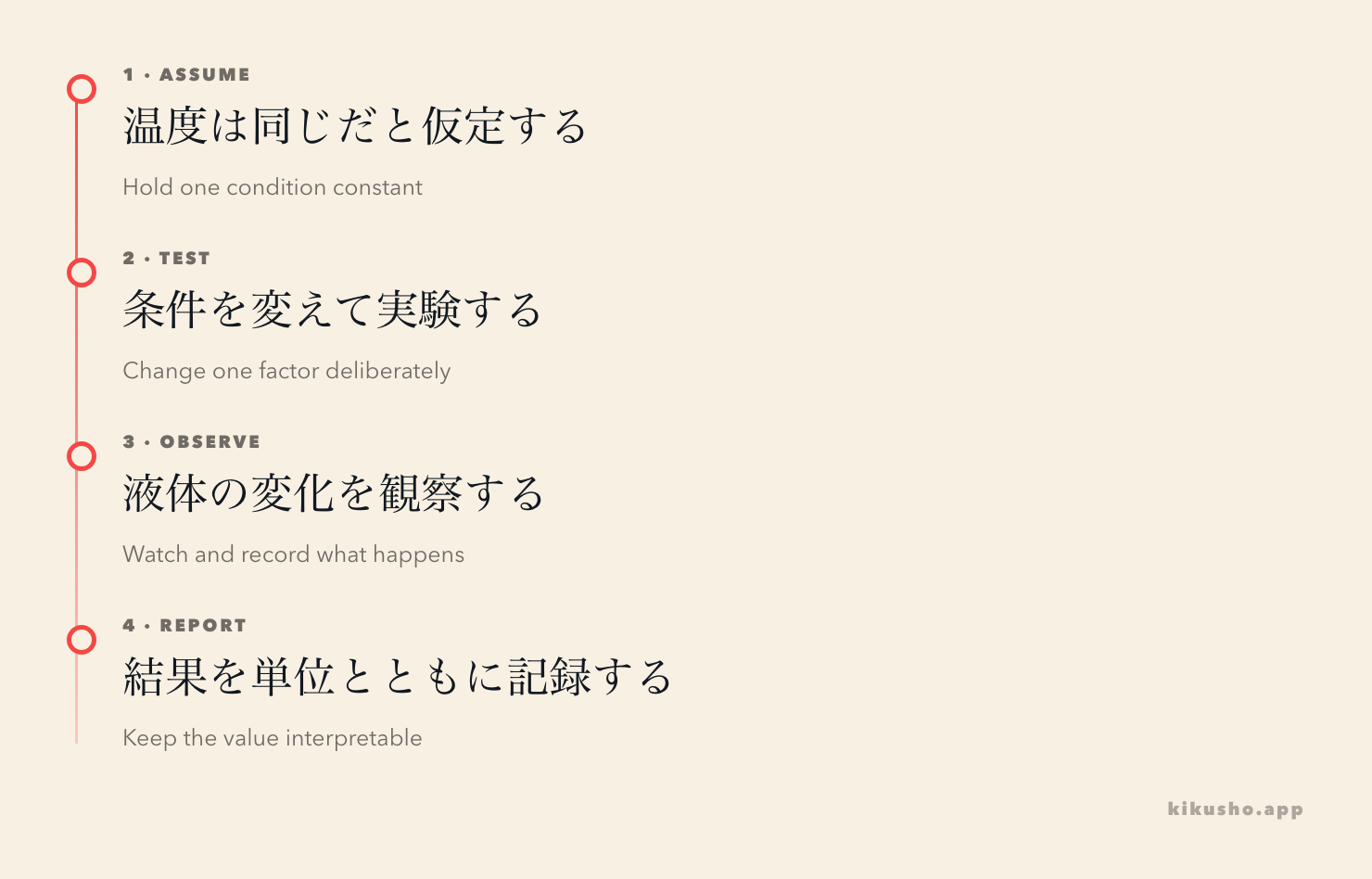
A 仮定 begins the reasoning. An 実験 creates a controlled test. What you record during that test becomes evidence; it does not become correct merely because the initial assumption sounded plausible.
観察 means looking with a purpose and recording change
観察する is to examine a thing or phenomenon carefully and objectively. It is stronger than simply seeing it.
生徒たちは植物の成長を毎日観察して、ノートに記録しました。
せいとたちは しょくぶつの せいちょうを まいにち かんさつして、ノートに きろくしました。
The students observed the plant's growth every day and recorded it in a notebook.
The Kotobank overview of 観察 draws a useful classroom distinction. Observation studies a state or change as it occurs; an experiment actively arranges or controls conditions to produce evidence. In practice they work together:
- 星を観察する: observe stars
- 動物の行動を観察する: observe animal behaviour
- 実験の結果を観察する: observe the result of an experiment
- 注意深く観察する: observe carefully
An experiment normally contains observation, but not every observation is an experiment. Watching the moon nightly is 観察. Changing one condition in a model and comparing the outcome is 実験, with observation inside it.
幅 and 速度 need a number, a 単位 and often 計算
幅 first means the distance from one side to the other.
この板の幅は三十センチです。
この いたの はばは さんじゅっセンチです。
This board is thirty centimetres wide.
The word also extends to a range or breadth: 温度の幅, a temperature range; 選択の幅, breadth of choice; 知識の幅, breadth of knowledge. The physical sense remains the easiest anchor: the dictionary entry for 幅 begins with the distance from one horizontal edge to the other.
単位 tells the reader what the number counts or measures. Metres, seconds and kilograms are units. In other contexts, 単位 can mean a group treated as one whole or an academic credit, so 大学で単位を取る does not describe laboratory measurement.
幅はミリメートル単位で記録してください。
はばは ミリメートルたんいで きろくして ください。
Please record the width in millimetres.
The official Japanese metrology material from NITE lists the seven SI base units and explains how derived units form a coherent system. At N3, the language lesson is simpler: a bare 30 is incomplete if the reader needs to know whether it means millimetres, centimetres or metres.
速度 names speed, velocity or rate. In ordinary descriptions it often behaves like English “speed”: 車の速度, a car's speed; 速度が上がる, speed increases. In physics, Japanese can distinguish 速さ, the magnitude of motion, from 速度, which also includes direction. That technical distinction matters in a physics course, but context often uses 速度 more broadly.
計算する turns the measured values into a result.
距離と時間から平均速度を計算します。
きょりと じかんから へいきんそくどを けいさんします。
We calculate the average speed from distance and time.
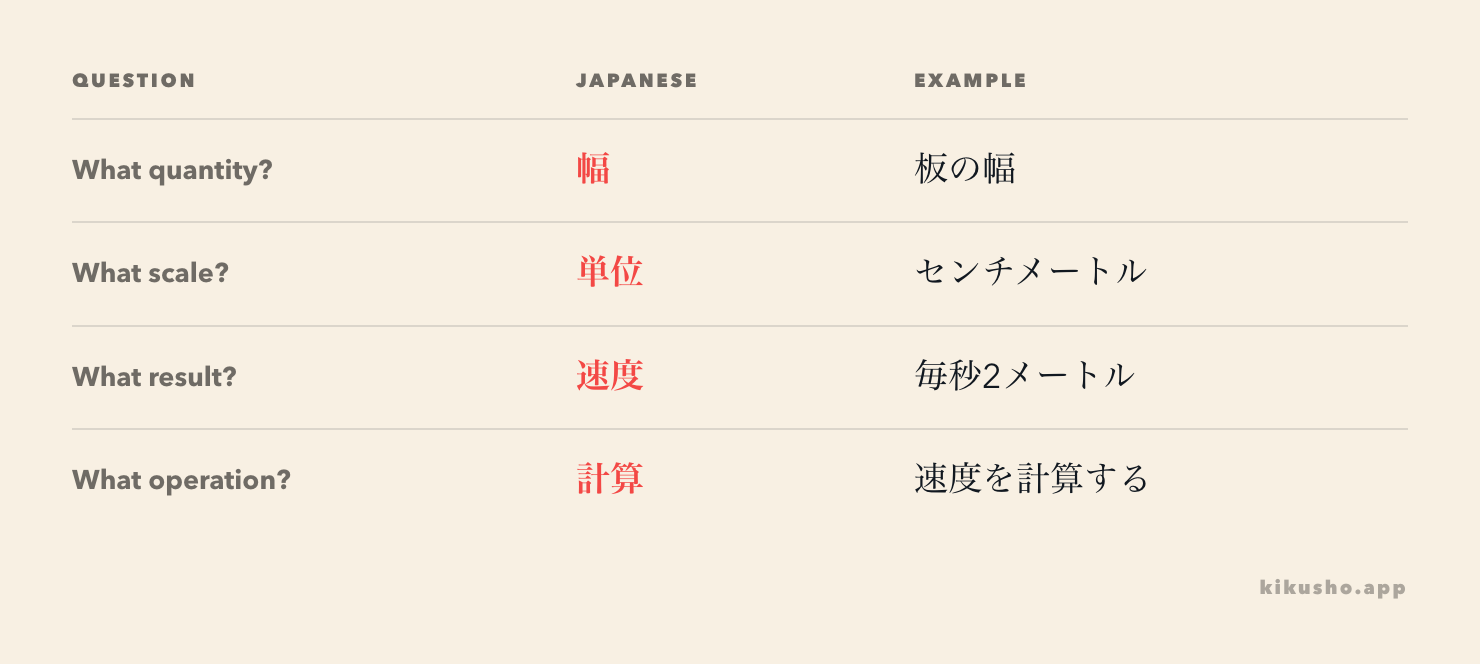
The collocations prevent a common category mistake. You 幅を測る, measure a width; 単位を付ける, attach a unit; and 速度を計算する, calculate a speed. 単位 is not the value itself, and 計算 is the operation rather than the measured object. The N3 lesson on amount and degree covers the language used when those values rise, fall or remain approximate.
正確 describes a value or action that is free from error
正確 is a na-adjective. Before a noun, use 正確な; before an action, use 正確に.
- 正確な値: an accurate value
- 正確な時計: an accurate clock
- 正確な記録: an accurate record
- 正確に測る: measure accurately
- 正確に計算する: calculate accurately
幅を正確に測るために、同じ場所を三回測りました。
はばを せいかくに はかるために、おなじ ばしょを さんかい はかりました。
To measure the width accurately, we measured the same place three times.
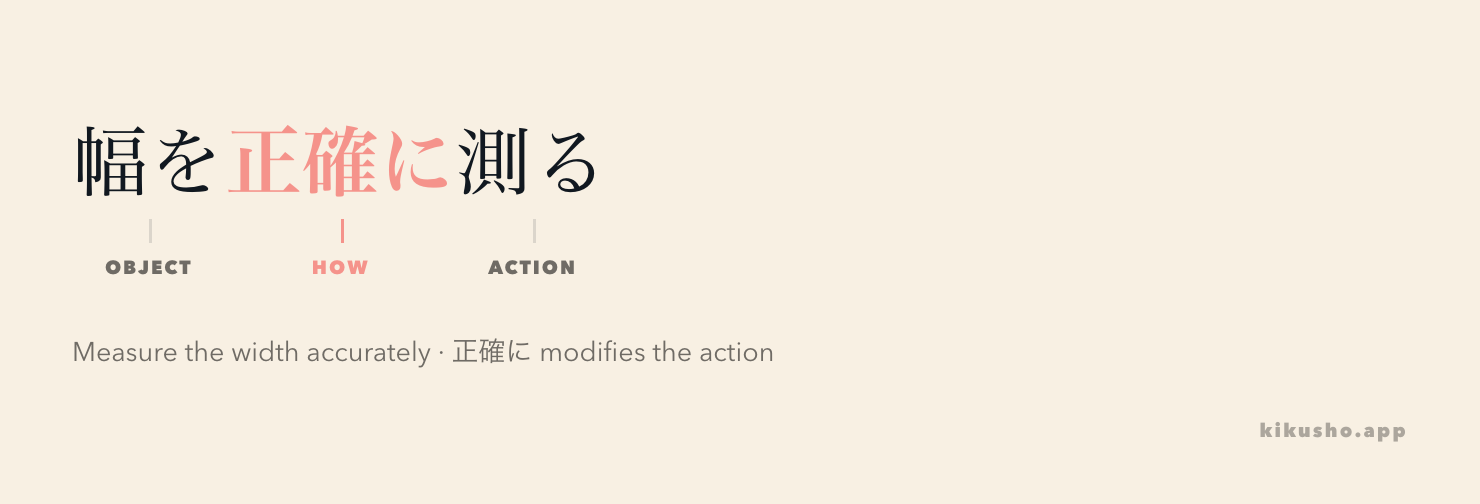
正しい is the broader word for correct or right. 正確 focuses on agreement with facts, a standard or an intended value. 精密 instead describes something very fine, detailed or precise, as in 精密機械, precision machinery. A device can be 精密 in construction but still give an inaccurate value if it is badly calibrated. At N3, keep the safe contrast: 正確な答え, an accurate answer; 精密な機械, a finely made precision machine.
One laboratory note can use all ten words
化学の実験で、温度が同じなら液体の色も同じ速さで変わると仮定しました。二つの容器を観察し、色が変わるまでの時間を秒単位で記録しました。容器の幅も正確に測り、変化の速度を計算しました。物理で習った計算方法も使いましたが、結果には少し差がありました。
In a chemistry experiment, we assumed that if the temperature was the same, the liquids would change colour at the same rate. We observed two containers and recorded in seconds how long the colour change took. We also measured the width of the containers accurately and calculated the rate of change. We used a calculation method learned in physics, but the results differed slightly.
The note keeps the roles separate. 化学 names the field, 仮定 states the starting condition, and 実験 names the test. 観察 supplies the record. 幅 and time are measured, 単位 makes each number interpretable, and 計算 produces a 速度. 正確 evaluates the care taken with the measurement, while 物理 identifies the source of the method.
When you make cards from a science text, keep the partner that fixes the word's job: 変化を観察する, 速度を計算する, 秒単位で記録する. A single English label such as “measure” will not preserve those roles. Let Kikusho build from the line you encountered, then retain the Japanese combination that made the statement precise.
Practice
1 · Chemistry reading. How do you read 化学?
- A. ぶつり
- B. かがく
- C. けいさん
- D. かてい
2 · Chemistry or science. Which spelling means “chemistry” rather than science in general?
- A. 科学
- B. 仮学
- C. 化学
- D. 物学
3 · Starting assumption. Complete the sentence: 温度は同じだと( )して、結果を比べた。
- A. 仮定
- B. 観察
- C. 単位
- D. 速度
4 · Method sequence. Which option gives the experiment and the observation their proper roles?
- A. 星を実験して、望遠鏡を観察した。
- B. 実験が学生を観察して、条件を単位した。
- C. 液体を観察したので、色を実験になった。
- D. 条件を変えて実験し、液体の変化を観察した。
5 · Measurement unit. The report says 幅は25と記録した, but the value is unclear. What is most obviously missing?
- A. 仮定
- B. 単位
- C. 物理
- D. 観察
6 · Accurate action. Which sentence means “Measure the width accurately”?
- A. 幅を正確に測ってください。
- B. 幅が正確を測ってください。
- C. 正確を幅にしてください。
- D. 幅に正確な測ってください。
7 · Calculation. Which collocation means “calculate the average speed”?
- A. 平均速度を観察する
- B. 平均速度を仮定になる
- C. 平均速度を計算する
- D. 平均速度を単位する
8 · Word formation. Which compound is read ぶつりかがく and means “physical chemistry”?
- A. 物理科学
- B. 仮定化学
- C. 化学物理
- D. 物理化学
9 · Width beyond objects. What does 選択の幅が広い mean?
- A. The measurement is inaccurate.
- B. There is a broad range of choices.
- C. The experiment has a high speed.
- D. The physics class is wide.
10 · Reading a laboratory note. What does 秒単位で記録し、速度を正確に計算した mean?
- A. They recorded the values in seconds and calculated the speed accurately.
- B. They assumed that every second had the same width.
- C. They observed a physics class without recording it.
- D. They changed the unit because the experiment failed.
Answers and explanations
- Choose B: かがく. The other readings belong to 物理, 計算 and 仮定.
- C. 化学 means chemistry. 科学 has the same reading but means science more broadly.
- A. A temporary starting condition is 仮定, giving 同じだと仮定する.
- D. The researchers change a condition to conduct the experiment, then observe the liquid's change.
- B. A numerical measurement needs a 単位 such as millimetres or centimetres.
- A. 正確に is the adverbial form and modifies the action 測る.
- C. 速度 is something you can 計算する from distance and time.
- D. 物理化学 combines 物理 and 化学 and is read ぶつりかがく.
- B. 幅 extends from physical width to breadth or range, so the phrase means that many choices are available.
- A. 秒単位で identifies seconds as the recording unit, and 正確に describes how the speed was calculated.
Common questions
What is the difference between 化学 and 科学?
Both are read かがく. 化学 means chemistry, the study of substances and their changes. 科学 means science more broadly. In speech, ばけがく may be used informally when the speaker needs to make chemistry unambiguous.
What is the difference between 仮定 and 仮説?
仮定 is an assumption or condition temporarily accepted so that reasoning can continue. 仮説 is an explanatory hypothesis proposed for testing. A scientific hypothesis may contain several assumptions.
What is the difference between 観察 and 実験?
観察 means carefully observing a state or change. 実験 means conducting an experiment, usually by arranging or changing conditions to test what happens. An experiment normally includes observation.
How is 正確 used in a measurement report?
正確 is a na-adjective meaning accurate or exact. It can describe a value, record, clock or method, and 正確に modifies an action: 正確に測る means to measure accurately.