
On this page
These ten N2 words let you read an assembly or maintenance report: 部品 are connected and 組み立てる into a device, its 性能 and 動作 are tested, and a fault may force the line to 停止する. The important distinctions concern viewpoint: a user 操作する a machine while the machine 動作する; 機能 says what it can do, while 性能 says how well it does it.
Ten entries follow a machine from parts to testing
| Entry | Pronunciation | Role and practical meaning | Typical pattern |
|---|---|---|---|
| 組み立てる | くみたてる, kumitateru | transitive ichidan verb; assemble, construct or set up from parts | 部品を組み立てる |
| 性能 | せいのう, seinō | noun; performance, capability or operating quality | 性能を測定する |
| 接続 | せつぞく, setsuzoku | noun; する verb; connection, linking or changing transport services | 電池を回路に接続する |
| 停止 | ていし, teishi | noun; する verb; stop, suspension or interruption | 運転を停止する |
| 電池 | でんち, denchi | noun; battery or electric cell | 電池を交換する |
| 電流 | でんりゅう, denryū | noun; electric current | 電流が流れる |
| 動作 | どうさ, dōsa | noun; する verb; bodily movement or machine operation | 正常に動作する |
| 能率 | のうりつ, nōritsu | noun; rate of work or work efficiency | 作業能率が上がる |
| 部品 | ぶひん, buhin | noun; component, part or accessory of a machine or product | 部品を交換する |
| 分解 | ぶんかい, bunkai | noun; する verb; disassembly, analysis or decomposition | 機械を分解する |
All ten spelling-and-reading records are placed at N2 in Kikusho's September 2026 inventory, with no internal placement disagreement. The two baseline files descend from the same Waller dataset and count as one source family. Current technical and dictionary sources below verify the language, while the JLPT organisers make clear that there is no exhaustive official vocabulary list for the current test. N2 therefore describes this curriculum's study order, not a promise that a particular word will appear.
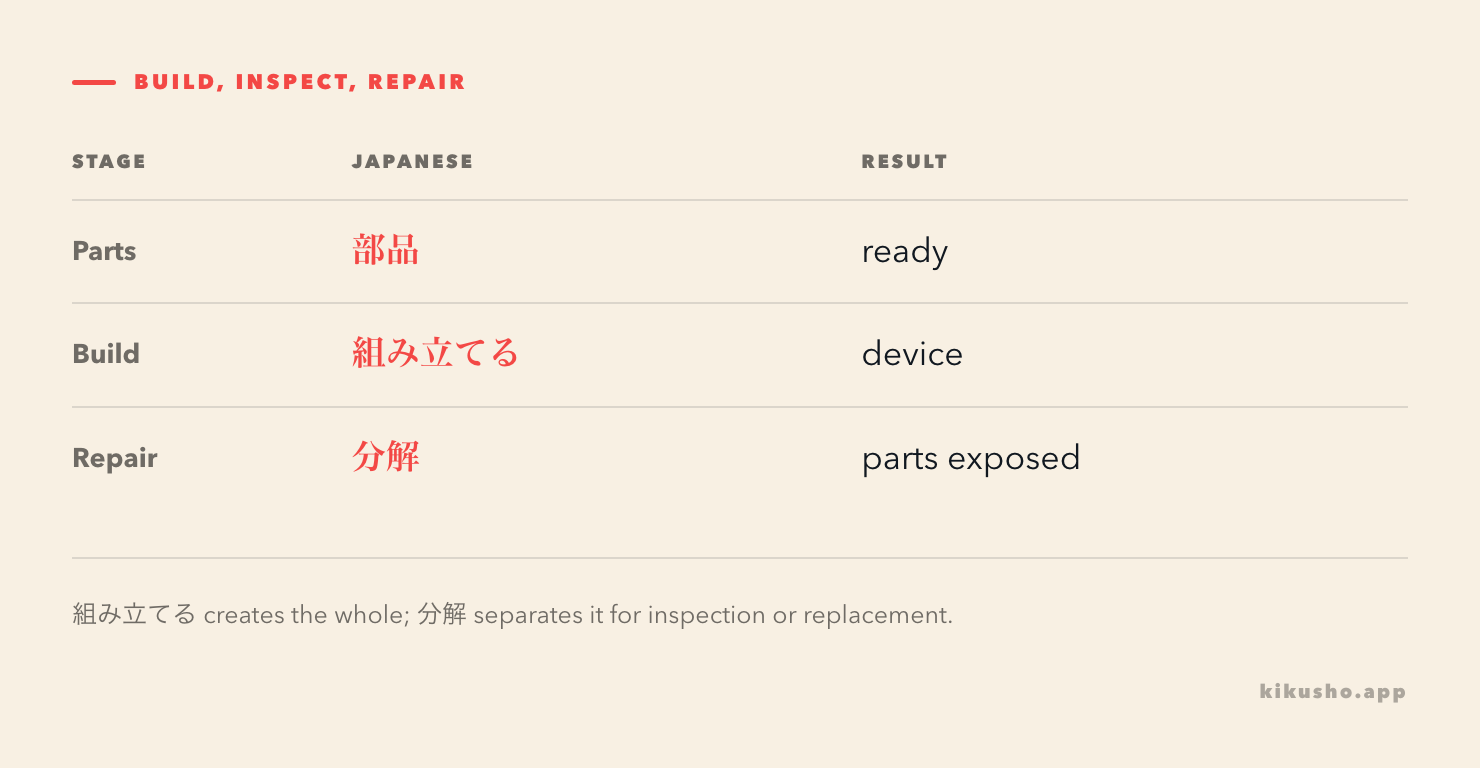
組み立てる joins 部品; 分解 separates the result
部品 is a component used as part of a larger machine or product. A component can be designed, manufactured, installed, replaced or removed:
- 部品を取り付ける: attach a component
- 部品を交換する: replace a component
- 部品が足りない: a component is missing
- 電子部品: electronic component
組み立てる takes separate elements and puts them together into a structured whole.
作業員は説明書を見ながら、十個の部品を組み立てました。
さぎょういんは せつめいしょを みながら、じゅっこの ぶひんを くみたてました。
The worker assembled the ten components while looking at the instructions.
The object can also be the finished thing: 機械を組み立てる, assemble a machine. The noun is 組み立て/組立て, assembly or construction. Daijisen also records an abstract sense, structure or composition, as in 文の組み立て, sentence structure.
分解 reverses the physical process when it means taking an assembled object into parts.
故障した装置を分解して、古い部品を交換します。
こしょうした そうちを ぶんかいして、ふるい ぶひんを こうかんします。
We will disassemble the faulty device and replace the old component.
The dictionary entry for 分解 shows why context matters. The same word covers analysing a problem into elements, factoring in mathematics and chemical decomposition. 時計を分解する is physical disassembly; 問題を分解して考える means break a problem into parts for analysis.
接続 creates a link; 電流 flows through it
接続 joins two points so that power, data, people or transport can continue between them. The particles reveal the endpoints:
- 電池を回路に接続する: connect a battery to a circuit
- 機器同士を接続する: connect devices to each other
- ネットワークに接続する: connect to a network
- 京都で新幹線に接続する: connect with the Shinkansen at Kyoto
The first object marked by を is what someone connects; に marks its destination or network. The intransitive description is 二つの装置が接続されている, two devices are connected.
電池 stores or produces electrical energy through a physical or chemical process. Everyday compounds include 乾電池, dry-cell battery; 充電池, rechargeable battery; and 太陽電池, solar cell.
電流 is electric current. Japanese says 電流が流れる, current flows, and 電流を流す, send current through something.
電池を回路に接続すると、小さな電流が流れます。
でんちを かいろに せつぞくすると、ちいさな でんりゅうが ながれます。
When the battery is connected to the circuit, a small electric current flows.
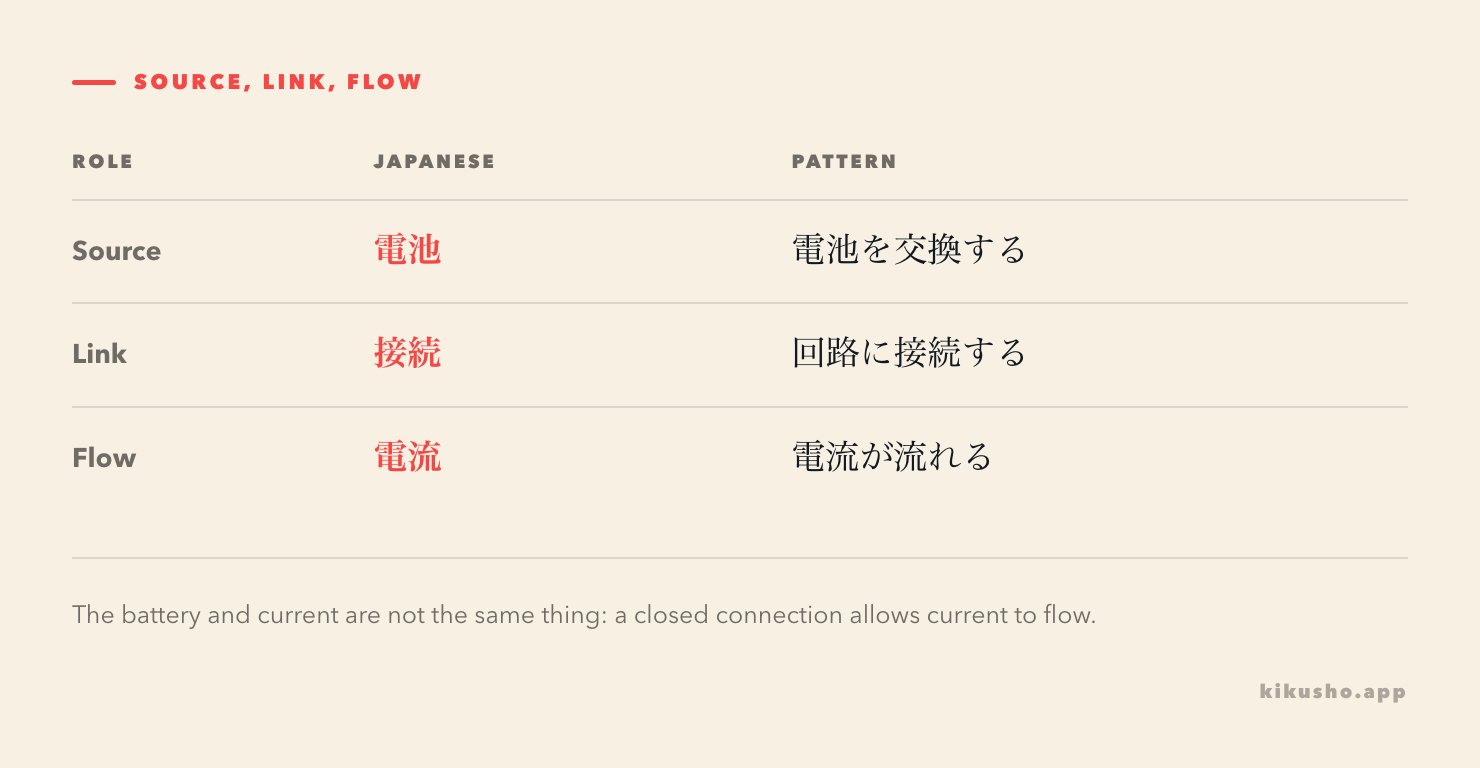
Panasonic Energy's battery explanation uses exactly this physical relationship: wires connect two metals into a circuit, and current in that circuit lights an LED. The battery is not the current itself. It creates the conditions that allow current to flow through a closed path.
The N1 word 電源 is broader than 電池. A battery can be one power source, but a device may instead use mains power or another supply. The N1 technology lesson distinguishes 電源 from 回路 and continues into standards and patents.
動作 is the movement; 操作 is the control action
動作 first means a person's bodily action or movement:
ロボットは人の手の動作をまねします。
ロボットは ひとの ての どうさを まねします。
The robot imitates the movement of a person's hand.
With machinery or software, 動作 describes operation or behaviour:
- 正常に動作する: operate normally
- 動作を確認する: check operation
- 動作が遅い: respond or run slowly
- 動作不良: malfunction or faulty operation
操作, introduced in the N3 machine lesson, is what the user does to control the machine.
利用者がボタンを操作すると、装置が動作します。
りようしゃが ボタンを そうさすると、そうちが どうさします。
When the user operates the button controls, the device runs.
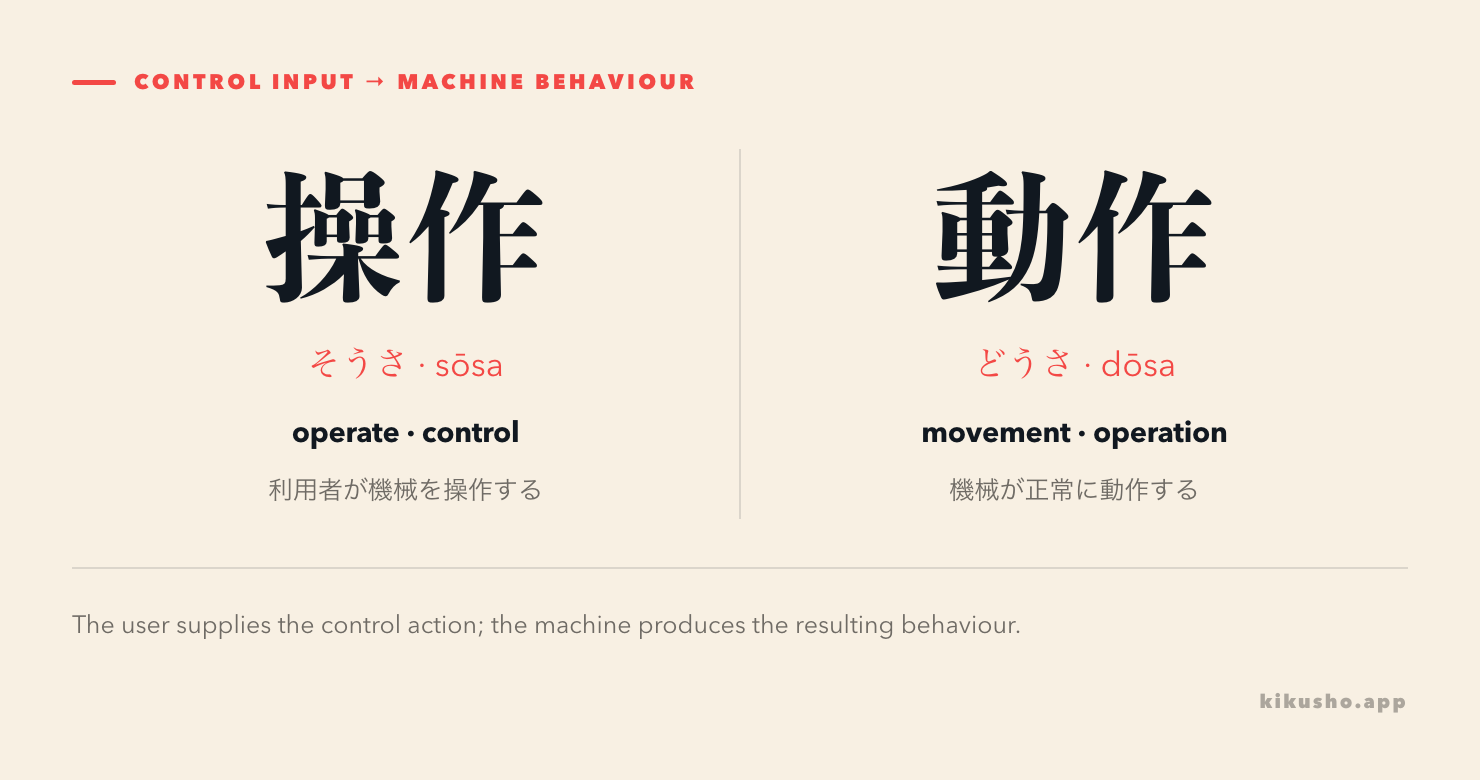
Daijisen records both bodily movement and machine operation for 動作. Its 操作 entry instead centres on manipulating controls. A technician can therefore report 操作に問題はないが、動作が不安定だ: the way the controls are used is fine, but the machine's behaviour is unstable.
性能 measures capability; 機能 names a feature
性能 evaluates the qualities and capabilities of a machine or tool. It often appears with measurable factors such as speed, output, precision, capacity or durability.
- 性能が高い/低い: have high/low performance
- 性能を高める: improve performance
- 性能を比較する: compare performance
- 性能試験: performance test
新型の電池は、同じ大きさでも性能が高く、長く使えます。
しんがたの でんちは、おなじ おおきさでも せいのうが たかく、ながく つかえます。
The new-model battery has better performance despite being the same size and lasts longer.
機能 names a function or feature: search, automatic stopping, temperature control and so on. Two machines can share the same 機能 but differ in 性能. For example, both cameras may record video, but one records at a higher resolution for longer. Daijisen defines 性能 through a machine's qualities and ability to perform work, which supports this performance viewpoint.
A useful test is the question being answered:
- どんなことができるか。 What can it do? → 機能
- どのくらいよくできるか。 How well can it do it? → 性能
The boundary is not mathematical in every sentence, but it prevents the common mistake of translating both as an undifferentiated “ability.”
能率 focuses on the rate at which work advances
能率 commonly evaluates how much work is completed within a given time. It is especially natural for a worker, team, task or production line.
- 作業能率: work efficiency
- 能率が上がる/下がる: efficiency rises/falls
- 能率を高める: increase work efficiency
- 能率的に働く: work efficiently
部品の置き場所を変えたら、組み立て作業の能率が上がりました。
ぶひんの おきばしょを かえたら、くみたてさぎょうの のうりつが あがりました。
When we changed where the components were kept, assembly work became more efficient.
効率 overlaps, but is broader and is the usual technical term for a ratio of useful output to energy or other input. エネルギー効率 is natural; replacing it mechanically with 能率 would change the technical register. Daijisen foregrounds the amount of work done in a fixed time, while the technical 効率 entry discusses useful work relative to supplied energy.
停止 marks a stopped process or service
停止 means that motion, operation, supply or a service stops or is suspended.
- 機械が停止する: the machine stops
- 機械を停止する: stop the machine
- 運転を停止する: suspend operation
- サービスを一時停止する: temporarily suspend a service
- 心肺停止: cardiopulmonary arrest
異常な電流を検出すると、安全装置が機械を自動停止させます。
いじょうな でんりゅうを けんしゅつすると、あんぜんそうちが きかいを じどうていしさせます。
When an abnormal current is detected, the safety system automatically stops the machine.
With が, the subject enters the stopped state. With を and a transitive verb, someone or something stops an operation. In compounds such as 自動停止, the word names the stopping function without specifying the actor each time.
A maintenance report uses all ten words
組み立てた装置の性能試験中に、動作が突然停止しました。担当者が電池と回路の接続を確認したところ、一つの部品に異常があり、電流が正しく流れていませんでした。装置を分解して部品を交換し、再び組み立てた後は正常に動作しました。作業台の配置も見直したため、修理の能率も上がりました。
During a performance test of the assembled device, its operation suddenly stopped. When the technician checked the connection between the battery and circuit, one component was faulty and current was not flowing correctly. After disassembling the device, replacing the component and assembling it again, it operated normally. The workbench layout was also reviewed, so repair efficiency improved.
The report assigns each word a separate job. 性能試験 evaluates capability, 動作 describes behaviour, 停止 reports the fault state, 接続 identifies the link, and 電流 identifies the flow. Repair exposes the 部品 through 分解, then reverses the process with 組み立てる. 能率 evaluates the repair work, not the electrical energy conversion.
For a useful Kikusho card, retain the partner that fixes the role: 電流が流れる, 性能を比較する, 正常に動作する. If you capture 分解 from a chemistry text, edit the proposed example before saving rather than keeping a machine-disassembly sentence that belongs to a different sense.
Practice
1 · Assembly reading. Choose the reading of 組み立てる.
- A. くみだてる
- B. ぐみたてる
- C. くみたてる
- D. くみたつ
2 · Reverse processes. Which pair means “assemble the device, then take it apart”?
- A. 装置を接続して、停止する
- B. 装置を組み立てて、分解する
- C. 装置を性能して、動作する
- D. 装置を電流して、能率する
3 · Component spelling. Which word is read ぶひん and means a component?
- A. 部分
- B. 部門
- C. 部品
- D. 物品
4 · Electrical sequence. Complete the sentence: 電池を回路に( )すると、電流が流れる。
- A. 接続
- B. 性能
- C. 分解
- D. 停止
5 · User and machine. Which sentence correctly assigns the two roles?
- A. 機械がボタンを操作し、利用者が動作する。
- B. 利用者が機能を動作し、機械が操作する。
- C. 利用者が機械を操作し、機械が正常に動作する。
- D. 動作が利用者を操作し、部品が性能する。
6 · Feature or performance. Both cameras can record video, but one produces sharper images and lasts longer. Which statement fits?
- A. 機能は似ているが、性能が違う。
- B. 性能は似ているが、機能を分解する。
- C. 能率は停止したが、接続が高い。
- D. 電流は組み立てたが、部品が長い。
7 · Work rate. Workers rearranged the parts and now assemble more units per hour. What improved?
- A. 電流
- B. 動作
- C. 接続
- D. 作業能率
8 · Stoppage. Which expression means “temporarily suspend the service”?
- A. サービスを一時停止する
- B. サービスを一時性能する
- C. サービスを一時部品する
- D. サービスを一時電流する
9 · Sense of 分解. In 複雑な問題を三つの部分に分解して考える, what does 分解 mean?
- A. Charge a battery.
- B. Break the problem into elements for analysis.
- C. Stop a production line.
- D. Assemble physical components.
10 · Fault report. What does 接続に問題はないが、動作が不安定だ mean?
- A. The connection is fine, but the machine's operation is unstable.
- B. The battery has been disassembled, but the parts are efficient.
- C. The operator is absent, so there is no current.
- D. The product has no functions, but its performance is high.
Answers and explanations
- The correct dictionary reading is C, くみたてる.
- B joins the parts first and then separates the resulting device.
- C, 部品 is the machine-component word; 部分 means a portion.
- A, 接続 creates the circuit link through which current can flow.
- C gives 操作 to the user and 動作 to the machine.
- A says the feature sets are similar while measurable performance differs.
- D, 作業能率 evaluates the amount of work completed in a period.
- A, 一時停止する is the standard suspension expression.
- B selects the analytical sense: divide the problem into elements.
- A contrasts a sound connection with unstable machine behaviour.
Common questions
What is the difference between 動作 and 操作?
動作 is a person's movement or a machine's operation and behaviour. 操作 is the act of controlling a machine or interface. The user 操作する the controls; the machine then 動作する.
What is the difference between 性能 and 機能?
機能 is a function or feature: what something is designed to do. 性能 is performance or capability: how well it can do its work. Two products may have the same functions but different speed, accuracy or battery life.
What is the difference between 能率 and 効率?
能率 commonly focuses on how much work is completed in a given time, especially human or production work. 効率 is broader and often compares useful output with energy, cost or other input. The words overlap.
Does 分解 always mean taking a machine apart?
No. It can mean separating an assembled object into parts, analysing a problem into elements, or chemical decomposition. A machine-maintenance context selects the disassembly sense.