On this page
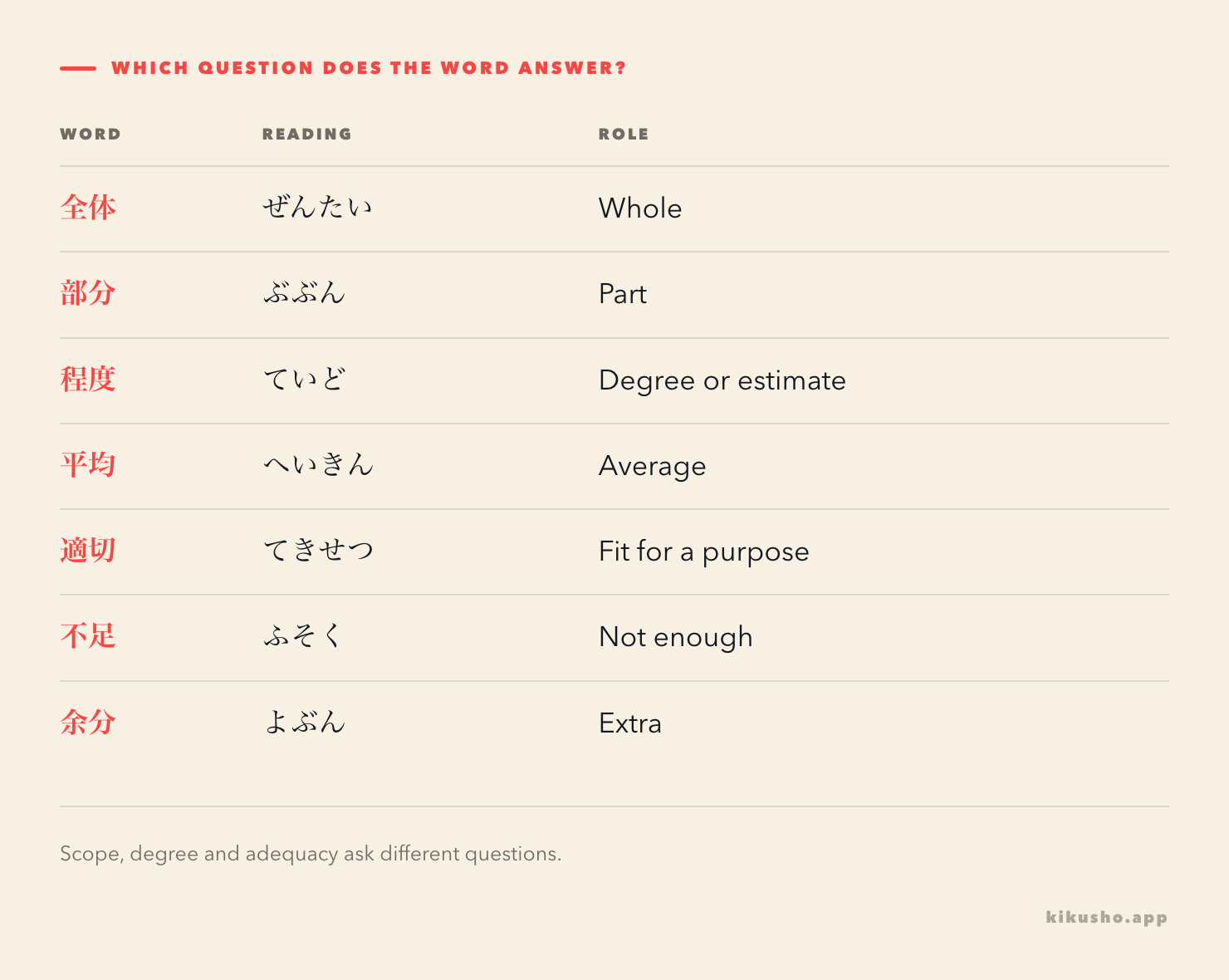
For a meeting with ten people, 椅子が不足しています means there are not enough chairs, while 二つ余分に用意しました means you prepared two extra. In this N3 vocabulary set, 全体 and 部分 describe scope, 程度 describes degree or an approximate amount, 平均 gives an average, and 適切, 不足 and 余分 relate something to a purpose or need.
Those roles matter as much as the English translations. A figure can be an average without being an appropriate target, and a part can be large without being the whole. Learn which question each word answers, then the form that puts it into a sentence.
Seven words, several different jobs
These are the selected everyday uses for this lesson. The dictionary links support the readings, meanings and forms; the level note below explains where teaching lists disagree.
| Word | Reading | Form in this lesson | Meaning | Useful combination |
|---|---|---|---|---|
| 全体 | ぜんたい | Noun | The whole of something | 資料全体: the entire document or set of materials |
| 程度 | ていど | Noun; follows an amount for approximation | Degree, extent; about that amount | 三十分程度: about thirty minutes |
| 適切 | てきせつ | Noun / na-adjective | Appropriate for the situation or purpose | 適切な方法: an appropriate method |
| 不足 | ふそく | Noun / suru verb | An insufficient amount; a shortfall | 時間が不足する: time is insufficient |
| 部分 | ぶぶん | Noun | A part of a whole | 最後の部分: the last part |
| 平均 | へいきん | Noun / suru verb | Average; calculate an average | 点数を平均する: average the scores |
| 余分 | よぶん | Noun / na-adjective | Something extra beyond a need or plan | 余分に用意する: prepare extra |
全体 and 部分 identify the scope
資料全体を確認してください。
Please check the entire document or set of materials.
最後の部分だけを直しました。
I revised only the last part.
全体 includes all of the bounded thing under discussion. In the first example, the target is the 資料, not everything in the room. 部分 picks out a constituent part; it does not tell you that the part is half, small, or any other fixed fraction. だけ makes the second example's restriction explicit: only the last part was revised.
Meshclass's separately authored entries confirm the noun uses of 全体, “whole” and 部分, “part”. Their relation is about coverage of a target, rather than a judgement about whether its size is satisfactory.
程度 gives a degree or a rough amount
変更の程度は小さいです。
The extent of the change is small.
準備には三十分程度かかります。
Preparation takes about thirty minutes.
ある程度わかります。
I understand to some extent.
The first sentence treats 程度 as a noun meaning degree or extent. The second places it after a duration, turning the duration into an approximation. It neither promises exactly thirty minutes nor sets thirty minutes as a minimum. In the third, ある程度 leaves the extent unspecified: there is some understanding, but no percentage is supplied.
You can ask どの程度 when the unknown is the degree or extent. Meshclass illustrates 程度 with degree and ある程度; the linked dictionary also records the approximate-amount use. Keep those two uses together without treating every occurrence as a count.
平均 combines scores into a mean
六十点、七十点、八十点の平均は七十点です。
The average of sixty, seventy and eighty points is seventy points.
For these invented scores, the arithmetic is (60 + 70 + 80) ÷ 3 = 70. One student scored below seventy, one exactly seventy, and one above it. The average describes the group through a calculation; it does not assign seventy points to every student.
点数を平均する uses the suru-verb form to describe averaging the scores. Meshclass's 平均 entry supports both the noun and the suru verb. The dictionary distinguishes several kinds of mean and other senses; the calculation here is specifically an arithmetic mean.
When a report's average tempts you to make a claim about every individual, 必ずしも and its negative continuations can express the missing guarantee. Reading a statistic and qualifying a generalisation are different skills that often meet in the same paragraph.
適切 judges fit; 不足 and 余分 compare with a need
目的に合った適切な方法を選んだ。
I chose an appropriate method that suited the purpose.
適切 evaluates how well something fits the situation or purpose. It can describe a method, explanation or response; it does not itself give a numerical amount. Meshclass shows 適切 as a noun and na-adjective, including its な attachment before a noun.
時間が不足しています。
There is not enough time.
不足 needs a reference point: enough for what? The sentence may refer to time for preparation, a journey or a task already mentioned. It allows some time to remain. Meshclass's 不足 examples also show noun compounds and 不足する for inadequate supply.
十人の会議に、椅子を二つ余分に用意した。
I prepared two extra chairs for a meeting of ten people.
余分 relates the extra provision to the expected or required amount. If each person needs one chair, this example describes twelve prepared chairs. The additional two may be spares for unexpected attendees; their being extra does not make them wasteful. Meshclass's 余分 entry illustrates both 余分な before a noun and 余分に when preparing extra.
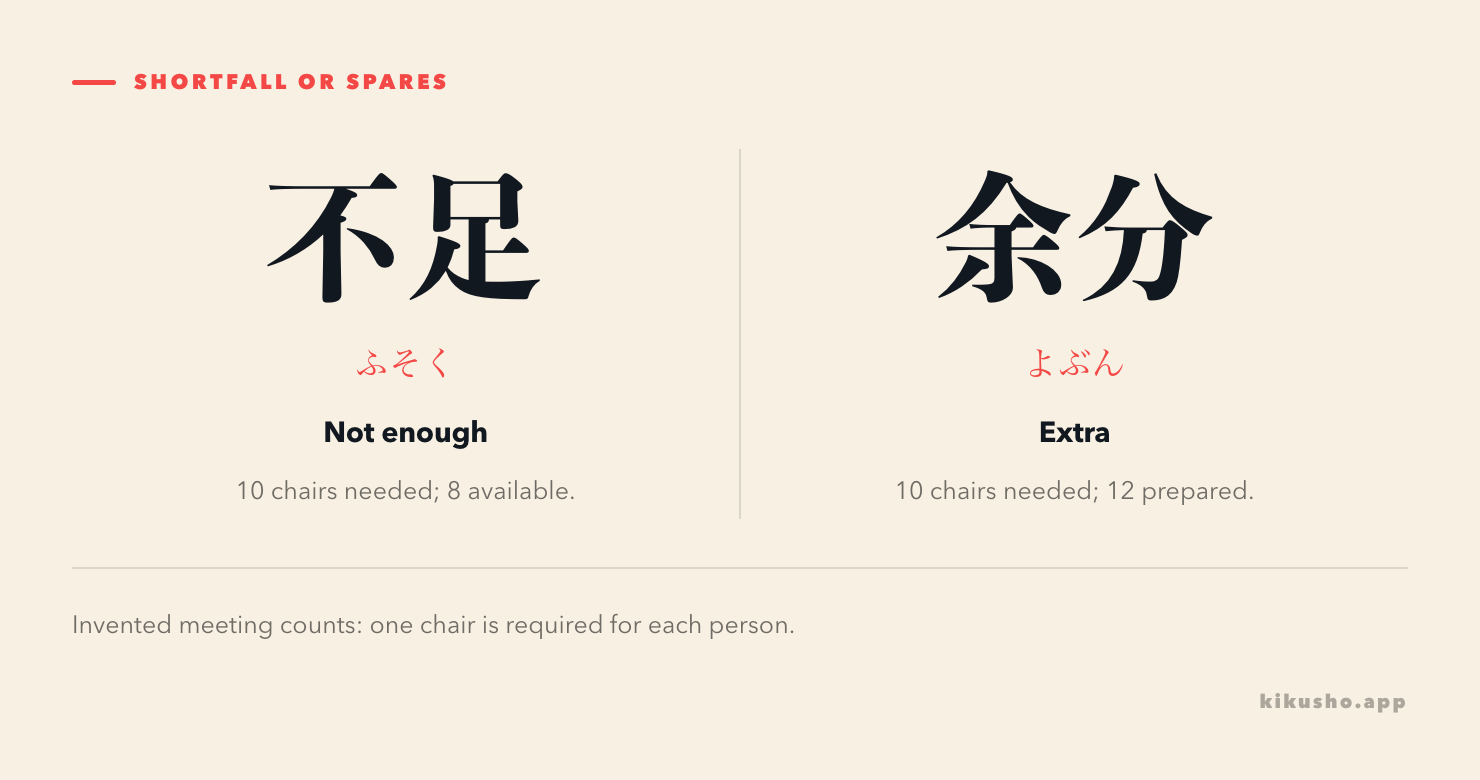
This comparison depends on the requirement, not a permanently “right” number of chairs. A meeting of eight people would change the assessment. It also leaves 適切 as a broader judgement: even enough chairs might be unsuitable for a particular room or activity.
Use the ending that belongs to the word
The seven headwords do not all attach alike. These patterns keep a translation such as “appropriate” from turning into an invented Japanese verb.
| Pattern | Example | What the form does |
|---|---|---|
| Noun + の + noun | 全体の構造 | The structure of the whole |
| Na-adjective + な + noun | 適切な方法 / 余分な椅子 | An appropriate method / extra chairs |
| Na-adjective + に + action | 適切に説明する / 余分に用意する | Explain appropriately / prepare extra |
| Noun + が + 不足する | 時間が不足する | Time is insufficient |
| Noun + を + 平均する | 点数を平均する | Calculate the average of the scores |
The N5 guide to i-adjectives and na-adjectives gives the prerequisite な and に patterns. Here, learn the word together with its combination: 全体の, 適切な, 不足する. The English part of speech cannot choose the Japanese ending for you.
If you encounter a preparation note containing 椅子が不足しています, Kikusho's photo capture can help you keep that real sentence with the word 不足. Check the proposed example before saving it, especially the required and available amounts. Reviewing “shortage” alone would lose the comparison that made the note useful.
What the N3 placement means here
The curriculum's frozen inventory proposes N3 for these seven spelling-and-reading records. Its two Waller-derived lists share a lineage, so their agreement counts as one provenance family. Dictionaries establish meanings and forms, rather than exam-level assignments.
The independent Meshclass pages linked above explicitly label 全体, 部分 and 平均 N3, but 適切 and 不足 N2. Its 程度 and 余分 pages list intermediate-course associations without an explicit JLPT label; those course references do not establish an N3 label.
JapaneseTest4You labels 全体, 程度, 適切, 部分, 平均 and 余分 N3, including the conflicting placement of 適切. That list agreement is not treated as a second independent linguistic review. This lesson keeps the planned N3 grouping while exposing the boundary differences.
Only the selected uses in the tables are taught here. 全体 has other adverbial uses, 不足 has a separate dissatisfaction sense, and 平均 can describe levelling or balance. Those extra dictionary senses need their own contexts; they do not inherit this lesson's scope or practice credit.
Practice
The eight choices mix readings, spelling, interpretation and word forms. Record one letter for each number before opening the solutions.
Question 1
In a score report, how is 平均 pronounced?
A. へいきん
B. ひらきん
C. へいぎょう
D. ひょうきん
Question 2
A writer wants the noun ていど, meaning degree or extent. Which written form belongs in the report?
A. 提度
B. 程渡
C. 呈土
D. 程度
Question 3
Thirty people will attend, but the organiser has materials for only twenty. Fill the noun slot:
参加者は三十人ですが、資料は二十人分しかありません。これは資料の( )です。
A. 平均
B. 不足
C. 全体
D. 程度
Question 4
A colleague writes 資料全体を確認してください。 What work have they requested?
A. Check only the extra copies.
B. Calculate an average from the materials.
C. Check the entire document or set of materials.
D. Revise only the last section.
Question 5
Someone estimates 準備には三十分程度かかります。 Which interpretation preserves the estimate?
A. Preparation takes about thirty minutes.
B. Preparation takes exactly thirty minutes.
C. Preparation requires a minimum of thirty minutes.
D. Thirty minutes is a calculated mean, with no estimate being made.
Question 6
Which sentence attaches 適切 correctly before 方法 in the na-adjective use taught here?
A. 目的に合う適切の方法を選んだ。
B. 目的に合う適切する方法を選んだ。
C. 目的に合う適切な方法を選んだ。
D. 目的に合う適切に方法を選んだ。
Question 7
Each of ten attendees needs one chair. The organiser says 椅子を二つ余分に用意した。 What does the preparation include?
A. Only two chairs in total.
B. Two fewer chairs than needed.
C. Exactly the required ten chairs, with no extras.
D. Two additional chairs beyond the required ten.
Question 8
After editing, someone reports 資料の最後の部分だけを直しました。 Which description matches the scope?
A. They revised every part of the document.
B. They revised only the last part.
C. They calculated the average length of its sections.
D. They prepared additional copies without editing.
Compare your recorded choices with the numbered explanations when your attempt is complete.
Answers and explanations
Answer 1. A. The selected reading is へいきん. B mixes a possible kun-reading of 平 into this compound; C changes its second element; D supplies a different sound sequence. None of those three is the reading of 平均 in the score report.
Answer 2. D. 程度 is the spelling of ていど for degree or extent. A substitutes 提 for 程, B substitutes 渡 for 度, and C replaces both characters. These lookalikes do not supply the requested headword.
Answer 3. B. 不足 names the shortfall: materials for twenty cannot meet a requirement for thirty. Some materials exist, so the answer does not assert that there are none. 平均 would need a set of values to average; 全体 identifies a whole; 程度 describes an extent or degree without naming this lack.
Answer 4. C. 資料全体 covers the entire specified document or set. A adds a distinction between required and extra copies that the sentence never makes. B introduces a statistical task, and D restricts the work to a last section even though 全体 includes the whole target.
Answer 5. A. 三十分程度 gives an approximate duration. B replaces approximation with exactness; C invents a lower bound. D reads 平均 into a sentence that uses 程度 and presents an estimate instead.
Answer 6. C. The na-adjective pattern is 適切な方法. A uses の where this attributive form needs な; B invents 適切する as the verb form; D puts the adverbial に form directly before 方法. 適切に can modify an action, as in 適切に説明する, but it does not replace な in this noun phrase.
Answer 7. D. 二つ余分に identifies two extras relative to the ten needed, giving twelve prepared chairs in this scenario. A mistakes the extra count for the total. B reverses surplus into shortage, and C removes the two extras. Whether the reserves are useful or wasted requires further context.
Answer 8. B. 最後の部分だけ limits the revision to the last part. A contradicts だけ by expanding the work to the whole document. C and D introduce averaging or extra copies; neither describes the revision reported by 直しました.
Common questions
Does 不足 mean there is none of something?
不足 means an amount is insufficient for a need. There may be some available: eight chairs are insufficient when ten people each need one.
Does 余分 always mean wasteful?
余分 describes something extra beyond the required or planned amount. Extra chairs or money can be useful reserves; the word alone does not say they are wasted.
What forms do 適切 and 余分 use before nouns and verbs?
In their na-adjective uses, they take な before a noun and に when modifying an action: 適切な方法, 適切に説明する, 余分な椅子 and 余分に用意する.