On this page
These 17 N2 records describe a material, its outline, its orientation and the quality of its surface or response. The set has 16 written headwords because 鈍い appears twice: にぶい and のろい overlap around slowness, but they do not fit the same range of sentences.
Seventeen records make an object description precise
| Headword | Reading | Word class and practical meaning | Typical combination |
|---|---|---|---|
| 粗い | あらい, arai | i-adjective; coarse, rough-textured, widely spaced or imprecise | 粒が粗い |
| 荒い | あらい, arai | i-adjective; violent, rough, wild or excessive | 波が荒い |
| 曲線 | きょくせん, kyokusen | noun; curved line, curve | 曲線を描く |
| ゴム | ごむ, gomu | noun; rubber; elastic material | ゴム製 |
| 三角 | さんかく, sankaku | noun; triangle or triangular form | 三角の印 |
| 材木 | ざいもく, zaimoku | noun; timber or lumber prepared as usable material | 材木を運ぶ |
| 垂直 | すいちょく, suichoku | noun; na-adjective; vertical or perpendicular | 地面に垂直な線 |
| 水平 | すいへい, suihei | noun; na-adjective; level or horizontal | 水平に置く |
| 正方形 | せいほうけい, seihōkei | noun; square | 正方形の紙 |
| 長方形 | ちょうほうけい, chōhōkei | noun; rectangle, usually non-square in ordinary use | 長方形の窓 |
| 直線 | ちょくせん, chokusen | noun; straight line | 直線を引く |
| 透明 | とうめい, tōmei | noun; na-adjective; transparent or clear | 透明な板 |
| 銅 | どう, dō | noun; copper | 銅線 |
| 鈍い | にぶい, nibui | i-adjective; dull, insensitive, faint or slow to react | 刃が鈍い |
| 鈍い | のろい, noroi | i-adjective; slow, sluggish or dull-witted | 動きが鈍い |
| 木材 | もくざい, mokuzai | noun; wood as a material or resource | 木材を加工する |
| 軟らかい | やわらかい, yawarakai | i-adjective; soft, yielding or easily deformed | 軟らかいゴム |
Kikusho's September 2026 inventory places all 17 spelling-and-reading records at N2 without an internal level conflict. Its two baseline files trace back to Waller and therefore provide a single lineage of level evidence. Current comparison pages separately place 正方形 and 長方形 in an N2 shapes set and explain 粗い as N2 vocabulary. The JLPT organisers do not publish an exhaustive official vocabulary list; N2 is a useful study placement, not a promise about a particular test paper.
粗い concerns detail; 荒い concerns force or behaviour
Both adjectives are read あらい, and both come from the idea of something not being smooth or orderly. Their modern spellings direct attention to different kinds of roughness.
粗い contrasts with 細かい. Use it for large particles, wide gaps, a rough texture or work that lacks detail.
- 粒が粗い: the grains are coarse
- 目の粗い網: a wide-mesh net
- 表面が粗い: the surface is rough
- 見積もりが粗い: the estimate is imprecise
この木材は表面が粗いので、紙やすりで磨きます。
この もくざいは ひょうめんが あらいので、かみやすりで みがきます。
This wood has a rough surface, so we will sand it.
荒い contrasts with 穏やか or 丁寧. It describes forceful natural movement, rough conduct or behaviour that goes beyond a reasonable degree.
- 波が荒い: the waves are rough
- 息が荒い: breathing is heavy
- 運転が荒い: the driving is rough
- 金遣いが荒い: someone spends money recklessly
荒い運転をすると、積んだ材木が動いて危険です。
あらい うんてんを すると、つんだ ざいもくが うごいて きけんです。
Rough driving is dangerous because the loaded timber can move.
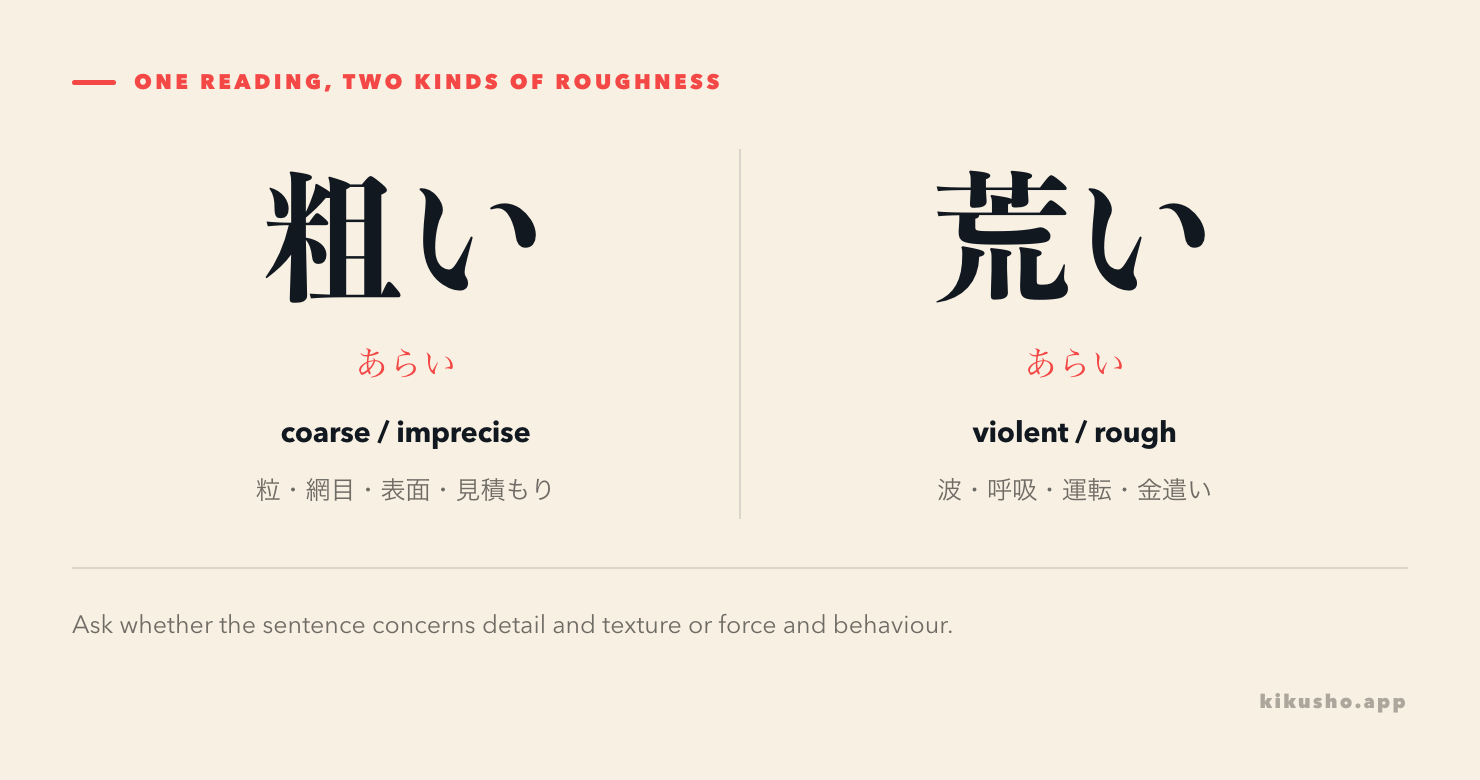
The dictionary entries for 粗い and 荒い preserve some historical overlap, so this is a strong default rather than an absolute border. For an N2 choice question, identify the noun first: grains, mesh, surface and level of detail favour 粗い; waves, breathing, temperament and driving favour 荒い.
直線, 曲線, 垂直 and 水平 answer different geometry questions
直線 and 曲線 describe the form of a line. A 直線 continues straight; a 曲線 changes direction continuously.
二つの点を直線で結び、その下に緩やかな曲線を描いてください。
ふたつの てんを ちょくせんで むすび、その したに ゆるやかな きょくせんを えがいて ください。
Connect the two points with a straight line, then draw a gentle curve below it.
垂直 and 水平 describe orientation or the relationship between lines and surfaces. 垂直 can mean physically vertical, but its geometric core is “perpendicular”: meeting at a right angle. 水平 is level, like still water, and therefore perpendicular to gravity.
柱が床に対して垂直か、床が水平かを確認しました。
はしらが ゆかに たいして すいちょくか、ゆかが すいへいかを かくにんしました。
We checked whether the post was perpendicular to the floor and whether the floor was level.
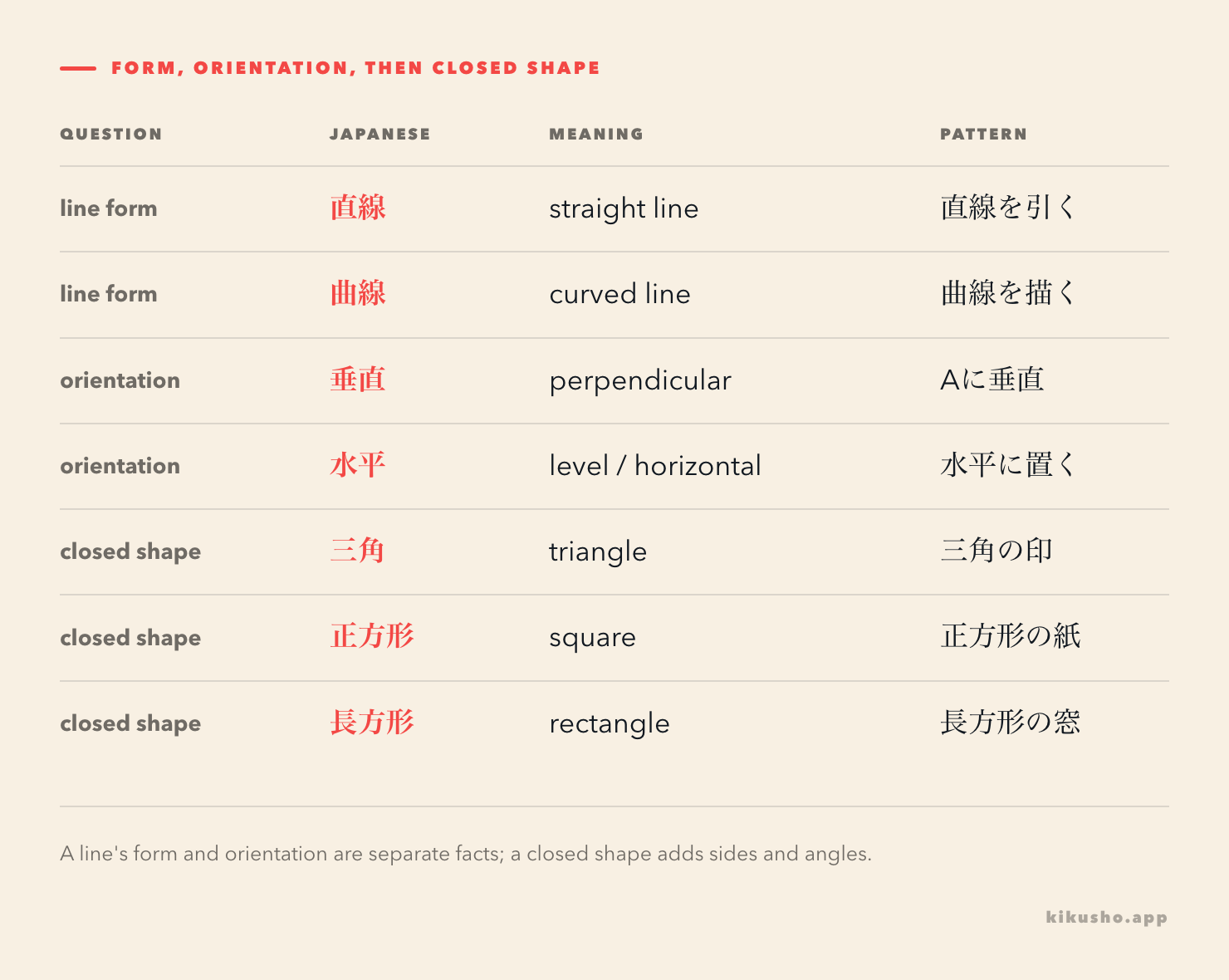
The definition of 垂直 begins with the right-angle relationship, while 水平 refers to a level surface or a direction at right angles to gravity. On a rotated diagram, two diagonal lines may still be 垂直 to each other. Calling either line 水平 would depend on the page or real-world reference.
The verbs also differ:
- 直線を引く / 曲線を描く: draw a straight line / curve
- Aに対して垂直である: be perpendicular to A
- 水平に置く: place something level
- 水平を保つ: keep something level
The N2 science and measurement lesson supplies the language for recording the angle, position and result after you identify the relationship.
三角, 正方形 and 長方形 name closed shapes
三角 means a three-cornered form and often works as the everyday shortening of 三角形, triangle. It can also name a triangular mark.
注意が必要な場所に三角の印を付けました。
ちゅういが ひつような ばしょに さんかくの しるしを つけました。
We put a triangular mark where caution is needed.
正方形 has four equal sides and four right angles. 長方形 has four right angles; in everyday descriptions, it usually means the oblong rectangle whose adjacent sides have different lengths.
正方形の紙を半分に切ると、同じ大きさの長方形が二枚できます。
せいほうけいの かみを はんぶんに きると、おなじ おおきさの ちょうほうけいが にまい できます。
If you cut a square sheet of paper in half, you get two equal rectangles.
Mathematically, a square satisfies the definition of a rectangle because all four angles are right angles. Ordinary Japanese usually names the square separately when equal sides matter. The reference definitions of 正方形 and 長方形 make that relationship explicit.
The N3 materials and shapes lesson introduces the broader word 四角, which may describe a square, rectangle or simply a boxy four-cornered form. N2 正方形 and 長方形 remove that ambiguity.
木材 and 材木 view the same wood at different stages
Both nouns can translate as “wood,” “timber” or “lumber,” and dictionaries list them as near-synonyms. The difference is the viewpoint.
木材 presents wood as a material or resource. It suits science, industry, processing and general classification: 木材を乾燥させる, dry wood; 木材を加工する, process wood; 木材の性質, the properties of wood.
材木 presents wood as material ready for construction or manufacture, commonly in the form of logs, beams and boards. You buy it from a 材木店, stack it at a site and cut it to the required dimensions.
工場で木材を乾燥させてから、材木として現場へ運びます。
こうじょうで もくざいを かんそうさせてから、ざいもくとして げんばへ はこびます。
The wood is dried at the factory, then transported to the site as construction timber.
The 木材 reference covers wood used as material or raw material. The 材木 entry narrows the image to wood prepared for buildings or products, especially squared timber and boards. Real usage overlaps, so choose by focus rather than treating one word as wrong.
ゴム and 銅 behave differently because the materials do
ゴム names rubber, valued for stretching and returning toward its original form. ゴム製 means made of rubber, while 輪ゴム is an elastic band and 消しゴム is an eraser.
軟らかいゴムの部品が、二枚の板の間に入っています。
やわらかい ゴムの ぶひんが、にまいの いたの あいだに はいって います。
A soft rubber part sits between the two plates.
銅 is copper. It conducts heat and electricity well and can be drawn into wire, which is why 銅線, copper wire, is a high-value combination to remember.
透明なカバーの中に、細い銅線が見えます。
とうめいな カバーの なかに、ほそい どうせんが みえます。
A thin copper wire is visible inside the transparent cover.
The material properties support the language: the ゴム reference centres on large elastic deformation, while the 銅 entry records copper's conductivity and workability. Do not use the material name as an adjective by itself before another noun. Use ゴムの部品, ゴム製の部品, 銅の板 or a compound such as 銅線.
透明 and 軟らかい describe properties you can test
透明 is a noun and a na-adjective. A 透明な object lets light pass so that what lies beyond it can be seen clearly. 透明の also appears in product labels, but 透明な板 is the standard descriptive pattern.
板が透明なので、内部の曲線まで見えます。
いたが とうめいなので、ないぶの きょくせんまで みえます。
Because the plate is transparent, even the curved line inside is visible.
軟らかい is an i-adjective for a material that is soft, yielding or easily deformed. The spelling with 軟 makes the opposition to 硬い, hard, visible. 柔らかい is the more common spelling for something supple, gentle or fluffy, and the two overlap in everyday writing.
このゴムは軟らかく、弱い力でも形が変わります。
この ゴムは やわらかく、よわい ちからでも かたちが かわります。
This rubber is soft and changes shape even under a small force.
Kanjipedia's same-reading comparison associates 軟らかい with easy deformation and 柔らかい with suppleness and resilience. Orthographic practice is not a laboratory measurement, so context and house style still matter. The N4 materials lesson gives the broader contrast among the three かたい spellings, 柔らかい, glass and slippery surfaces.
鈍い changes reading when slowness becomes the whole point
Read 鈍い as にぶい for a dull edge, insensitive perception, a weak stimulus or a slow reaction. Its clean opposite in this lesson's physical domain is 鋭い, sharp or keen.
- 刃が鈍い: the blade is dull
- 感覚が鈍い: the senses are insensitive
- 鈍い音: a dull sound
- 鈍い痛み: a dull ache
- 反応が鈍い: the response is slow
Read it as のろい when the main judgment is that movement, work or thought is slow.
- 動きが鈍い(のろい): the movement is sluggish
- 仕事が鈍い(のろい): the work progresses slowly
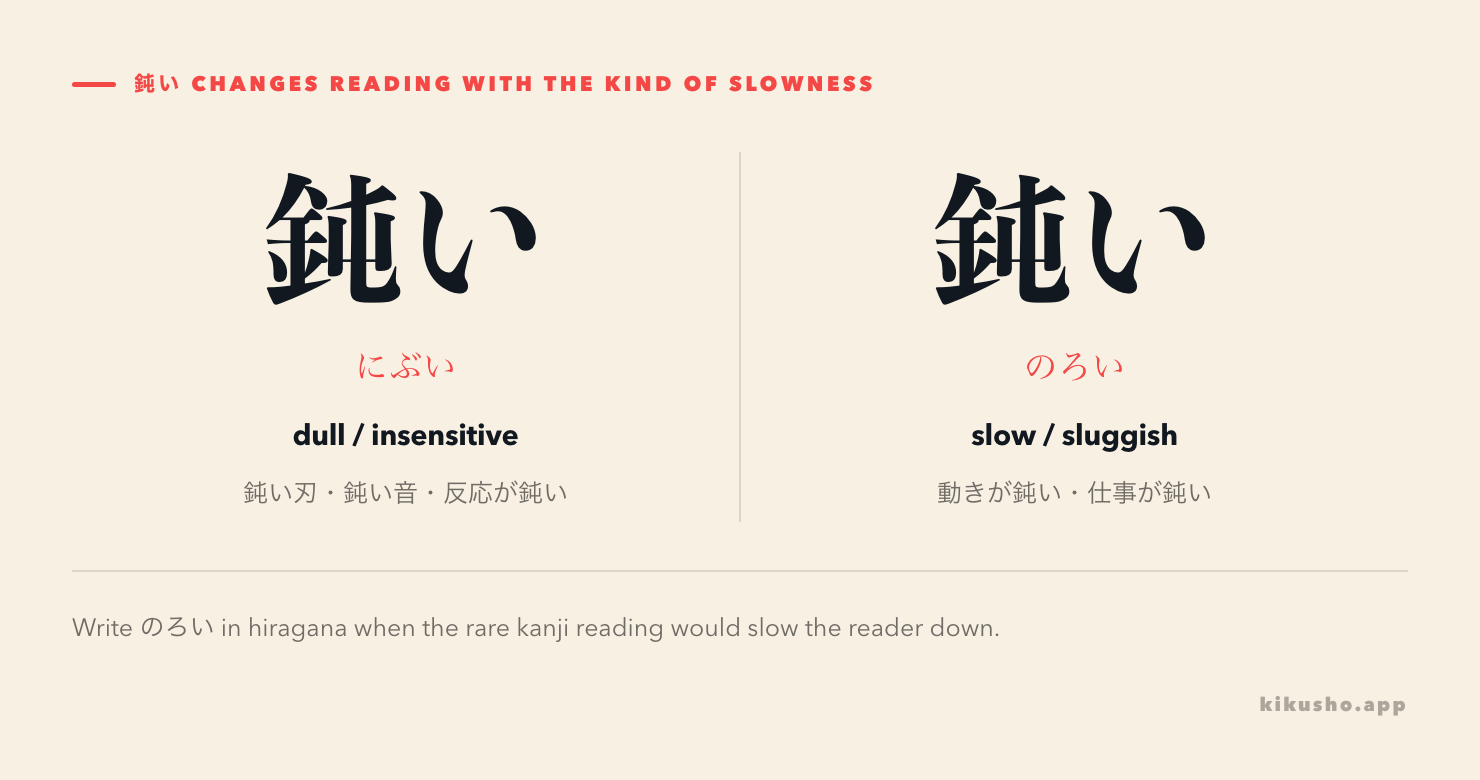
刃が鈍い(にぶい)ため、作業が鈍い(のろい)のではありません。
はが にぶいため、さぎょうが のろいのでは ありません。
The work is not slow because the blade is dull.
Kanjipedia treats にぶい as the standard reading across dullness, faint stimuli and slow response. It marks のろい as a reading outside the standard jōyō table and limits it to slowness or dull thinking. In ordinary prose, writing のろい in hiragana removes the ambiguity immediately.
One inspection note can use every record
図面には、正方形の板と長方形の板があり、三角の印は銅線を通す位置を示しています。直線は互いに垂直で、曲線の下端は水平です。透明なゴム製カバーを付ける前に、木材の表面を確認しました。一部は目が粗く、材木の運び方も荒かったため、角が傷ついていました。軟らかい部分に問題はありませんが、工具の刃が鈍く、作業員の動きも鈍いようです。
The plan shows square and rectangular boards, and the triangular marks indicate where the copper wire passes. The straight lines are perpendicular to each other, and the lower end of the curve is horizontal. Before attaching the transparent rubber cover, we inspected the wood surface. Some grain was coarse, and the timber had been handled roughly, so the corners were damaged. The soft section is fine, but the tool's blade is dull and the worker's movements also seem slow.
The written context does work that an English list cannot. It selects 粗い for coarse grain and 荒い for rough handling. It separates 木材 as the inspected material from 材木 as transported stock. The final sentence lets the same spelling 鈍い carry two readings because dullness belongs to the blade and slowness belongs to movement. Preserve those partners when you turn a line into a Kikusho card.
The N1 continuation moves from ordinary labels to material register, structural strength, brittleness, smoothness and three-dimensional form.
Practice
1 · Coarse grain. 木の粒が大きく、表面がなめらかではない。 Which spelling fits あらい?
- A. 荒い
- B. 粗い
- C. 軟い
- D. 鈍い
2 · Rough conduct. Which sentence uses the correct spelling?
- A. 運転が粗いので、荷物が動いた。
- B. 網の目が荒いので、小さな魚が逃げた。
- C. 波が荒いので、船を出せない。
- D. 粉が荒いので、細かくひいた。
3 · Orientation reading. Choose the reading of 垂直.
- A. すいへい
- B. ちょくせん
- C. すいちょく
- D. きょくせん
4 · Line relationship. Two lines meet at a right angle, although both look diagonal on the page. Which description is precise?
- A. 二本の線は垂直だ。
- B. 二本の線は水平だ。
- C. 二本の線は透明だ。
- D. 二本の線は材木だ。
5 · Exact shape. Which word identifies a four-sided figure whose sides are all equal and whose angles are all right angles?
- A. 三角
- B. 曲線
- C. 長方形
- D. 正方形
6 · Wood as a resource. Complete the report: この工場では国内の( )を乾燥させ、家具用に加工している。
- A. 木材
- B. 材木店
- C. 銅線
- D. ゴム
7 · Material property. Which phrase means “a transparent rubber cover”?
- A. 透明をゴムのカバー
- B. 透明なゴム製カバー
- C. ゴムが透明にカバー
- D. 透明でゴムをカバー
8 · Dull blade. Which reading fits このナイフは刃が鈍い?
- A. あらい
- B. やわらかい
- C. のろい
- D. にぶい
9 · Sluggish progress. In 仕事が鈍い, which reading foregrounds slow progress?
- A. のろい
- B. にぶい
- C. とうめい
- D. すいへい
10 · Connected inspection. 表面の粒は大きいが、作業員の扱い方は丁寧だった。 Which summary matches the sentence?
- A. 表面は荒いが、扱い方は粗くない。
- B. 表面は透明で、扱い方は鈍い。
- C. 表面は粗いが、扱い方は荒くない。
- D. 表面は軟らかく、扱い方は水平だ。
Reveal the inspection answers
1 · B. 粒の大きさ and a surface lacking smoothness take 粗い, the spelling for coarseness or insufficient detail.
2 · C. Strong natural movement takes 荒い, so 波が荒い is correct. Mesh and powder take 粗い; rough driving also takes 荒い.
3 · C. 垂直 is read すいちょく. 水平 is すいへい, 直線 is ちょくせん and 曲線 is きょくせん.
4 · A. 垂直 expresses a right-angle relationship. Neither line needs to look vertical relative to the page.
5 · D. A 正方形 has four equal sides and four right angles. A 長方形 has four right angles but ordinarily suggests unequal adjacent sides.
6 · A. 木材 presents wood as the factory's material or industrial resource. 材木店 means a timber shop rather than the substance being processed.
7 · B. 透明 is a na-adjective before the compound ゴム製カバー: 透明なゴム製カバー.
8 · D. A blade that does not cut well is 鈍い(にぶい).
9 · A. 鈍い(のろい) foregrounds slow movement or progress. Hiragana のろい is common when the writer wants to make the reading unmistakable.
10 · C. Large surface grains make the surface 粗い. 丁寧な扱い is not 荒い, so the handling was not rough.
Common questions
What is the difference between 粗い and 荒い?
Both are read あらい. 粗い describes coarse particles, a rough texture, wide spacing or work lacking detail. 荒い describes violent movement, rough behaviour or excessive use, as in 波が荒い and 運転が荒い.
What is the difference between 鈍い read にぶい and のろい?
にぶい covers a dull blade, insensitive perception, a weak stimulus or a slow response. のろい focuses on slow movement, progress or thinking and is often written in hiragana because this reading of 鈍い is outside the standard jōyō reading table.
What is the difference between 木材 and 材木?
木材 is wood as a material or industrial resource, including wood before or after processing. 材木 usually presents timber as usable or traded building material, especially logs, beams and boards prepared for work.
How are 垂直 and 水平 different?
垂直 means perpendicular to a stated line or surface and often appears vertical relative to the ground. 水平 means level or horizontal, at a right angle to gravity like the surface of still water. Two lines can be 垂直 to each other without either one being vertical on the page.