On this page
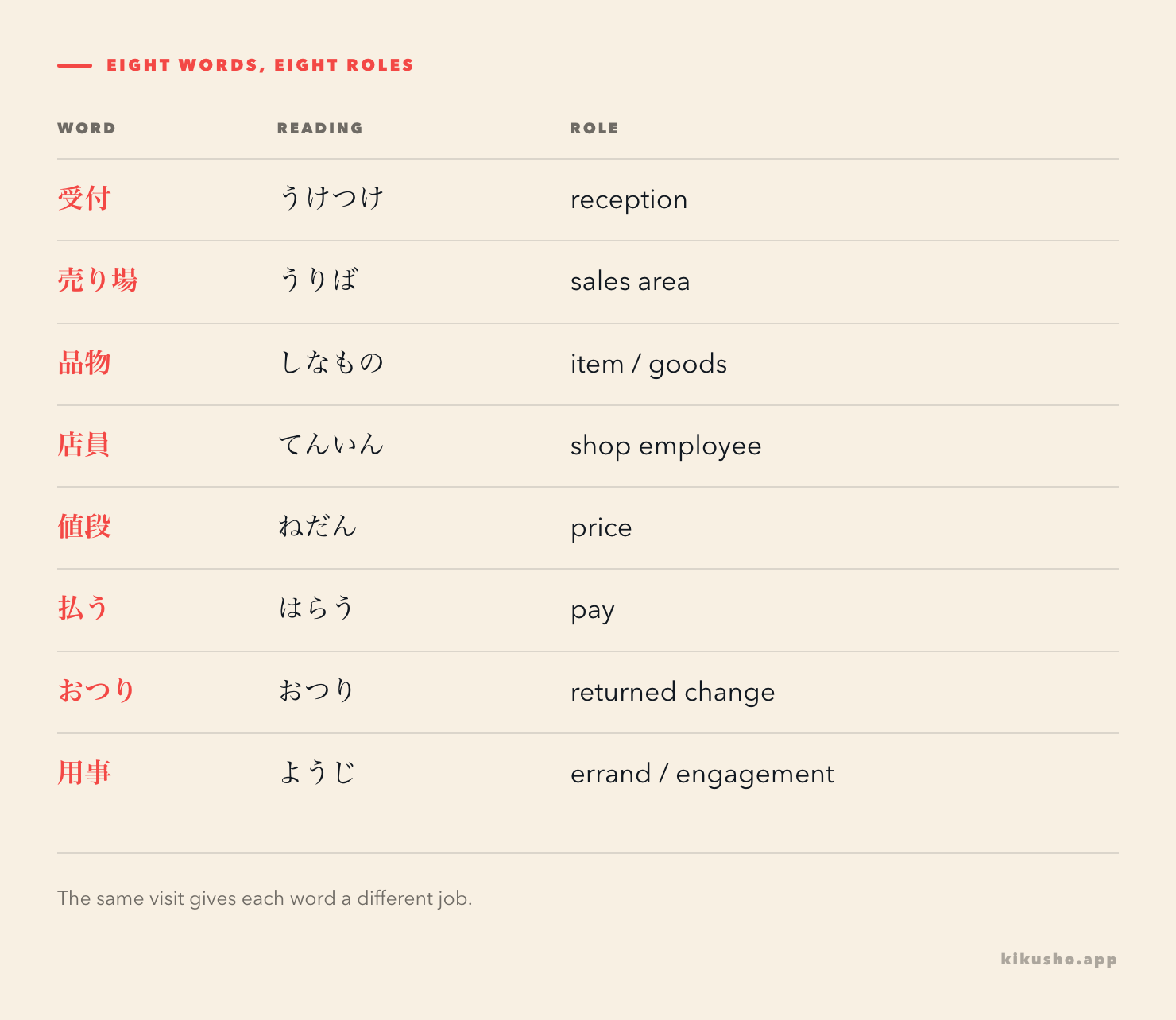
Eight useful N4 shopping and service words are 受付, 売り場, 品物, 店員, 値段, 払う, おつり and 用事. Together they identify the desk, the sales area, the goods, the staff, the price, the payment, the change and the errand that brought you there.
The nouns label different roles in the same visit. Knowing that a word belongs to a shop is less useful than knowing whether it names a person, a place or an amount of money. This set teaches those everyday senses, with examples of notices and conversations; it does not attempt every dictionary meaning of the eight words.
Eight words name the places, people and money in a visit
| Word | Reading | Word class | Meaning in this set | A useful combination |
|---|---|---|---|---|
| 受付 | うけつけ | noun | reception desk; reception or acceptance of submissions | 受付で聞く: ask at reception |
| 売り場 | うりば | noun | area or department where goods are sold | くつの売り場: shoe department |
| 品物 | しなもの | noun | a physical item or goods | 品物を選ぶ: choose an item |
| 店員 | てんいん | noun | someone employed in a shop | 店員に聞く: ask a shop employee |
| 値段 | ねだん | noun | the amount an item costs | 品物の値段: an item's price |
| 払う | はらう | transitive godan verb | give money in payment | お金を払う: pay money |
| おつり | おつり | noun | cash returned when you give more than is due | おつりをもらう: receive change |
| 用事 | ようじ | noun | something to attend to; an errand or engagement | 用事がある: have something to do |
These are ordinary vocabulary, not eight special honorific expressions. The familiar お in おつり belongs to the polite expression you will commonly hear at a checkout. You may also see お釣り, with the same reading.
The curriculum's planning lists place these words at N4, except that 値段 has an N4/N3 disagreement. The two licensed lists share Jonathan Waller's Tanos ancestry, so agreement between them is not independent level confirmation. We include the everyday price sense here because it belongs with paying and receiving change. The JLPT's explanation of its syllabus policy is the reason to treat such labels as learning estimates.
受付 and 売り場 send you to different places
受付(うけつけ) can be a reception desk or the people handling reception. In a notice about applications, it can also mean accepting or receiving those applications. The NINJAL dictionary entry distinguishes these two uses.
Consider this simple notice in a building with a reception desk and shops:
受付は1階です。くつの売り場は2階です。
うけつけは いっかいです。くつの うりばは にかいです。
Reception is on the first floor. The shoe department is on the second floor.
Here 受付 names the desk that receives visitors. 売り場(うりば) names the place where something is sold. The spelling 売場 on a floor guide has the same reading. A 売り場 may occupy part of a floor; the word does not require a whole shop or a whole storey.
On a service notice, 受付時間(うけつけじかん) gives the hours during which requests, registrations or visitors are accepted. Read the surrounding words to find out what the service receives.
One English gloss needs care: receipt can mean the act of receiving something. That sense can explain 受付, but a shopping receipt is a different object. The till's paper record is レシート. You cannot replace it with 受付 just because both have been translated as “receipt.”
For floor numbers and other quantities, the N4 counter lesson supplies the broader counting patterns.
品物 is the item; 店員 is the person you ask
品物(しなもの) points to a tangible thing: an item on a shelf, goods being delivered or something handed over a counter. It can refer to one item as well as several. English “goods” does not make the Japanese noun permanently plural.
店員(てんいん) identifies a shop employee, as in the JMdict entry served by Jisho. The person might advise customers, arrange stock or take payment; the word alone does not mean “cashier.” Keep the ん in the reading taught here: てん・いん.
この品物の値段を店員に聞きました。
この しなものの ねだんを てんいんに ききました。
I asked a shop employee the price of this item.
The sentence assigns each noun a job. 品物 is the thing being priced. 値段 is the information requested. 店員 is the person asked, marked by に. The word combination 品物の値段 tells you whose price you mean.
A counter instruction might read:
品物はこちらに置いてください。
しなものは こちらに おいてください。
Please put the item here.
The request concerns the object, not the employee or the department. If the ending is unfamiliar, ~てください explains how an action becomes an instruction.
値段, 払う and おつり occupy different parts of a payment
値段(ねだん) is the price, an amount associated with the item. The NINJAL entry for 値段 records its everyday conversational use.
この品物の値段は700円です。
この しなものの ねだんは ななひゃくえんです。
This item costs 700 yen.
払う(はらう) is the action of paying. An amount or money can take を; the payment method takes で. In 現金で払う(げんきんで はらう), 現金 means cash. カードで払う means pay by card. These describe the method, not the amount.
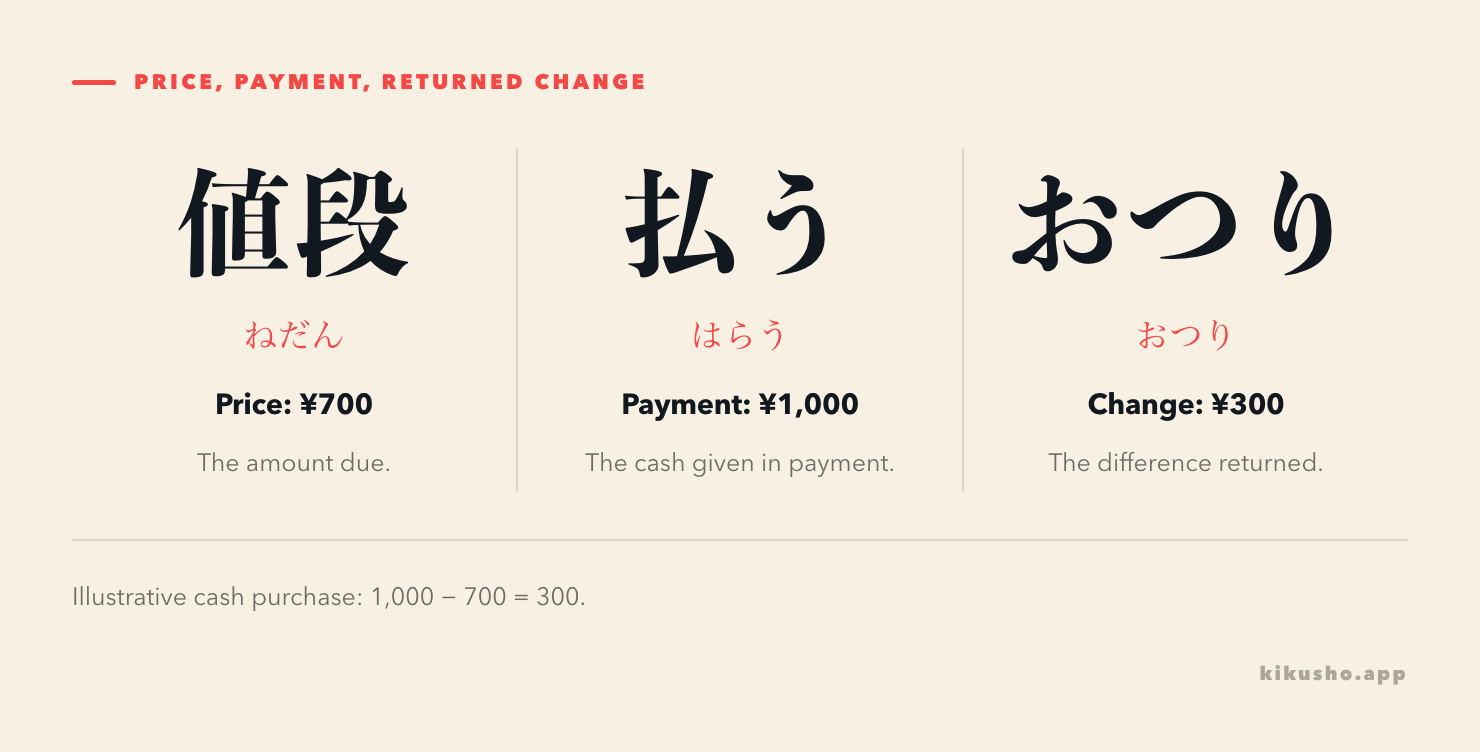
おつり is that returned money. It does not mean every coin in your wallet or the item's price. Shogakukan's definition of 釣銭 identifies おつり as the difference returned after payment with a larger amount of cash. A card payment does not normally produce this kind of change.
払う follows the ordinary godan pattern for verbs ending in う:
| Form | Reading | Function |
|---|---|---|
| 払います | はらいます | polite nonpast |
| 払って | はらって | て-form |
| 払った | はらった | plain past |
| 払わない | はらわない | plain negative |
カードで払ってもいいですか。
カードで はらっても いいですか。
May I pay by card?
That question uses the permission pattern ~てもいい. The vocabulary lesson adds the payment verb, rather than treating the whole grammar pattern as new N4 material.
Do not turn “pay” into a universal translation of 払う. Its dictionary entry in Digital Daijisen also includes removing things and other uses. This lesson covers the financial sense, not every object that can accompany the verb.
用事 names something you need to attend to
用事(ようじ) may be an errand, an appointment or another matter requiring your attention. The NINJAL entry treats it as conversational vocabulary and records 用事がある and 用事が済む(ようじが すむ), “the matter is finished.”
銀行に用事があります。
ぎんこうに ようじが あります。
I have something to attend to at the bank.
This names the destination and leaves the task unspecified. It does not tell the listener whether you are withdrawing money, submitting a form or meeting someone. English “business” in a dictionary gloss means a matter to deal with here, rather than a company you own.
You can also explain that you are unavailable with 用事があります, without giving the details. It describes your engagement; it is not a label for a shop's opening hours.
A clinic may have a 受付 too. For a more specific reason for the visit, the N4 health lesson explains a dentist's appointment. 受付 can move between a shop building, a clinic and an office because receiving visitors is a role, not a type of business.
A notice gives you a phrase worth keeping
On your next floor guide, look for 売場 and what is sold there. On a service notice, look for 受付 and the hours beside it. At payment, separate what the item costs from what you hand over and what comes back. Those situations make different parts of the set visible.
Kikusho's photo capture suits a short sign such as 受付時間. Highlight that expression and check the resulting reading and explanation before saving it. Keeping the original photo with the card gives you the notice to revisit during offline reviews. The useful memory is the expression attached to a place you recognised.
Vocabulary selection adapted from Jonathan Waller / Tanos, through Jamie Sinclair's Open Anki lists and stephenmk's Yomitan adaptation. The combined vocabulary-data adaptation is CC BY-SA 4.0; readings and senses were checked in dictionaries, and the examples and exercises here were written for this lesson.
Practice questions
Seven exercises test the readings, spelling and roles of this set. Write your choices down as you go; the explanations follow Question 7. We wrote these questions for this page, using the five N4 vocabulary task types.
Question 1
Choose the reading of 受付 in 受付は1階です。
- ア うけつけ
- イ うけとり
- ウ じゅけつ
- エ うけつき
Question 2
Choose the spelling of てんいん, meaning a shop employee.
- ア 店印
- イ 店院
- ウ 店員
- エ 店因
Question 3
Complete the sentence with the word that names the amount the bag costs.
このかばんの( )は2,500円です。
- ア 受付
- イ 値段
- ウ 用事
- エ 店員
Question 4
What does 用事があります most closely mean in a reply to an invitation?
- ア I work at that shop.
- イ I need some change.
- ウ I own a company.
- エ I have something to attend to.
Question 5
Choose the natural use of 払う with its financial meaning.
- ア 明日は用事を払います。
- イ この品物の色を払います。
- ウ レジでお金を払います。
- エ 店員の名前を払います。
Here レジ means the checkout, 色(いろ)means colour and 名前(なまえ)means name.
Question 6
Read the floor notice. Where should someone go to look at shoes?
受付:1階
くつの売り場:2階
かばんの売り場:3階
- ア The reception desk on the first floor.
- イ The shoe sales area on the second floor.
- ウ The bag sales area on the third floor.
- エ The notice does not identify a place selling shoes.
Question 7
An item costs 800 yen. You give the cashier 1,000 yen in cash. How much is the おつり?
- ア 200円
- イ 800円
- ウ 1,000円
- エ 1,800円
Answers and explanations
Answer 1
ア: うけつけ. In this notice 受付 names reception. うけとり is the reading of a different word, 受け取り; the other two choices do not give the reading of 受付. The compound's whole reading matters more than guessing from one character.
Answer 2
ウ: 店員. 店 identifies the shop and 員 identifies a member or employee. 院, 印 and 因 are different characters, so the other choices do not spell the target word. This exercise asks for the written word, not just a plausible sequence of sounds.
Answer 3
イ: 値段. このかばんの値段 is the bag's price. 受付 is reception, 用事 an engagement or task, and 店員 a person working in a shop. None of those names what the bag costs.
Answer 4
エ: I have something to attend to. 用事があります can explain why someone is occupied without naming their task. It does not state that they are a shop employee, that they need returned money or that they own a company. The English gloss “business” needs this distinction.
Answer 5
ウ: レジでお金を払います。 “I pay at the checkout.” お金 is the money paid, marked by を; レジで gives the location. A task, an item's colour and a person's name are not the things being paid in this financial use. The alternatives attach the payment verb to the wrong kind of noun.
Answer 6
イ: the shoe sales area on the second floor. くつの売り場 supplies both the goods and the place. Reception is on a different floor, and the third-floor 売り場 sells bags. A 売り場 is a place to find the specified goods, not another word for 受付.
Answer 7
ア: 200円. The returned difference is 1,000 − 800 = 200 yen. The 800 yen is the 値段; 1,000 yen is the cash handed over. Adding the two amounts does not describe money returned to you.
Common questions
Does 受付 mean a shopping receipt?
受付(うけつけ)means reception, a reception desk or the acceptance of applications and submissions. It does not name the paper showing what you paid. レシート is the usual word for a till receipt.
What is the difference between 値段 and おつり?
値段(ねだん)is an item's price. おつり is the money returned after you hand over more cash than the amount due. For an item priced at 700 yen, handing over 1,000 yen produces 300 yen in change.
Is 値段 N4 or N3 vocabulary?
The planning sources disagree: one places 値段 at N4 and another at N3. This lesson includes its everyday price sense at N4. These are study-list estimates; the JLPT does not publish an exhaustive vocabulary syllabus.