On this page
These seven N2 Japanese illness, symptoms and recovery vocabulary words move beyond naming a basic condition. They let you report three specific symptoms, distinguish an examination from a diagnosis, describe contagion, say that someone cures a condition and name the recuperation that follows.
The most useful unit is not the English gloss alone. Learn 吐き気がする, 診断を受ける, 病気を治す and 休養をとる as complete patterns, because the particle and verb reveal how each noun works.
Seven N2 words connect a symptom report to recuperation
| Entry | Reading | Word class | Meaning in this set | Phrase worth keeping |
|---|---|---|---|---|
| 休養 | きゅうよう, kyūyō | noun; suru verb | rest or recuperation for recovery | 休養をとる: take time to recuperate |
| くしゃみ | くしゃみ, kushami | noun | sneeze | くしゃみが出る: sneeze |
| 診断 | しんだん, shindan | noun; suru verb | diagnosis; medical judgment | 診断を受ける: receive a diagnosis |
| 伝染 | でんせん, densen | noun; suru verb | contagion; transmission | 病気が人に伝染する: a disease spreads to a person |
| 治す | なおす, naosu | transitive godan verb | cure or heal | 病気を治す: cure an illness |
| 吐き気 | はきけ, hakike | noun | nausea; the feeling of being about to vomit | 吐き気がする: feel nauseous |
| めまい | めまい, memai | noun | dizziness; vertigo | めまいがする: feel dizzy |
休養 has two long vowels, きゅうよう. 吐き気 is read はきけ: the 気 is け in this compound, not the usual standalone reading き. The assigned forms くしゃみ and めまい are normally written in kana; rare kanji spellings are not needed to use them accurately.
くしゃみ, 吐き気 and めまい select different symptom patterns
All three words are nouns, but they do not enter a report in exactly the same way.
くしゃみ names the physical event of sneezing. Two ordinary patterns view that event from different angles:
- くしゃみをする: perform the action of sneezing
- くしゃみが出る: a sneeze comes out or occurs
花粉が多い日は、くしゃみが何度も出ます。
かふんがおおいひは、くしゃみがなんどもでます。
On days with a lot of pollen, I sneeze repeatedly.
The Japanese dictionary entry for くしゃみ defines the reflex and records the historical kanji 嚔. Modern general writing usually leaves the word in hiragana. くしゃみが止まらない is useful when the repeated event is the point.
吐き気(はきけ) is the sensation of nausea. It does not by itself assert that the person actually vomited.
朝から吐き気がしますが、まだ吐いてはいません。
あさからはきけがしますが、まだはいてはいません。
I have felt nauseous since this morning, but I have not vomited.
That contrast matters because 吐く(はく) is the action “to vomit,” while 嘔吐(おうと) is the formal noun for vomiting. The 吐き気 definition describes the feeling of being about to expel the contents of the stomach and explicitly notes that vomiting need not follow.
めまい is dizziness: a feeling of spinning, swaying or losing stable orientation. It also commonly takes がする.
急に立ち上がったとき、少しめまいがしました。
きゅうにたちあがったとき、すこしめまいがしました。
When I stood up suddenly, I felt slightly dizzy.
The official Edogawa City hospital-language guide gives both 吐き気がする and めまい as practical symptom language. The Japan Foundation likewise records 吐き気がする in its Irodori vocabulary list.
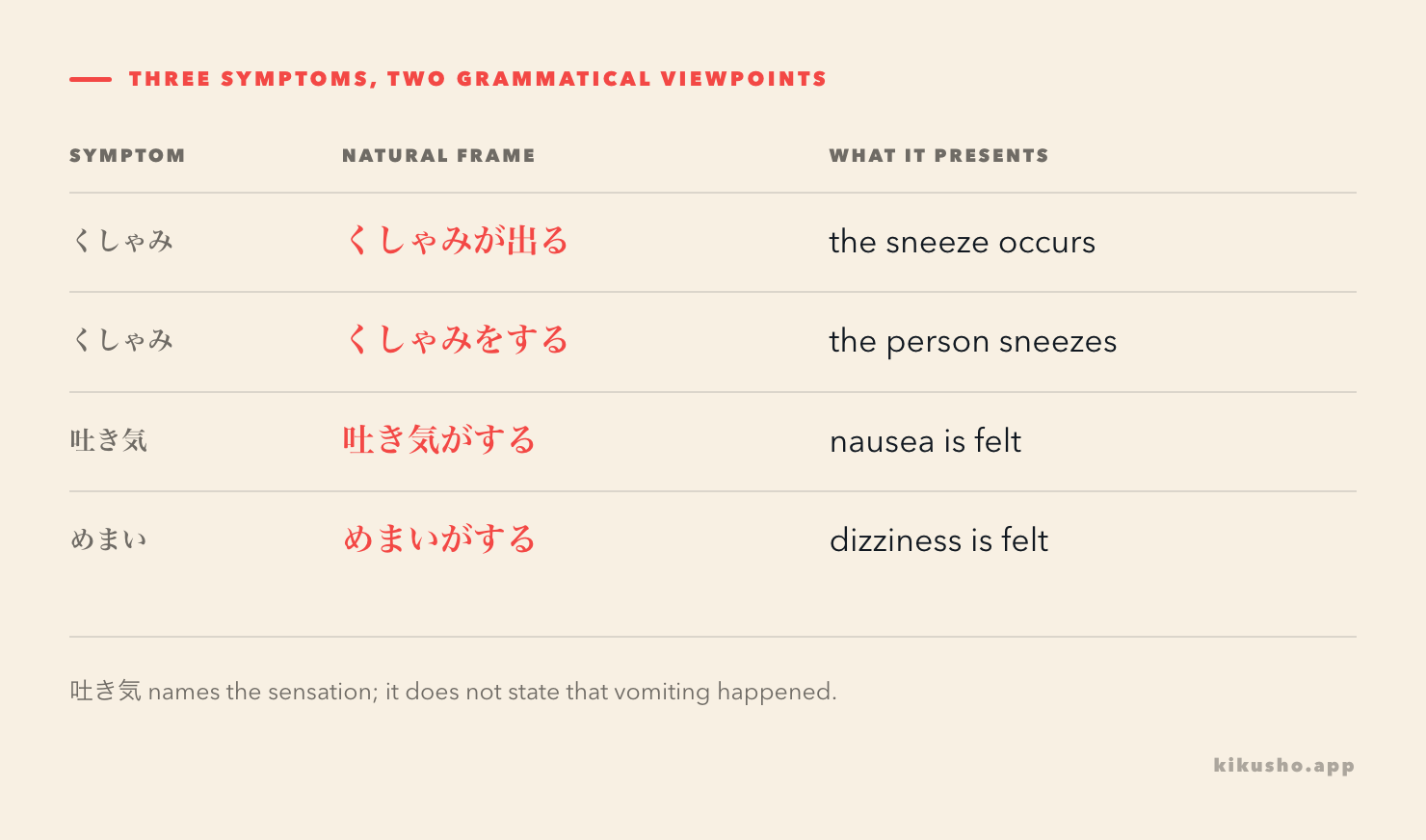
Do not turn 吐き気 into “vomiting” in a reading question. The sentence may deliberately separate the sensation from the later action.
診察, 検査 and 診断 are three different jobs
診断(しんだん) is a judgment about a person's health, illness or condition. The Digital Daijisen entry also records extended uses such as 経営診断, a diagnosis or assessment of a business, but the medical sense is central here.
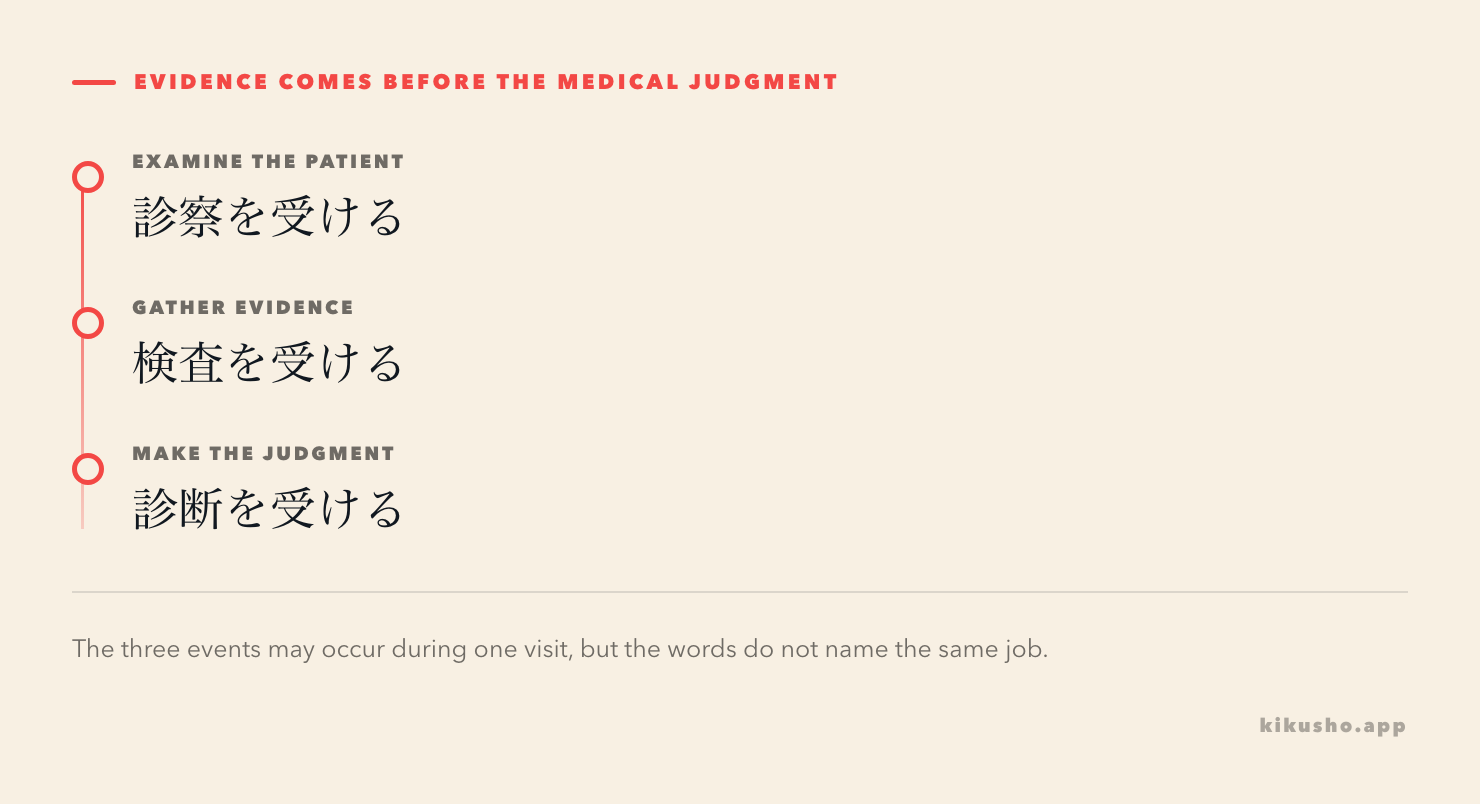
Three nearby words often occur during one appointment:
| Stage | What it does | Patient-centred phrase |
|---|---|---|
| 診察(しんさつ) | a clinician examines and questions the patient | 診察を受ける |
| 検査(けんさ) | a test or check gathers evidence | 検査を受ける |
| 診断(しんだん) | the clinician judges the condition from the evidence | 診断を受ける/~と診断される |
医師は診察と検査の結果から、花粉症だと診断しました。
いしはしんさつとけんさのけっかから、かふんしょうだとしんだんしました。
From the examination and test results, the doctor diagnosed hay fever.
Agency changes the expression. A doctor may 診断を下す or 患者を~と診断する. A patient normally 診断を受ける or is ~と診断される.
患者は軽いアレルギーだと診断されました。
かんじゃはかるいアレルギーだとしんだんされました。
The patient was diagnosed with a mild allergy.
The N3 illness vocabulary lesson teaches 検査 as the information-gathering step. 診断 adds the judgment made from that evidence; it is not another word for the test itself.
伝染 focuses on something passing from one individual to another
伝染(でんせん) means contagion or transmission. In health contexts, it describes a disease passing to another living being.
その病気は人から人へ伝染します。
そのびょうきはひとからひとへでんせんします。
The disease spreads from person to person.
The 伝染 entry notes that everyday Japanese often treats 伝染 and 感染(かんせん) as near-synonyms. A more precise distinction is still useful:
- 感染 focuses on a pathogen entering and multiplying in a host: ウイルスに感染する.
- 伝染 focuses on the condition passing from one individual to another: 病気が人に伝染する.
The particles reflect that viewpoint. A person may be the subject who 感染する, while the disease is often the subject that 伝染する.
The N1 illness and recovery lesson extends this contrast with 安静, 感染, formal fatigue vocabulary and the marked readings 傷(しょう) and 吐く(つく).
伝染 also leaves medicine behind and describes a behavior or mood spreading socially:
一人があくびをすると、周りの人にも伝染しました。
ひとりがあくびをすると、まわりのひとにもでんせんしました。
When one person yawned, it spread to the people around them too.
彼女の笑いが教室中に伝染しました。
かのじょのわらいがきょうしつじゅうにでんせんしました。
Her laughter spread through the whole classroom.
This figurative range helps on N2 context questions: a sentence about laughter can still select 伝染 even though no illness is present.
治す is transitive; 治る describes the condition improving
治す(なおす) puts an agent in control of the action. It is transitive, so the condition being cured or healed takes を.
医師は患者のけがを治そうとしています。
いしはかんじゃのけがをなおそうとしています。
The doctor is trying to heal the patient's injury.
Its intransitive partner 治る(なおる) puts the improving condition in the subject position.
患者のけがは順調に治っています。
かんじゃのけがはじゅんちょうになおっています。
The patient's injury is healing well.
| Viewpoint | Form | Particle pattern | Example |
|---|---|---|---|
| an agent cures or heals something | 治す | condition を 治す | 病気を治す |
| a condition gets better | 治る | condition が 治る | 傷が治る |
| an agent repairs or corrects a non-health problem | 直す | object を 直す | 時計を直す/間違いを直す |
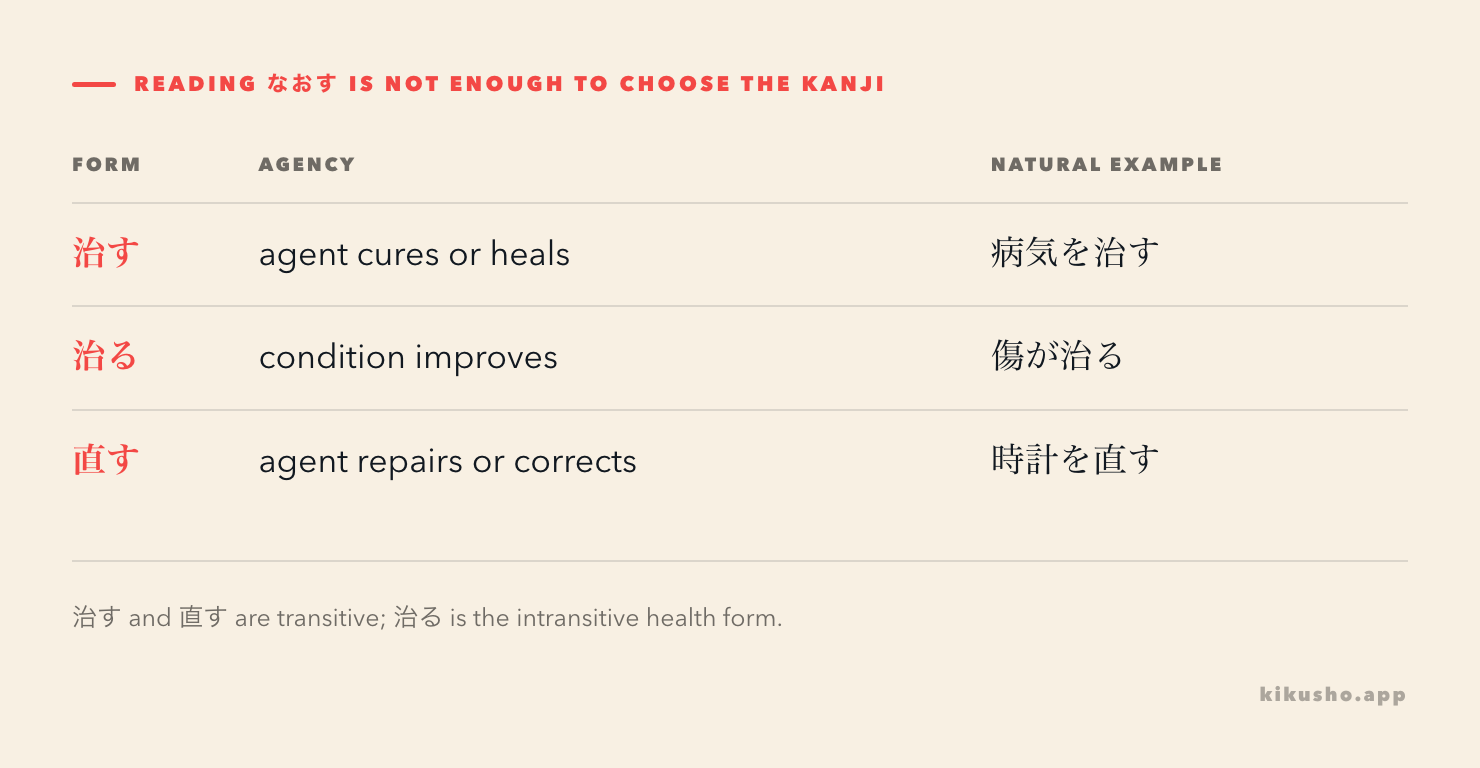
The broad dictionary family behind なおす covers restoring something to a normal state. The usage breakdown specifies that illness and injury are normally written 治す, while faults, machines and errors take 直す. A source gloss that says “cure, fix, correct, repair” therefore describes the whole sound family; the assigned spelling 治す selects the health branch.
休養 is restorative rest rather than a short pause
休養(きゅうよう) is rest taken to recover strength or maintain health. Learn it through 休養をとる, 休養が必要だ and 休養に充てる.
医師の診断を受けたあと、数日間休養をとりました。
いしのしんだんをうけたあと、すうじつかんきゅうようをとりました。
After receiving the doctor's diagnosis, I took several days to recuperate.
日曜日は心と体の休養に充てるつもりです。
にちようびはこころとからだのきゅうようにあてるつもりです。
I intend to devote Sunday to mental and physical recuperation.
The noun differs in emphasis from two shorter rest words:
| Word | Typical scale and purpose | Example |
|---|---|---|
| 休憩 | a pause inside an activity | 十分休憩する: take a ten-minute break |
| 休息 | stopping activity to rest | 少し休息する: rest for a while |
| 休養 | recuperative rest that restores body or mind | 自宅で休養をとる: recuperate at home |
Bunpro's 休養 entry places the word at N2 and describes rest taken to regain physical strength or improve health. The distinction is a tendency rather than a fixed number of minutes: context can make 休息 long, but 休養 foregrounds restoration.
A short report connects all seven records
朝からくしゃみが止まらず、昼ごろには吐き気がして、めまいもしました。病院で診察と検査を受け、医師から軽いアレルギーだと診断されました。人に伝染する病気ではないそうです。医師は「薬だけで治そうとせず、十分な休養をとってください」と説明しました。
あさからくしゃみがとまらず、ひるごろにははきけがして、めまいもしました。びょういんでしんさつとけんさをうけ、いしからかるいアレルギーだとしんだんされました。ひとにでんせんするびょうきではないそうです。いしは「くすりだけでなおそうとせず、じゅうぶんなきゅうようをとってください」とせつめいしました。
The sneezing would not stop from the morning, and around noon I also felt nauseous and dizzy. At the hospital I received an examination and tests, and the doctor diagnosed a mild allergy. I was told that it was not an illness that spreads to other people. The doctor explained, “Do not try to cure it with medicine alone; get enough recuperative rest.”
The report keeps roles visible. The patient experiences 吐き気 and めまい, receives a 診断, hears whether the condition can 伝染, and takes 休養. The doctor is the implied agent behind 治す.
N2 practice: formation, context and usage
1 · Reading a recuperation plan. How is 休養 read in 数日間、休養をとる?
A. きゅうよ
B. きゅよう
C. きゅうよう
D. きゅうおう
2 · Writing a medical judgment. Which spelling represents しんだん?
A. 診察
B. 診断
C. 検断
D. 診段
3 · Building a health word. Choose the kanji that completes 健康__, meaning a health checkup or medical examination.
A. 染
B. 断
C. 養
D. 気
4 · Reporting a sensation. Complete both blanks naturally: 昼から__がして、立つと__もします。
A. 吐き気・めまい
B. くしゃみ・休養
C. 診断・伝染
D. 休養・診断
5 · Distinguishing evidence from judgment. Complete: 血液__の結果を見て、医師が診__を下しました。
A. 診・察
B. 断・療
C. 検査・断
D. 休養・察
6 · Following agency. Which sentence says that the illness got better, without naming a person who cured it?
A. 医師が病気を治しました。
B. 薬で病気を治します。
C. 病気が治りました。
D. 医師が時計を直しました。
7 · Choosing the written form. Which sentence uses the expected kanji for なおす?
A. 時計を治す。
B. 間違いを治す。
C. けがを直す。
D. 病気を治す。
8 · Reading a figurative use. In 笑いが教室中に伝染した, what happened?
A. A medical diagnosis was announced.
B. Laughter spread through the classroom.
C. Everyone took restorative rest.
D. A student felt nauseous.
9 · Selecting the right kind of rest. A worker stops for ten minutes during a meeting. Which word most directly names that pause?
A. 休養
B. 診断
C. 休憩
D. 伝染
10 · Interpreting a symptom report. Read: 吐き気はしましたが、吐きませんでした。めまいもすぐに治りました。 Which statement preserves both contrasts?
A. The person vomited, and the dizziness continued.
B. The person felt nauseous without vomiting, and the dizziness soon went away.
C. The person sneezed and received a diagnosis.
D. The symptoms spread to another person.
Answers and explanations
1 · C, きゅうよう. Both compounds carry a long vowel: きゅう plus よう. Dropping either う changes the written reading.
2 · B, 診断. 診断 is the medical judgment. 診察 is a real word but names the clinician's examination of the patient, not the target spelling.
3 · B, 断. 健康診断 is a fixed compound for a health checkup or medical examination. The final two kanji retain the word 診断.
4 · A, 吐き気・めまい. Both sensations commonly use がする. The other choices combine this frame with an action, restorative rest or a medical judgment.
5 · C, 検査・断. A blood test supplies evidence: 血液検査. The doctor then makes the judgment: 診断を下す.
6 · C. 治る is intransitive, and 病気 is the subject marked by が. A and B use transitive 治す with an agent or means; D concerns repairing a clock.
7 · D. Health conditions conventionally take 治す. Repairs and corrections take 直す, so 時計を直す and 間違いを直す would be the expected spellings. A, B and C reverse those choices.
8 · B. 伝染 extends figuratively to a yawn, laughter, mood or tendency spreading among people. No disease is required in this sentence.
9 · C, 休憩. A bounded pause inside an ongoing meeting is a 休憩. 休養 foregrounds recuperation of body or mind rather than the meeting's scheduled break.
10 · B. 吐き気 names the sensation, and the negative 吐きませんでした says vomiting did not occur. めまいが治りました says the dizziness went away.
Store each record with the grammar that identifies it: くしゃみが出る, 吐き気/めまいがする, ~と診断される, 病気が人に伝染する, 病気を治す and 休養をとる. Those frames turn seven translations into seven usable choices.
Kikusho's dated inventory assigns all seven spelling-and-reading records to N2, and current N2 study materials independently support several of them. Other publishers sometimes introduce familiar items such as くしゃみ earlier. Since the JLPT does not issue an exhaustive vocabulary list, the level is a study placement; the tested skill here is choosing the precise word, spelling and construction from context.
Common questions
What is the difference between 診察, 検査 and 診断?
診察 is the clinician's examination of a patient, 検査 is a test or check that gathers information, and 診断 is the medical judgment made from the examination and other evidence. A patient can therefore receive all three at different stages of one visit.
What is the difference between 伝染 and 感染?
The words overlap in everyday use. More precisely, 感染 focuses on a pathogen entering and multiplying in a host, while 伝染 focuses on a disease or tendency passing from one individual to another. 伝染 also has figurative uses such as あくびが伝染する.
How are 治す and 治る different?
治す is transitive: someone cures an illness or heals an injury, so the condition takes を. 治る is intransitive: the illness or injury gets better, so it takes が. Non-health repairs and corrections are normally written 直す.
Do 吐き気 and めまい use ある or する?
Both commonly use the sensation pattern がする: 吐き気がする and めまいがする. 吐き気 is the feeling of nausea and does not itself say that vomiting occurred; めまい describes dizziness.