On this page
These ten N3 words describe how an 発明, invention, becomes a designed and manufactured product: engineers 設計する, factories 製造する, and users 操作する a 機械 or 装置. Three boundaries make the set easier to remember: 器械 and 機械 are both きかい, 型 and 形 can both be かた, and a machine's 機能 is different from the 操作 a user performs.
Ten entries build one product story
| Entry | Pronunciation | Role and practical meaning | Typical pattern |
|---|---|---|---|
| 型 | かた, kata | noun; mold, model, type or established pattern | 型に入れる |
| 器械 | きかい, kikai | noun; instrument, often small and directly handled | 医療器械 |
| 機械 | きかい, kikai | noun; powered machine, machinery or mechanism | 機械を動かす |
| 機能 | きのう, kinō | noun; function, faculty or capability | 機能を追加する |
| 自動 | じどう, jidō | noun; の modifier; automatic operation | 自動で止まる |
| 製造 | せいぞう, seizō | noun; する verb; manufacture or production | 部品を製造する |
| 設計 | せっけい, sekkei | noun; する verb; design or detailed planning | 装置を設計する |
| 操作 | そうさ, sōsa | noun; する verb; operation or control of equipment | 機械を操作する |
| 装置 | そうち, sōchi | noun; apparatus, device or installed system | 安全装置 |
| 発明 | はつめい, hatsumei | noun; する verb; invention or act of inventing | 新しい方法を発明する |
The September 2026 Kikusho inventory assigns these ten spelling-and-reading records to N3. Nine have no internal placement conflict. 器械 is the exception: one Waller-derived source row places it at N3 and another at N2. Those rows belong to the same source family, so the disagreement shows editorial instability rather than two independent exam judgments. Current Japanesetest4you pages independently present 機械, 機能, 自動, 製造, 設計, 操作, 装置 and 発明 in its N3 material. The JLPT FAQ confirms that the current test has no published exhaustive vocabulary list.
器械 and 機械 sound identical but suggest different tools
機械 is the broad everyday word for a powered machine or machinery. It often contains moving parts and uses power to perform work.
工場の機械が急に止まりました。
こうじょうの きかいが きゅうに とまりました。
The factory machine suddenly stopped.
器械 usually names an instrument directly handled by a person, particularly in medicine, measurement, science or gymnastics.
医師は新しい検査器械を使いました。
いしは あたらしい けんさきかいを つかいました。
The doctor used a new examination instrument.
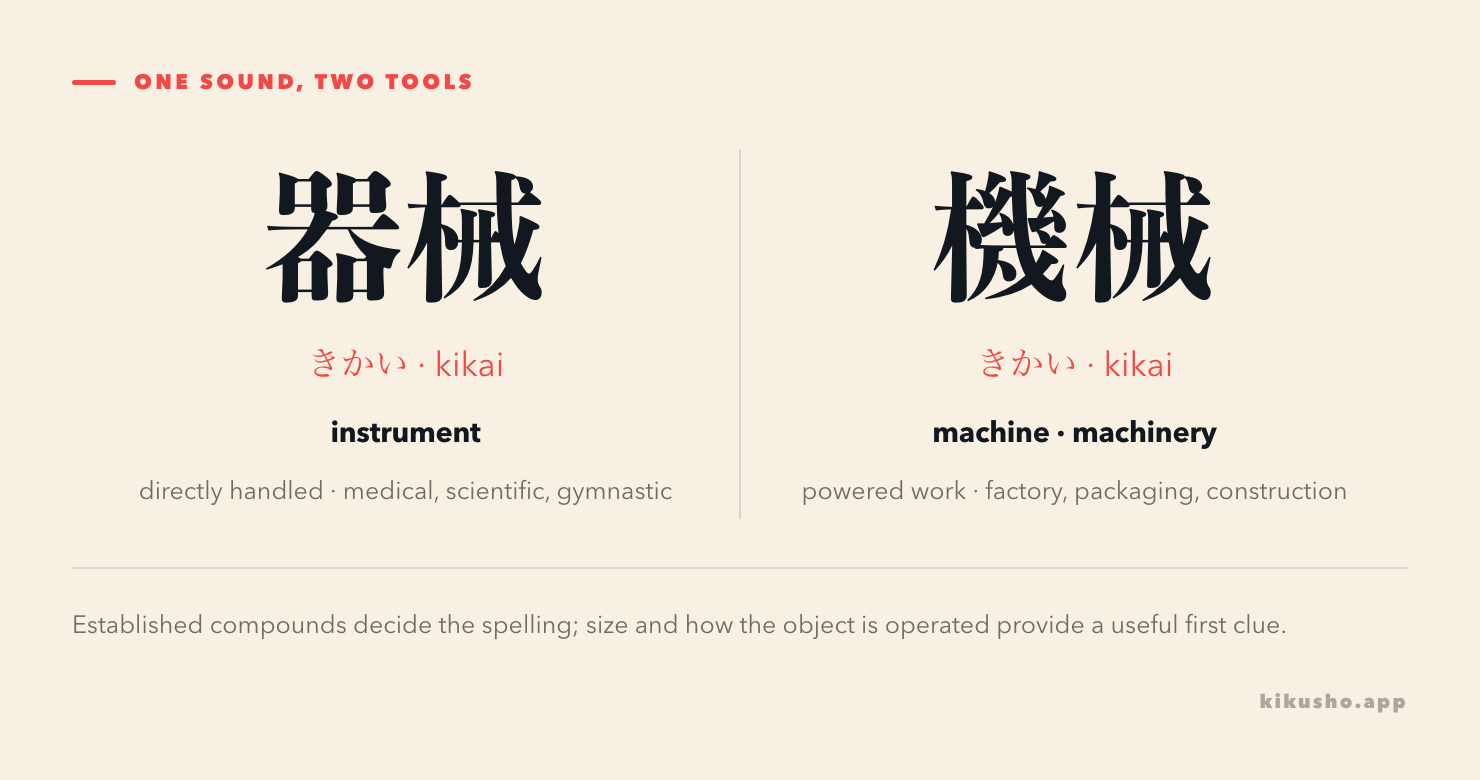
The Shogakukan dictionary note gives the practical tendency: powered equipment such as 工作機械 and 包装機械 commonly uses 機械, while smaller directly operated instruments such as 測定器械 and 光学器械 commonly use 器械. This is not a rule that lets you rename every object. Established compounds decide the spelling: 器械体操 means artistic gymnastics, but 機械体操 is not the normal name of the sport.
型 gives production a model; 形 describes the visible form
In manufacturing, 型 can be the mold or die that gives material a fixed form. 型に入れる means place something in a mold; 型から外す means remove it.
熱いプラスチックを型に入れて、同じ部品を作ります。
あつい プラスチックを かたに いれて、おなじ ぶひんを つくります。
We put hot plastic into a mold and make identical components.
型 also classifies models and types:
- 新型: new model or new type
- 旧型: old model
- 小型: compact or small-sized type
- A型: type A
The reading かた overlaps with 形, but the focus changes. 型 supplies a model, mold, type or repeatable pattern. 形 describes the form or appearance something has. A factory may use 丸い型, a round mold, to give the product 丸い形, a round shape. Daijisen's かた entry records this division while also showing areas where the two spellings overlap.
設計 decides the structure; 製造 produces the goods
設計 turns requirements into a concrete structure. Engineers decide dimensions, materials, parts and how the product should work, then express those decisions in drawings or specifications.
技術者は安全装置を設計しています。
ぎじゅつしゃは あんぜんそうちを せっけいしています。
The engineer is designing a safety device.
The detailed Kotobank engineering entry describes design as deciding a structure sufficiently for real production and representing it in drawings, specifications and instructions. It is more specific than an early idea.
製造 is the process of producing goods. It commonly takes a physical product or component as its object:
- 自動車を製造する: manufacture automobiles
- 電子部品を製造する: manufacture electronic components
- 国内で製造された製品: a product manufactured domestically
- 製造年月日: date of manufacture
設計 and 製造 often occur in sequence, but they are not synonyms. A design can exist before anything is manufactured, and a factory can manufacture a product designed elsewhere.
発明 starts with a new technical idea
発明 means an invention or the act of inventing. A person can 装置を発明する, invent a device, or an invention can transform daily life.
彼女は水を少なく使う洗浄装置を発明しました。
かのじょは みずを すくなく つかう せんじょうそうちを はつめいしました。
She invented a cleaning device that uses little water.
The Japan Patent Office defines 発明 in patent law as a highly advanced creation of a technical idea using natural laws. That legal definition is narrower than every casual use of “idea.” Its beginner patent guide also makes a useful language boundary clear: an invention is the technical creation, while a patent is the right that may protect it. The N1 manufacturing lesson continues from 発明 to 特許, standards, circuits and precision processing.
機能 tells what it does; 操作 tells what the user does
機能 is a capability or intended role of a machine, device, program or body part.
- 検索機能: search function
- 安全機能: safety function
- 新しい機能を追加する: add a new feature
- 機能が低下する: a function declines
- 正常に機能する: function normally
操作 is the act of controlling or operating equipment. It can describe pressing buttons, moving controls or giving commands.
この装置には自動停止機能があるので、操作は簡単です。
この そうちには じどうていしきのうが あるので、そうさは かんたんです。
This device has an automatic-stop function, so it is easy to operate.
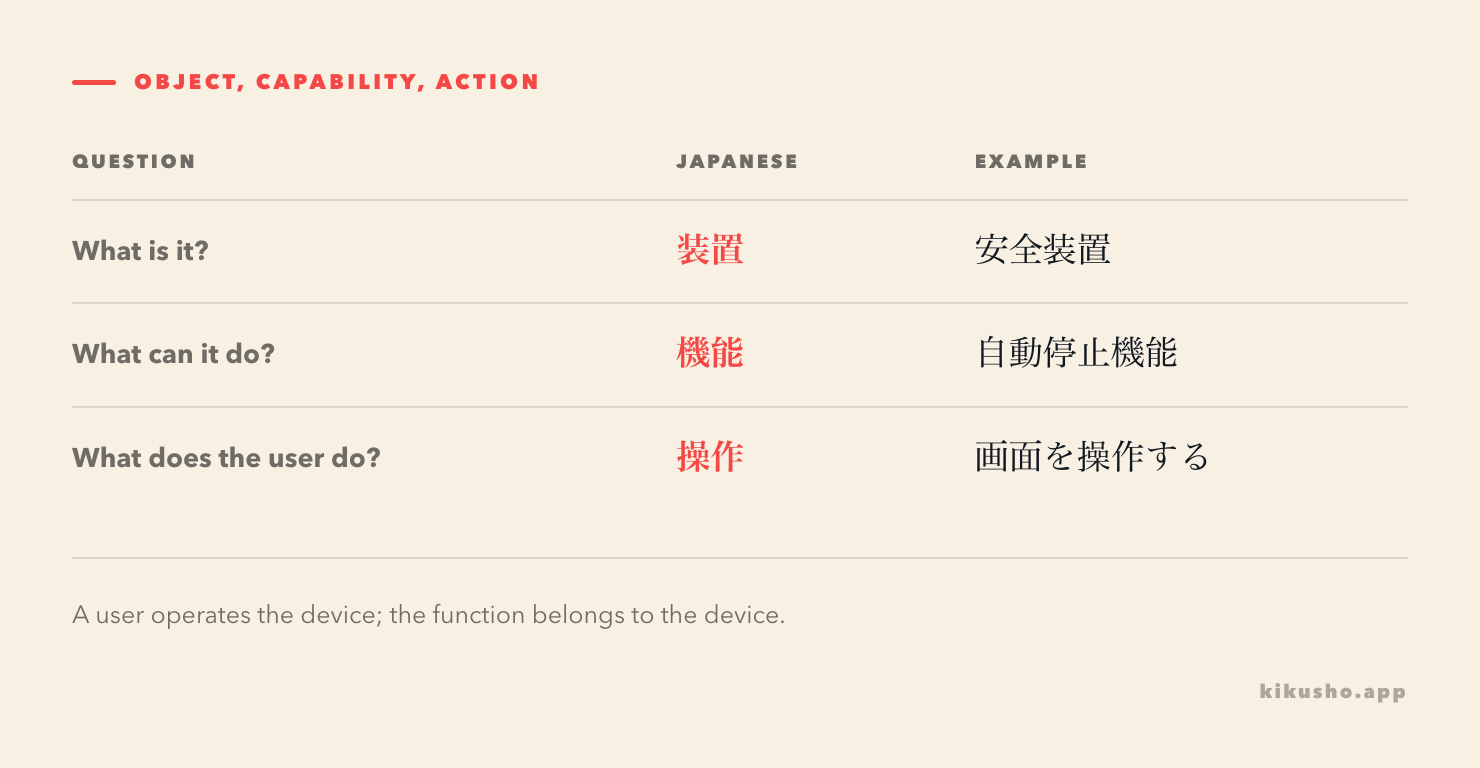
The device has a function: 装置に機能がある. The user performs an operation: 利用者が装置を操作する. A manual may be a 操作説明書, operating instructions, and a screen may be an 操作画面, control interface. Daijisen centres the equipment sense of 操作 on moving or controlling tools and machines to do work.
操作 can also mean manipulation or control in non-machine contexts, such as 情報を操作する, manipulate information. In this lesson, the machine context fixes the intended sense.
装置 is an apparatus assembled for a purpose
装置 is a device, apparatus or installed system made of parts that work together for a particular purpose. It can be a complete product or a subsystem inside a larger machine.
- 安全装置: safety device
- 冷却装置: cooling apparatus
- 通信装置: communications equipment
- 自動制御装置: automatic control system
機械 and 装置 overlap, but their viewpoints differ. 機械 often foregrounds a machine that performs physical work. 装置 foregrounds an arranged set of components installed to fulfil a function. A factory robot is a 機械; the sensors and controller that stop it near a person form a safety 装置.
自動 means a process runs by itself
自動 means automatic operation. It often contrasts with 手動, manual operation.
ドアは人が近づくと自動で開きます。
ドアは ひとが ちかづくと じどうで ひらきます。
The door opens automatically when a person approaches.
Common patterns distinguish the mode from the device:
- 自動で動く: operate automatically
- 自動的に止まる: stop automatically
- 自動運転: automated driving or operation
- 自動販売機: vending machine
- 自動/手動を切り替える: switch between automatic and manual
自動 does not mean that nobody designed or monitors the process. It says that the immediate action proceeds through a mechanism or control system rather than through a person performing every step.
One production report joins all ten entries
開発チームは、食品を同じ型に入れる小型機械を発明しました。まず機械と安全装置を設計し、試作品の機能を確認しました。利用者は画面で機械を操作できますが、温度の調整は自動です。工場では来月からこの機械を製造します。品質検査には専用の測定器械を使います。
The development team invented a compact machine that places food into identical molds. First, it designed the machine and its safety system and checked the prototype's functions. The user can operate the machine from a screen, while temperature adjustment is automatic. The factory will manufacture the machine from next month. A dedicated measuring instrument will be used for quality inspection.
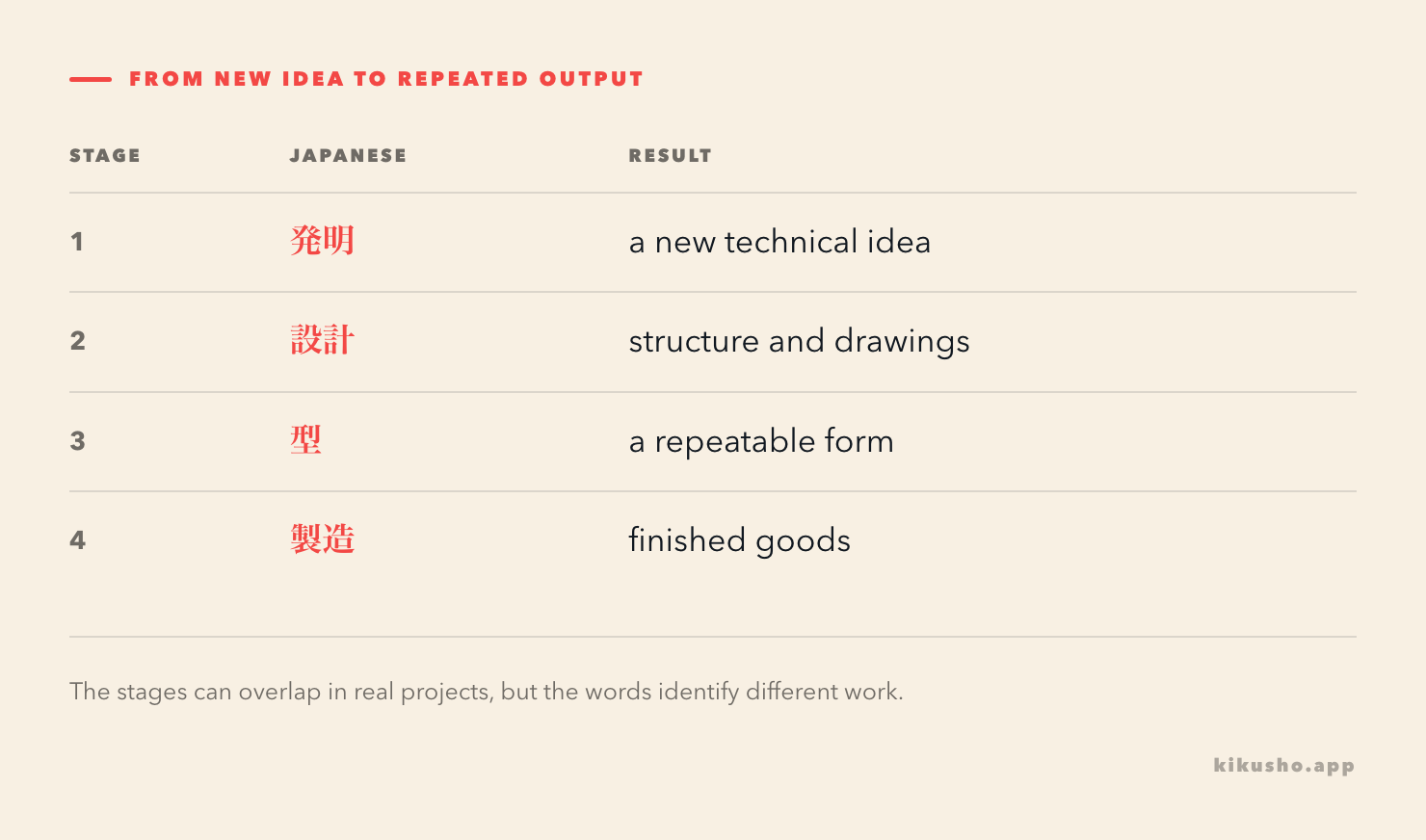
The final sentence deliberately switches from 機械 to 器械. The manufactured product is the powered machine; the inspection tool is a measuring instrument. The report also keeps 機能 with the product and 操作 with the user.
For study, capture the smallest phrase that preserves that role. 機能 alone is abstract, while 自動停止機能を追加する shows both the capability and its verb. 型 alone has several meanings, while 部品を型から外す fixes the manufacturing sense. Kikusho lets you edit the proposed meaning and example before saving, so the card can retain the context you actually met.
The N3 project lesson helps with the planning and implementation around this work. The present lesson supplies the machines, design and production language inside the project.
Practice
1 · Same sound, different instrument. A doctor directly handles a small instrument during an examination. Which spelling fits きかい?
- A. 機会
- B. 器械
- C. 機械
- D. 奇怪
2 · Factory equipment. Complete the sentence: 工場の( )が故障して、生産が止まった。
- A. 機械
- B. 器械体操
- C. 発明
- D. 型紙
3 · Mold or visible form. Which pair correctly completes the sentence? 丸い( )に材料を入れると、製品も丸い( )になる。
- A. 形/型
- B. 型/形
- C. 型/型
- D. 形/機能
4 · Reading. Choose the reading of 設計.
- A. せつけい
- B. せいけい
- C. せっけい
- D. せっかい
5 · Design before production. The engineers decide dimensions and materials and prepare drawings. What are they doing?
- A. 製造している
- B. 操作している
- C. 設計している
- D. 自動している
6 · Capability or action. Which sentence correctly separates 機能 from 操作?
- A. 利用者が機能を操作にある。
- B. 装置が利用者を機能する。
- C. 操作が装置を追加する。
- D. 装置には検索機能があり、利用者が画面を操作する。
7 · Automatic mode. Which expression means “switch from manual to automatic operation”?
- A. 手動から自動に切り替える
- B. 製造から設計に切り替える
- C. 機能から型に切り替える
- D. 器械から発明に切り替える
8 · Apparatus. Which compound most naturally names a system installed to prevent danger?
- A. 安全発明
- B. 安全操作
- C. 安全装置
- D. 安全製造
9 · Invention and manufacture. Which sequence is logically possible?
- A. 製品を発明し、設計し、工場で製造する。
- B. 工場を操作し、発明を自動する。
- C. 製造を器械し、型を機能する。
- D. 設計を止めてから、設計図を決める。
10 · Report meaning. What does 試作品の機能を確認した say?
- A. They operated every factory machine.
- B. They checked what the prototype was able or intended to do.
- C. They manufactured the final product.
- D. They changed the prototype's visible shape.
Answers and explanations
- The examination instrument is B, 器械. 機械 usually points to a powered machine; 機会 is “opportunity.”
- A, 機械 fits a factory machine whose failure stops production.
- B, 型/形 uses a mold first and describes the resulting visible shape second.
- C, せっけい preserves the small っ before けい.
- C, 設計している describes deciding a structure and representing it in drawings.
- D gives the search capability to the device and the control action to the user.
- A contrasts 手動, manual operation, with 自動, automatic operation.
- C, 安全装置 is an apparatus or system installed for safety.
- A gives a natural path from invention through design to manufacturing.
- B reads 機能 as the prototype's capability, not the act of controlling it.
Common questions
What is the difference between 機械 and 器械?
Both are read きかい. 機械 commonly means a powered machine or machinery. 器械 commonly means a smaller instrument directly handled by a person, especially in medicine, science or gymnastics. Actual naming conventions matter, so the distinction is useful rather than absolute.
What is the difference between 機能 and 操作?
機能 is what a machine, device or system is able or intended to do. 操作 is the act of controlling or operating it. A device can have many functions, while a user learns the operations needed to use them.
Is 型 the same as 形?
Both may be read かた. 型 often means a mold, model, type or established pattern. 形 usually concerns visible shape or form. A mold used to make a product is 型; the resulting object's outward shape is 形.
What is the difference between 発明 and 製造?
発明 is the creation of a new technical idea or invention. 製造 is the production of goods. An invention may be designed and tested before a factory manufactures it.