On this page
These seven N2 words control the formal path of a document: write the correct 宛名 and 氏名, make a 複写, choose 書留 for a recorded journey or 速達 for speed, then confirm the 受取. 受話器 adds the physical telephone handset used when a postal or document problem must be resolved by voice.
Seven entries refine delivery, proof and copying
| Headword | Pronunciation | Grammatical role and central sense | Anchor expression |
|---|---|---|---|
| 宛名 | あてな, atena | noun; addressee name or addressing information on mail | 封筒に宛名を書く |
| 受取 | うけとり, uketori | noun; receipt, receiving or acknowledgement of receipt | 荷物の受け取り |
| 書留 | かきとめ, kakitome | noun; registered mail | 書留で送る |
| 氏名 | しめい, shimei | noun; family name and given name together | 氏名を記入する |
| 受話器 | じゅわき, juwaki | noun; telephone receiver or handset | 受話器を取る |
| 速達 | そくたつ, sokutatsu | noun; express or special-delivery mail | 速達で出す |
| 複写 | ふくしゃ, fukusha | noun; transitive する verb; copy or duplicate | 原本を複写する |
Kikusho's September 2026 reference snapshot places all seven exact spelling-and-reading records at N2 and reports no internal level conflict. The two baseline files share Waller ancestry, so they count as one source family. Current independent pages also place 受話器 and 受取 at N2; Japan Post verifies the service vocabulary in live use rather than assigning an exam level. The JLPT organisers publish no exhaustive current vocabulary list, so the label is a study order, not a boundary around possible exam language.
宛名 belongs to the delivery; 氏名 belongs to the person
氏名 means a person's family name and given name together. It appears on applications, identity checks, registrations and official forms.
申請書には、本人の氏名を正確に記入してください。
しんせいしょには、ほんにんの しめいを せいかくに きにゅうしてください。
Enter the applicant's full name accurately on the application form.
宛名 identifies to whom a letter, parcel, email field or label is directed. On physical mail, practical addressing information usually combines the recipient's name with the address needed for delivery.
封筒の宛名が間違っていたので、書き直しました。
ふうとうの あてなが まちがっていたので、かきなおしました。
The addressee information on the envelope was wrong, so I rewrote it.
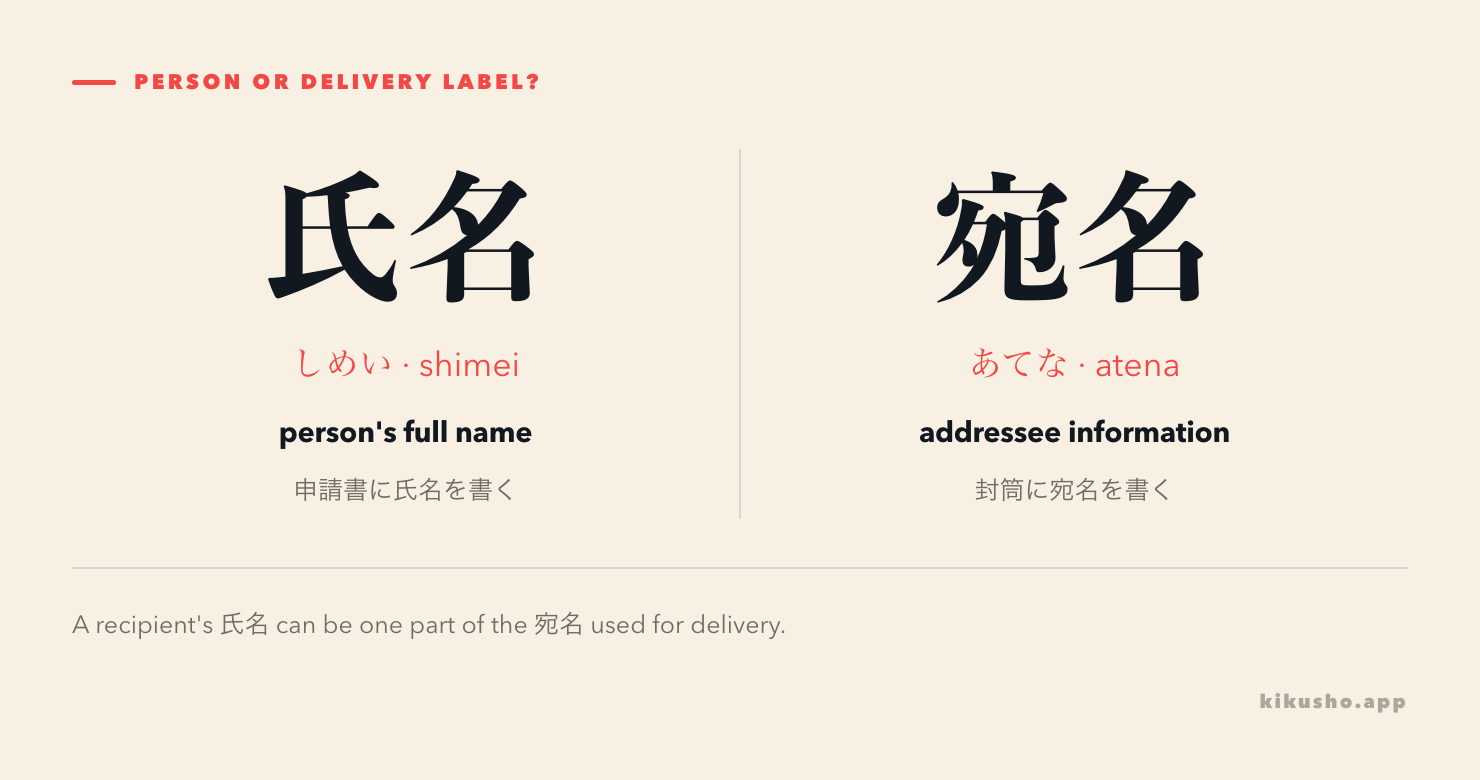
Japan Post's post-office pickup instructions use both viewpoints: the sender writes the pickup post office in the 宛名, while also entering the recipient's address and 氏名. 宛先 is the destination to which something is sent; 宛名 focuses on what is written as the addressee. A form asking for your identity needs 氏名, while an envelope needs its delivery-facing 宛名.
This continues the earlier lesson's 姓名, another word for a full name. Modern official instructions frequently print 氏名, so learn the form's actual label instead of assuming that every full-name field uses the same compound.
受取 can be an event, a confirmation or a written receipt
The inventory headword 受取 is read うけとり. Modern prose also writes 受け取り, 受取り and 受け取. The kana makes the connection to the verb 受け取る visible.
First, the noun can name the act of receiving:
書留の受け取りには、署名が必要でした。
かきとめの うけとりには、しょめいが ひつようでした。
A signature was required to receive the registered item.
It can also refer to written evidence acknowledging receipt. 受取書 is a receipt or acknowledgement document; 受領書 is another formal term. For a shop payment, 領収書 is the ordinary specific term for a receipt proving payment.
The Daijisen entry separates receiving something from the written proof handed over for money or goods. That is why translating every 受取 as a cash-register receipt is too narrow.
The same stem appears in compounds:
- 受取人: recipient
- 受取場所: pickup or receipt location
- 受取確認: confirmation of receipt
- 受取拒否: refusal to accept delivery
The N3 verb 受け取る describes the action performed by a receiver: 大学から書類を受け取る. The noun packages that action as a step, status or document: 書類の受け取りを確認する.
書留 creates a record; 速達 gives priority to speed
書留 is registered mail. The writing suggests “write down and retain,” which fits a service that records handling rather than merely promising haste.
Japan Post's domestic terms state that general registered mail is recorded from acceptance through delivery and provides compensation if the item is lost or damaged within the service conditions. At acceptance, the sender receives a 受領証, and delivery obtains a seal or signature from the recipient or authorised receiver.
大切な契約書なので、書留で送りました。
たいせつな けいやくしょなので、かきとめで おくりました。
Because it was an important contract, I sent it by registered mail.
速達 prioritises faster handling. It is useful when a deadline matters, but speed alone does not replace the recorded chain of custody supplied by 書留.
締め切りが明日なので、書類を速達で出します。
しめきりが あしたなので、しょるいを そくたつで だします。
The deadline is tomorrow, so I will send the documents by express mail.
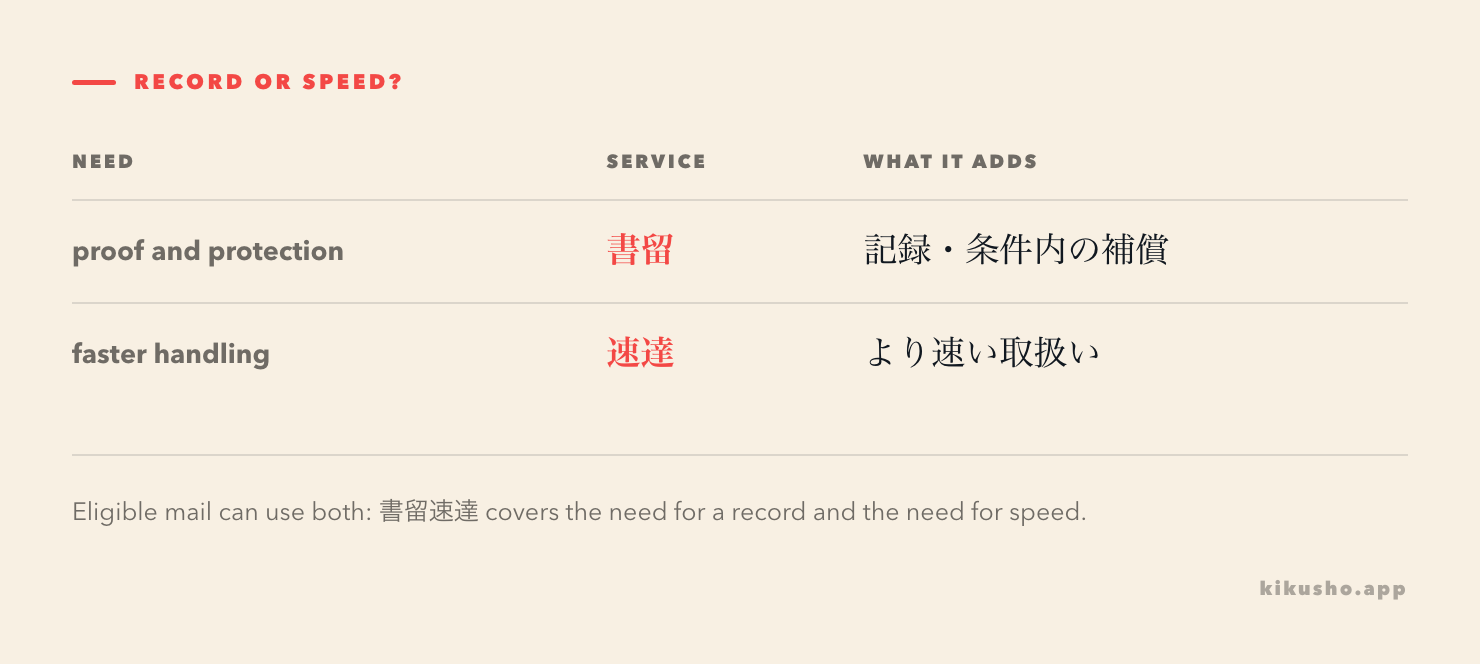
The contrast is functional, not exclusive. Japan Post's current 速達 page lists 書留 among the options that can be combined with express delivery. 書留速達 therefore makes sense when both a record and faster handling matter. Fees and delivery times depend on the item and current service terms, so check them when sending real mail.
複写 starts from an original; 印刷 produces an output
複写する makes another copy from an existing original. The object is commonly a document, drawing, photograph or page.
身分証明書の表と裏を複写してください。
みぶんしょうめいしょの おもてと うらを ふくしゃしてください。
Please copy the front and back of the identity document.
Useful forms include 複写機, copying machine; 複写を取る, make a copy; and 複写禁止, copying prohibited. The Daijisen definition covers copying again from an existing item, making multiple identical sheets with carbon paper, and reproducing an original with a copier.
印刷する, taught in the N3 layer, puts text or images onto paper or another surface. A newly prepared PDF can be 印刷 even when no physical original is being copied. 複写 foregrounds duplication from an original; 印刷 foregrounds producing the printed output.
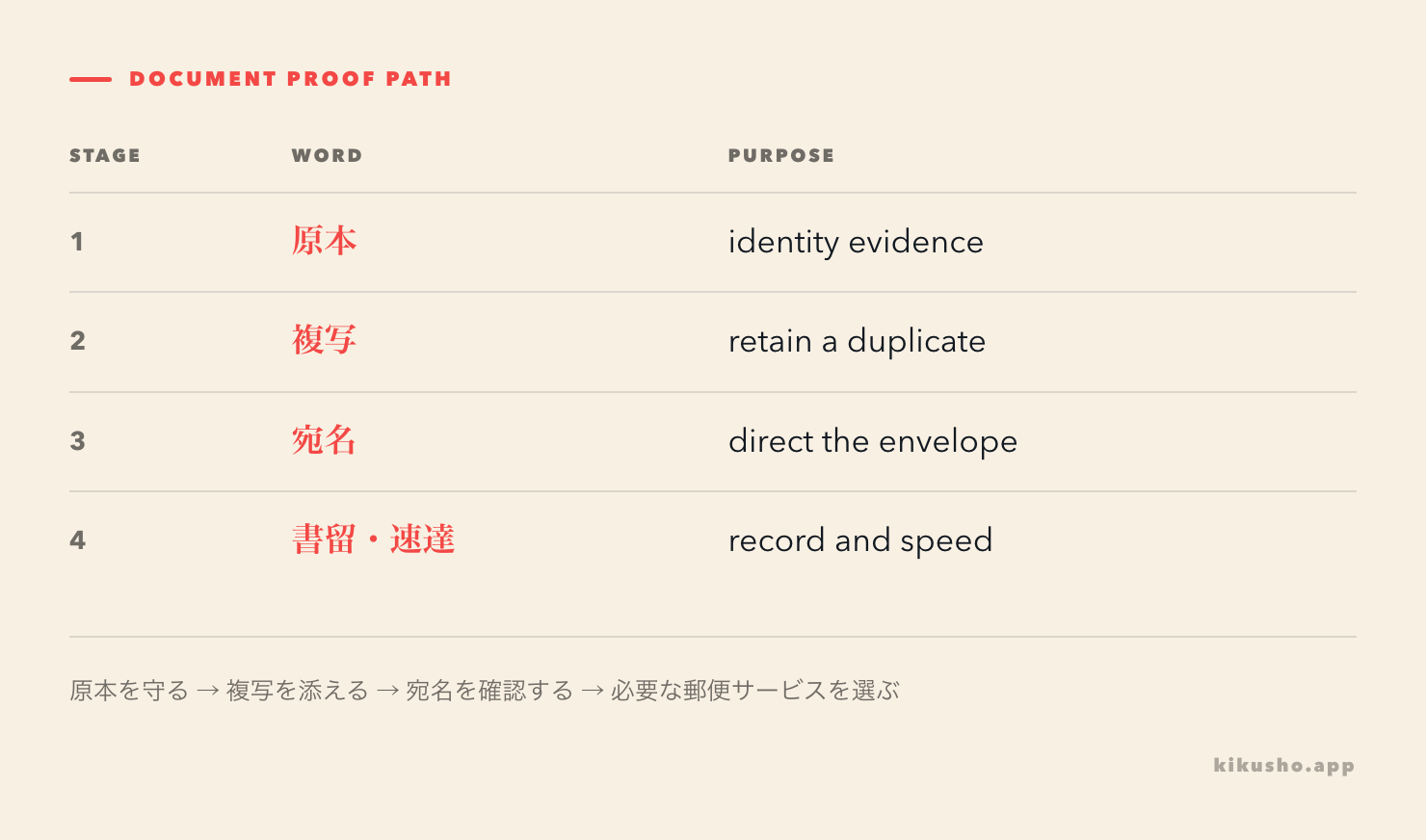
This distinction also helps with instructions. 原本を提出し、複写を手元に残す means submit the original and retain a copy. 申請書を印刷して記入する means print the application form and fill it out. One instruction distinguishes original from duplicate; the other turns a file into a writable sheet.
受話器 is the physical handset, not the person answering
受話器 is the receiver or handset held to the ear and mouth on a telephone. It is especially visible with landlines, intercoms and older telephone scenes.
電話が鳴ったので、すぐに受話器を取りました。
でんわが なったので、すぐに じゅわきを とりました。
The phone rang, so I immediately picked up the receiver.
The usual pair is 受話器を取る, pick up, and 受話器を置く, put it down or hang up. 受話器が外れている means the receiver is off the hook. The Shogakukan dictionary entry records these exact physical collocations.
The whole device is a 電話機. A 受信機 receives radio or other signals. A person who answers a call is not called a 受話器; 器 marks an instrument. Smartphones usually have no separate handset, but the word remains useful wherever the physical receiver matters.
A scholarship application uses all seven words
Read the applicant's account:
奨学金の申請書に氏名を記入し、身分証明書の複写を添えました。封筒の宛名を確認した後、締め切りが近かったので書留速達で送りました。翌日、事務局から電話があり、受話器を取ると、書類の受取が完了したと説明されました。
I entered my full name on the scholarship application and attached a copy of my identity document. After checking the addressing information on the envelope, I sent it by registered express mail because the deadline was close. The next day the office called; when I picked up the receiver, I was told that receipt of the documents was complete.
The text keeps the roles separate. 氏名 identifies the applicant; 複写 protects the original; 宛名 directs the envelope; 書留 supplies a record; 速達 adds speed; 受話器 is the handset used for the call; and 受取 names the office's receipt of the documents.
The N3 mail and digital communication lesson provides the prerequisite actions 記入, 印刷 and 受け取る, plus the distinction between 郵便, 便り, 電子, データ and 通信. The formal connectors lesson helps you read conditions and exceptions in submission instructions. Formal personal letters later add the conventions in the advanced letter vocabulary lesson.
Practice
1 · Receiver reading. How is 受話器 read?
- A. じゅうわき
- B. じゅわき
- C. しゅわぎ
- D. うけはなき
2 · Registered spelling. Which word means registered mail?
- A. 速達
- B. 受取
- C. 書留
- D. 複写
3 · Person or envelope. Complete the instruction naturally: 申請書に本人の( )を書き、封筒の( )を確認してください。
- A. 氏名/宛名
- B. 宛名/氏名
- C. 受取/書留
- D. 複写/速達
4 · Noun form. Which sentence uses 受取 naturally as a noun?
- A. 事務局を受取しました。
- B. 書類が受取に書きました。
- C. 受取で氏名を速達します。
- D. 荷物の受け取りを確認しました。
5 · Recorded journey. A sender needs a record from acceptance through delivery and applicable compensation. Which service fits?
- A. 複写
- B. 書留
- C. 宛名
- D. 受話器
6 · Two needs. The document is valuable and must arrive quickly. Which choice addresses both needs?
- A. 氏名だけを書く
- B. 複写を捨てる
- C. 書留速達で送る
- D. 受話器を郵便する
7 · Copy from an original. Which instruction means “Make a copy of the identity document”?
- A. 身分証明書を複写してください。
- B. 身分証明書を速達してください。
- C. 身分証明書を宛名してください。
- D. 身分証明書を受話器してください。
8 · Telephone hardware. Which action ends a landline call by returning the handset?
- A. 宛名を置く
- B. 受取を置く
- C. 書留を置く
- D. 受話器を置く
9 · Addressing logic. Which statement is accurate?
- A. 氏名 always means a postal destination rather than a person's name.
- B. A recipient's 氏名 can be one part of the 宛名 on an envelope.
- C. 宛名 means only the sender's telephone number.
- D. 宛名 and 氏名 both mean express delivery.
10 · Scholarship account. Why did the applicant use 書留速達?
- A. The handset was broken.
- B. The original document had no name.
- C. The deadline was close and the applicant wanted registered handling.
- D. The office prohibited copies.
Set all ten answers before opening the review below.
Answers and explanations
1 · B, じゅわき. The three mora are じゅ・わ・き. The noun names the telephone receiver or handset.
2 · C, 書留. 書留 is registered mail. 速達 is express delivery, while 受取 and 複写 are not postal services.
3 · A, 氏名/宛名. The form asks for the person's full name, 氏名. The envelope carries the addressing information, 宛名.
4 · D, 荷物の受け取りを確認しました. Here 受け取り is the noun “receipt” or “receiving.” The other options attach する or particles without a valid structure.
5 · B, 書留. Registered mail records its handling and provides compensation under the service conditions. Speed alone is the purpose of 速達.
6 · C, 書留速達で送る. 書留 answers the need for a record, while 速達 answers the need for faster delivery. The services can be combined for eligible items.
7 · A, 身分証明書を複写してください. 複写する reproduces an existing original as a copy.
8 · D, 受話器を置く. This means putting the receiver back or hanging up. 受話器を取る begins the physical action of answering.
9 · B. 氏名 identifies the person by family name and given name. When that person is the recipient, the 氏名 can appear within the envelope's 宛名.
10 · C. The account says 締め切りが近かったので, explaining the need for speed, and explicitly says 書留速達, adding registered handling.
Common questions
What is the difference between 宛名 and 氏名?
氏名 is a person's family name and given name. 宛名 is the addressee information written on a letter, parcel or label so it reaches that person or organisation. A recipient's 氏名 can therefore be one part of the 宛名.
What is the difference between 書留 and 速達?
書留 is registered handling: acceptance and delivery are recorded, and the service includes compensation under its conditions. 速達 prioritises faster delivery. They solve different problems and Japan Post allows them to be used together for eligible mail.
Does 受取 mean a receipt or the act of receiving?
Both senses exist. 受取, also written 受け取り or 受取り, can name receiving an item, and it can name a written acknowledgement or receipt. Context and compounds such as 荷物の受け取り, 受取書 and 受取人 show which meaning is active.
What is the difference between 複写 and 印刷?
複写 reproduces an existing original as a copy, often with a copier. 印刷 is the broader process of putting text or images onto paper or another surface, including printing a newly created file. The actions overlap when a copier prints a duplicate, but their viewpoints differ.