
On this page
These five N2 records let you follow a short business report from a trading company's activity to foreign exchange and sales. The central distinctions are structural: 商業 is the field of commerce, 商社 is a company, 為替 concerns money exchange or settlement, and 売り上げ/売上 are two written forms of the same sales word rather than two different financial results.
Five records, four concepts
| Record | Reading | Core meaning | Useful combination |
|---|---|---|---|
| 売り上げ | うりあげ, uriage | sales; sales revenue | 売り上げが伸びる |
| 売上 | うりあげ, uriage | sales; compact business spelling | 売上高 |
| 為替 | かわせ, kawase | exchange; remittance or settlement | 為替レート |
| 商業 | しょうぎょう, shōgyō | commerce; trade as an activity | 商業施設 |
| 商社 | しょうしゃ, shōsha | trading company | 総合商社 |
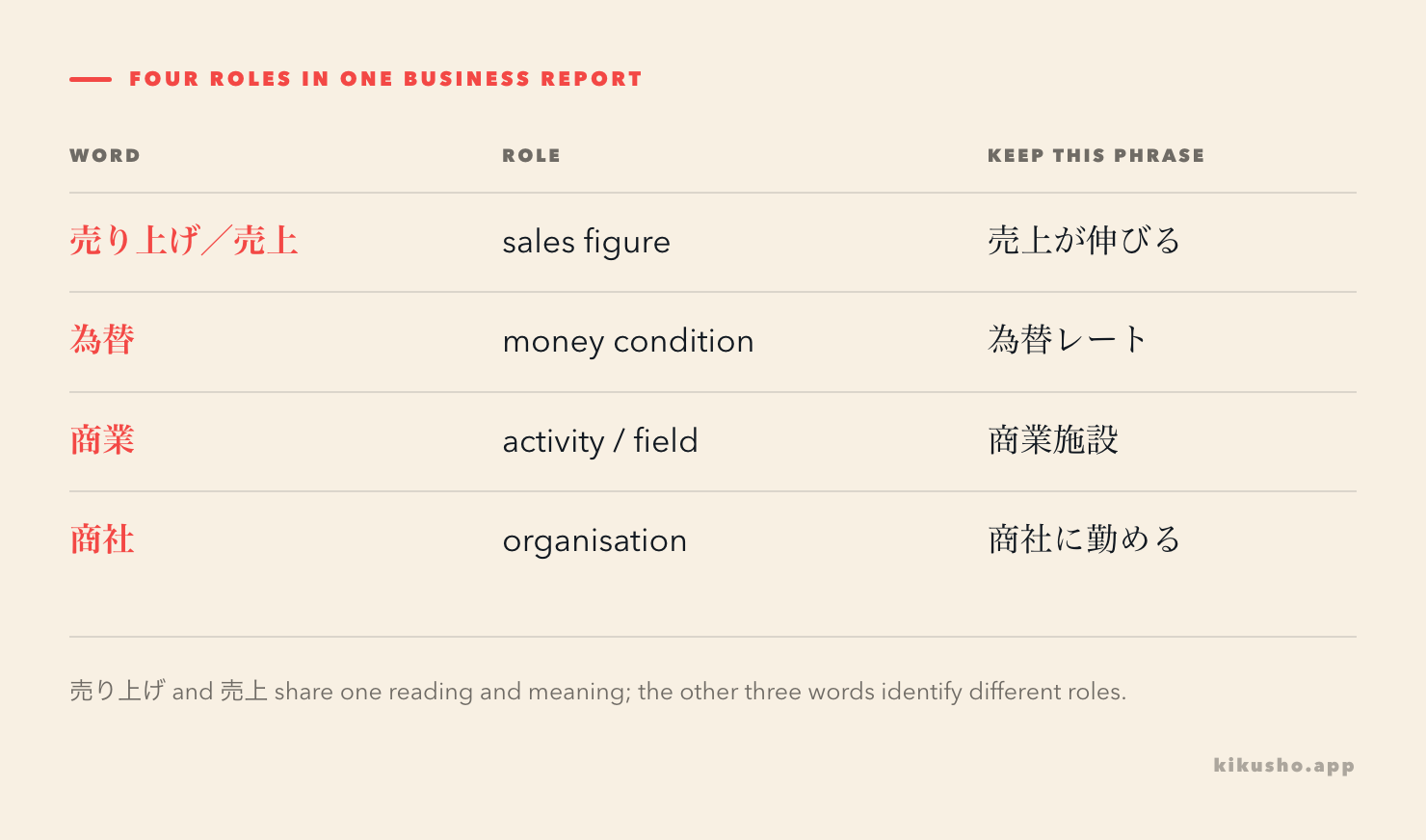
The inventory deliberately contains both 売り上げ and 売上 because the spelling changes with document style even though the reading and basic meaning do not. All five records are assigned to N2 without an internal level disagreement. Current N2 comparison lists also include the words. Because the official JLPT FAQ confirms that vocabulary lists are not published exhaustively, these observations guide study planning rather than predicting a particular test form.
売り上げ and 売上 are the same noun in different clothes
The full form 売り上げ(うりあげ) makes its origin transparent: it comes from 売り上げる, to sell or sell out a quantity. In ordinary prose, the kana help the reader recover the pronunciation immediately.
The compact 売上 is common in accounting, reports, charts and interface labels. It also anchors fixed compounds:
- 売上高(うりあげだか): total sales; sales revenue
- 売上金(うりあげきん): proceeds from sales
- 売上目標(うりあげもくひょう): sales target
- 売上予測(うりあげよそく): sales forecast
売上げ is a third accepted spelling. The Agency for Cultural Affairs' guidance on okurigana shows why official writing may shorten the noun while retaining the full okurigana in the verb 売り上げる. For a learner, the practical rule is simple: recognise all three noun spellings, keep their reading うりあげ, and follow the style of the document you are writing.
新商品の売り上げは、予想より早く伸びました。
しんしょうひんの うりあげは、よそうより はやく のびました。
Sales of the new product grew faster than expected.
報告書の「売上」の欄に、今月の金額を入力してください。
ほうこくしょの「うりあげ」の らんに、こんげつの きんがくを にゅうりょくして ください。
Enter this month's amount in the “Sales” field of the report.
The spelling changes between the sentences; the word does not.
売上 is revenue, not profit
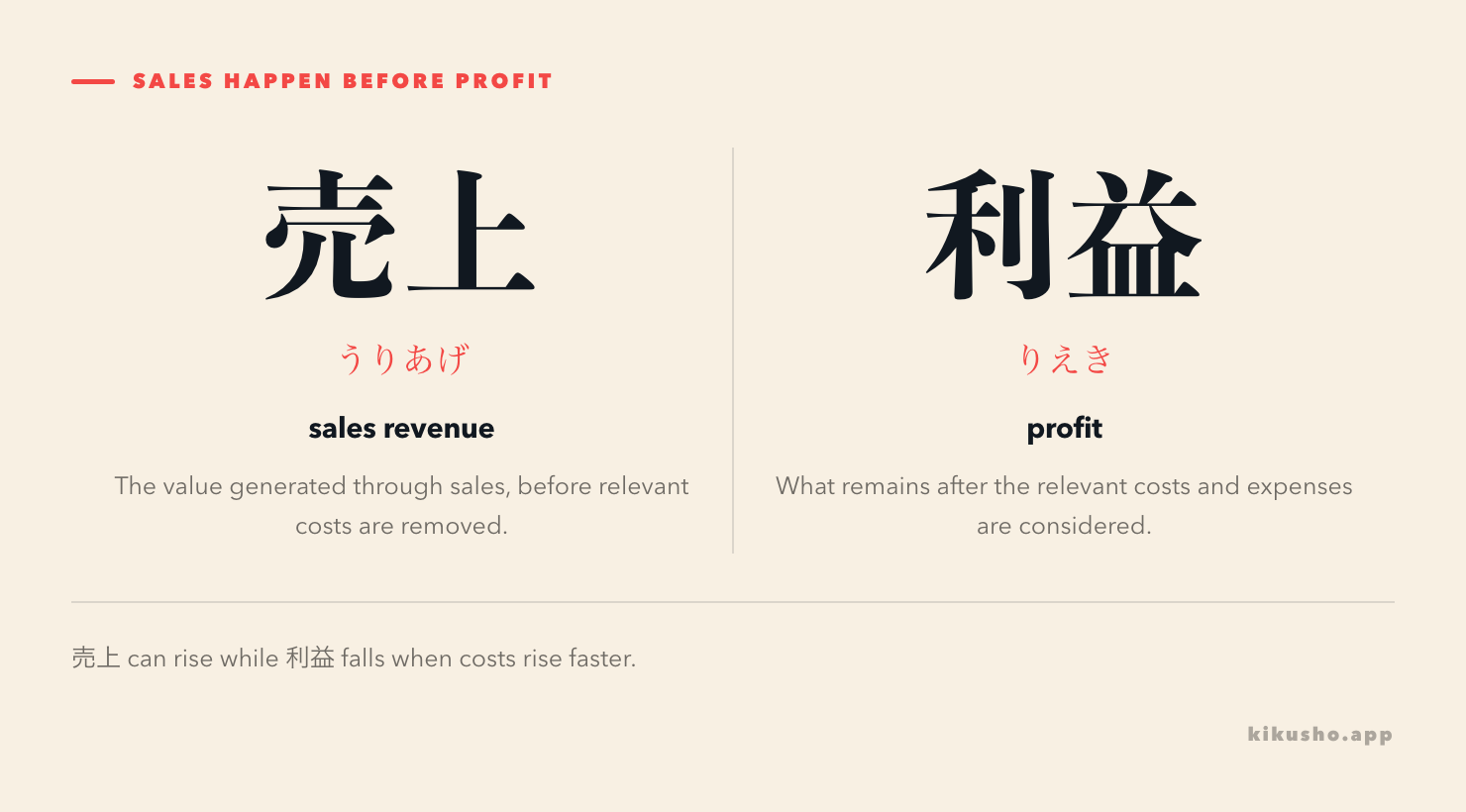
売上 measures what a business earns through sales before the relevant costs have been removed. 利益(りえき) is profit. Official statistical guidance likewise separates total sales from operating profit and describes operating profit after business expenses are deducted. This distinction matters because the two figures can move in different directions.
売上は増えましたが、輸送費も上がったため、利益は減りました。
うりあげは ふえましたが、ゆそうひも あがったため、りえきは へりました。
Sales increased, but profit decreased because shipping costs also rose.
Natural partners help keep the concepts apart:
| Sales language | Meaning |
|---|---|
| 売上が増える/減る | sales increase or decrease |
| 売上が伸びる/落ちる | sales grow or fall |
| 売上を計上する | record sales in the accounts |
| 利益が出る | make a profit |
The phrase 売上を上げる is valid: the first 上 belongs to the noun's spelling, and 上げる is the verb “raise.” Read it as うりあげを あげる.
商業 is an activity; 商社 is an organisation
商業(しょうぎょう) names commerce: economic activity that moves goods from producers toward buyers through buying, selling and distribution. The Kotobank 商業 entry covers both a narrow focus on buying and selling and a broader field that can include services supporting distribution.
It commonly modifies a place, district or field:
- 商業活動: commercial activity
- 商業施設: commercial facility or retail complex
- 商業地域: commercial district
- 商業の発展: development of commerce
商社(しょうしゃ) names a company engaged in trade. It is not a general replacement for 会社. A software developer, hospital operator or small manufacturer can be a 会社 without being a 商社.
The Japan Foreign Trade Council describes trade and business investment as central parts of a trading company's model. That relationship explains the lesson's investment frame: 投資 is an action a 商社 may perform, while 商社 is the organisation and 商業 is the wider activity. The earlier politics and economics lesson teaches 投資, 資本, 資産 and 利益 directly; they remain prerequisite comparisons here rather than extra assigned headwords.
その商社は、食品の輸入だけでなく、海外の農業事業にも投資しています。
その しょうしゃは、しょくひんの ゆにゅうだけでなく、かいがいの のうぎょうじぎょうにも とうしして います。
That trading company not only imports food but also invests in overseas agricultural businesses.
駅の周辺には、新しい商業施設が建設されています。
えきの しゅうへんには、あたらしい しょうぎょうしせつが けんせつされて います。
A new commercial complex is being built around the station.
為替 connects currencies and distant payments
為替(かわせ) has a broader history than the English phrase “exchange rate.” The dictionary entry starts with settling debts or moving funds without transporting cash. Modern business contexts often narrow it to 外国為替, foreign exchange.
Use the longer compounds when precision matters:
- 外国為替: foreign exchange
- 為替相場/為替レート: exchange rate
- 為替の変動: exchange-rate movement
- 為替差益/為替差損: foreign-exchange gain or loss
The bare noun is common in context: 為替が動く, the currency market or rate moves; 為替の影響を受ける, be affected by exchange rates. Yet it does not name a foreign currency itself. ドルを為替する is not the basic pattern to learn.
海外から商品を仕入れる商社は、為替の変動に注意しています。
かいがいから しょうひんを しいれる しょうしゃは、かわせの へんどうに ちゅういして います。
Trading companies that source goods from abroad watch exchange-rate movements.
Suppose a Japanese company must pay one dollar for a part. If the hypothetical rate changes from 1 dollar = 150 yen to 1 dollar = 140 yen, that same dollar costs fewer yen. The yen has strengthened. This arithmetic belongs to 為替レート; whether the company's final 利益 rises also depends on prices, volumes and costs.
One report connects the whole chain
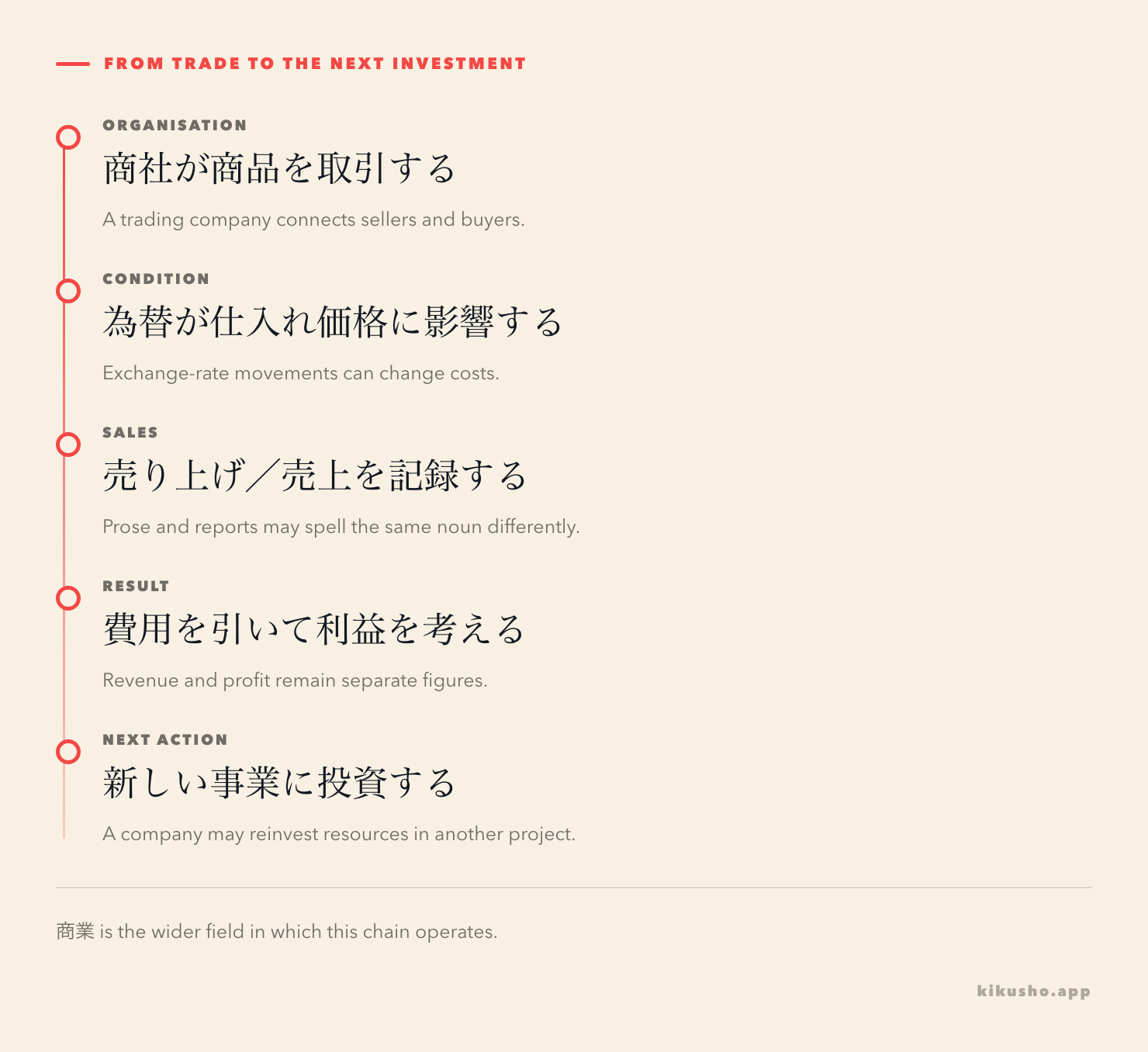
この商社は、海外のメーカーから部品を仕入れ、国内の商業施設に販売しています。今年は為替の変動で仕入れ価格が上がりましたが、新しい販売網への投資によって売り上げは増加しました。社内の報告書では「売上」と表記され、費用を引いた後の利益とは別に示されています。
This trading company buys parts from overseas manufacturers and sells them to commercial facilities in Japan. This year, exchange-rate movements raised its purchasing costs, but investment in a new sales network increased sales. In the internal report, sales are written as 売上 and shown separately from profit after expenses.
Each noun has one job. 商社 identifies the company, 商業 classifies the facilities and activity, 為替 supplies an international money condition, and 売り上げ/売上 name the same sales figure in prose and report style. 投資 explains an action, while 利益 names a later result.
Practice
Use all eight questions before opening the answer key. The choices mix readings, spelling conventions, roles and connected business context.
1 · Currency line. A report says 海外取引では為替が動く. Which kana reproduce 為替?
- A. いがえ (igae)
- B. かわせ (kawase)
- C. ためかえ (tamekae)
- D. かわり (kawari)
2 · Full okurigana. Which form keeps the full okurigana for the sales noun?
- A. 売り上げ
- B. 売上
- C. 売高
- D. 売り高げ
3 · Fixed compound. Complete the standard expression for total sales: 売( )高.
- A. り
- B. げ
- C. 上
- D. 金
4 · The organisation. Which word fits a company that connects sellers and buyers in domestic or international trade?
- A. 商業
- B. 商社
- C. 為替
- D. 売上
5 · The field. 駅前は店が多く、地域の( )が発展している。 Which word names commerce as an activity?
- A. 商社
- B. 売上
- C. 為替
- D. 商業
6 · Revenue and profit. Which sentence is economically and grammatically coherent?
- A. 売上は増えたが、費用が上がったので利益は減った。
- B. 売上は会社なので、商業に勤めている。
- C. 利益を為替して、商社が読み方になった。
- D. 商業は売上の別の書き方だ。
7 · Precise paraphrase. 為替レートが変動した most directly means:
- A. The trading company changed its legal name.
- B. Every commercial facility closed.
- C. The exchange ratio between currencies changed.
- D. Sales and profit became identical.
8 · Connected report. 商社は為替の影響を受けたが、新しい市場への投資で売り上げを伸ばした。 What happened?
- A. A commercial district changed the spelling of a currency.
- B. A trading company faced exchange-rate effects but grew sales through investment in a new market.
- C. Revenue was automatically equal to profit.
- D. A company stopped all trade because kana were missing.
Reveal the trade and economy answer key
- B. 為替 is read かわせ.
- A. 売り上げ preserves both parts of the full okurigana; 売上 is the compact form.
- C. The fixed compound is 売上高(うりあげだか).
- B. 商社 is the trading company; 商業 is commerce as an activity or field.
- D. 商業 can develop in an area and describes commercial activity.
- A. Rising expenses can reduce profit even when sales increase.
- C. 為替レート specifies the exchange ratio between currencies.
- B. 商社 supplies the organisation, 為替 the condition, 投資 the action and 売り上げ the result.
Common questions
What is the difference between 売り上げ and 売上?
Both are read うりあげ and name sales or sales revenue. 売り上げ keeps the full okurigana and is easy to read in ordinary prose. 売上 is the compact spelling common in accounts, tables and compounds such as 売上高. 売上げ is another accepted spelling.
What is the difference between 売上 and 利益?
売上 is the value generated by selling goods or services. 利益 is profit, what remains after the relevant costs and expenses are considered. A company can increase its 売上 while its 利益 falls.
Does 為替 mean exchange rate?
為替 broadly concerns settling or transferring money without physically moving cash. In international business it often points to foreign exchange. 為替相場 and 為替レート explicitly mean the exchange rate.
What is the difference between 商業 and 商社?
商業 is commerce as an activity, field or sector. 商社 is a trading company, an organisation that connects sellers and buyers and may also handle logistics, finance and business investment. A 商社 participates in 商業.