On this page
An article about a city's budget might mention 議会、予算、費用 in one paragraph: the council, the plan and the cost. These Japanese politics and economics words name different parts of public decisions and business activity, so read each word's role alongside its translation.
This N2 vocabulary set contains eighteen headwords: 金融、議会、景気、国会、財産、資本、首相、選挙、税金、損害、大臣、費用、予算、利益、政党、資産、投資、不景気. The politics words identify institutions, people, an organisation and an event. The money words identify conditions, resources, actions and results.
Our planning snapshot credits Jonathan Waller's Tanos materials. It places the first fourteen words above at N3, 政党 at N2, and 資産・投資・不景気 at N1. 選挙 also has N1 observations; the imported Waller adaptations are one source family. These are editorial study-list placements. The JLPT has no exhaustive official vocabulary syllabus, and this page's N2 section does not make every prerequisite a new N2 word.
Politics words separate an institution from a person
The earlier newspaper-vocabulary lesson explains reporting and publishing. This set supplies some of the people, organisations and subjects that the reporting can be about. All Japanese sentences below are original teaching examples, not accounts of current officeholders or scheduled events.
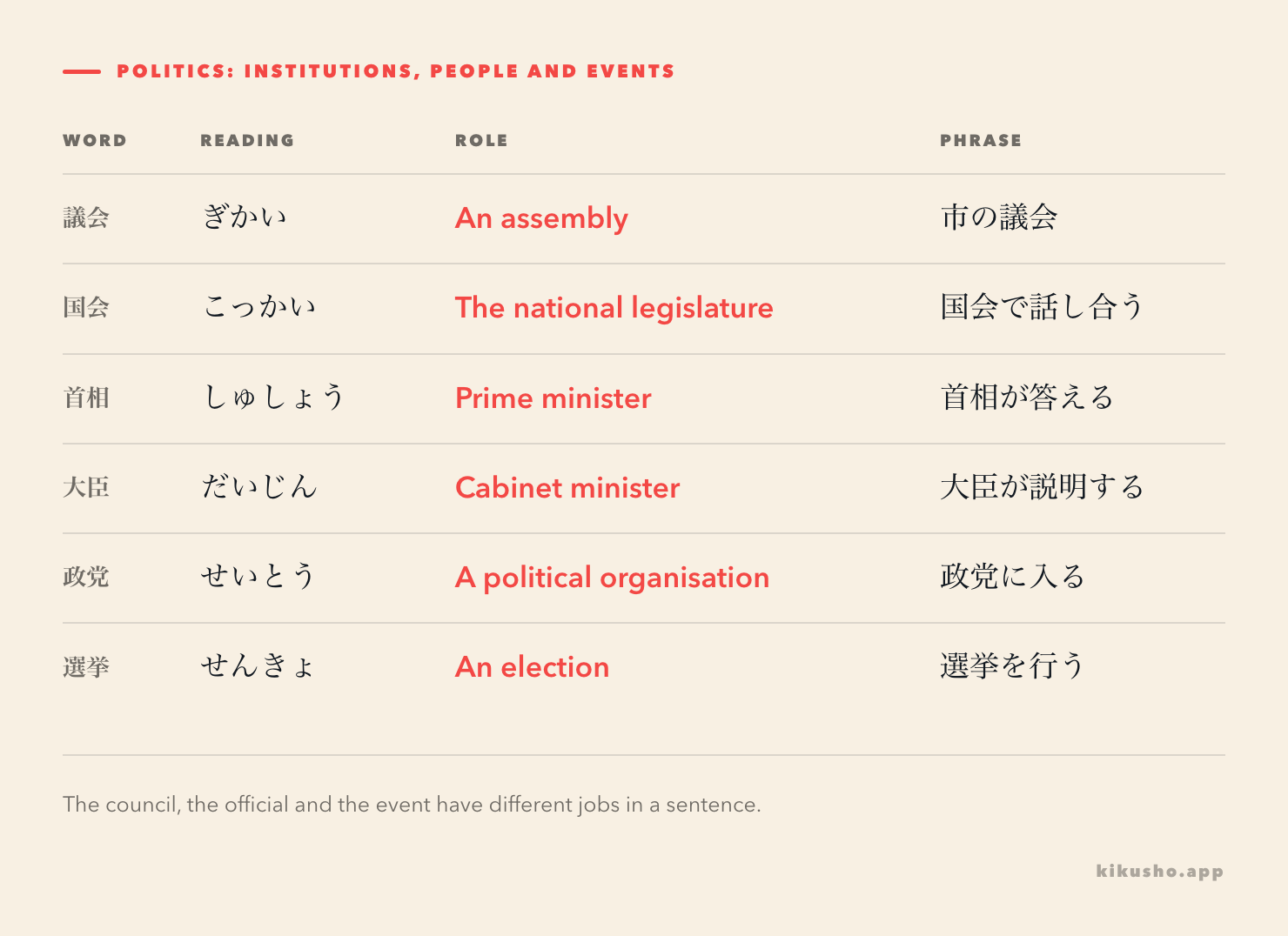
| Word and reading | Part of speech here | Meaning | Useful phrase | Source |
|---|---|---|---|---|
| 議会(ぎかい) | Noun | A legislative assembly; council or parliament | 市の議会: the city council | Daijisen |
| 国会(こっかい) | Noun | The national legislature; in Japan, the Diet | 国会で話し合う: discuss in the Diet | Daijisen |
| 首相(しゅしょう) | Noun | Prime minister | 首相が答える: the prime minister answers | Daijisen |
| 大臣(だいじん) | Noun | Cabinet minister | 大臣が説明する: a minister explains | Daijisen |
| 政党(せいとう) | Noun | A political party | 政党に入る: join a party | Daijisen |
| 選挙(せんきょ) | Noun; also a suru verb for electing | An election | 選挙を行う: hold an election | Daijisen |
議会 and 国会 overlap at one scale
議会 is the broader assembly word: it can name a national parliament or a local council. 国会 points to the national legislature; in Japanese domestic news, it names the Diet. The useful local phrase is 市の議会(しの ぎかい), a city council.
市の議会で、新しい予算について話し合いました。
しの ぎかいで、あたらしい よさんについて はなしあいました。
The city council discussed the new budget.
Here, the assembly is the setting for the discussion. 予算 is what it discusses. Swapping those nouns would change which part of the event the sentence names.
首相 and 大臣 name people with different titles
The modern political reading is 首相(しゅしょう): short しゅ, followed by しょう. 大臣(だいじん) names a minister. In Japanese political reporting, 首相 is the customary shorter title for the prime minister.
首相が記者の質問に答えました。
しゅしょうが きしゃの しつもんに こたえました。
The prime minister answered a reporter's question.
大臣が予算について説明しました would instead say that a minister explained the budget. The title identifies the person; it does not tell you whether the explanation was accurate or the proposal accepted.
政党 is the organisation; 選挙 is the event
政党 means a political party. One inherited source gloss includes “member of,” but the headword names the organisation, not an individual member.
彼は新しい政党に入りました。
かれは あたらしい せいとうに はいりました。
He joined a new political party.
For the election itself, use 選挙: 選挙を行う, to hold an election, or 選挙がある, there is an election. It can form a verb meaning to elect someone, but the ordinary noun names the process or event rather than the party participating in it.
景気, 不景気 and 金融 describe the economic setting
| Word and reading | Part of speech here | Meaning | Useful phrase | Source |
|---|---|---|---|---|
| 金融(きんゆう) | Noun | Finance; the provision and movement of money, especially lending/borrowing | 金融の仕組み: how finance works | Daijisen |
| 景気(けいき) | Noun | The state of economic or business activity | 景気が悪い: business conditions are bad | Daijisen |
| 不景気(ふけいき) | Noun; na-adjective | Depressed economic activity; poor business conditions | 不景気になる: enter a slump | Daijisen |
景気 concerns the state of economic activity. In 景気が悪い, business conditions are bad. The word does not mean every possible kind of “condition,” even though that bare English gloss appears in some learning lists.
不景気 combines 不 + 景気 and describes a lack of economic vigour. It can be a noun, as in 不景気になる, or take な before a noun, as in 不景気な時期(ふけいきな じき), a period of poor economic conditions. This lesson uses its economic sense, rather than its separate descriptions of a gloomy face or mood.
不景気で、店の客が減りました。
ふけいきで、みせの きゃくが へりました。
The shop had fewer customers because business conditions were poor.
金融 concerns money being made available and moving between participants, particularly through borrowing and lending. The independently authored Bank of Japan explanation of settlement and finance connects it with providing money for payments. Thus 金融の仕組み(きんゆうの しくみ) concerns how finance works; 景気の話(けいきの はなし) concerns business conditions. They are related topics, with different nouns.
財産, 資産, 資本 and 投資 follow the resources
| Word and reading | Part of speech here | Meaning | Useful phrase | Source |
|---|---|---|---|---|
| 財産(ざいさん) | Noun | Property or wealth; also something valuable figuratively | 財産を残す: leave property behind | Daijisen |
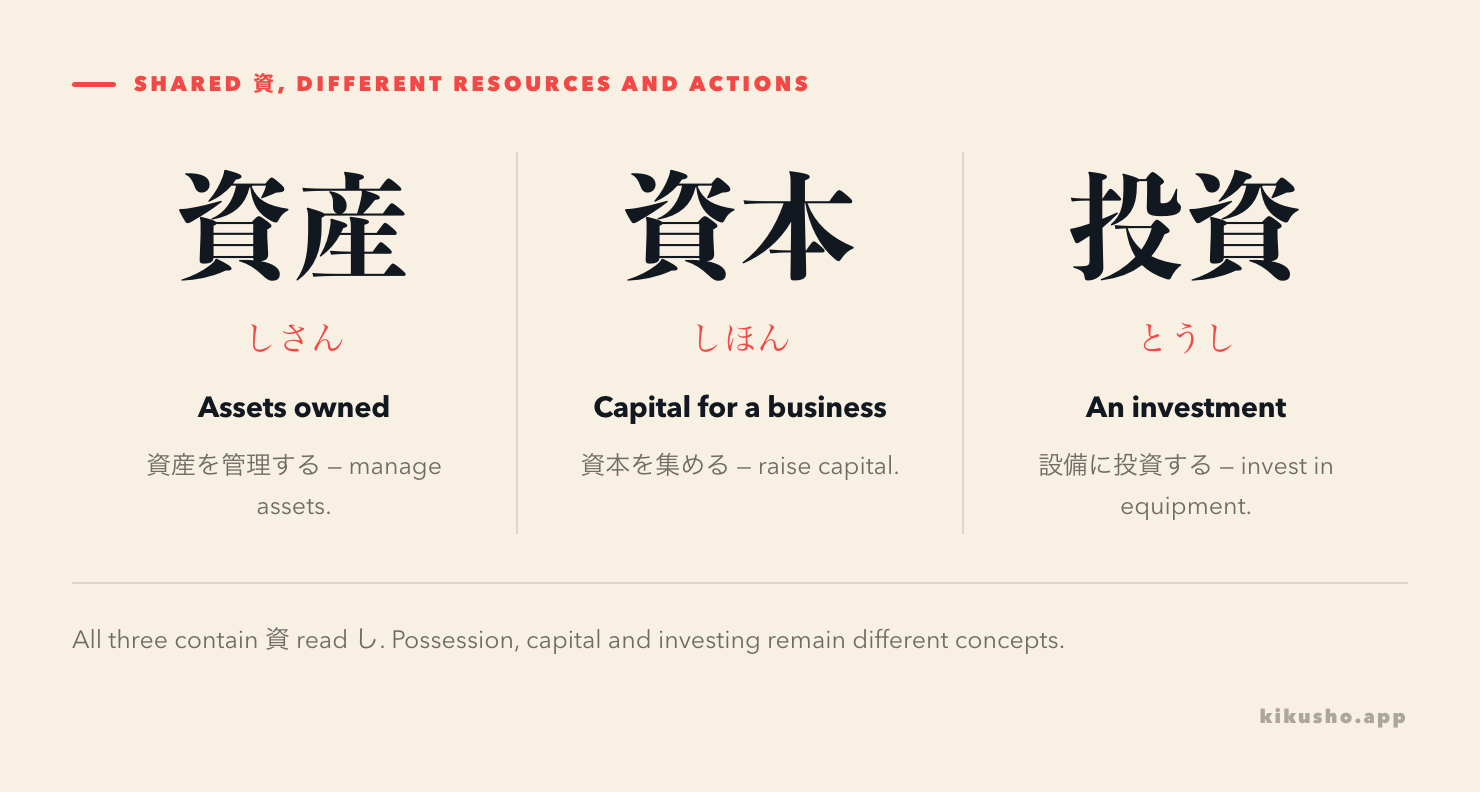
| 資産(しさん) | Noun | Assets; economically valuable things owned | 資産を管理する: manage assets | Daijisen |
| 資本(しほん) | Noun | Capital used to start or conduct a business | 資本を集める: raise capital | Daijisen |
| 投資(とうし) | Noun; suru verb | Investment made with an expected benefit | 設備に投資する: invest in equipment | Daijisen |
財産 and 資産 overlap when you mean valuable property. The distinction is not a rule that one belongs to a person and the other to a company. You can describe both personal and corporate property with these nouns. Learn a usable frame: 財産を残す for leaving property behind; 資産を管理する for managing assets.
財産 also lets you describe something valuable without putting a monetary price on it:
この経験は大切な財産です。
この けいけんは たいせつな ざいさんです。
This experience is a valuable resource.
資本 names capital, here the resources used to establish or run a business. 投資 names investing resources for an expected benefit. One is the capital; the other can name the action of committing it. An expectation of benefit is part of the purpose, not a promise that profit follows.
会社は新しい設備に投資しました。
かいしゃは あたらしい せつびに とうししました。
The company invested in new equipment.
資 is read し in 資産・資本・投資. That shared sound and character help with recognition, while each complete word still needs its own sense and phrase. For the reading mechanism behind such compounds, the kanji-reading guide distinguishes the character's sounds from the word that selects one.
予算, 費用, 税金, 利益 and 損害 follow the money's role
| Word and reading | Part of speech here | Meaning | Useful phrase | Source |
|---|---|---|---|---|
| 予算(よさん) | Noun | An advance estimate or spending plan; a budget | 予算を立てる: draw up a budget | Daijisen |
| 費用(ひよう) | Noun | Money needed or spent to do something; costs | 費用がかかる: incur costs | Daijisen |
| 税金(ぜいきん) | Noun | Money paid as tax to national/local authorities | 税金を納める: pay tax | Daijisen |
| 利益(りえき) | Noun | Business profit; also a benefit or advantage | 利益が出る: make a profit | Daijisen |
| 損害(そんがい) | Noun | Damage, harm or loss suffered | 損害を受ける: suffer damage | Daijisen |
予算 looks ahead: it estimates or allocates money for a plan. 費用 describes money needed or spent to do something. A cost can be estimated in advance too, so time alone does not separate the words. Their frames help: 予算を立てる draws up a plan; 費用がかかる says that doing something costs money.
修理には予想より多くの費用がかかりました。
しゅうりには よそうより おおくの ひようが かかりました。
The repairs cost more than expected.
The sentence reports costs. It does not say whether those costs exceeded a set budget.
税金 is money paid as tax. 納める(おさめる) is a useful partner: 税金を納めました(ぜいきんを おさめました), “I paid the tax.” The word does not cover every payment to a business or another person.
利益 can mean profit from business, or a benefit/advantage in a wider context. Read it りえき for these economic senses. 利益が出る reports a profit; it does not report the size of the budget or the total property owned.
損害 names damage or loss suffered. It can concern harm to property or an economic loss, rather than the planned cost of an activity.
台風で、店が大きな損害を受けました。
たいふうで、みせが おおきな そんがいを うけました。
The shop suffered major damage in the typhoon.
損害を受ける gives you an affected party. 修理の費用 would instead name what repairs cost. Those concepts can occur together in a story without being interchangeable descriptions of the same amount.
Keep one sentence that fixes the role
A news paragraph may discuss 予算 and 費用 without using either as the subject of a verb. Mark the partner you need to remember: 立てる with a budget, かかる with costs, 受ける with damage. A longer glossary will not supply that choice for you.
For Kikusho, a sentence about repair costs is a useful text capture. Check the generated example and editable meaning against the line you read, so the 費用 card prompts the cost frame you encountered. An assets card needs its own phrase, 資産を管理する; importing the same English “money” gloss into both would remove the difference you wanted to keep.
The preceding N2 lesson on verb register, meaning and respect adds a separate check for formal reporting: a courteous verb changes the relationship expressed, while these nouns keep their particular referents.
Practice
Use the readings and roles to tackle the six tasks below. These are original exercises; the complete answer key comes after the sixth task.
Question 1
A learner is studying 金融の仕組み. Which kana sequence reads 金融?
A. きんゆ
B. ぎんゆう
C. きんゆう
D. きんよう
Question 2
The word names a political organisation: 彼は新しいせいとうに入りました。 Select its spelling.
A. 政党
B. 正当
C. 政当
D. 正党
Question 3
Build the economic-slump word with 景気 as its second part. Pick the first character: ( )景気.
A. 好
B. 大
C. 高
D. 不
Question 4
The traveller makes a spending plan before choosing accommodation. Fill that role: 旅行の( )を立ててから、宿を選びました。
A. 費用
B. 予算
C. 損害
D. 利益
Question 5
今年は利益が出ました。 Find the sentence with the same basic meaning.
A. 今年は税金を納めました。
B. 今年の予算を立てました。
C. 今年の選挙に参加しました。
D. 今年の事業でもうけがありました。
Question 6
The target is 資産, the noun for assets. Which sentence uses that word appropriately?
| Choice | Sentence |
|---|---|
| A | 資産な会社で働いています。 |
| B | 去年より資産くなりました。 |
| C | 会社の資産を管理しています。 |
| D | 資産しましたので、あとで確認してください。 |
Answers and explanations
A shared topic can explain a tempting distractor without making it the right noun for the sentence.
Answer 1: C, きんゆう. Keep きん and the long ゆう. A loses the final う, B voices the first consonant as though the first character were 銀, and D changes ゆう to よう. None of those gives 金融's taught reading.
Answer 2: A, 政党. This is the political party that someone joins. 正当 is the different word for something justified or legitimate. The remaining character combinations do not spell the assigned headword. The sentence reads かれは あたらしい せいとうに はいりました.
Answer 3: D, 不. The word is 不景気(ふけいき), poor business conditions. This formation joins 不 to 景気. 好景気 goes in the favourable direction; 大 and 高 do not supply the negative piece required for the taught slump word. This question tests building this particular word, not a rule that 不 attaches freely to every noun.
Answer 4: B, 予算. 予算を立てる means drawing up a budget. 費用 names costs, 損害 damage/loss, and 利益 profit or advantage. Each belongs to the money domain, but none fills the spending-plan role selected by 立てる here.
Answer 5: D. 利益が出る says that the business made a profit, expressed by もうけがありました. A says tax was paid, B that a budget was drawn up, and C that someone participated in an election. They report different actions and do not establish a profit.
Answer 6: C. 資産 is the noun object of 管理しています: “I manage the company's assets.” It does not take the adjective forms 資産な or 資産く in A and B, nor form the suru verb 資産する in D. For the noun-based investment verb taught in this set, use 投資する.
Common questions
What is the difference between 議会 and 国会?
議会(ぎかい) names a legislative assembly, including a local council. 国会(こっかい) names the national legislature and, in Japanese news about Japan, the Diet. The words overlap at the national level; a city council is not Japan's 国会.
Does 政党 mean a party member?
政党(せいとう) means the political party itself, an organisation. It does not mean one member of that party. 政党に入る means joining a party; 政党の代表 means the party's representative.
Are 財産 and 資産 completely different kinds of property?
No. 財産(ざいさん) and 資産(しさん) overlap for economically valuable property. 資産 is useful in asset-management and accounting contexts. 財産 also has a figurative sense for something valuable, such as experience. Avoid a rigid rule that one is only personal and the other only corporate.
Are all eighteen words N2 vocabulary?
No. Fourteen have N3 placements in the planning snapshot, 政党 has N2, and 資産, 投資 and 不景気 have N1. 選挙 also has N1 observations alongside N3. The lesson is a comparison in the N2 section; the list labels are study estimates, not an exhaustive official JLPT syllabus.