On this page
Temporal 〜ところ identifies the stage of an action: 書くところ is about to write, 書いているところ is writing now, and 書いたところ is just finished writing. The verb form before ところ sets that stage; 書いていた on its own describes past ongoing writing and needs its own place in the chart.
ところ can name a place or the moment of an action
In 静かなところ (a quiet place), ところ is a location noun. In 今から書くところです (I'm about to write), it is a noun-like marker for an action's moment. The Japan Foundation's teaching explanation distinguishes these two uses; this lesson teaches the temporal one, with です or だ after the whole phrase.
This page sits in the N3 grammar study path, while the four assigned forms are placed at N4 in Kikusho's reference inventory, following JLPTsensei's N4 list. Bunpro also estimates ていた at N4. These are study estimates: the JLPT no longer publishes exhaustive content specifications. The Foundation page's old 3級 label predates the current exam levels and cannot establish a modern N3 classification.
The form before ところ determines the stage
Use a plain verb immediately before ところ, then make the whole sentence polite with です. These are the four assigned constructions, including ていた, which can stand without ところ.
| assigned form | attachment | stage or meaning | original example and translation |
|---|---|---|---|
| ところ | dictionary form + ところ | immediately before an action | 今から手紙を書くところです。 (I am about to write a letter.) |
| ているところ | て-form + いる + ところ | action in progress now | 今、手紙を書いているところです。 (I am in the middle of writing a letter.) |
| たところ | た-form + ところ | immediately after completion | たった今、手紙を書いたところです。 (I have just written the letter.) |
| ていた | て-form + いた, without ところ | action or state ongoing in the past | 昨日の夜、手紙を書いていました。 (I was writing a letter last night.) |
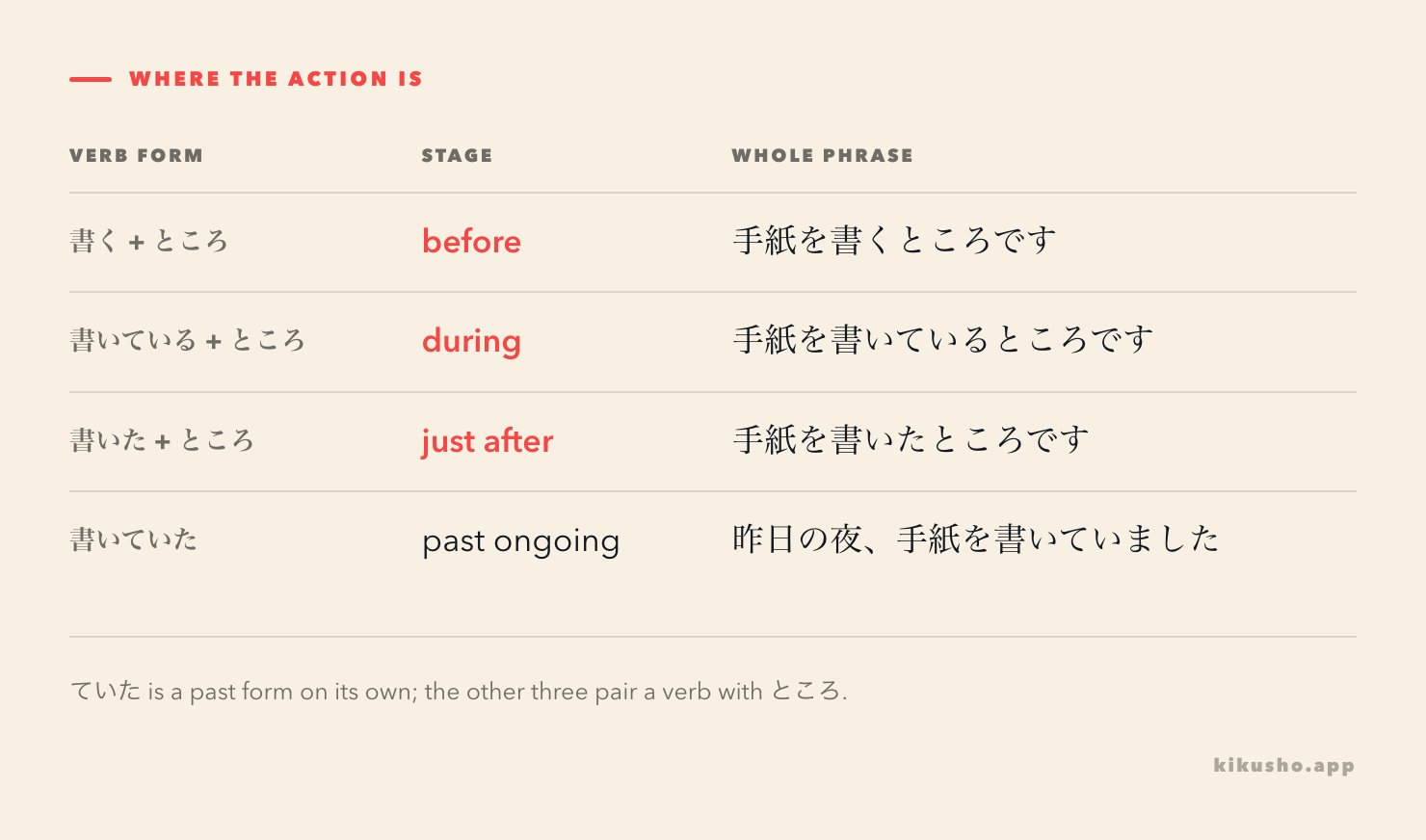
The Foundation's three-stage chart and Bunpro's independent ていた reference verify the attachment. The examples use one verb so the changing form remains visible.
Dictionary form puts the action just ahead
今から手紙を書くところです says the writing has not begun. 書く is non-past, but here the phrase locates an imminent action, often because the speaker is about to be occupied. JLPTsensei's ところ page and the Foundation's examples independently confirm the just-before use. If 書く/書いて/書いた still takes effort, review dictionary forms and verb groups first. ところ does not conjugate the verb for you.
ているところ shows current activity; ていた shows a past state
今、手紙を書いているところです catches the writing while it is underway. Plain 今、手紙を書いています also says you are writing; adding ところ highlights that exact moment, often because someone wants to know whether you are free. The Foundation's activity restriction matters: temporal ているところ fits activities such as writing or eating, while a ている result or state such as knowing something is not automatically in the middle of knowing it. The ている versus てある guide explains why ている can describe a continuing result as well as an activity.
昨日の夜、手紙を書いていました says the writing was ongoing last night. Plain ていた moves the reference time into the past; it does not by itself mean just finished. 書いていた is the plain form and 書いていました its polite form. Both JLPTsensei and Bunpro treat it as its own past ongoing construction.
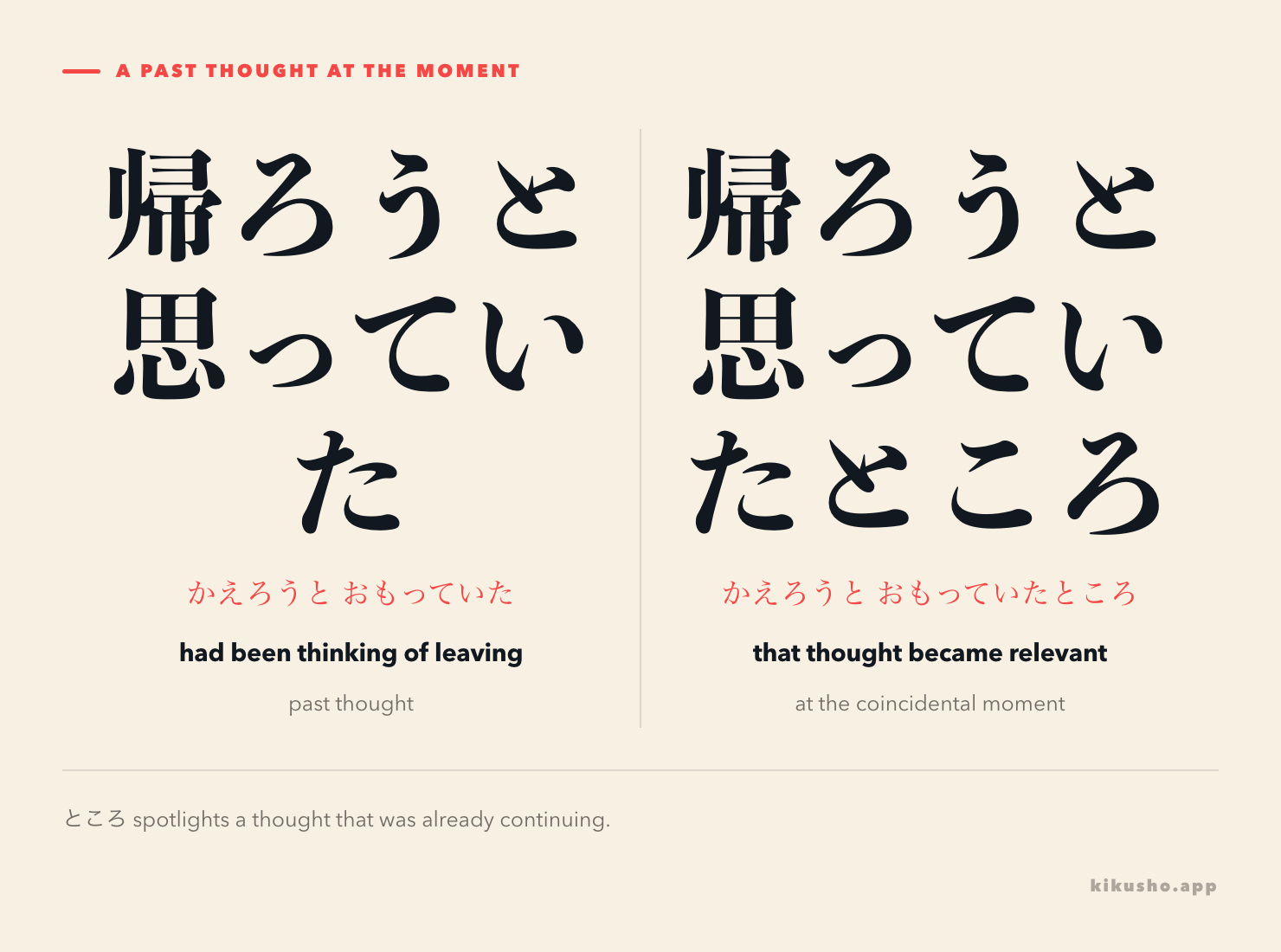
Add ところ to that past form and another use appears: ちょうど帰ろうと思っていたところです。 (I had just been thinking of heading home.) The thought had continued before this coincidental moment; ところ places it when it became relevant. The Foundation's teacher note on ていたところ explicitly describes a previously continuing state, often a thought or feeling. That differs from 帰っているところです, which would focus on an action underway now.
たところ places the end immediately before the reference moment
たった今、手紙を書いたところです puts completed writing right against now. Plain past 書きました reports that you wrote it, without specifying just-finished timing. The Foundation distinguishes たところ from たばかり: たばかり may reflect the speaker's sense that an action remains recent after more time, whereas たところ locates the immediate aftermath. Do not let their shared English just hide that difference.
Following particles make different constructions: 〜たところで (even if one did...) and 〜ところに (at the moment when...) need separate lessons. Neither is another stage of the sentence-final 書くところです. Politeness also belongs after ところ: 書くところです, never a ます-form immediately before it. In casual conversation ところ may shorten to とこ, as Bunpro notes; that shortening leaves the stage intact.
When a conversation hands you 帰ったところです, save the whole phrase rather than 帰る alone. Kikusho can take spoken or pasted text and keep the example sentence and nuance, so the moment the verb form marked remains available for review.
Choose the stage in these six questions
Attempt all six before the shared answer block. The numbered headings give no hints.
Question 1
You have not started writing a letter, but you are about to. Which sentence fits?
- a) 今から手紙を書くところです。
- b) 今、手紙を書いているところです。
- c) たった今、手紙を書いたところです。
Question 2
You are writing a letter at this moment. Complete 今、手紙を__ところです。
- a) 書く
- b) 書いている
- c) 書いた
Question 3
You finished the letter seconds ago. Complete たった今、手紙を__ところです。
- a) 書く
- b) 書いている
- c) 書いた
Question 4
Which sentence says I was writing a letter last night, without suggesting immediate completion now?
- a) 昨日の夜、手紙を書いていました。
- b) たった今、手紙を書いたところです。
- c) 今から手紙を書くところです。
Question 5
Write one polite Japanese sentence for I am in the middle of reading this letter right now. Use ところ and begin with 今.
Question 6
Which sentence presents a thought about leaving that had already been going on just as it became relevant?
- a) ちょうど帰ろうと思っていたところです。
- b) 今から帰るところです。
- c) たった今帰ったところです。
Answers and explanations
Answer 1
a). 書くところ is before writing starts. b) says it is underway; c) puts it just after completion.
Answer 2
b) 書いている. 今、手紙を書いているところです。 puts the writing in progress. a) would be just before it; c) just after it.
Answer 3
c) 書いた. たった今、手紙を書いたところです。 uses the た-form for the immediate aftermath. a) has not begun; b) would still be writing.
Answer 4
a). 書いていました is the polite past ongoing form of 書いていた. b) describes a just-finished letter now; c) an imminent letter now.
Answer 5
One model answer is 今、この手紙を読んでいるところです。 (I'm in the middle of reading this letter right now.) 読んでいる is 読む's て-form plus いる. The plain form precedes ところ; です makes the full sentence polite. 読んでいた would move the activity into the past.
Answer 6
a). 思っていた marks the earlier continuing thought and ところ places it at the coincidental moment. b) only says leaving is about to begin; c) says it has just finished. Neither reports the prior thought.
The stage can answer a social question
Someone asks whether you are free. 今、手紙を書いているところなので、あとで電話します。 (I'm in the middle of writing a letter, so I'll call later.) tells them the activity occupies you at this very moment, rather than merely naming your task for the day. The Foundation's teacher guidance places 〜るところ and 〜ているところ in invitations and polite refusals. The verb form matters because it tells the other person whether they can join you, should wait, or have reached you just after you finished.
Common questions
What does ところ mean after a verb?
In the temporal construction, ところ names the stage of an action. Dictionary form + ところ is just before it; ているところ is during it; たところ is just after it. ところ can also mean a physical place.
How is ていた different from ているところ?
ていた is the past form of ている: 書いていた means was writing. 書いているところ highlights writing underway at the current moment. ていたところ can spotlight a previously continuing state or thought at a particular moment.
Is たところ the same as たばかり?
たところ locates completion immediately before the reference moment. たばかり can reflect a speaker's sense that completion is still recent even after a longer interval.