On this page
食べる and 帰る both end in る. Conjugate them the same way and one comes out wrong: 食べる politely becomes 食べます, but 帰る becomes 帰ります, not 帰えます, the form its ending would predict. The difference is which of Japanese's two verb groups each one actually belongs to, and that single fact decides how a verb builds every other form you will need, starting with the polite ます ending most beginners meet first.
Every verb has to be sorted into one of these groups before you can conjugate it at all, and the sorting is not always obvious from spelling. Get it wrong and every later form (the negative, the past, the て-form) inherits the mistake. Get it right at the dictionary form, and the rest of conjugation is pattern-matching.
Two groups decide almost every conjugation
A verb's dictionary form (its plain, unconjugated, listed-in-a-dictionary shape) always ends in an う-row sound: う, く, ぐ, す, つ, ぬ, ぶ, む or る. That single fact splits nearly the whole language into two working groups.
- う-verbs (also called godan, "five-step"): the ending changes before most endings attach. 飲む, 書く, 話す, 待つ, 会う are う-verbs.
- る-verbs (also called ichidan, "one-step"): the ending barely changes at all. 食べる, 見る, 起きる, 寝る are る-verbs.
A third, tiny group sits outside both patterns. する (to do) and 来る, kuru (to come) are Japanese's only two irregular verbs, and their forms (します, 来ます) are memorised individually rather than built from either rule. Everything else you will meet is one of the two groups above.
Ending in る doesn't mean what it looks like
Here is the part spelling alone will not tell you. Both groups can produce a dictionary form ending in る, so that ending by itself does not sort a verb. You need one more test: the sound immediately before る.
| Sound before る | Group | Example |
|---|---|---|
| あ, う, お | う-verb, always | 作る (つくる), 乗る (のる) |
| い, え | る-verb (usually) | 食べる, 見る, 起きる |
"Usually" is doing real work in that second row. A short, fixed list of common verbs end in an い or え sound before る and still conjugate as う-verbs:
| Verb | Reading | Meaning |
|---|---|---|
| 帰る | かえる | to go home |
| 入る | はいる | to enter |
| 走る | はしる | to run |
| 知る | しる | to know |
| 要る | いる | to need |
| 切る | きる | to cut |
| 喋る | しゃべる | to chat |
| 減る | へる | to decrease |
None of these are rare verbs you can afford to guess at. 帰る and 知る are two of the first hundred verbs any beginner meets. There is no shortcut for this list beyond meeting each one enough times that the correct form stops requiring a check.
That is exactly the kind of thing a rule cannot give you and repetition can. When you meet one of these verbs somewhere real (a caption, a line in a show, something a friend says), capturing the sentence in Kikusho keeps 帰ります in the exact context you met it, reading and example sentence intact, instead of a bare headword you have to reconjugate from memory each time it comes up again.
Each group turns into ます a different way
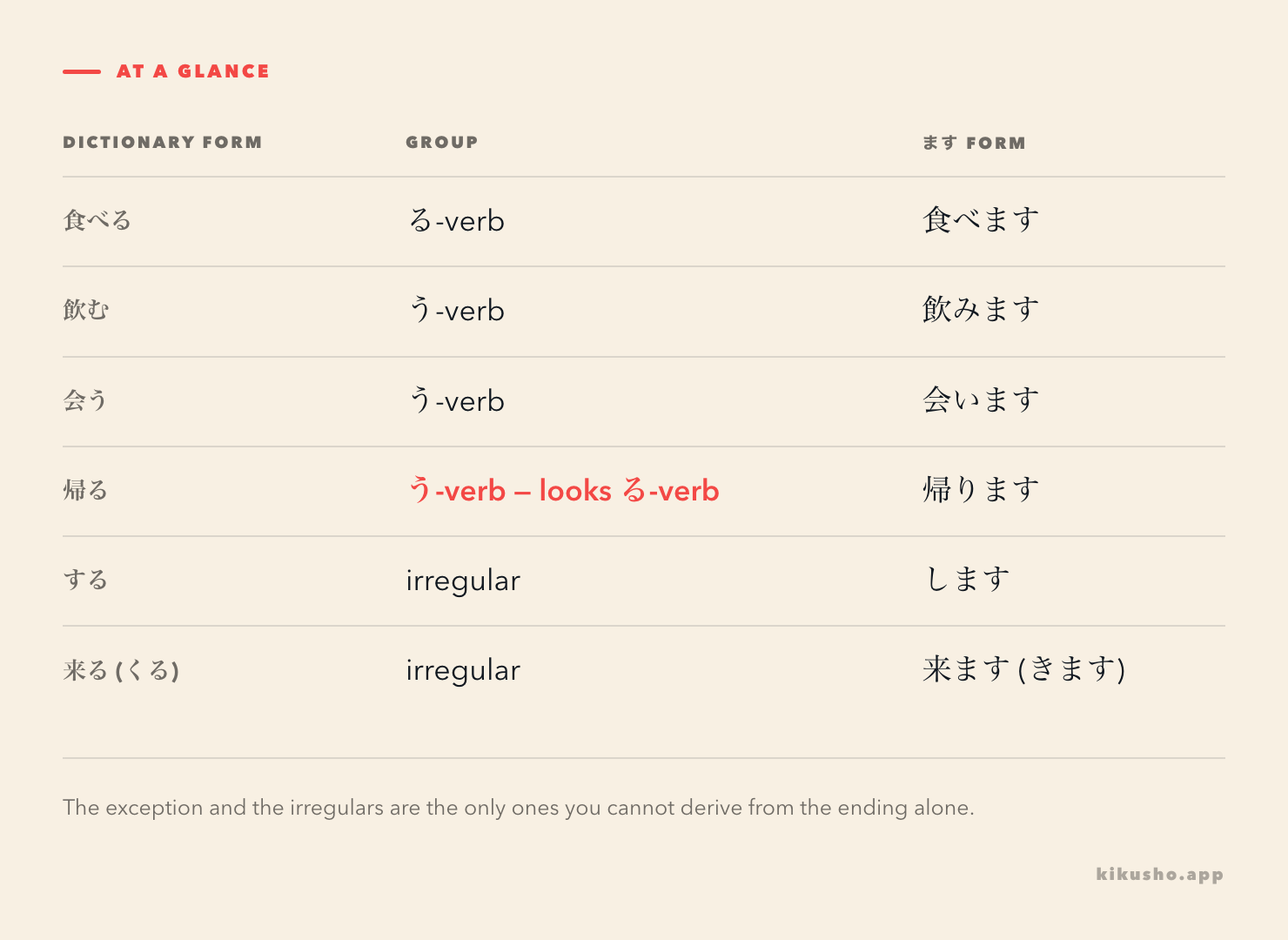
For an る-verb, drop る and add ます: 食べる → 食べます, 見る → 見ます. There is nothing else to remember.
For an う-verb, the final kana's u-sound changes to the matching i-sound, and ます attaches to that:
| Ending | Becomes | Example | ます form |
|---|---|---|---|
| う | い | 会う | 会います |
| く | き | 書く | 書きます |
| ぐ | ぎ | 泳ぐ | 泳ぎます |
| す | し | 話す | 話します |
| つ | ち | 待つ | 待ちます |
| ぬ | に | 死ぬ | 死にます |
| ぶ | び | 遊ぶ | 遊びます |
| む | み | 飲む | 飲みます |
| る | り | 帰る | 帰ります |
死ぬ is worth noticing on its own: it is the only verb in the language ending in ぬ, so that whole row exists for one word. The last row is the exception verb from above, conjugating exactly like any other う-verb once you know which group it is in.
する and 来る sit outside this table entirely: します and 来ます (きます) are simply learned as themselves.
The dictionary form isn't a half-built sentence
It is easy to treat 食べる as raw material (the thing you conjugate) and ます as the finished product. It isn't. 食べる is a complete sentence on its own, meaning "I eat" or "I'll eat," in exactly the register you would use with a friend, a sibling, or in your own head. ます is not what makes a verb usable; it is what makes it polite.
The choice between them is about who is listening, not about which one is more correct. Service staff, a stranger, a work presentation: ます. A friend, a parent, a diary entry, your own thoughts: the dictionary form, unconjugated. Most textbooks teach ます first because getting the register wrong with a stranger reads worse than getting it wrong with a friend. But the plain form is not a beginner shortcut you graduate out of. It is also the base that most other grammar (と, けど, つもり, plain-form quoting) attaches to directly, which is one reason it keeps reappearing long after ます stops being new.
The mistake that gives away a beginner's ear
The tell is almost always the exception list, in one of two directions. Either a real う-verb gets treated like a る-verb because it ends in -eru or -iru (帰えます instead of 帰ります, 知えます instead of 知ります), or, less often, an ordinary う-verb gets ます glued straight onto its dictionary form with no vowel shift at all (飲むます instead of 飲みます). Both are audible to a native speaker the instant they land, in a way a wrong particle sometimes isn't, because the ending is not approximately right. It is a different verb's ending.
Three sentences to check the rule against
Question 1. Which is the correct ます form of 飲む (to drink)?
a) 飲みます b) 飲むます c) 飲びます d) 飲ぬます
Answer 1: 飲みます. 飲む is an う-verb ending in む, and む's い-row equivalent is み: む becomes み before ます. (b) skips the vowel shift entirely; (c) and (d) shift to the wrong row, ぶ and ぬ instead of む.
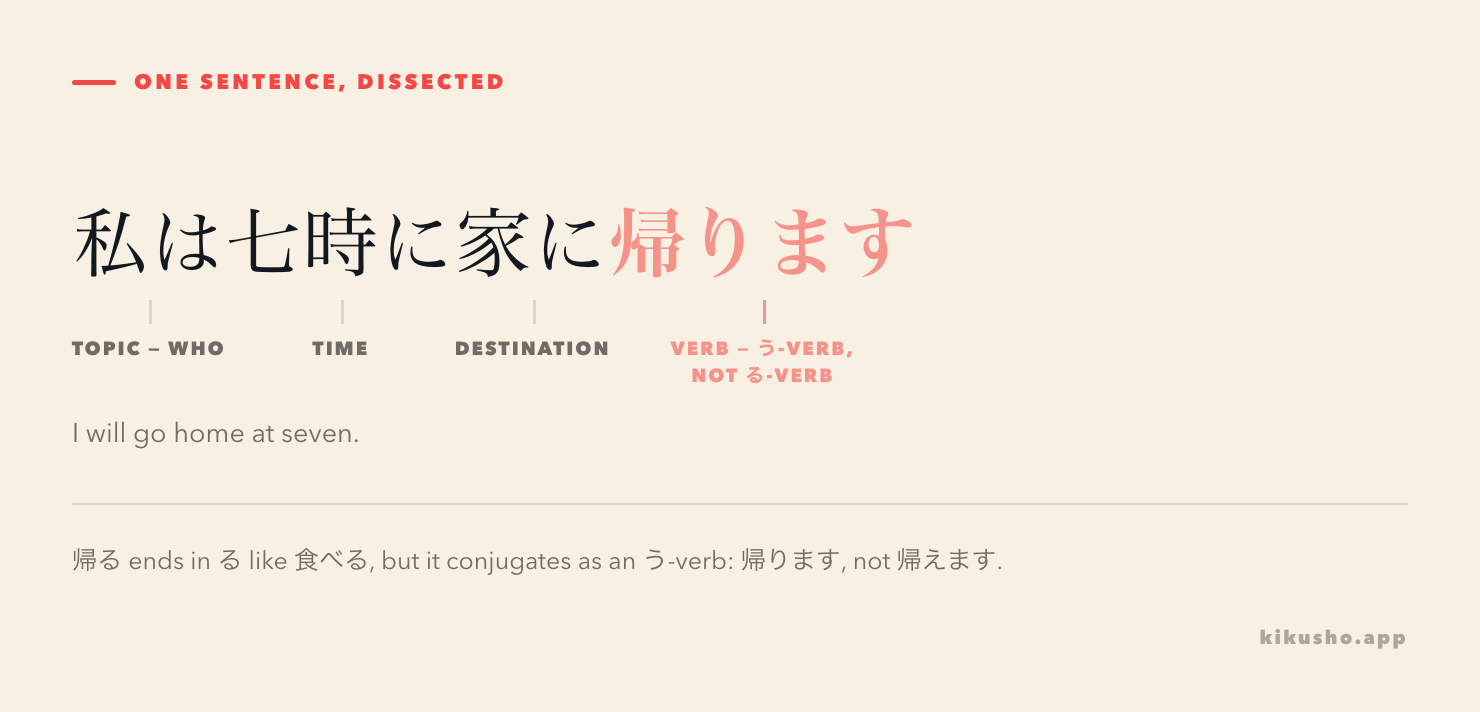
Question 2. Put these into a natural sentence meaning "I'll go home at seven": 家に ・ 帰ります ・ 七時に ・ 私は
Answer 2: 私は七時に家に帰ります。 Topic first (私は), then time (七時に), then the place marked with に (家に), verb last (帰ります). 帰る keeps its う-verb ます form despite the -eru ending, the exception covered above, now in the sentence where it shows up.
Question 3. Complete the message with the right form of 会う (to meet): 「あした、ともだちと えきで___。」(Tomorrow, I'll ___ my friend at the station.)
a) 会います b) 会うます c) 会えます d) 会いります
Answer 3: 会います. 会う is an う-verb; う becomes い before ます. (c) 会えます is the potential form ("can meet"): a different meaning, not a spelling slip. (b) and (d) do not shift the vowel correctly.
Once these two groups and their exceptions stop needing a table, the rest of conjugation moves fast: the negative, the past and the て-form all reuse the same split, which is also where Japanese's politeness system starts, not with keigo, but with the plain-versus-ます choice this lesson covers.
Common questions
How do I know if a Japanese verb is ichidan (a る-verb) or godan (an う-verb)?
Check the sound right before る. An あ, う or お sound before る always means godan: 作る, 乗る. An い or え sound before る usually means ichidan: 食べる, 見る. But a short, fixed list of common verbs break that pattern and are godan anyway: 帰る, 入る, 走る, 知る, 要る, 切る, 喋る, 減る. A dictionary marks the difference directly, as v1 for ichidan and v5 for godan, when you are unsure.
Why does 帰る conjugate like an う-verb even though it ends in -eru?
Because the groups sort verbs by their historical conjugation pattern, not by their spelling. 帰る has always inflected along the godan pattern; that it happens to end in -eru is coincidence, not a rule violation. A handful of everyday verbs share this trait and are simply memorised as a short list rather than derived from the ending.
Should I learn ます form or dictionary form first?
Most textbooks teach ます form first, since it is the safe default with strangers, and delay the plain form to avoid a beginner using it with the wrong person. But the dictionary form is the base every other conjugation is built from (negative, past, て-form), so both need learning close together, not one fully before the other.
What are Japanese's only two irregular verbs?
する (to do) and 来る, kuru (to come). Their polite forms, します and 来ます, follow neither the ichidan nor the godan pattern and are memorised on their own. Every other verb in the language is one of the two regular groups.