On this page
Use ~ために when the first clause names a deliberate objective pursued through the second action. Use ~ように when it names a result or state you want to bring about, especially an ability, something to avoid, an event outside direct control, or an outcome with a different subject.
That control test solves the clearest cases, but it is not a mechanical ban. The Japan Foundation describes the deeper difference as viewpoint: ために presents a goal as the agent's active objective, while ように puts the process or desired result in focus.
Start with the verb immediately before the connector
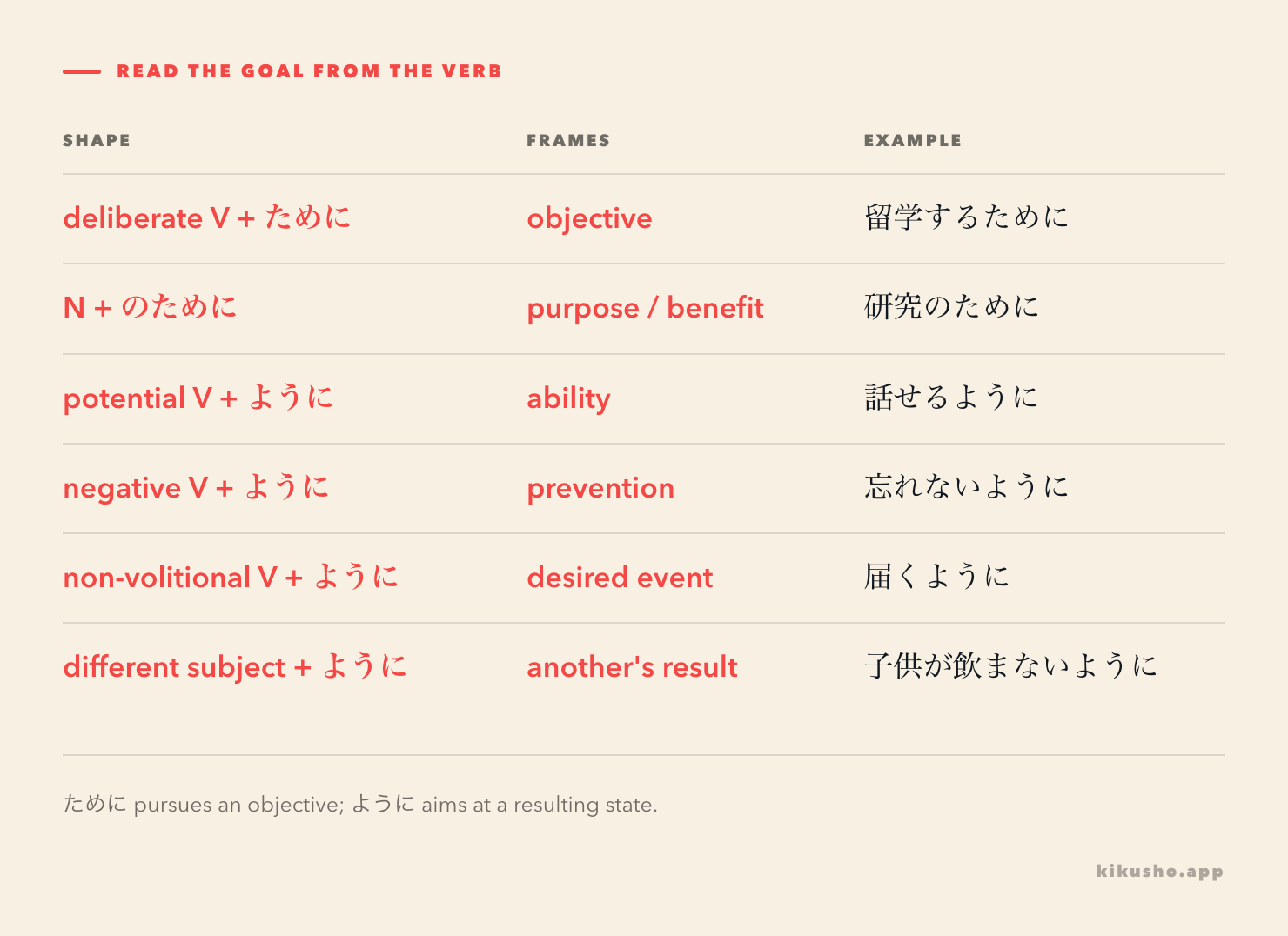
| Form | Connection | What the first clause presents | Example |
|---|---|---|---|
| deliberate verb + ために | dictionary form | an objective the agent pursues | 留学するために |
| noun + のために | noun + の | a purpose, benefit, or cause | 研究のために |
| potential verb + ように | non-past plain form | an ability to achieve | 話せるように |
| negative verb + ように | ない-form | a result to prevent | 忘れないように |
| non-volitional verb + ように | non-past plain form | a hoped-for state or event | 届くように |
| different subject + ように | subject can change | another person's or thing's result | 子供が飲まないように |
In these purpose patterns, both connectors lead into the action taken toward the goal:
留学するために、お金をためています。
I am saving money in order to study abroad.
日本語が話せるように、毎日練習しています。
I practise every day so that I can speak Japanese.
Saving is a deliberate step toward the deliberate plan 留学する, so ために fits. In the second sentence, the target is the state “be able to speak.” A potential form such as 話せる strongly points to ように.
The Japan Foundation's Irodori purpose summary gives the same core division: ために follows something achievable by volition, while ように commonly follows potential verbs, negative forms, and non-volitional predicates.
ために treats the goal as an intentional project
Purpose ために follows the dictionary form of an action that someone can set out to do.
日本で働くために、ビザを申請しました。
I applied for a visa in order to work in Japan.
医者になるために、大学で勉強しています。
I am studying at university in order to become a doctor.
The main-clause action is performed as a means toward the first goal. The agent who applies intends to work; the person studying intends to become a doctor. Even though “become” describes a change, 医者になる is a career objective a person can deliberately pursue.
This explains a common subject tendency. In a straightforward ために purpose sentence, the understood controller of both clauses is normally the same:
私は日本で働くために、ビザを申請しました。
私は naturally controls both 働く and 申請する. If one person acts to create a result for somebody else, ように is usually clearer:
子供が薬を飲めるように、母親はジュースに混ぜました。
The mother mixed the medicine into juice so that the child could take it.
The child is the subject of 飲める; the mother is the subject of 混ぜました. ように allows the sentence to keep that difference visible.
ように aims at a state, ability, or avoided result
Three shapes account for many N3 questions.
Potential + ように targets an ability:
小さい字も読めるように、眼鏡をかけます。
I wear glasses so that I can read small print too.
Negative + ように targets prevention:
約束を忘れないように、カレンダーに書きました。
I wrote it on the calendar so that I would not forget the appointment.
Non-volitional event + ように targets something the main-clause agent cannot directly perform:
プレゼントが誕生日までに届くように、速達で送りました。
I sent the present by express mail so that it would arrive by the birthday.
You can choose express delivery; you cannot perform “the present arrives” as your own intentional action. The Japan Foundation's teaching entry for purpose ように explicitly groups negative forms, potential expressions, and changes outside a person's control in this pattern.
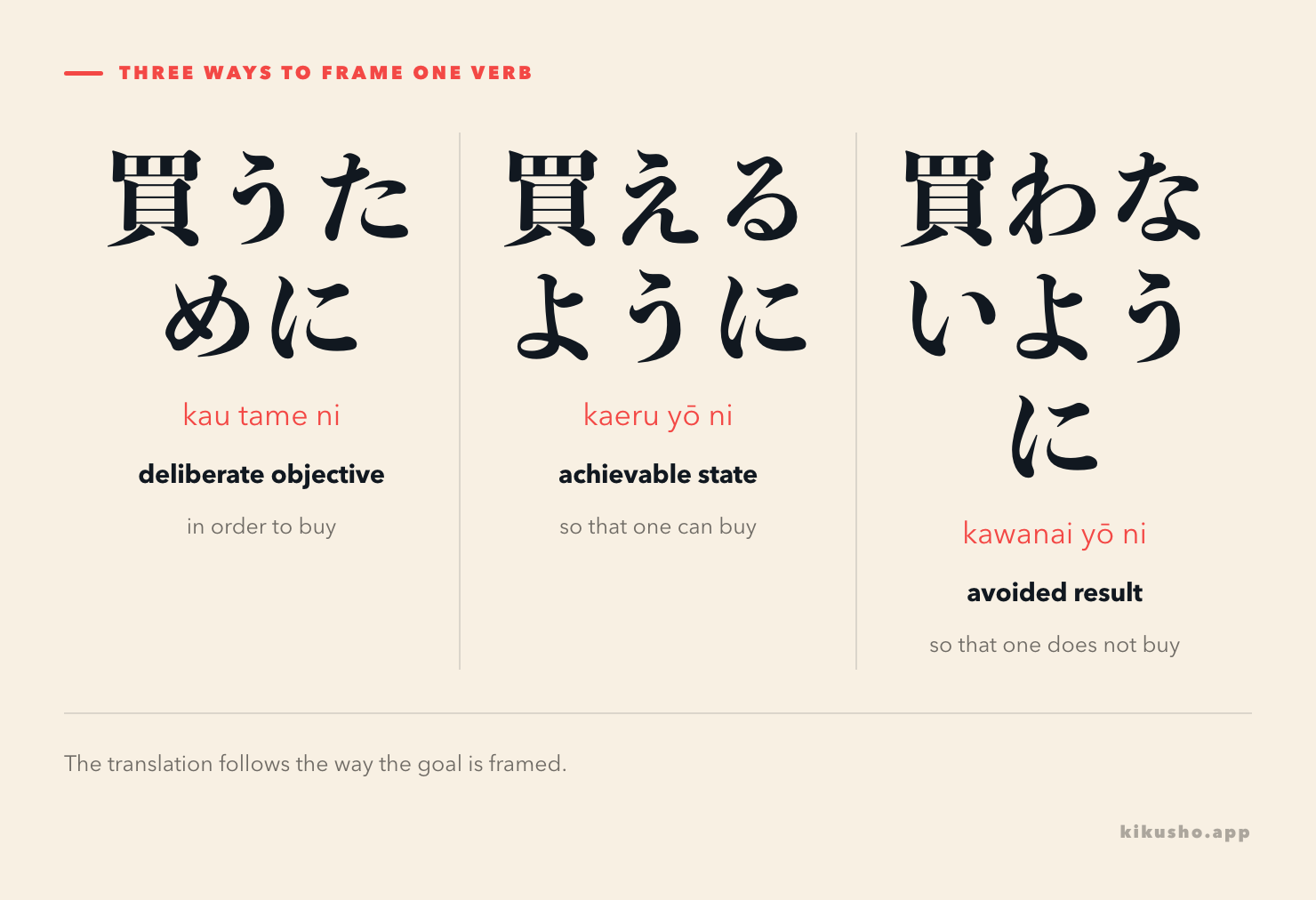
These forms make a practical first check:
- 買うために: in order to buy it, as a deliberate objective
- 買えるように: so that one can buy it, as an achievable state
- 買わないように: so that one does not buy it, as an outcome to avoid
The same situation can be framed from two viewpoints
The verb type is evidence, not the whole meaning. Compare a goal that admits more than one viewpoint:
大学院に入るために、毎日勉強しています。
I study every day in order to enter graduate school.
大学院に入れるように、毎日勉強しています。
I study every day so that I can get into graduate school.
The first sentence presents admission as the student's explicit objective. The second uses the potential 入れる and focuses on reaching the state where admission is possible. The study behaviour may be identical.
The Japan Foundation's detailed comparison of ように and ために describes precisely this shift between an intentional, actively pursued purpose and attention to the process or result. This is why translating both expressions as “in order to” loses the decision Japanese is making.
It also explains why rewriting the verb can change the connector:
子供が元気に育つように、親は食事に気をつけています。
The parents pay attention to meals so that the child grows up healthy.
子供を元気に育てるために、親は食事に気をつけています。
The parents pay attention to meals in order to raise the child healthily.
育つ presents the child's development. 育てる presents the parents' deliberate act of raising the child. The world has not changed; the grammatical viewpoint has.
Do not confuse purpose ために with cause ために
ために has uses beyond deliberate purpose. A noun with の can name who benefits:
家族のために働いています。
I work for my family.
It can also mark a cause:
大雪のために、電車が遅れました。
Because of heavy snow, the train was delayed.
事故があったために、道が混んでいました。
The road was crowded because there had been an accident.
Snow and past accidents are not objectives. In these sentences, ために is close to “because of.” A past form before ために is therefore a strong sign that you are reading a cause, since a completed event cannot be the future purpose of the action that follows.
The Japanese Language Education Society's reference study of ために, ように, and のに records purpose, benefit, usefulness, and cause-related functions for ため, while describing purpose ように as result-oriented and available when the two clause subjects differ or the target is stative.
Keep other ように patterns outside this comparison
ように performs several jobs that are not competing with purpose ために:
- 日本語が話せるようになりました: I became able to speak Japanese.
- 毎日読むようにしています: I make a habit of reading every day.
- 忘れないようにしてください: Please make sure not to forget.
- 先生が言ったように: as the teacher said.
The words look alike because よう presents a manner, state, or model. Only the purpose pattern in this lesson has a main action taken so that the ように-clause becomes true.
The control distinction also appears elsewhere in Japanese grammar. In ば and なら before advice, the kind of condition determines whether a request can follow. At N1, べく and んがため return to deliberate purpose in a formal written register. Everyday ように and ために provide the foundation for both comparisons.
Practice: decide all nine before checking
Question 1. Choose the connector. 日本語のニュースが分かる__、毎日聞いています。
- a) ために
- b) ように
- c) ための
- d) ような
Question 2. Choose the connector for a deliberate career goal. 看護師になる__、専門学校に入りました。
- a) ように
- b) ために
- c) ための
- d) ような
Question 3. Two subjects are explicit. 赤ちゃんが起きない__、父親は静かにドアを閉めました。
- a) ために
- b) ように
- c) ためだ
- d) ようだ
Question 4. Which sentence naturally means “I made a note so that I would not forget”?
- a) 忘れないために、メモをなくしました。
- b) 忘れるように、メモを取りました。
- c) 忘れないように、メモを取りました。
- d) 忘れたために、メモを取りました。
Question 5. In 大雪のために、試合が中止になりました, what does ために express?
- a) A deliberate purpose
- b) A comparison
- c) A cause
- d) An ability
Question 6. Put the four chunks in order. One chunk goes in the ★ position.
海外で __ __ ★ __。
- ① 毎日練習しています
- ② 働ける
- ③ 英語を
- ④ ように
Question 7. Which rewrite deliberately changes the viewpoint from the child's growth to the parents' action?
Original: 子供が元気に育つように、親は食事に気をつけています。
- a) 子供を元気に育てるために、親は食事に気をつけています。
- b) 子供が元気に育ったために、親は食事に気をつけています。
- c) 子供を元気に育つように、親は食事に気をつけています。
- d) 子供が元気なための、親は食事に気をつけています。
Question 8. Which pair correctly contrasts objective focus with ability focus?
- a) 大学院に入るために / 大学院に入れるように
- b) 大学院に入るような / 大学院に入れるための
- c) 大学院に入ったために / 大学院に入れたような
- d) 大学院に入れるために / 大学院に入らないような
Question 9. Read the passage and choose the best pair.
来月、日本で発表します。みんなに内容が伝わる( A )、短い文を使うつもりです。質問にも答えられる( B )、毎日会話を練習しています。
- a) A ために / B ために
- b) A ように / B ように
- c) A ように / B ために
- d) A ために / B ように
Stop here until every blank has an answer. The explanations are collected in the next section.
Check every decision
Answer 1: b) ように. 分かる describes understanding as a state or ability, so the listening is done to make that result possible.
Answer 2: b) ために. Becoming a nurse is presented as the student's deliberate career objective, and entering vocational school is a step toward it.
Answer 3: b) ように. The baby is the subject of 起きない, while the father closes the door. ように naturally holds the desired result when the two subjects differ.
Answer 4: c) 忘れないように、メモを取りました. The ない-form presents forgetting as the result to prevent. Option d makes past forgetting the cause of taking a note, which describes a different timeline.
Answer 5: c) A cause. Heavy snow is why the match was cancelled. It cannot be an intended goal, so ために means “because of” here.
Answer 6: ② → ④ → ③ → ①; the ★ chunk is ③ 英語を. The completed sentence is 海外で働けるように、英語を毎日練習しています. Potential 働ける combines with ように, and 英語を begins the main clause.
Answer 7: a) 子供を元気に育てるために、親は食事に気をつけています. The intransitive 育つ presents the child's resulting growth. Transitive 育てる presents raising the child as the parents' deliberate objective, so ために fits that new viewpoint.
Answer 8: a) 大学院に入るために / 大学院に入れるように. Dictionary-form 入る presents admission as an active objective. Potential 入れる presents being able to enter as the state the student hopes to reach.
Answer 9: b) A ように / B ように. 内容が伝わる has the content as its subject and presents the desired result “gets across.” 答えられる is potential and presents the ability to answer. Both therefore take ように.
When the English says “in order to,” inspect the Japanese goal instead of translating the connector first. A deliberate project points toward ために. An ability, prevention, outside result, or changed subject points toward ように. When both seem plausible, decide whether the speaker is presenting an objective or the state they hope to reach.
Common questions
What is the difference between ように and ために?
Purpose ために presents a deliberate objective that the agent pursues. Purpose ように presents a desired result or state, especially with potential verbs, negative forms, non-volitional events, or different subjects in the two clauses.
Can ように follow a volitional verb?
Yes in some uses and contexts. The volitional versus non-volitional test is a strong first guide for purpose clauses, but ように can focus on the process or resulting state, and it has other uses such as requests, wishes, resemblance, and change with ようになる.
Does ために always mean in order to?
No. ために can also mark a cause, as in 大雪のために電車が遅れた, or a beneficiary, as in 家族のために働く. Context and the form before it show which relationship is intended.