On this page
Both 窓が開いている and 窓が開けてある translate as the window is open, which is why they blur together. てある tells you a person opened it and left it that way on purpose; ている only reports that it stands open. You settle which of those you mean one word before the auxiliary, when you reach for either a transitive verb or its intransitive twin.
The fork is the verb, not the auxiliary
The rule fits in a sentence. てある attaches only to a transitive verb and asserts that somebody brought the state about; the ている resultant state uses the intransitive twin and asserts nothing about who. The decision is made when you pick the verb, and the auxiliary just falls out of it.
Japanese stocks these verbs in pairs. 開く and 開ける, 閉まる and 閉める, つく and つける: one member of each describes a thing changing by itself, the other describes a person changing it. てある reaches for the second; the ている state reaches for the first. Two sentences that both land on "the window is open" have started from opposite ends of that pair.
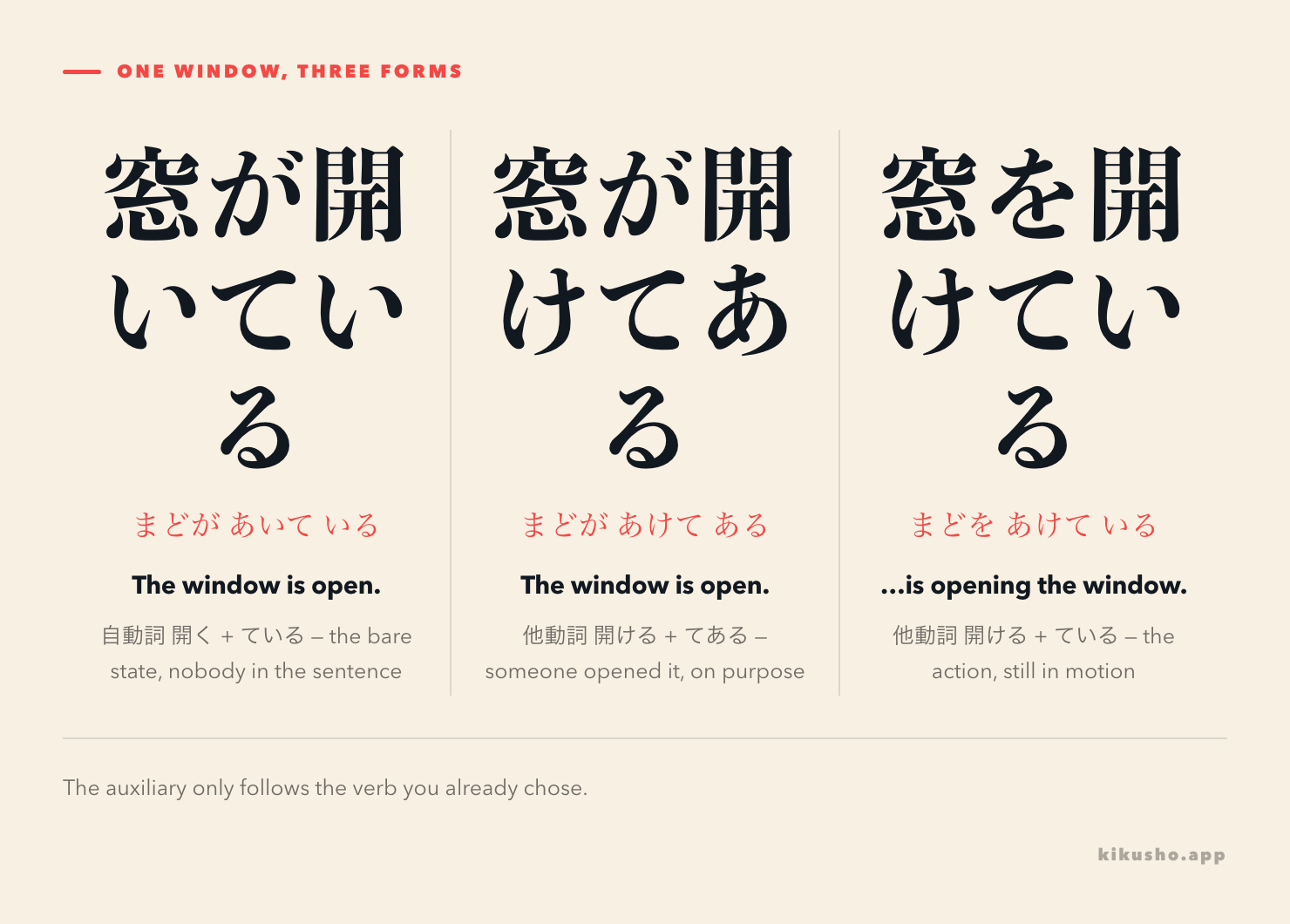
Read the three together and the machine is visible. The first uses the intransitive verb and reports a fact. The second uses the transitive verb with てある and slips an agent in behind it. The third uses that same transitive verb with ている, and it is not a state at all: it is the opening itself, caught mid-motion.
The test: did someone set this up, and is that the point?
When you are stuck between them, ask one thing of the scene. Is the fact that a person arranged this part of what you are saying? If yes, you want a transitive verb and てある. If you are only noting how things stand, and who or what made them so is beside the point, you want the intransitive verb and ている.
Picture the classroom window. Walk in and find it open with no story attached, and it is 窓が開いている. If the caretaker opened it before class to air the room, and you are pointing at that arrangement, it is 窓が開けてある. Same window, same openness; only the second sentence carries a hand.
てある also tends to look forward. It picks up a sense of preparation: the state was set so that something later would go smoothly. That is why 予約してある, the booking is made, and 切符を買ってある, the ticket is bought, read less like reports of a past action than like reassurances that you are set. ている has no stake in what comes next. It describes the present and stops there.
Where ている is at home: the state with nobody in it
ている on an intransitive change-of-state verb is the plain resultative: something changed, and it is still in the changed state. 電気がついている, the light is on. 花が咲いている, the flowers are out. 割れている, it is in pieces. None of these names an agent, and none wants one. The flowers were not opened by anybody, and a plate that "is broken" invites no question about who did it, which is where 〜てしまう would instead frame the breaking as an event that ran its course.
This is the form to reach for when the world simply is a certain way. It is also, not by accident, the form you meet describing a scene rather than issuing an instruction: the state of a room, a character walking in on something, the way things were found. You would report a wallet on the pavement as 財布が落ちている, never 財布が落としてある. A dropped wallet is the exact case where nobody meant anything, and ている is the form that says so; 落としてある would insist someone set it down there on purpose.
Where てある is at home: a state somebody set up
てある takes a transitive verb and reports its result while pointing, without naming, at whoever produced it. The clearest tell is what it does to the grammar around it. The noun that was the verb's direct object, marked を, usually shifts to が, because the sentence is no longer about the act of doing but about the state of the thing.
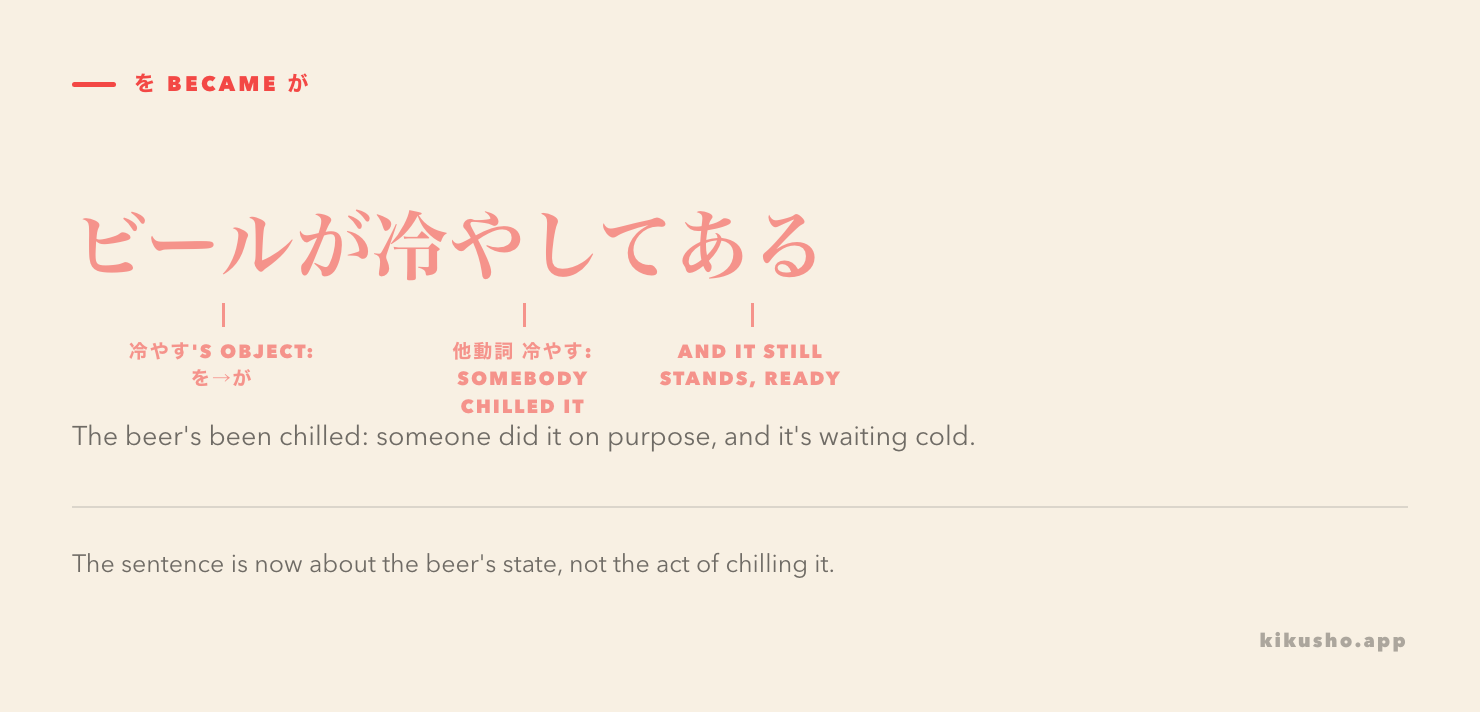
冷やす is transitive, to chill something. ビールが冷やしてある says the beer has been chilled and is chilled now, and that a person did it on purpose: someone readying the drinks before guests arrive. Set it against ビールが冷えている, built on the intransitive 冷える. There the beer is cold, and whether it got that way in a fridge someone stocked or a cold garage is simply not in the sentence.
A note left for you works the same way. メモが置いてある means a memo has been placed there, by someone, for you to find, and the placing is half the message. 置く is transitive, so it takes てある cleanly; the sentence hands you both the memo on the table and the intention behind it.
This is also the form on a great many signs and notices, because a notice is precisely a state a person arranged for you to find: ここに名前が書いてある, your name is written here. The writing was done by someone, deliberately, so that you would read it, which is the whole of てある in four syllables.
These forms are almost never met in isolation. You read 立入禁止と書いてある on a barrier, or hear a friend say 予約してあるから大丈夫 as you walk toward a restaurant, and the grammar arrives already wearing its context. A card that keeps only the dictionary verb, 書く or 予約する, throws away the part that was hard: the てある that turned the verb into a standing, arranged state. Kikusho keeps the form you actually met: photograph the sign or say the sentence you heard, and the card comes back with 書いてある intact, its reading, and the note that this is a result somebody set up. That is the shape you will need to recognise next time, not the citation form you already knew.
The same scene, said two ways
Line the two up across a few ordinary scenes and the point stops being about windows.
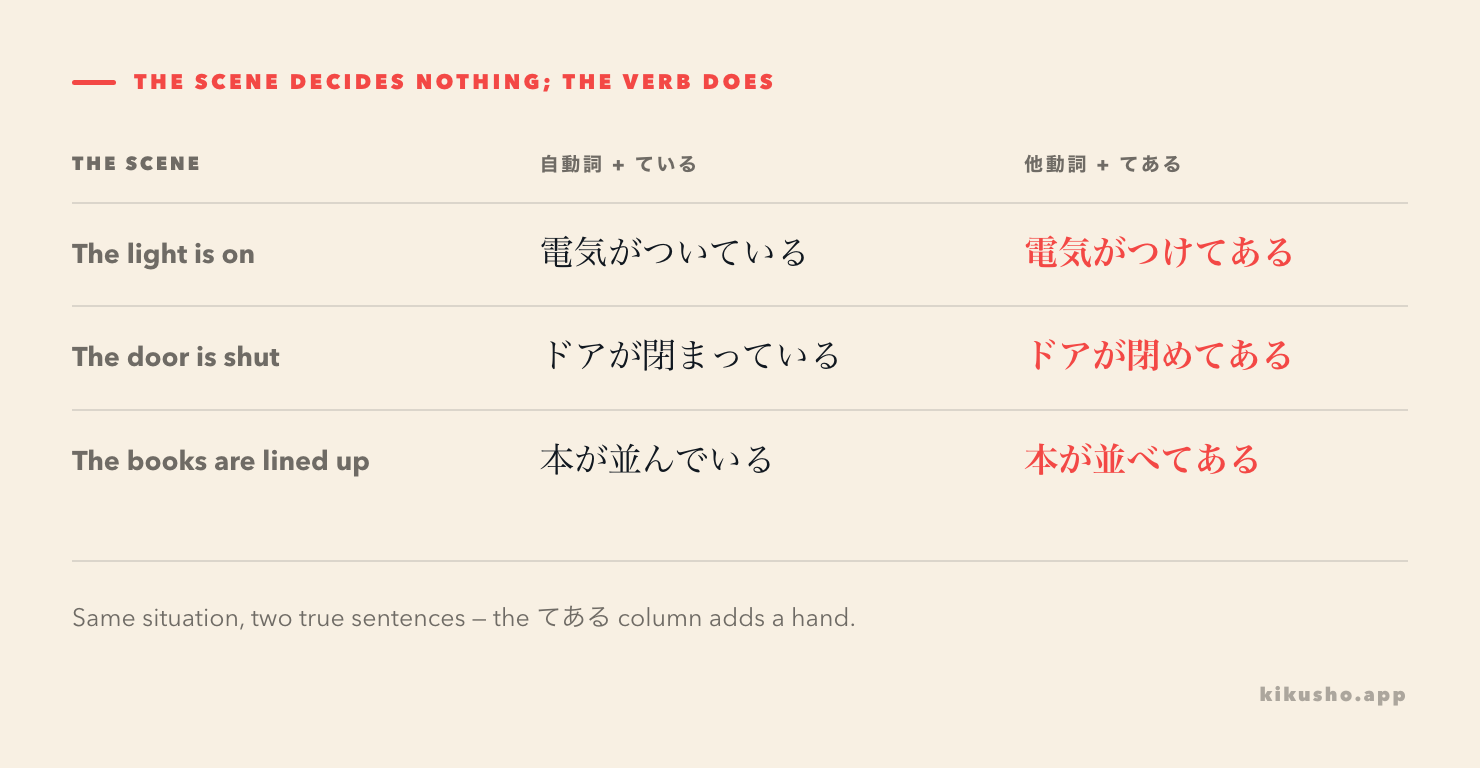
Every row is one situation and two sentences that are both true of it. The left column reports; the right column reports and implicates. 電気がついている notices the light. 電気がつけてある says somebody left it on, which in the right room means "so don't switch it off" or "they must still be here." The door carries the same freight: ドアが閉めてある can be a small instruction, the door shut on purpose so the cat stays in, where ドアが閉まっている only tells you it is shut. The surplus meaning is never in the light or the openness itself. It is in the transitive verb, chosen before you ever reached ある.
What breaks when you pick wrong
Two mistakes account for nearly all of it, and a native ear catches both at once.
The first is pairing てある with an intransitive verb. 窓が開いてある means nothing: 開く has no object for a hidden agent to have acted on, so てある has nothing to pin its "somebody did this" to. The same collapse hits 冷えてある, 割れてある and 消えてある, each one grabbing てある with the wrong half of the pair. The shortcut: if the verb cannot take を, it cannot take てある.
The second is using the transitive verb with ている and expecting a state. 窓を開けている is grammatical, but it does not give you an open window. It gives you someone in the middle of opening one, or someone who keeps it open as a habit. A learner who wanted "the window is open" and landed here has reported an action in place of a result, and the を rather than が is the fingerprint.
The split trips up reading as much as speaking. A notice that says 準備してあります is promising you that things have been set up and are waiting; take it for a bare 準備している and you have downgraded a guarantee into a picture of someone still bustling about. The てある was the whole assurance.
Both repairs are the same move, and it happens early. Decide first whether you are reporting a bare state or a state someone arranged. Pick the verb that matches, the intransitive twin or the transitive one. Then ている or てある is no longer a choice you can get wrong, because the verb already made it.
Common questions
Can 〜てある attach to any verb?
Only to transitive verbs, the ones that take a を object. 窓を開ける gives 窓が開けて ある, but the intransitive 開く cannot: 窓が開いてある is not Japanese. For a state built on an intransitive verb, use 〜ている instead — 窓が開いている.
What is the difference between 開けてある and 開けている?
開けてある reports a window someone opened and left open on purpose. 開けている, the same transitive verb with 〜ている, reports the action instead: someone is in the middle of opening it, or keeps it open as a habit. てある gives you the arranged result; ている on a transitive verb gives you the activity.
Why does 窓を開ける become 窓が開けてある?
Because the sentence stops being about the act of opening and becomes about the state of the window. The noun that was the direct object of 開ける takes を; once it is the thing whose state you are describing, it usually shifts to が.
Does 〜てある always imply preparation?
Not always, but it leans that way. Alongside "someone did this" it often carries "and it is ready for what comes next", which is why 予約してある and 買ってある feel like reassurances that you are set, not bare reports that an action happened.