On this page
この道具は使えば使うほど、手になじみます: “The more I use this tool, the more comfortable it feels in my hand.” The pattern ~ば~ほど (ba… hodo) links two changing degrees, giving Japanese its “the more…, the more…” construction.
This N3 grammar lesson covers three related items: ば~ほど, ほど for degree and approximation, and ほど~ない for a negative comparison. You need plain verb forms, the ば conditional and the difference between い- and な-adjectives. Read 道具 as どうぐ, “tool”; 手になじむ means to come to fit or feel familiar in the hand.
ば~ほど links two scales
In the opening sentence, use increases and the tool feels more familiar. The repeated verb identifies the first scale. The clause after ほど gives the result.
That result need not be an improvement. 荷物が増えれば増えるほど、移動が大変になります means “The more luggage there is, the harder getting around becomes.” 荷物(にもつ)is luggage, 増える(ふえる)means to increase, and 移動(いどう)means movement or travel between places.
“Proportional” here describes a tendency. The grammar does not claim a measurable ratio: using a tool twice as often does not promise exactly twice the comfort. Nor does a sentence establish that its claim is true. It gives the speaker a way to connect degrees.
The JLPT Sensei lesson on ば~ほど gives the repeated pattern for verbs and adjectives. The earlier lesson on ば and なら covers the conditional forms themselves; here the task is to use them inside a comparison.
Change the first ending, then repeat the plain form
For a verb, put its ば form first and its dictionary form before ほど. Keep the two forms tied to the same action.
| Word type | Starting form | Comparison opening |
|---|---|---|
| Godan verb | 読む(よむ), read | 読めば読むほど |
| Ichidan verb | 調べる(しらべる), investigate | 調べれば調べるほど |
| する verb | 練習する(れんしゅうする), practise | 練習すれば練習するほど |
| Irregular verb | 来る(くる), come | 来れば来るほど(くればくるほど) |
| い-adjective | 安い(やすい), inexpensive | 安ければ安いほど |
| な-adjective | 静か(しずか), quiet | 静かなら静かなほど |
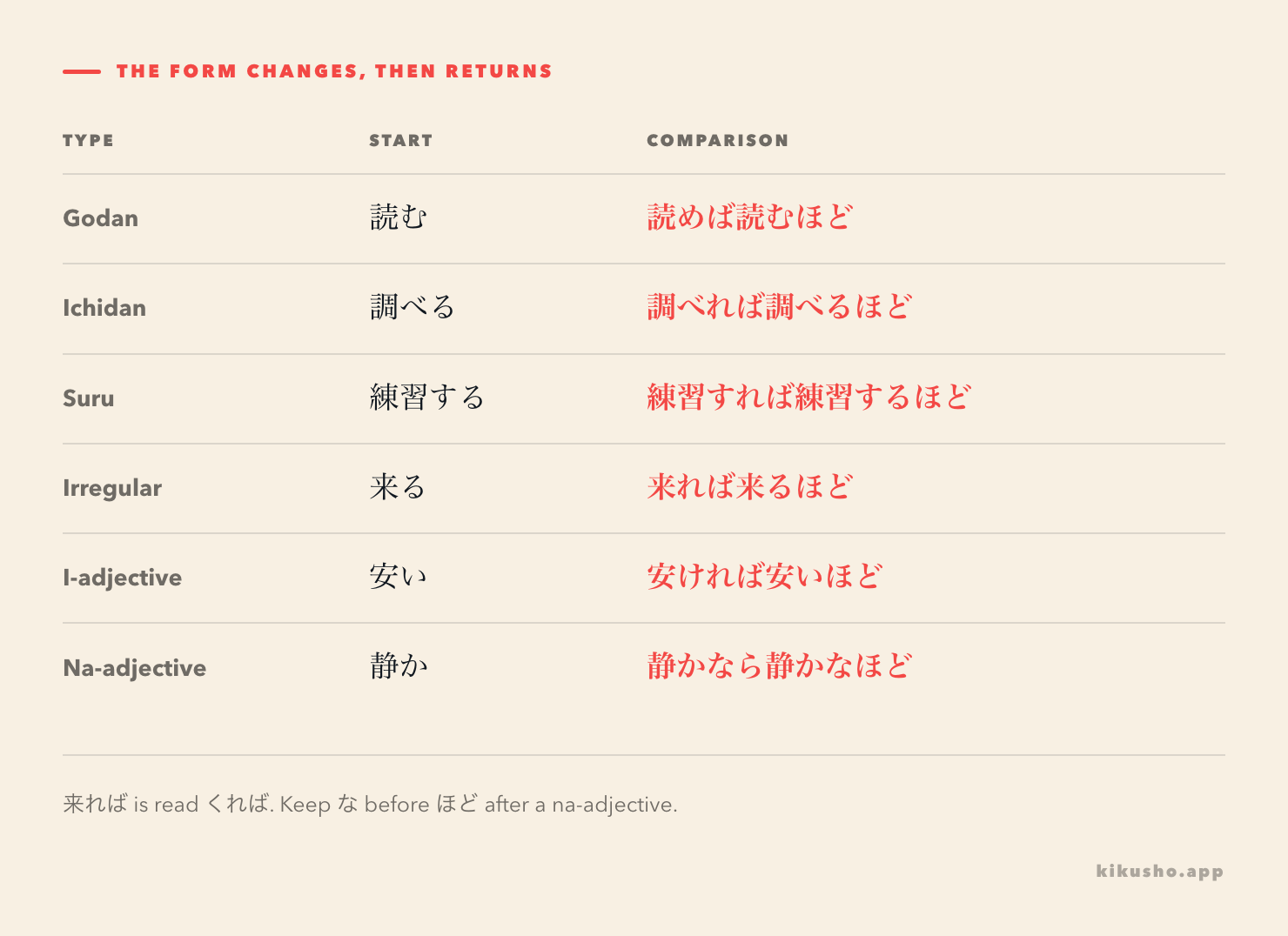
For godan verbs, change the final u sound to e before ば: 読む → 読めば. For ichidan verbs, replace る with れば: 調べる → 調べれば. The verb-group guide helps you identify which group you have.
With する compounds, the second noun can be left out: 練習すればするほど is also correct. This is the shorter version of 練習すれば練習するほど, not permission to switch to an unrelated verb halfway through. Bunpro's explanation explicitly records this shortening.
Adjectives measure a quality instead of an action
An い-adjective loses its final い before ければ, then returns to its ordinary form: 安ければ安いほど. For いい, use the よい stem: よければよいほど.
A な-adjective can use なら followed by なほど. 案内は簡単なら簡単なほど、分かりやすいです means “The simpler the instructions, the easier they are to understand.” 案内(あんない)means guidance or instructions here; 簡単(かんたん)means simple.
The な matters: 静かなら静かなほど has it even though 静かなら does not. A more formal alternative is 静かであれば静かなほど, with である variants also possible. Tae Kim's formation guide shows this であれば option. You do not need it to make an ordinary polite sentence: the final です or ます can supply politeness.
The second scale can run downward
“The more…, the more…” is only an English label. Japanese also handles “the fewer…, the easier…” through the words you choose.
荷物が少なければ少ないほど、移動が楽です。
にもつが すくなければ すくないほど、いどうが らくです。
The less luggage you have, the easier it is to get around.
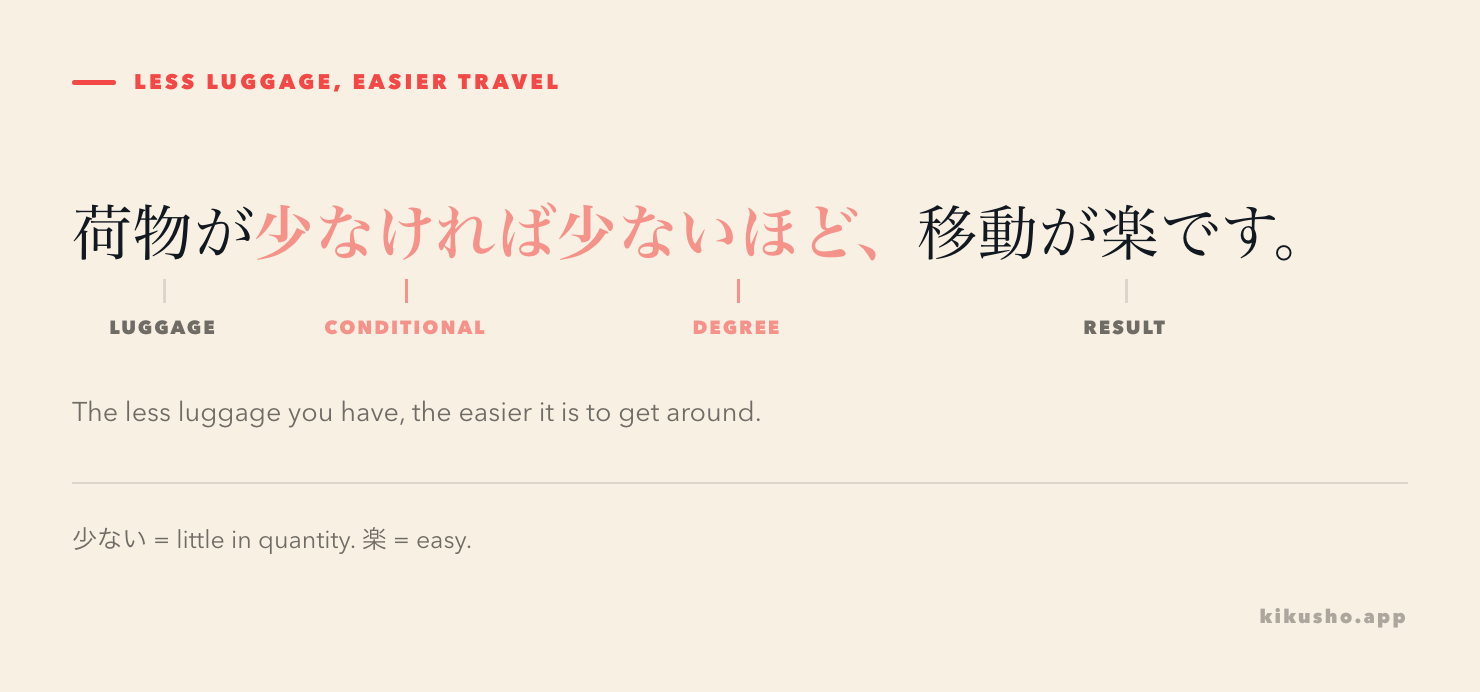
少ない(すくない)means few or little in quantity. 楽(らく)means easy or comfortable. Neither half needs a separate word meaning “more”: the paired construction does that work. Maggie Sensei's examples and explanation show that the same frame accommodates different directions and consequences, including unwanted ones.
ほど alone can measure intensity or an approximate amount
The core idea of ほど (hodo, also written 程) is degree or extent. It does not require a repeated conditional.
この箱は、一人では持てないほど重いです。
この はこは、ひとりでは もてないほど おもいです。
This box is so heavy that I cannot carry it alone.
持てない is the negative potential of 持つ: “cannot carry/hold.” The clause before ほど supplies a measure of how heavy the box is. It is not saying that carrying the box more often makes it heavier. Bunpro's separate ほど lesson covers this degree use and its attachment.
The common shapes are plain verb + ほど, い-adjective + ほど, な-adjective + なほど and noun + ほど. Before another noun, use ほどの: 一人では持てないほどの重さ, “a weight too great to carry alone.” 重さ(おもさ)is weight.
After a number and counter, ほど can instead make an estimate: 二十分ほど待ちました(にじゅっぷんほど まちました), “I waited about twenty minutes.” There is no second changing scale. The JLPT Sensei explanation of degree and approximation treats these as uses of the same form. Do not turn an approximate time into a promise of an exact maximum.
ほど~ない compares something with a benchmark
For ほど~ない, put the comparison target before ほど and negate the description that follows:
A は B ほど + negative predicate
| Sentence | What it says |
|---|---|
| この箱は、あの箱ほど重くありません。 | This box is not as heavy as that one. |
| この部屋は、隣の部屋ほど静かではありません。 | This room is not as quiet as the next room. |
| 私は兄ほど速く走れません。 | I cannot run as fast as my older brother. |
隣(となり)means next door or adjacent, 兄(あに)means one's own older brother, and 走る(はしる)means to run. The negative ending follows the predicate type: 重い → 重くない, 静か → 静かではない, 走れる → 走れない. Polite versions appear in the table.
The object before ほど is the benchmark. In the first row, that is あの箱, “that box.” The sentence still allows this box to be heavy; it says its weight does not reach the other's. Bunpro's negative-comparison explanation makes this benchmark relationship explicit.
You can also compare a result with an expectation: 思ったほど難しくありませんでした, “It was not as difficult as I thought.” Here 思った gives the expected degree. In ほどではない, the degree itself can be denied: 買い替えるほどではありません, “It is not to the point of needing a replacement.” 買い替える(かいかえる)means to buy a replacement.
A different shape, Bほど…人はいない, says nobody reaches B's level: 姉ほどこの町に詳しい人はいません, “Nobody knows this town as well as my older sister.” Read 姉 as あね and 詳しい as くわしい. This is the emphatic comparison also covered in JLPT Sensei's ほど~ない lesson; check whether the sentence is comparing A with B or denying the existence of anyone comparable.
A missing ば does not automatically mean a mistake
荷物は少ないほどいいです can mean “The less luggage, the better.” 少なければ has been omitted, but the proportional reading remains. Both Bunpro and Maggie Sensei describe this possibility.
Keep the full pattern while learning to build it. When reading, let context decide whether a lone ほど gives a proportion, an intensity, an approximation or a negative comparison. Adding ば to 二十分ほど would not uncover a hidden comparison.
These constructions are grouped under N3 by Bunpro and JLPT Sensei. Takoboto's community entry instead labels ば~ほど N2. Those are study-list judgments; the JLPT explains why it no longer publishes item lists. The sources agree on the basic repeated construction despite the different level label.
For a word such as なじむ, the useful context is the tool and the hand, not just the gloss “become familiar.” Pasting an encountered sentence into Kikusho lets you check and edit the resulting vocabulary card before saving it. Keep the comparison as its example context so that the next review still shows what was becoming familiar, and why.
Five questions to try before reading the answers
The solutions are grouped in the next section. Complete the whole set first; these are original practice questions, not official JLPT items.
Question 1: choose the adjective form
Complete “The cheaper the ticket, the happier I am”:
チケットは安ければ__ほど、うれしいです。
A. 安く
B. 安い
C. 安かった
D. 安さ
Question 2: rebuild the sentence
Use each piece once to say “The more I listen to this song, the more I like it.” Which piece belongs at ★?
この曲は __ __ ★ __。
A. 聞く
B. 好きになります
C. 聞けば
D. ほど
曲(きょく)means song or piece of music.
Question 3: read the comparison in context
昨日は駅がとても混んでいました。でも、今日は人が少なくて、歩きやすいです。今日は昨日__混んでいません。
“Yesterday the station was very crowded. But today there are fewer people, and it is easy to walk around.” Choose the expression that completes the comparison.
A. から
B. だけ
C. ほど
D. まで
混む(こむ)means to be crowded.
Question 4: interpret the degree
What does 一人では持てないほど重い箱でした mean?
A. The box became heavier each time I carried it.
B. I carried about one box.
C. It was a box too heavy for me to carry alone.
D. It was lighter than a box I had carried alone.
Question 5: read the shorter version
Someone packing for a trip says 荷物は少ないほどいいです. What is the intended meaning?
A. The less luggage, the better.
B. There is not as much luggage as yesterday.
C. I have about one piece of luggage.
D. It is incorrect because 少なければ must always be present.
Answers and explanations
Answer 1: B, 安い
The completed pair is 安ければ安いほど. The first copy changes to the conditional; the second keeps its plain adjective form. 安く is adverbial, 安かった is past and 安さ is a noun meaning cheapness. None supplies the second adjective in the requested repeated pattern.
Answer 2: D, ほど
The order is C → A → D → B: この曲は聞けば聞くほど好きになります. The star is the third slot. 聞けば introduces the condition, 聞くほど supplies its degree, and 好きになります gives the resulting change. Putting the result into the repeated pair would break the requested construction.
Answer 3: C, ほど
今日は昨日ほど混んでいません compares today's crowding with yesterday's. The preceding sentences establish that today is less crowded. から gives a starting point or source, だけ limits something, and まで marks an endpoint; none makes this negative degree comparison in the supplied sentence.
Answer 4: C
持てないほど gives a degree of heaviness: carrying the box alone is beyond the speaker's ability. There is no repeated action or changing relationship, so A adds a meaning that is absent. B invents an approximate quantity, and D invents another box as a benchmark.
Answer 5: A
The omitted first half can be restored as 少なければ: 荷物は少なければ少ないほどいいです. The shorter form is natural in this packing context. There is no reference to yesterday, no number to approximate, and no requirement to pronounce both halves every time. If you chose D, reread a sentence containing only ほど and identify what is being measured before deciding anything is missing.
Common questions
What does ば~ほど mean in Japanese?
ば~ほど links changes in degree: the more you do something, or the more something has a quality, the more another result follows. The result can also decrease. Use a verb's ば form followed by the same verb in dictionary form and ほど, as in 使えば使うほど.
Can the first half of ば~ほど be omitted?
Yes, when the context supports a proportional reading. 少ないほどいい can mean the fewer, the better, without 少なければ. However, ほど also expresses degree, approximation and negative comparisons, so every occurrence is not an abbreviated ば~ほど sentence.
How do な-adjectives work with ば~ほど?
A common pattern is 静かなら静かなほど, meaning the quieter it is, the more. Keep な before ほど. A more formal alternative is 静かであれば静かなほど; である can also appear in the repeated part.
Is ば~ほど N3 or N2 grammar?
Bunpro and JLPT Sensei place this pattern at N3, which is the placement used here. Takoboto labels its community grammar entry N2. These are editorial classifications; the JLPT does not issue an exhaustive grammar syllabus. Learn the ば conditional and adjective forms first.