On this page
These twelve N3 words cover the path from an interview and hiring to a transfer, assigned responsibilities and the running of a workplace. Learn them through who acts, what they manage and which noun each word normally accompanies; that is what separates near-neighbours such as 係 and 担当.
Twelve entries cover careers, roles and organisation
| Word | Reading | Word type and core sense | Anchor phrase |
|---|---|---|---|
| 異動 | いどう, idō | noun; する verb; personnel transfer or change of assignment | 東京支店へ異動する |
| 係 | かかり, kakari | noun; assigned role or person in charge | 受付係 |
| 管理 | かんり, kanri | noun; する verb; control, maintenance or administration | 在庫を管理する |
| 経営 | けいえい, keiei | noun; する verb; running or operating a business | 会社を経営する |
| 失業 | しつぎょう, shitsugyō | noun; する verb; unemployment or loss of employment | 失業中 |
| 支店 | してん, shiten | noun; branch office or branch store | 大阪支店 |
| 就職 | しゅうしょく, shūshoku | noun; する verb; obtaining or entering employment | 会社に就職する |
| 職業 | しょくぎょう, shokugyō | noun; occupation or profession | 職業は教師です |
| 担当 | たんとう, tantō | noun; する verb; assigned responsibility; being in charge | 営業を担当する |
| 面接 | めんせつ, mensetsu | noun; する verb; formal interview | 面接を受ける |
| 雇う | やとう, yatou | godan verb; hire or employ for pay | 社員を雇う |
| 労働 | ろうどう, rōdō | noun; する verb; labour or work | 労働時間 |
Kikusho places this set in its N3 sequence. The underlying references disagree about two boundaries: 異動 appears at N3 and N1, while 面接 appears at N3 and N2. Current external lists also vary; Bunpro labels 支店 and 面接 N4, whereas Japanesetest4you includes the core employment words in its N3 vocabulary list. The JLPT organisers publish no exhaustive official vocabulary list, so these labels are useful study estimates rather than guarantees.
If 会議, 課長 and 事務所 are still new, begin with the N4 workplace and school set. The present group moves from naming a workplace to describing how people enter it, leave it and divide its work.
At N1, the personnel and workplace organisation set continues into staff placement, promotion, resignation, retirement and recorded career history.
面接, 就職, 失業 and 雇う change with the viewpoint
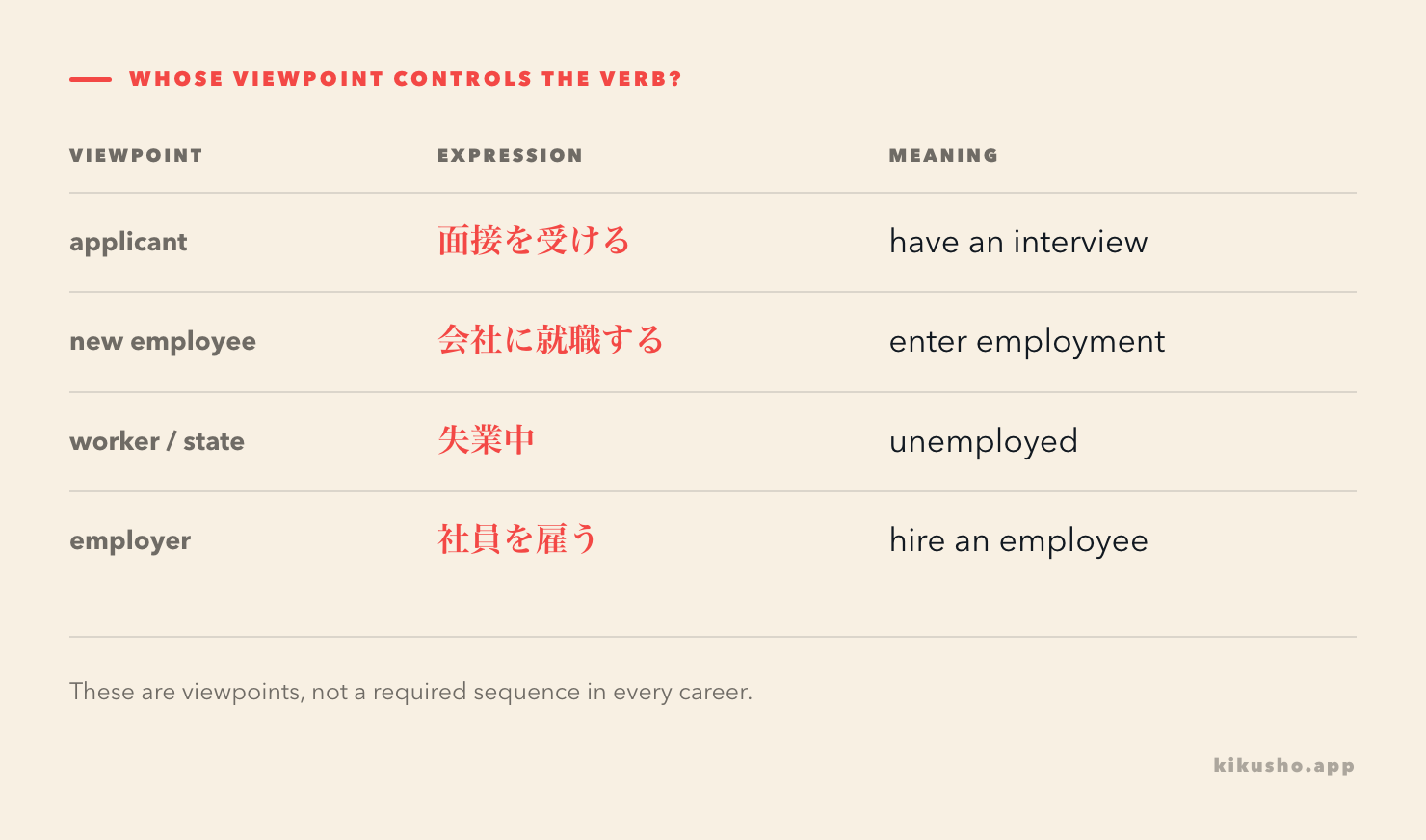
Four words belong to employment, but the subject is not always the same person. A candidate receives an interview and enters a company. An employer hires someone. 失業 describes the worker's loss of employment or resulting state.
| Viewpoint | Natural pattern | Meaning |
|---|---|---|
| applicant | 面接を受ける | have or sit an interview |
| new employee | 会社に就職する | obtain a position with a company |
| worker or job seeker | 失業する / 失業中 | lose one's job / be unemployed |
| employer | 社員を雇う | hire an employee |
来週、出版社の面接を受けます。
らいしゅう、しゅっぱんしゃの めんせつを うけます。
I have an interview with a publishing company next week.
卒業後、地元の会社に就職しました。
そつぎょうご、じもとの かいしゃに しゅうしょくしました。
After graduating, I found employment with a local company.
会社は経験のある人を二人雇いました。
かいしゃは けいけんの ある ひとを ふたり やといました。
The company hired two experienced people.
With 就職する, the destination takes に: 会社に就職する. With 雇う, the person hired takes を: 人を雇う. 雇う is a godan verb, so its useful forms include 雇います, 雇って and 雇わない.
職業 answers a broader question. It names the occupation someone regularly pursues, rather than one particular application or employer.
兄の職業は看護師です。
あにの しょくぎょうは かんごしです。
My older brother's occupation is nursing; he is a nurse.
The dictionary definition of 職業 centres on work pursued regularly for one's livelihood. A person can change companies while keeping the same 職業.
異動 changes an assignment; 支店 names the destination
異動 in workplace language is an official change in post, duties or location. It is not the ordinary word for moving an object or travelling across a room. Daijisen's entry specifically includes changes to a person's position or duties.
田中さんは四月に東京支店から大阪支店へ異動します。
たなかさんは しがつに とうきょうしてんから おおさかしてんへ いどうします。
Tanaka will transfer from the Tokyo branch to the Osaka branch in April.
移動 is the wider word for physical movement. 東京支店へ移動する can mean moving or travelling to the Tokyo branch. 東京支店へ異動する says the person's work assignment changes.
支店 is a branch office or store operating under a main office. The contrast is often 本店 or 本社, depending on whether the context is a store or a company headquarters. The dictionary entry defines 支店 through that relationship to the main establishment.
係 labels a role; 担当 assigns responsibility
係 often appears on a sign or after another noun. 受付係 is the reception role or the receptionist serving in that role; 案内係 is an information or guidance attendant. You can also ask 係の人, “the person in charge” or “the staff member responsible.”
担当 focuses on a particular area of responsibility. It works with する and often names the matter before を.
佐藤さんは予約の確認を担当しています。
さとうさんは よやくの かくにんを たんとうしています。
Sato is responsible for confirming reservations.
詳しくは担当者に聞いてください。
くわしくは たんとうしゃに きいてください。
For details, please ask the person responsible.
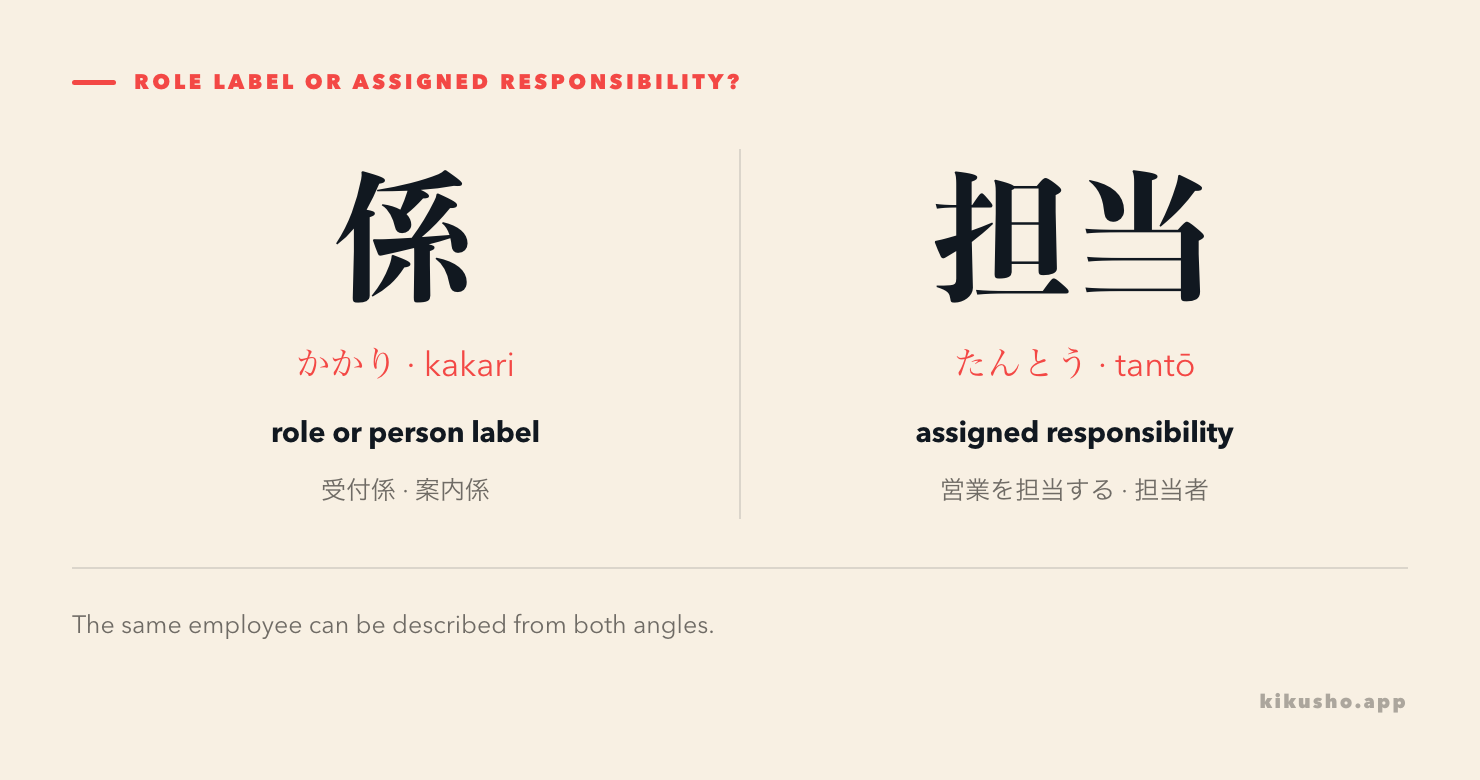
The words can refer to the same employee from different angles. At a hotel, someone may be 受付係 because that is the role on the desk and 予約確認を担当する人 because reservation checks are part of the person's assigned work. The Goo thesaurus comparison treats both as words for a role or person while noting the stronger assigned-responsibility sense of 担当.
管理 keeps an operation under control; 経営 runs the business
管理 covers control, upkeep and administration according to a purpose or standard. Its object is often something that must remain accurate, safe or usable:
- 在庫を管理する: manage inventory
- 建物を管理する: manage or maintain a building
- 品質を管理する: control quality
- 健康を管理する: manage one's health
経営 concerns running a business or organisation as a whole:
- 会社を経営する: run a company
- 店を経営する: operate a shop
- 学校を経営する: run a school
- 経営方針: management policy or business direction
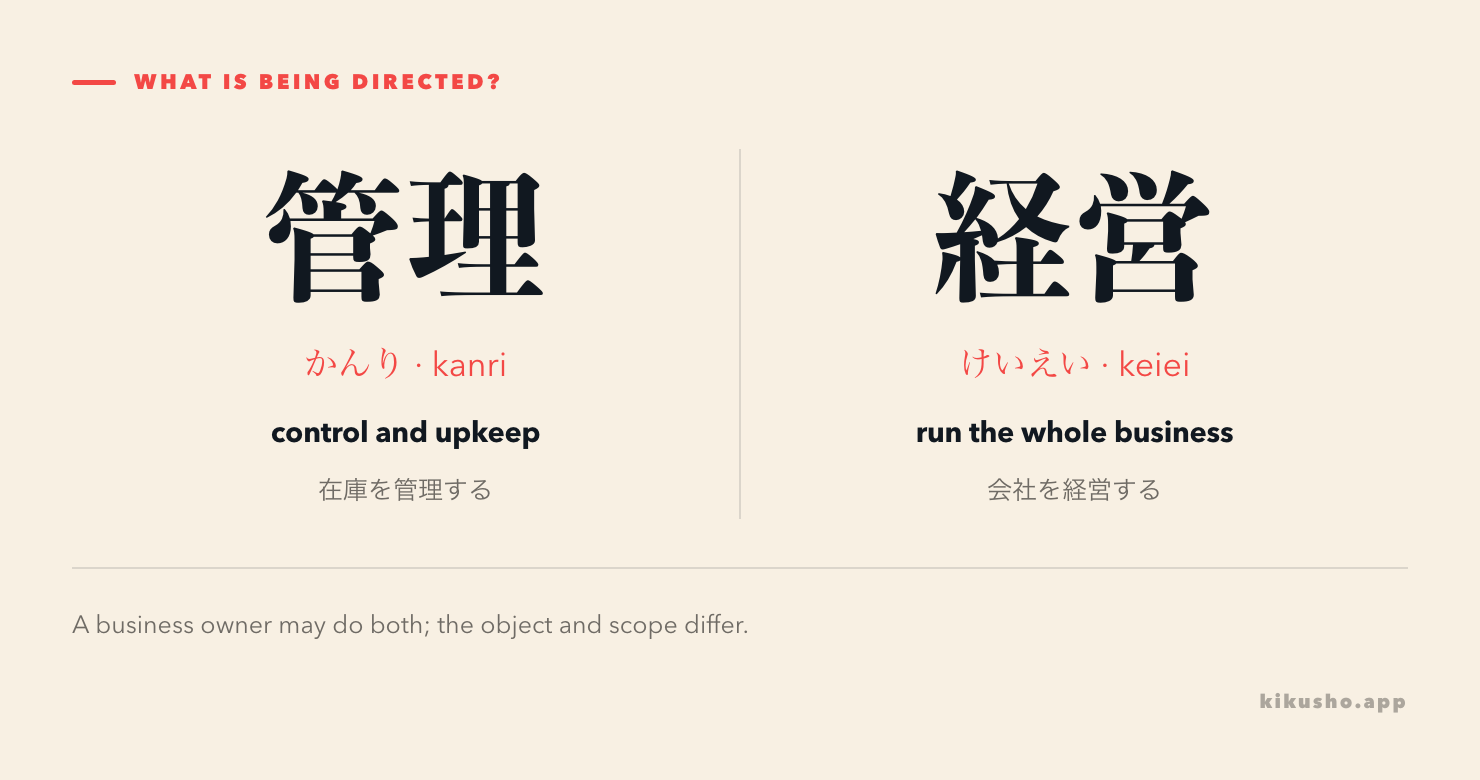
The distinction is one of scope, not rank. A shop owner may 店を経営する while also 在庫を管理する. Daijisen describes 管理 through control and maintenance for smooth operation; Britannica Japan's entry on 経営 centres it on making and carrying out decisions to achieve an organisation's aims.
労働 appears when work is measured or discussed as a system
仕事 is the ordinary broad word for a job, task or work. 労働 presents work as physical or intellectual effort, especially in economic, legal or institutional discussion. That is why it forms compounds used in workplace rules and news:
| Compound | Reading | Meaning |
|---|---|---|
| 労働時間 | ろうどうじかん | working hours |
| 労働条件 | ろうどうじょうけん | working conditions |
| 労働者 | ろうどうしゃ | worker; labourer |
| 肉体労働 | にくたいろうどう | physical labour |
この会社は労働時間を短くしました。
この かいしゃは ろうどうじかんを みじかくしました。
This company shortened its working hours.
As Daijisen explains, the term includes physical and intellectual effort directed toward production or income. It can sound needlessly formal for a small personal task: 部屋の掃除は今日の仕事です is more ordinary than calling the cleaning 労働.
One branch announcement puts the twelve words to work
Read the company announcement first:
来月、大阪支店を開きます。新しい支店では、在庫管理を田中さんが担当し、受付係は二人です。東京支店から三人が異動します。会社の経営を安定させるため、労働時間と労働条件も見直します。人事部は新しい社員を二人雇う予定で、来週面接を行います。
Next month, we will open the Osaka branch. At the new branch, Tanaka will be responsible for inventory management, and there will be two reception staff. Three employees will transfer from the Tokyo branch. To stabilise the running of the company, we will also review working hours and conditions. Human Resources plans to hire two new employees and will conduct interviews next week.
Now read the situation from an applicant's side:
山田さんの以前の職業は販売員でしたが、勤めていた店が閉まり、失業しました。来週面接を受け、採用されればこの会社に就職します。
Yamada previously worked as a salesperson, but the shop where they worked closed and they lost their job. They will have an interview next week and, if hired, will join this company.
The same event produces different verbs because the participants occupy different sides of it. The company 面接を行う and 人を雇う; Yamada 面接を受ける and 会社に就職する. For the formal language that may surround those exchanges, continue with Japanese politeness levels. The N3 news and business set adds words for reading reports about companies rather than describing the organisation inside one workplace.
Practice
1 · Reading. How is 異動 read in a personnel notice?
- A. いどうう
- B. いどう
- C. ことどう
- D. いど
2 · Orthography. Which word means an official personnel transfer rather than simple physical movement?
- A. 異動
- B. 移動
- C. 労働
- D. 就職
3 · Viewpoint. Complete the sentence from the company's perspective: 会社は新しい社員を二人( )。
- A. 就職しました
- B. 面接を受けました
- C. 雇いました
- D. 失業しました
4 · Usage. Which phrase naturally describes what a job applicant does?
- A. 面接を雇う
- B. 面接を受ける
- C. 面接に経営する
- D. 面接を失業する
5 · Context. A sign identifies the staff member working at reception. Which label fits?
- A. 受付係
- B. 受付経営
- C. 受付労働
- D. 受付支店
6 · Scope. Which sentence says that someone runs a restaurant as a business?
- A. レストランを異動する
- B. レストランを失業する
- C. レストランを経営する
- D. レストランに面接する
7 · Paraphrase. What does 田中さんの職業は教師です mean?
- A. Tanaka interviewed a teacher.
- B. Tanaka's occupation is teaching; Tanaka is a teacher.
- C. Tanaka manages a school building.
- D. Tanaka transferred to the teachers' branch.
8 · Meaning. Which description best matches 支店?
- A. A branch office or store under a main establishment
- B. A person responsible for one task
- C. The conditions under which employees work
- D. A period without employment
9 · Compound. What does 労働時間 refer to?
- A. The time of a job interview
- B. The date of a personnel transfer
- C. The age at which someone starts a career
- D. The hours a person works
10 · Connected text. Which statement agrees with the branch announcement?
- A. The Osaka branch will close next month.
- B. Tanaka will conduct every job interview.
- C. Three employees will transfer from the Tokyo branch.
- D. The company will hire three reception staff.
Decide all ten responses, then uncover the explanations.
Answers and explanations
Trace the grammatical viewpoint in each sentence before comparing your choices.
1 · B, いどう. 異動 is read いどう. In this context it refers to a change of post, duties or workplace.
2 · A, 異動. 異動 is the personnel word. 移動 is broader physical movement, while 労働 means labour and 就職 means entering employment.
3 · C, 雇いました. The company hires people: 社員を雇う. A person joins a company with 会社に就職する.
4 · B, 面接を受ける. The applicant receives or sits the interview. The employer can 面接を行う or interview a candidate.
5 · A, 受付係. 係 can label a role and the person serving in it. The other compounds do not name a receptionist.
6 · C, レストランを経営する. 経営する means to run a business or organisation. Managing its inventory would use 在庫を管理する.
7 · B. 職業 names a person's occupation. The sentence identifies teaching as Tanaka's occupation rather than describing one employer or task.
8 · A. 支店 is a branch office or branch store directed by a main establishment. It names a place in an organisation, not a role or employment condition.
9 · D, the hours a person works. 労働時間 is working time or working hours. 労働条件 is the related expression for working conditions.
10 · C. The notice says 東京支店から三人が異動します: three people will transfer from the Tokyo branch. It plans to hire two new employees, and the Osaka branch will open.
Common questions
What is the difference between 異動 and 移動?
異動 usually means an official change of post, duties or workplace when discussing personnel. 移動 is the broader word for physical movement from one place to another. 東京支店へ異動する therefore describes a transfer to the Tokyo branch, not merely travelling there.
What is the difference between 係 and 担当?
係 often labels a role or the person serving in it, as in 受付係. 担当 focuses on responsibility assigned to a matter, as in 営業を担当する, and 担当者 is the person responsible. Their uses overlap, but these sentence patterns keep the distinction practical.
What is the difference between 管理 and 経営?
管理 is controlling, maintaining or administering something so it works properly, such as inventory or a building. 経営 is running a business or organisation as a whole, including its direction and decisions.
Should a job applicant say 面接する or 面接を受ける?
A job applicant normally says 面接を受ける, to have or sit an interview. The company or interviewer can 面接する or 面接を行う, meaning to interview candidates or conduct the interview.