On this page
そっと, たっぷり, のんびり, ばったり and ぴったり are five N3 adverbs that describe how an action happens or how a thing sits: gently, in abundance, at an unhurried pace, all at once, or with an exact fit. None of them names a sound, and the skill worth building is not the English gloss but the verb each one keeps company with.
Why these five belong together
They are all 擬態語(ぎたいご, gitaigo): mimetic words that paint a manner or a state rather than imitate a noise. A barking dog is ワンワン, a real sound, and that belongs to the neighbouring class 擬音語(ぎおんご, giongo); NINJAL's onomatopoeia guide draws the line between the two. Nothing on this page makes a sound. そっと is the quality of a movement, たっぷり the size of an amount, のんびり the pace of an afternoon, ばったり the abruptness of an event, ぴったり the closeness of a fit.
Two habits tie the group together. Each is an adverb first, so it leans on a verb, and the verb is where the meaning settles: ばったり on its own says little, ばったり会う is a chance meeting. Most of them also accept an optional と before that verb, and that と is a register dial rather than a change of meaning, a little more deliberate with it and more colloquial without.
If you have met mimetic words a level below, the everyday onomatopoeia set follows six of them into ordinary sentences. The ones that build predicates with する, such as すっきり and にこにこ, wait a level up in the N2 mimetics lesson.
The five at a glance
| Word (reading) | The manner or state it names | A phrase to keep |
|---|---|---|
| そっと(そっと) | Softly, gently; also without being noticed | ドアをそっと閉める(close the door gently) |
| たっぷり(たっぷり) | Amply, in plenty; with room to spare | 時間がたっぷりある(have plenty of time) |
| のんびり(のんびり) | At an unhurried, relaxed pace | 家でのんびりする(take it easy at home) |
| ばったり(ばったり) | All at once: falling, meeting, or stopping | 友だちにばったり会う(run into a friend) |
| ぴったり(ぴったり) | With an exact fit or match; also abruptly stopping | サイズがぴったりだ(the size fits exactly) |
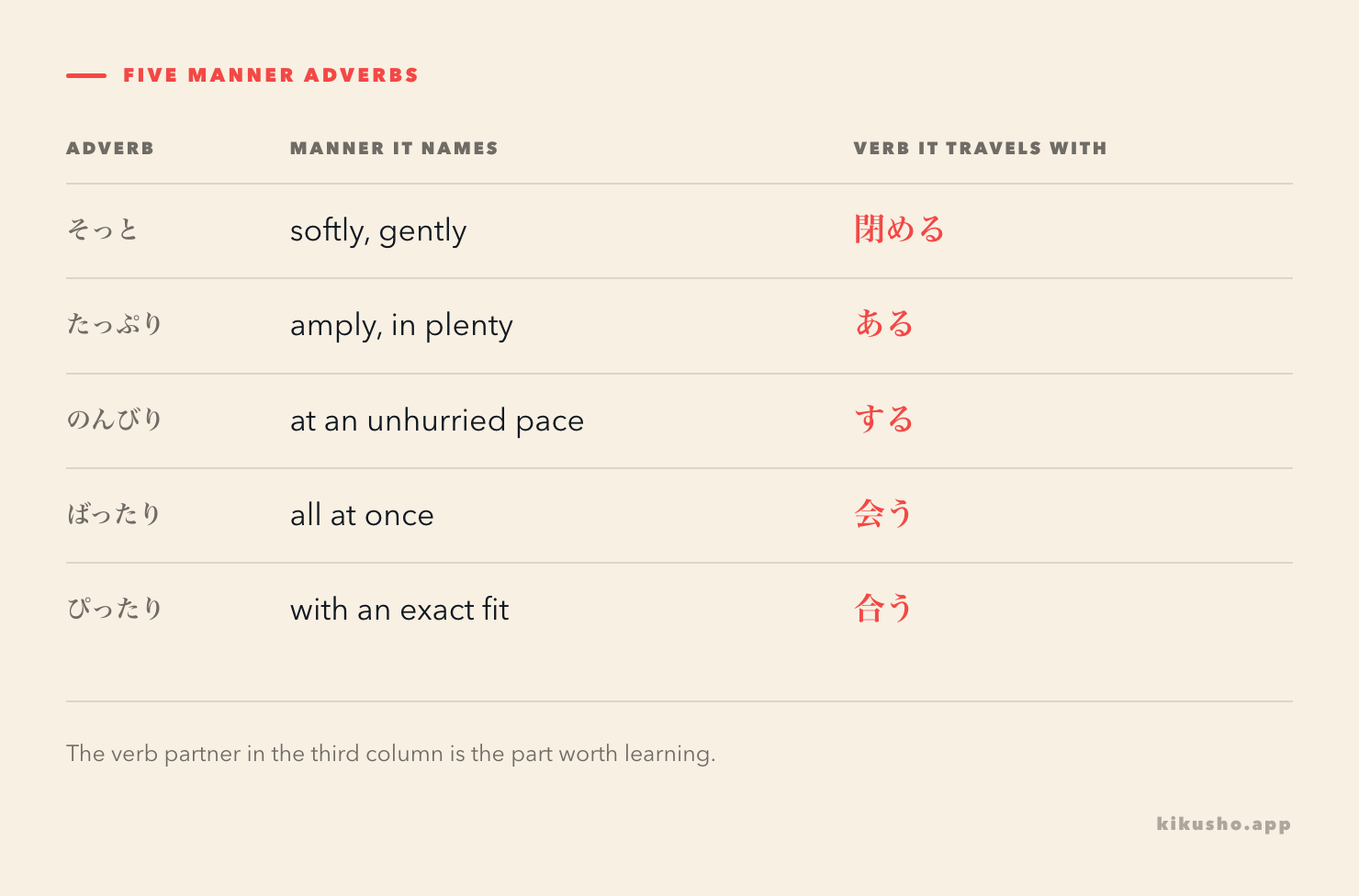
This curriculum files all five in N3 vocabulary, following the Waller and Tanos word lists it draws on. Those two lists are one source family, so their agreement is a single judgment, and other references disagree at the edges: Jisho tags そっと as N2. The current JLPT publishes no exhaustive vocabulary list, so read the level as a study placement, not a rule about where a word may appear.
そっと, たっぷり and のんびり each keep to one lane
Three of the five stay inside a single zone of meaning, which makes them the safe ones to learn first.
そっと: gently, and out of sight
そっと is the manner of doing something without disturbance, physical or social.
赤ちゃんが寝ているので、ドアをそっと閉めた。
あかちゃんが ねているので、ドアを そっと しめた。
The baby was sleeping, so I closed the door gently.
The same word covers doing something unnoticed:
彼女はそっと部屋を出て行った。
かのじょは そっと へやを でていった。
She slipped out of the room without a sound.
A fixed frame you will meet often is そっとしておく, to leave a person or thing alone: 今はそっとしておこう, let's leave them be for now. Daijisen lists exactly these senses, a gentle action, secrecy, and leaving alone, under the adverb そっと. The unrelated noun 率土 sits as a separate headword, which is why a stray gloss such as "ends of the earth" has nothing to do with the word you will actually hear.
たっぷり: more than enough, with room over
スープをたっぷり入れてください。
スープを たっぷり いれて ください。
Please put in plenty of soup.
たっぷり is abundance with a margin. It reaches from a quantity, 時間がたっぷりある (there is plenty of time), to a loose fit, たっぷりした服(ふく)(roomy clothes), to a full measure of something counted: 駅までたっぷり二十分(にじゅっぷん)かかる means it takes a good twenty minutes, twenty at the very least. Attached to a noun it turns into "brimming with": 自信たっぷり(じしんたっぷり)is full of confidence, 皮肉たっぷり(ひにくたっぷり)dripping with sarcasm.
のんびり: unhurried, and unworried
週末は家でのんびりしたい。
しゅうまつは いえで のんびり したい。
On the weekend I want to take it easy at home.
のんびり is a relaxed, unhurried pace, free of pressure. It readily takes する to become a predicate, のんびりする (to take it easy), and it describes a temperament as much as an afternoon: のんびりした性格(せいかく)is an easygoing character, and 温泉にのんびりつかる is to soak in a hot spring without hurry.
ばったり and ぴったり each carry three meanings
The other two are where learners come unstuck, because each one covers three situations that share only the feeling of something arriving all at once.
ばったり: three ways for something to happen abruptly
Daijisen gives ばったり three senses, and the verb tells you which one you are in.
- Falling: 疲れきってばったり倒れた(たおれた), collapsed with exhaustion.
- Meeting by chance: 駅で昔の友だちにばったり会った, ran into an old friend at the station.
- Ceasing: 客足(きゃくあし)がばったり途絶えた(とだえた), the flow of customers suddenly dried up.
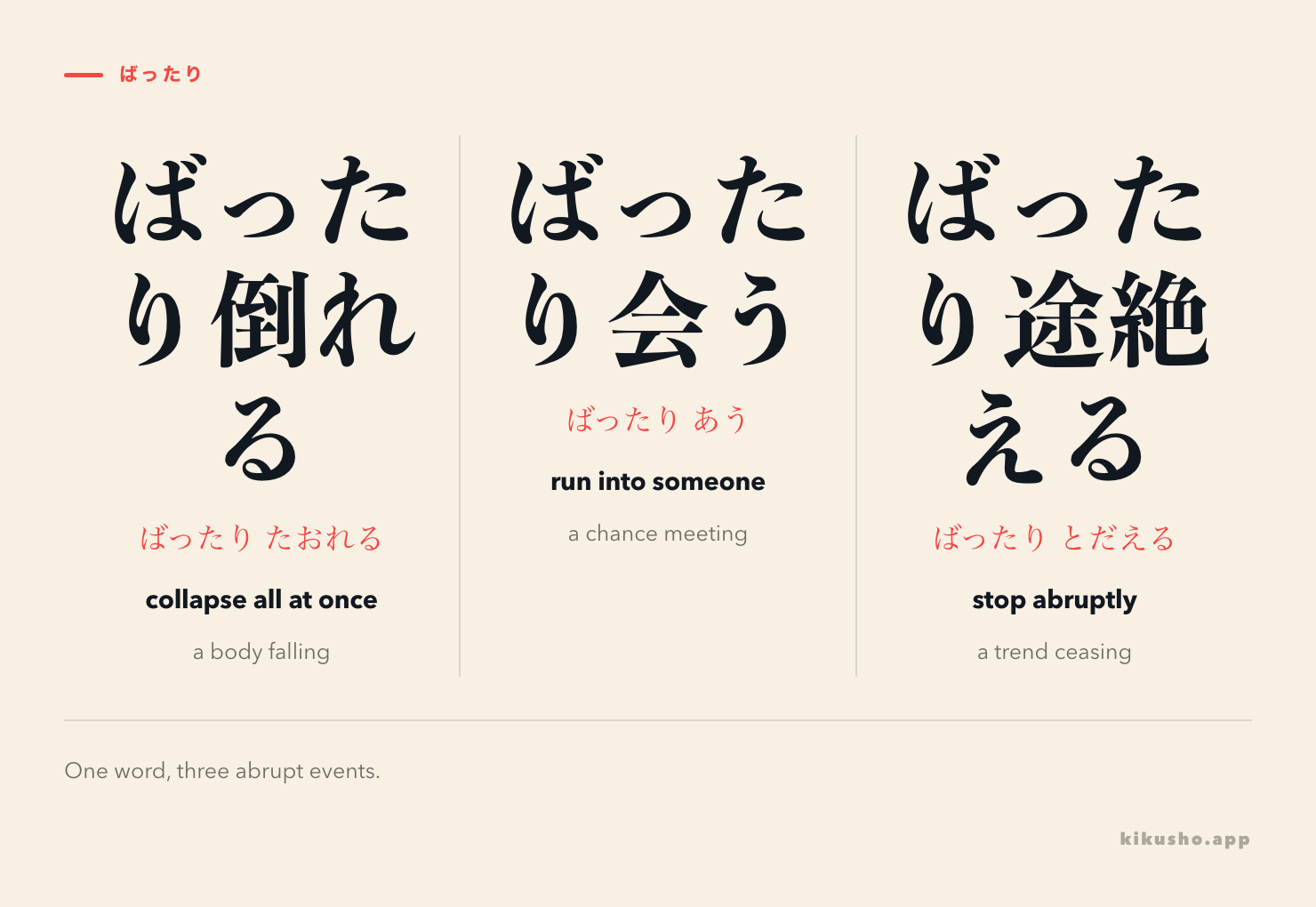
Of the three, ばったり会う is the one you will hear most, and the others are the same picture applied elsewhere: something coming to a hard stop, whether it is a body, an encounter, or a trend.
ぴったり: a fit, a match, or a full stop
- Closing with no gap: 窓(まど)をぴったり閉める, shut the window tight.
- Fitting or suiting exactly: この服は私にぴったりだ, these clothes fit me perfectly; 君にぴったりの仕事, a job that suits you exactly.
- Matching a number: ぴったり八時(はちじ)に着いた, arrived at eight o'clock exactly; 計算(けいさん)がぴったり合う, the sums come out exact.
- Stopping abruptly: 薬を飲んだら、痛み(いたみ)がぴったり止まった, after I took the medicine the pain stopped completely.
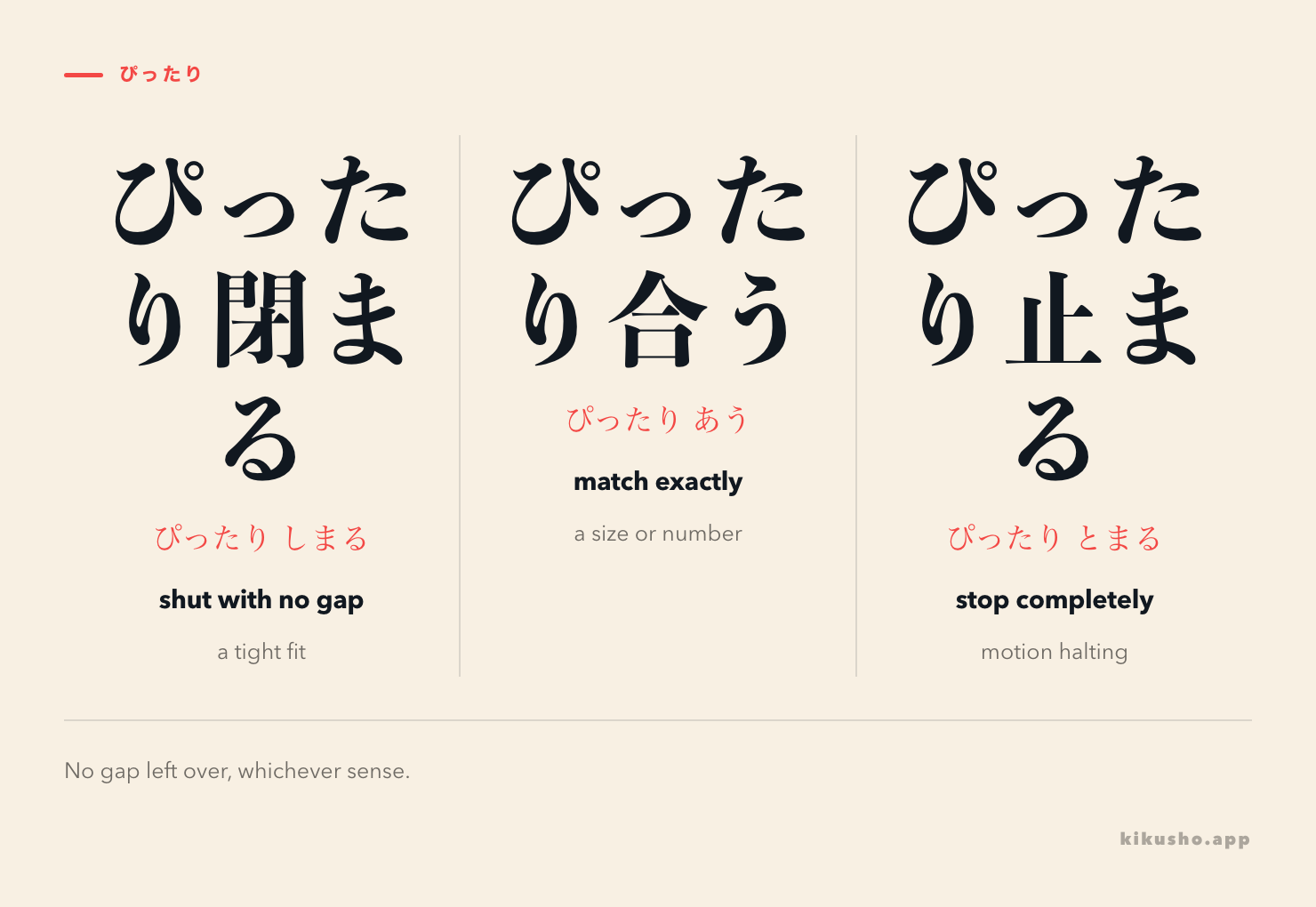
Unlike ばったり, ぴったり freely becomes a predicate: ぴったりだ, ぴったり合う, ぴったりの仕事. When someone hands you a jacket and says これ、ぴったり, they mean it fits.
Which ones you'll meet first
If you are learning these for use rather than for a checklist, three collocations earn their place at once: ばったり会う for chance meetings, ぴったり for anything that fits or matches, and たっぷり for generous amounts of food, sleep or time. のんびりする turns up whenever someone talks about a day off, and そっとしておく whenever someone is better left alone. These describe how an action is carried out; a separate N3 group, the adverbs that telegraph a sentence's ending such as かならずしも and まさか, works the other end of the clause.
The trap with a mimetic adverb is filing away the one-word gloss and dropping the verb that carried it, so そっと becomes "softly" with no sentence attached and ぴったり becomes "exactly" with nothing to fit. When one arrives in a line of manga or a scrap of overheard conversation, keep the whole phrase rather than the word. Kikusho drafts the card from the sentence you captured and reads it back in native audio, so ばったり会った returns as a chance meeting you can picture, not a definition you can no longer place.
Practice questions
Attempt all four before opening the answers.
1. Choose the adverb for the blank. 「駅で高校時代の友だちに( )会った。」 ① のんびり ② ばったり ③ たっぷり ④ そっと
2. Which sentence uses ぴったり in a natural, standard way? ① このドレスは私にぴったりだ。 ② 今日はぴったり疲れた。 ③ 昼にぴったりを食べた。 ④ 空がぴったり青い。
3. Closest in meaning. 「スープをたっぷり入れた。」 ① スープを少しだけ入れた。 ② スープを十分な量、入れた。 ③ スープをこぼした。 ④ スープを温めた。
4. Choose the adverb for the blank. 「子どもが寝ているので、( )ドアを閉めた。」 ① ばったり ② たっぷり ③ そっと ④ ぴったり
Answers and explanations
1. ② ばったり. ばったり会う is the set phrase for meeting someone unexpectedly, and 高校時代(こうこうじだい)means one's school days. ① のんびり (a relaxed pace), ③ たっぷり (an ample amount) and ④ そっと (gently) name manners that do not fit a chance encounter.
2. ①. 「このドレスは私にぴったりだ」says the dress fits me perfectly, and ぴったり readily becomes a predicate with だ. ② misuses it as a degree adverb with 疲れた, where Japanese says とても疲れた. ③ treats it as a food, which it is not. ④ puts it before an adjective, where 真っ青(まっさお)would carry "deep blue". Only ① draws on the fit-or-match sense.
3. ② スープを十分な量、入れた. たっぷり means amply or in plenty, and 十分な量(じゅうぶんな りょう), a sufficient amount, keeps that sense here. ① says only a little, the reverse. ③ (spilled it) and ④ (warmed it) add events the sentence never mentions. The match holds in this context; the two are not blanket synonyms.
4. ③ そっと. The goal is to avoid waking the child, so the door is closed gently and without noise, which is そっと. ④ ぴったり would describe closing it with no gap, a tight seal that says nothing about noise. ① ばったり (an abrupt fall or meeting) and ② たっぷり (an ample amount) do not describe how a door is closed.
Common questions
Are these five words actual sounds?
No. They are 擬態語 (gitaigo), mimetic words for a manner or a state, not 擬音語 (giongo) that imitate a noise. そっと is a gentle manner, たっぷり an ample amount, のんびり an unhurried pace, ばったり an abrupt event, ぴったり a close fit; none of them makes a sound.
Do I need the と, as in ばったりと会う?
With most of these the と is optional and does not change the meaning. Keeping it sounds a little more deliberate or literary; dropping it is more colloquial. ばったり会う and ばったりと会う are both correct.
Is そっと an N3 or an N2 word?
This curriculum places all five at N3, following its Waller and Tanos source lists. Some references, such as Jisho's level tags, mark そっと as N2. The JLPT publishes no official vocabulary list, so treat the level as a study placement rather than a boundary on use.
Can these adverbs take する or だ?
Some can. のんびり and ぴったり form predicates with する (のんびりする, ぴったりする), and ぴったり and たっぷり combine with だ or な (ぴったりだ, 自信たっぷりな). そっと and ばったり stay adverbs, though そっとしておく (to leave alone) is a fixed expression.