On this page
Nine N3 words carry the courtesy that N4 taught you to perform. Where 挨拶, お礼 and 謝る were the everyday acts — greeting someone, thanking them, saying sorry — these name the feelings and the codes beneath them: gratitude (感謝), thanks and the bow that gives it (礼), joy (喜び), the respect you hold for a person (尊敬) and the respect you pay them (敬意), good manners (礼儀), the correct way to do a thing (作法), and celebrating an occasion (祝う) with the celebration it leaves behind (祝い).
Most of them are Sino-Japanese nouns, and the useful question with a Sino-Japanese noun is always the same one: does it take する, or does it need a verb of its own? Two of these do — 感謝する, 尊敬する. The other three built the same way look identical and do not: you pay 敬意 rather than 敬意する it, and you are 礼儀正しい rather than 礼儀する. Getting that line right is most of what this set is for.
The nine words, and which ones take する
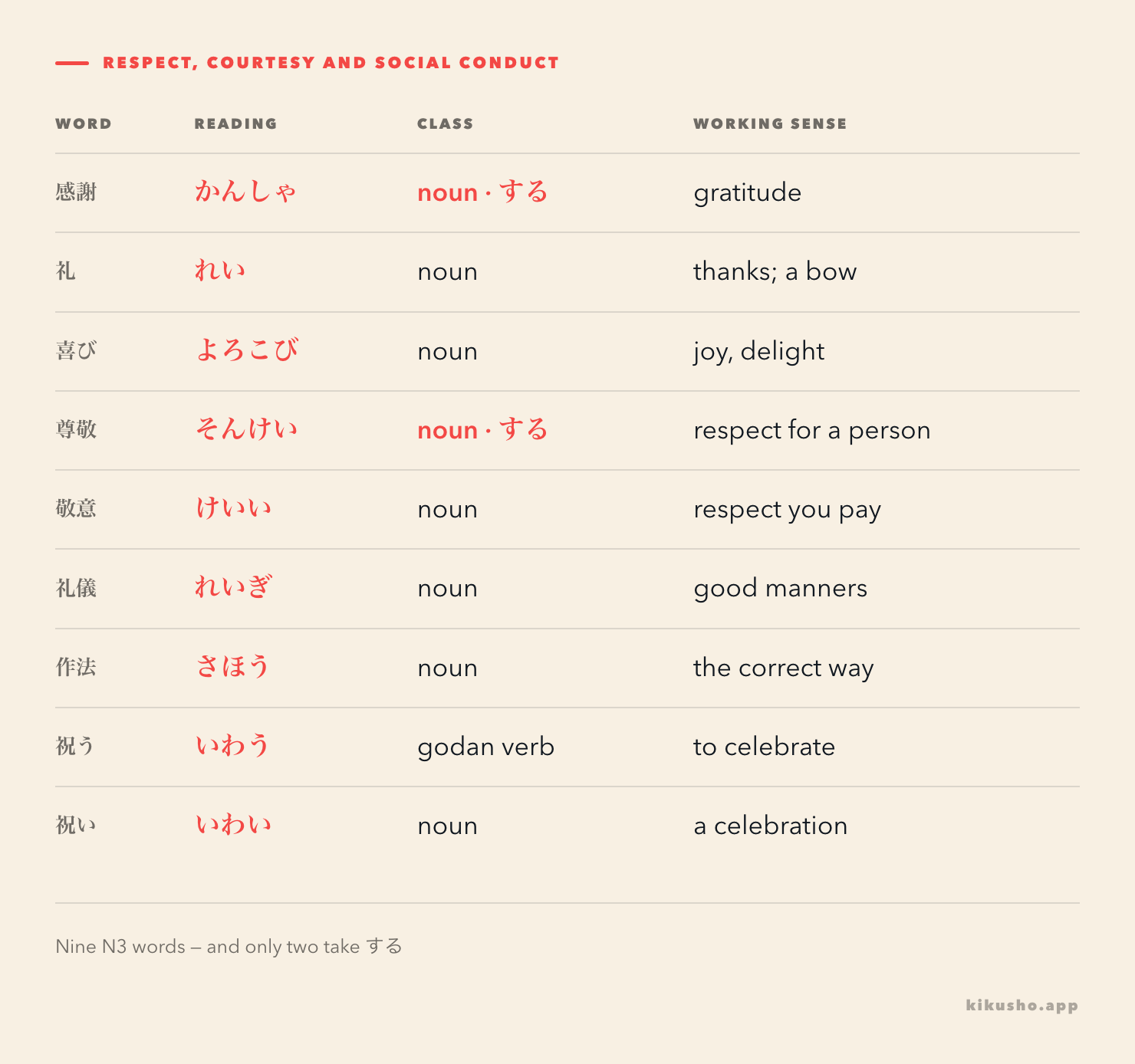
Seven of the nine are plain nouns. 祝う is a verb, and 感謝 and 尊敬 are nouns that double as する-verbs. The class is not a label to memorise and forget: it settles which particle a word takes and which ending you attach, and with near-synonyms this close that is often the only thing keeping two of them apart.
| Word | Reading | Class | What it does |
|---|---|---|---|
| 感謝 | かんしゃ | noun, する-verb | gratitude; to be grateful |
| 礼 | れい | noun | thanks; a bow; courtesy |
| 喜び | よろこび | noun | joy, delight |
| 尊敬 | そんけい | noun, する-verb | respect for a person; to look up to |
| 敬意 | けいい | noun | respect shown or paid to someone |
| 礼儀 | れいぎ | noun | (good) manners, courtesy |
| 作法 | さほう | noun | the correct way of doing something |
| 祝う | いわう | godan verb | to celebrate, to congratulate |
| 祝い | いわい | noun | a celebration; a congratulatory gift |
Five are on-reading kanji compounds (感謝, 尊敬, 敬意, 礼儀, 作法); the rest are native words, 喜び and 祝い drawn straight from the verbs 喜ぶ and 祝う, and 礼 standing alone as a single character.
感謝, 礼 and 喜び: gratitude, thanks, and joy
感謝 is gratitude as a felt stance, warmer and more formal than a quick ありがとう. As a する-verb it takes the situation you are grateful for: 助けてくれて感謝しています. As a noun it heads 感謝の気持ち, feelings of gratitude, and 感謝の言葉, words of thanks; 感謝祭 is the name for Thanksgiving. It is the word you use when you mean the gratitude, not just the phrase.
礼 is thanks turned into an act. お礼を言う and plain 礼を言う are to say thank you, while お礼 alone often refers to the thank-you present itself, the thing you hand back for a kindness. But 礼 also names the bow itself: 礼をする is to bow, and a class or a judo match opens and closes with a 礼. The same character sits inside 礼儀 below, and it is 礼 lost, 失礼, that gives the everyday word for rudeness in the N4 courtesy set.
喜び is joy, the noun from 喜ぶ, to be glad. 合格の喜び is the joy of passing an exam; 喜びの声 is a cry of delight. Its formal written cousin 慶び carries congratulations in set phrases, and お喜び申し上げます is the very formal "I offer my congratulations"; that ceremonial register is where the N2 courtesy words pick the thread up.
尊敬 and 敬意: the respect you feel, and the respect you pay
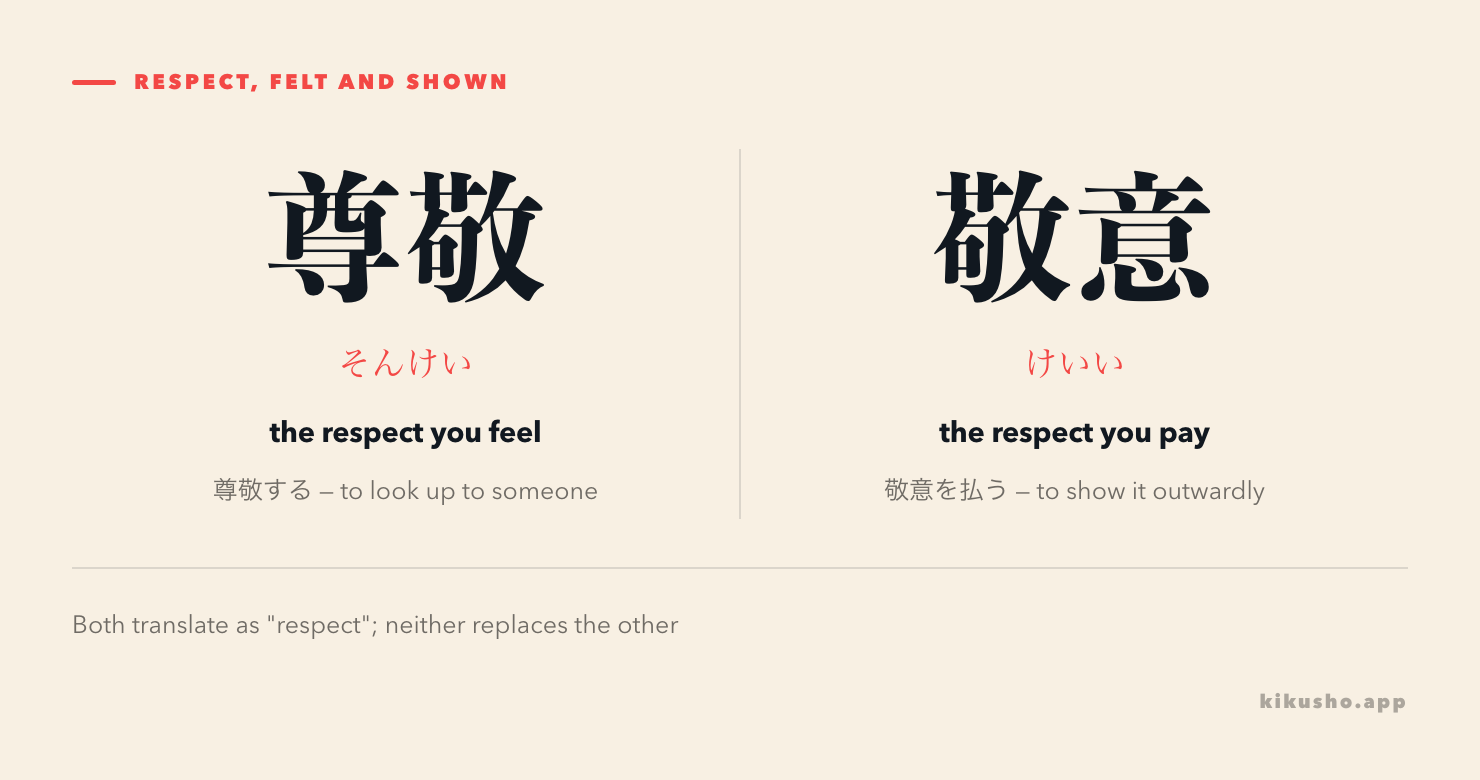
This is the pair worth slowing down for, because both translate as "respect" and neither can stand in for the other. 尊敬 is respect as an inner feeling: you look up to someone. It is a する-verb and takes its object with を — 私は祖父を心から尊敬している, I deeply respect my grandfather — and it gives Japanese the name for honorific language, 尊敬語, the keigo that lifts the other person up.
敬意 is that respect made outward and visible. You do not 敬意する; you pay it. 敬意を払う, and the more formal 敬意を表する, are how respect is shown: a bow, a form of address, standing when someone enters. 目上の人に敬意を払う, you show respect to those above you. So 尊敬 lives inside you and 敬意 is what it looks like from across the room, which is why one conjugates with する and the other waits for 払う.
礼儀 and 作法: being courteous, and doing it right
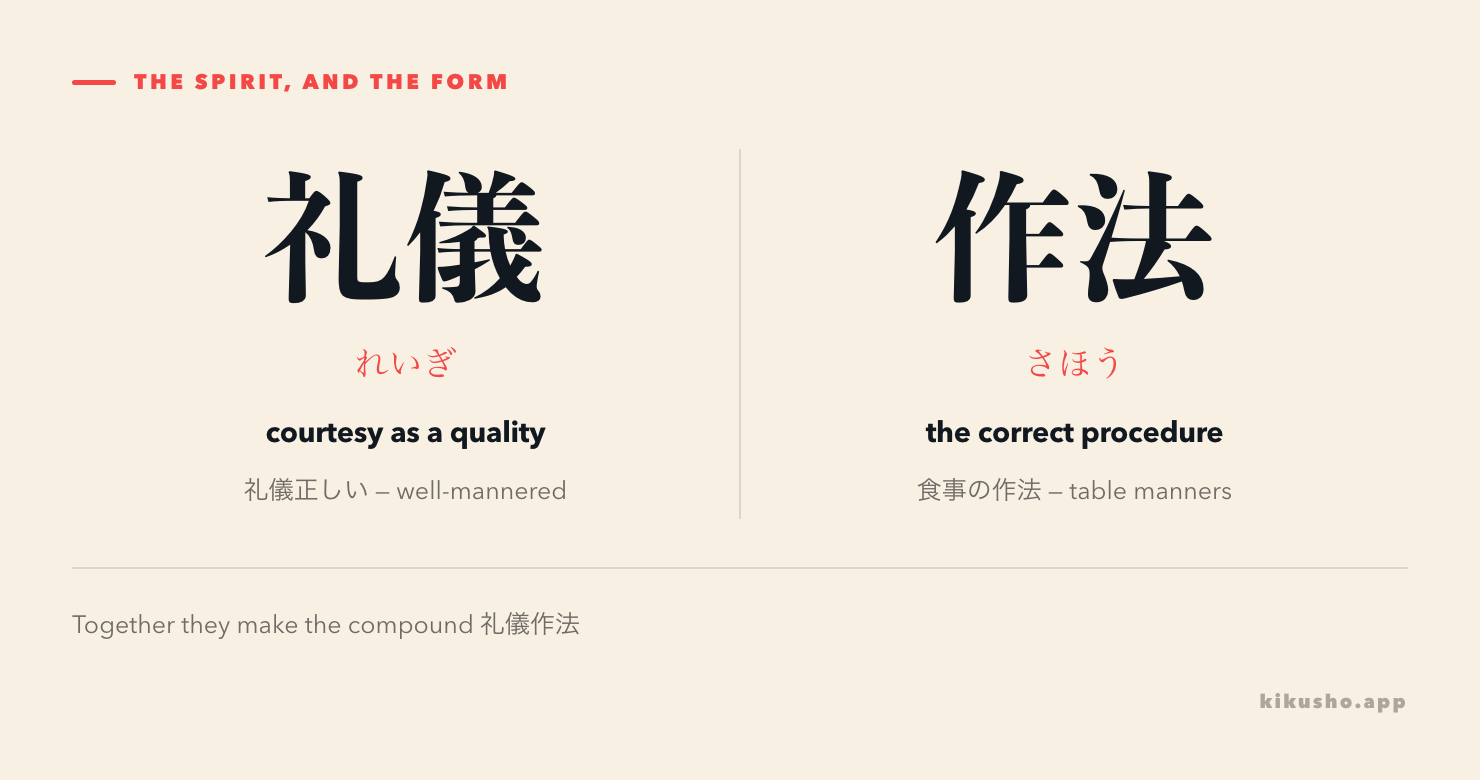
礼儀 is courtesy as a quality of a person. 礼儀正しい, literally correct in courtesy, is how you praise someone's conduct, and 礼儀を知らない, or the blunter 礼儀知らず, is the charge against someone who lacks it. It is about attitude: meeting people with the consideration a situation asks of you.
作法 is narrower and more physical: the prescribed, correct way of doing one particular thing. 食事の作法 is table manners, 箸の作法 is how you are meant to handle chopsticks, and 茶道には細かい作法がある, the tea ceremony has detailed procedures. Where 礼儀 is the spirit, 作法 is the choreography, and the two lock into the fixed compound 礼儀作法, manners and etiquette taken as a single idea.
祝う and 祝い: to celebrate, and the celebration
祝う is the verb: to celebrate or congratulate. What you celebrate takes を — 誕生日を祝う, 合格を祝う, 新年を祝う. 祝い, and far more often お祝い, is the noun beside it: the celebration itself, or the congratulatory gift you bring to one. 合格のお祝いにみんなで食事に行った, we all went out to eat to celebrate the pass; 出産祝い is a new-baby gift. This split of a native verb from its noun is the same shape as 喜ぶ and 喜び, and it is the plain, homegrown counterweight to the formal compounds 感謝 and 尊敬.
Where the set breaks its own pattern
The nine follow one rule, and the rule has three exceptions worth naming.
- Only 感謝 and 尊敬 take する. The other Sino-Japanese nouns look as though they should and do not. You pay 敬意, you observe 礼儀 and 作法. Reaching for 敬意する or 礼儀する is the exact mistake this set exists to head off.
- 礼 carries the most senses of any word here. Thanks, a bow, and courtesy all live in the one character, so 礼をする is to bow while 礼を言う is to thank. The verb, not the noun, tells you which 礼 is meant.
- 喜び and 祝い are the native pair among compounds. They come straight from verbs and behave like ordinary nouns, which is why neither needs — or accepts — する. When you want the action, you use 喜ぶ and 祝う instead.
Which of the nine you will meet first
None of these waits politely in a column for you. 感謝 and お礼 reach you the first time someone goes out of their way to help; 敬意 and 尊敬語 the first time you notice a colleague speaking differently to the section chief than to you; 作法 the first time a meal turns out to have rules you did not know; 祝い the first time you are asked to celebrate something with a Japanese family. Each arrives welded to a moment, one at a time.
That spread is the case against learning them from a list, and the case for catching each where it lands. Kikusho is built for exactly that catch: when お祝いの言葉 scrolls past in a message, or a poster asks for a 礼儀 you cannot quite parse, or you hear 尊敬している and want to keep it, you point the phone at the text or say the line out loud, and a card comes back with the reading, the sense and a note on register already filled in, for you to check before you save it. The reviews that follow run on FSRS with no signal needed, which suits a courtesy word you met once at a ceremony and will not need again until months later.
Learn the nine as four moves rather than nine entries — to thank, to respect, to mind your manners, to celebrate — and the exam question stops being "what does this word mean" and becomes "which of the two near-twins does this sentence want", which is the far more useful thing to be able to answer at speed.
Practice: readings, meaning in context and paraphrase
Try all six before you open the answers.
1 · Read the respect word. Give the reading of the bold word: 目上の人には敬意を払うべきだ。
- ① けいい
- ② きょうい
- ③ けいけん
- ④ こうい
2 · Spell the feeling. Which kanji writes そんけい, to respect or look up to someone?
- ① 尊敬
- ② 尊警
- ③ 導敬
- ④ 尊敏
3 · The grateful reply. Choose the word that fits: 助けていただいて、心から( )しています。
- ① 感謝
- ② 尊敬
- ③ 敬意
- ④ 作法
4 · Using 敬意. In which sentence is 敬意 used naturally?
- ① 先生の仕事に敬意を払う。
- ② 彼は毎日敬意する。
- ③ とても敬意な人ですね。
- ④ 朝ごはんに敬意を食べた。
5 · A courteous person. Which of these sits nearest the bold word in meaning? 彼女はとても礼儀正しい。
- ① マナーがよい
- ② 頭がいい
- ③ 元気だ
- ④ 正直だ
6 · The celebration. Choose the word that fits: 友達の合格を( )ために、パーティーを開いた。
- ① 祝う
- ② 感謝する
- ③ 尊敬する
- ④ 謝る
Answers and explanations
①, けいい. Both kanji take an on-reading here: 敬 is けい and 意 is い, so 敬意 comes out けいい. ② きょうい belongs to 脅威 or 驚異, not this word; ③ けいけん borrows the 験 of 経験, experience; ④ こうい is a different word entirely, the reading of 好意 (goodwill) or 行為 (an act).
①, 尊敬. そんけい is written 尊敬, esteem plus reverence. ② 尊警, ③ 導敬 and ④ 尊敏 each swap one character for a similar-looking one that does not form the word: 警 is the 警 of 警察 (police), 導 is to guide, and 敏 is quick or sharp.
①, 感謝. Someone helped you, so you are grateful: 感謝しています. ② 尊敬している would say you respect them, which does not answer being helped; ③ 敬意 is not a する-verb, so 敬意しています is ungrammatical; ④ 作法 (manners) is not a feeling you can direct at a person this way.
①, 先生の仕事に敬意を払う。 敬意 pairs with 払う to mean showing respect. ② 敬意する treats it as a する-verb, which it is not; ③ 敬意な attaches it like a な-adjective, which it also is not; ④ 敬意を食べる is nonsense, since respect is not eaten.
①, マナーがよい. 礼儀正しい means well-mannered, so "has good manners" is closest. ② 頭がいい (clever), ③ 元気だ (energetic) and ④ 正直だ (honest) each praise a different quality and miss the courtesy 礼儀 names.
①, 祝う. You throw a party to celebrate a friend passing, so 合格を祝う fits. ② 感謝する (be grateful) and ③ 尊敬する (respect) do not match celebrating an event, and ④ 謝る (apologise) is the opposite of the occasion.
Once the nine feel automatic, the words stop being the hard part and the choices between them become the skill. The same respect that lives in 尊敬 and 敬意 lives in the grammar of Japanese politeness levels, where 尊敬語 stops being a vocabulary item and becomes a set of verb forms you produce on the spot.
Common questions
What is the difference between 尊敬 and 敬意?
尊敬 (そんけい) is respect as an inner feeling: you look up to someone, and it is a する-verb, so 父を尊敬する means to respect your father. 敬意 (けいい) is that respect made visible, and it is not a する-verb: you pay it, 敬意を払う, or express it, 敬意を表する. 尊敬 is what you feel; 敬意 is what it looks like.
Is 感謝 a する-verb?
Yes. 感謝 (かんしゃ) works both as a noun, in 感謝の気持ち (feelings of gratitude), and as a する-verb: 助けてくれて感謝しています, I am grateful you helped me. Among these nine words only 感謝 and 尊敬 take する; 敬意, 礼儀 and 作法 look similar but do not.
What is the difference between 礼儀 and 作法?
礼儀 (れいぎ) is courtesy as a quality of a person: 礼儀正しい means well-mannered. 作法 (さほう) is the prescribed correct way of doing a specific thing, as in 食事の作法, table manners, or 箸の作法, how to handle chopsticks. 礼儀 is the spirit, 作法 is the form, and 礼儀作法 joins the two into one word.
How is 作法 read?
In the sense of manners and etiquette it is read さほう. The literal on-reading さくほう exists for the separate meaning "way of making" (of prose or a craft), so for courtesy it is always さほう, with the く of 作 elided.