On this page
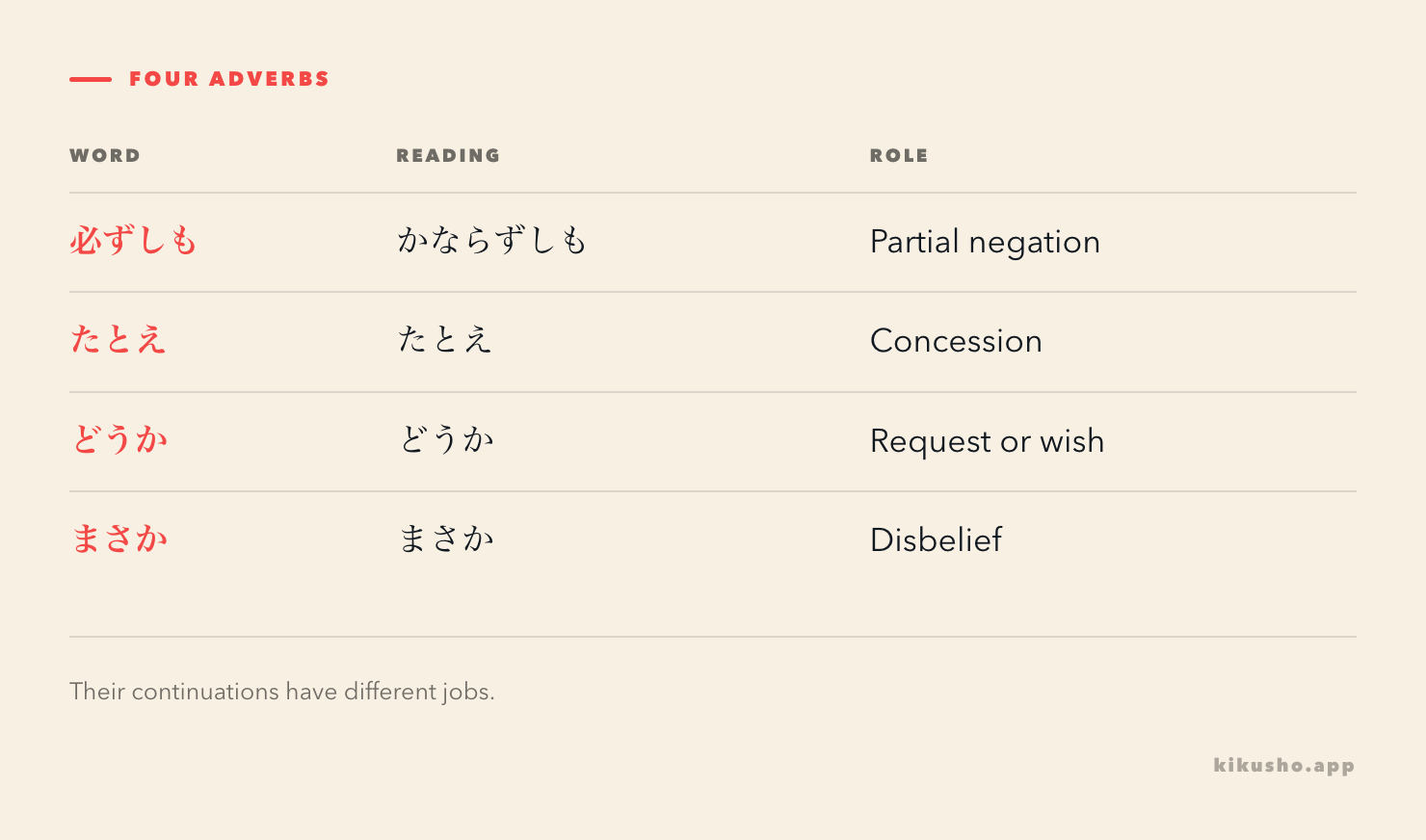
必ずしも goes with a negative expression for “not necessarily”; たとえ sets up “even if,” often with ても or でも. どうか strengthens a request or wish, while まさか expresses disbelief or surprise: these four Japanese adverbs suggest different continuations, and they do not all require a negative verb.
Four words, four relationships to the ending
The following are the adverb uses taught here. The dictionary entries distinguish them from other senses that happen to share a reading.
| Word | Reading | Selected meaning | A useful combination |
|---|---|---|---|
| 必ずしも | かならずしも | Not necessarily; not always | 必ずしも〜とは限らない |
| たとえ | たとえ | Even if | たとえ〜ても/〜でも |
| どうか | どうか | An earnest “please”; introducing a wish | どうか〜てください/〜ますように |
| まさか | まさか | Disbelief or surprise at something unexpected | まさか〜とは思わなかった; まさか! |
必ずしも qualifies a generalisation
高い商品が必ずしも良いとは限らない。
“Expensive products are not necessarily good.”
Price does not guarantee quality. The sentence does not say that every expensive product is bad, nor does it identify which products are good. Here 商品(しょうひん) means a product or goods, as in the business and news vocabulary set.
In its usual modern use, 必ずしも accompanies negation. The negation can sit in a longer expression such as 〜わけではない or 〜とは限らない, rather than directly on the verb nearest the adverb. It can also be a negative adjective or nominal predicate: 必ずしも便利ではありません means “It is not necessarily convenient.” Meshclass's grammar explanation includes this distinction between a general claim and what is necessarily true.
Read the whole ending before translating. Reducing 必ずしも to “never” turns a qualification into a complete denial.
たとえ grants a condition without changing the result
たとえ電車が遅れても、会議は九時に始まります。
“Even if the train is late, the meeting starts at nine.”
This invented meeting notice keeps the start time fixed despite the possible delay. It does not assert that the train will be late. The second clause can be affirmative, as it is here; たとえ does not require a negative conclusion.
The たとえ〜ても/〜でも pattern accepts several kinds of predicate:
| Predicate | Concessive form | Example after たとえ |
|---|---|---|
| Verb | て-form + も | 電車が遅れても: even if the train is late |
| い-adjective | Replace final い with くても | 高くても: even if it is expensive |
| な-adjective | Adjective stem + でも | 不便でも: even if it is inconvenient |
| Noun | Noun + でも | 日曜日でも: even if it is Sunday |
たとえ日曜日でも、この店は開いています。
“Even if it is Sunday, this shop is open.”
The concession includes Sunday among the circumstances under which the shop remains open. In たとえ高くても、買います (“Even if it is expensive, I will buy it”), expense likewise does not change the decision. Keep the word with both clauses when studying it.
どうか makes a request or wish earnest
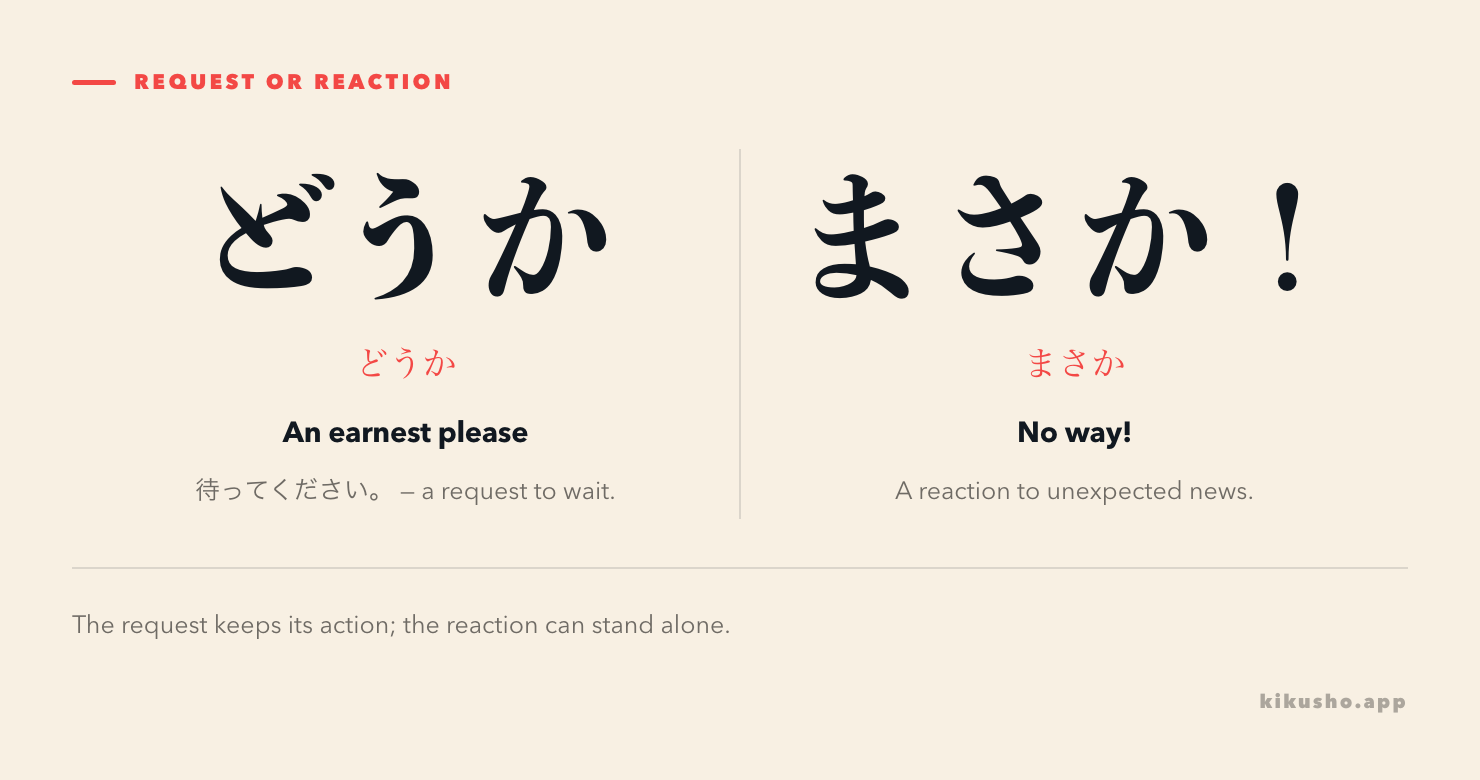
どうか、少し待ってください。
“Please wait a little.”
どうか adds a sincere appeal to the request. The action here is affirmative. In どうか、このことは誰にも言わないでください (“Please do not tell anyone about this”), the negative belongs to the request not to tell: it is not a polarity imposed by どうか. Meshclass's どうか lesson also gives requests and wishes as its uses.
For a private wish about your own exam, you could say どうか、試験に合格しますように: “May I pass the exam.” That is a hope, not a request directed at someone who can obey it. The ending tells you which speech act you are hearing. どうか is an earnest appeal; it is not a replacement for every routine “please” or invitation.
Two other strings need separating. どうかしたの? asks “Is something wrong?” In 本当かどうか, the かどうか construction means “whether it is true or not.” Neither is the request or wish selected for this set.
There is also a separate noun, 銅貨(どうか), meaning a copper coin. Its reading matches the adverb, but “copper coin” is not a meaning of the earnest “please” used above.
まさか expresses disbelief, including on its own
A task has finished much sooner than you expected:
まさか、こんなに早く終わるとは思わなかった。
“I never expected it to end this early.”
The task did end early. What is negative is 思わなかった, “I did not think”: the speaker had not expected that outcome. A negative ending beside まさか does not automatically deny the event itself. Meshclass's vocabulary entry illustrates the same unexpectedness, while the dictionary records the standalone reaction too.
まさか! can be a complete response: “No way!” or “You can't be serious!” It conveys disbelief or astonishment. It does not by itself settle whether the other person's news is true.
If you hear that reaction in conversation, say the phrase into Kikusho's voice capture and inspect the draft card before saving it. Keep the surprising situation in the editable example; a gloss of “by no means” alone would lose the role of a standalone まさか!. Saving the sentence with a word is useful here because negated expectations, requests and reactions can disappear when the surrounding speech is stripped away.
Treat N3 as a study placement
The curriculum's source lists place these four spelling-and-reading records at N3. Those lists share an underlying source, so agreement between them is not independent confirmation of every sense. The linguistic explanations above compare Shogakukan's dictionaries, displayed on Kotobank, with Meshclass's separately authored lessons.
There is a visible placement disagreement for 必ずしも: Meshclass labels its vocabulary entry N2 and its linked grammar lesson N3. Its vocabulary pages place たとえ, どうか and まさか at N3. These are teaching estimates, not an exhaustive official JLPT syllabus.
Start with negative predicates and the て-form. This page uses request and wish endings to make the adverbs' meanings clear; it does not replace a full lesson on each construction or cover every historical and noun sense in the dictionaries.
Practice
These eight questions are original practice. All solutions follow the last question.
Question 1
Which pronunciation matches the printed adverb 必ずしも?
A. かならしも
B. かならずも
C. かならずしも
D. ひつずしも
Question 2
Choose the usual spelling of かならずしも.
A. 心ずしも
B. 必ずしも
C. 泌ずしも
D. 秘ずしも
Question 3
Choose the adverb that makes this an earnest request to wait.
( )、少し待ってください。
A. まさか
B. たとえ
C. 必ずしも
D. どうか
Question 4
Choose the closest meaning of 高い商品が必ずしも良いとは限らない.
A. Expensive products are not necessarily good.
B. Every expensive product is bad.
C. Every expensive product is good.
D. There are no expensive products.
Question 5
Choose the closest meaning of たとえ電車が遅れても、会議は九時に始まります.
A. The meeting starts at nine only if the train is late.
B. The train will certainly be late for the meeting.
C. The meeting starts at nine even if the train is late.
D. The meeting is cancelled if the train is on time.
Question 6
You learn that a task has already finished much earlier than you expected. Someone says まさか! in response. What does the reaction express?
A. An instruction to finish the task.
B. Proof that the report is false.
C. A routine acknowledgement without surprise.
D. Disbelief or astonishment at the news.
Question 7
Which sentence expresses a sincere wish about passing your own exam?
A. どうか、ここで待ってください。
B. どうか、試験に合格しますように。
C. どうかしたのですか。
D. 明日参加するかどうかは、まだ決めていません。
Question 8
The task has already ended early. Which sentence says this was unexpected?
A. まさか、こんなに早く終わるとは思わなかった。
B. どうか、早く終わりますように。
C. たとえ早く終わっても、ここで待ちます。
D. 早く終わるとは必ずしも言えません。
Before continuing, put eight chosen letters beside their question numbers.
Answers and explanations
Answer 1. C. The reading is かならずしも. A omits ず; B omits し. D substitutes ひつ for the かなら portion of the reading used here.
Answer 2. B. 必ずしも is the usual spelling. 心, 泌 and 秘 are different characters; none gives this adverb's standard spelling.
Answer 3. D. どうか adds the earnest appeal. 必ずしも would need a qualifying negative expression, たとえ a conceded condition, and まさか would express disbelief rather than the requested appeal to the listener.
Answer 4. A. 必ずしも〜とは限らない removes the guarantee that expensive means good. B denies quality in every case, C asserts the guarantee, and D makes a claim about whether expensive products exist.
Answer 5. C. The conceded condition is the train's possible delay; the stated meeting time remains nine. A makes delay a necessary condition. B mistakes a hypothetical condition for a prediction. D adds a cancellation rule that the sentence never states.
Answer 6. D. まさか! reacts to the unexpected news. It is not an instruction, and disbelief is not proof of falsehood. C loses the surprise carried by the reaction.
Answer 7. B. どうか〜ますように introduces the wish here. A asks someone to wait; C asks whether something is wrong. D says “I have not yet decided whether to participate tomorrow,” using かどうか for “whether or not,” rather than the request/wish adverb.
Answer 8. A. 思わなかった denies the earlier expectation, not the early completion that has happened. B wishes for an outcome; C says the speaker will wait even if it happens; D says an early finish cannot necessarily be asserted. Those are different meanings, not three ungrammatical sentences.
Common questions
Do these four Japanese adverbs all require a negative verb?
No. In its usual modern use, 必ずしも accompanies a negative expression to qualify a generalisation. たとえ introduces a concession, often with ても or でも. どうか strengthens a request or wish. まさか expresses disbelief or surprise and can also stand alone as a reaction.
Does 必ずしも mean that something is never true?
No. 必ずしも〜とは限らない means that the claim is not necessarily true; it removes a guarantee rather than denying every possible case.
Can I say まさか without adding a sentence?
Yes. As a standalone reaction, まさか! expresses disbelief or surprise, roughly "No way!" It does not by itself prove that the news is false.