On this page
Japanese onomatopoeia belongs in ordinary sentences: しっかり持つ asks for a firm hold, はっきり話す describes clear speech, and びっくりする expresses surprise. Many of these words describe how something happens or feels, even when there is no sound to imitate.
A small set you can use outside manga
The broad term onomatopoeia includes sound imitation and mimetic expressions for states, movements and feelings. You do not need a comic-book explosion to use one. If you first meet them in dialogue, the guide to starting manga explains how the scene can help you follow an unfamiliar line. A study of everyday conversation published in Japanese Language Education Methods explicitly includes both imitative and mimetic vocabulary in its scope.
This N4 vocabulary lesson teaches six assigned words: しっかり, すっかり, すっと, どんどん, はっきり and びっくり. N4 is their placement in this curriculum's reference inventory. Its Waller/Tanos-derived lists share an origin, so two matching list records are not two independent level judgments. Chika Sensei's N4 comparison also teaches the distinction between すっかり and similar adverbs. These references guide study; they do not establish an exhaustive official JLPT syllabus.
The six belong together because you need to learn the expression and its partner, not just a vivid English gloss. Some modify another verb. Some also form a predicate with する. Similar spelling does not decide the construction for you.
Six meanings, with a phrase attached
| Word and reading | Core use | Part of speech or construction | Phrase worth retaining |
|---|---|---|---|
| しっかり | Firmly; securely; reliably; thoroughly | Adverb; also しっかりする | かばんをしっかり持つ: hold the bag firmly |
| すっかり | Completely; entirely | Adverb | 景色がすっかり変わる: the scenery changes completely |
| すっと | Swiftly and smoothly; straight; feeling cleared or refreshed | Adverb; also すっとする | すっと立つ: stand up smoothly |
| どんどん | Rapidly, one after another; without hesitation; repeated pounding | Adverb | 雨がどんどん強くなる: the rain gets heavier and heavier |
| はっきり | Clearly; distinctly; definitely | Adverb; also はっきりする | 名前をはっきり言う: say the name clearly |
| びっくり | Surprise or a startle | Often forms the verb びっくりする | 知らせにびっくりする: be surprised by the news |
These kana spellings give the readings directly. Keep the small っ in しっかり, すっかり, すっと, はっきり and びっくり. It marks a brief closure before the next consonant. In どんどん, the repeated unit contains ん, not っ.
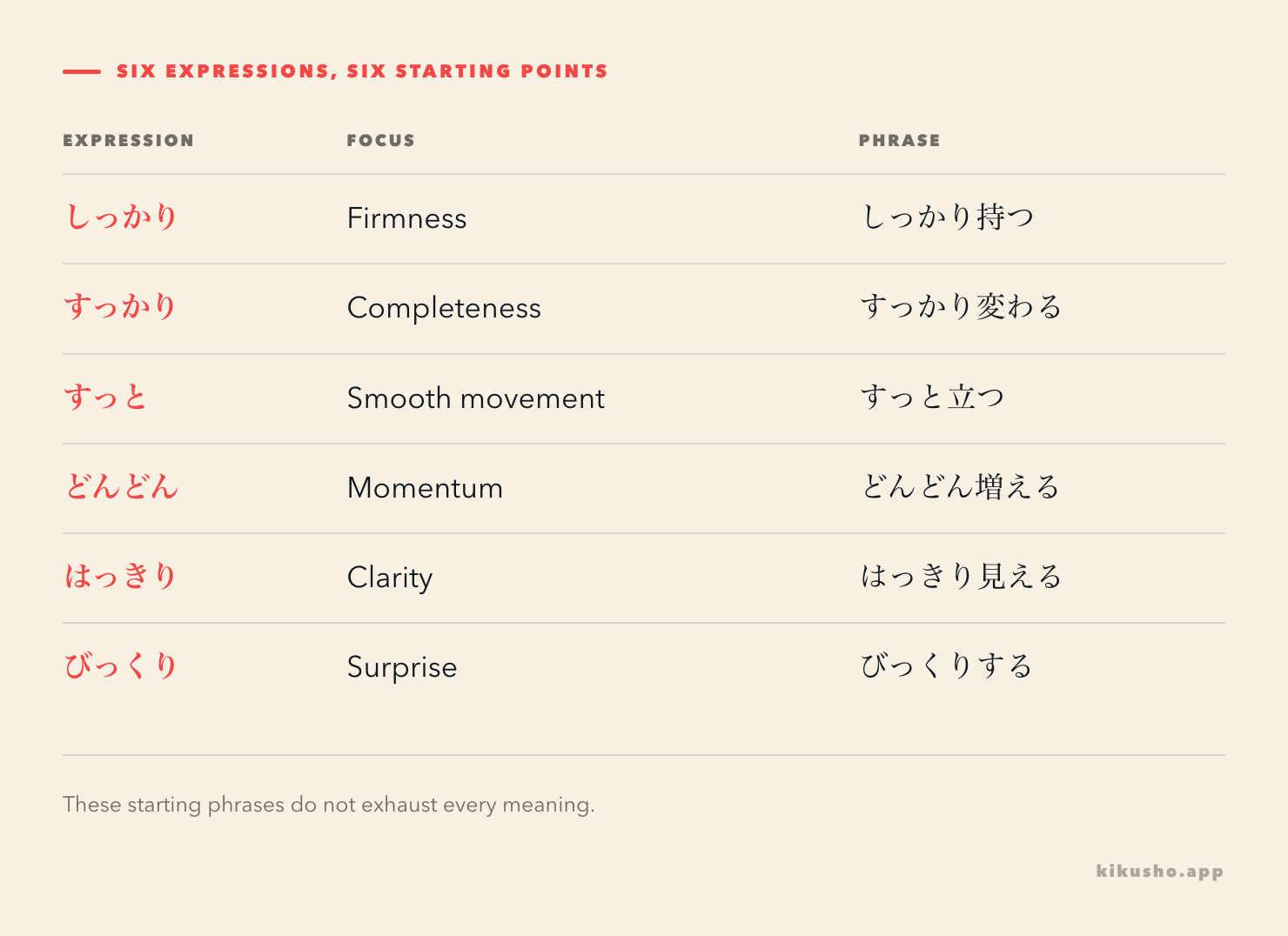
Firmness, completeness and clarity
しっかり: secure or dependable
この箱は重いので、両手でしっかり持ってください。
この はこは おもいので、りょうてで しっかり もってください。
This box is heavy, so please hold it firmly with both hands.
The request concerns the quality of the hold. しっかり持つ suggests a secure grip, not merely holding for a long time. In 説明をしっかり聞く(せつめいを しっかり きく), “listen carefully to the explanation,” the same word asks you to do the action properly and attentively.
It also describes a stable state: この椅子はしっかりしている(この いすは しっかりしている), “This chair is sturdy.” しっかりした人 is a dependable or sensible person. NINJAL's explanation shows physical firmness alongside reliability and thorough action; Shogakukan records the adverb and its use with する.
The instruction しっかりして! can urge someone to pull themselves together. Tone and circumstances matter: the expression can encourage, but it can also sound impatient. The ordinary vocabulary itself does not make a command gentle.
すっかり: the change is complete
工事が終わって、駅前の景色がすっかり変わりました。
こうじが おわって、えきまえの けしきが すっかり かわりました。
With the construction finished, the scenery in front of the station has changed completely.
Here すっかり presents the change as thorough. It says nothing about whether construction was fast or well done. The useful pair is すっかり変わる, “change completely.”
名前をすっかり忘れていました(なまえを すっかり わすれていました)means “I had completely forgotten the name.” NINJAL gives completion and complete forgetting as everyday uses. Do not swap in しっかり because the words look alike: careful remembering and complete forgetting point in different directions.
The earlier lesson on degree adverbs concerns how strongly something applies. Here, retain the more specific contribution of すっかり: the speaker presents a change or result as complete, rather than simply saying “very.”
はっきり: clear to the senses or mind
電話では、名前をはっきり言ってください。
でんわでは、なまえを はっきり いってください。
On the phone, please say your name clearly.
This asks for clarity. It need not mean shouting. はっきり見える means “can see clearly,” while はっきり覚えている(はっきり おぼえている)means “remember clearly.” NINJAL treats clear perception, speech and thinking as related uses.
A predicate with する can describe certainty: 出発の日はまだはっきりしていません(しゅっぱつの ひは まだ はっきりしていません), “The departure date is not definite yet.” Shogakukan's entry confirms this use as well as the optional と in phrases such as はっきりと見える.
Movement, momentum and reaction
すっと: without a stop or struggle
名前を呼ばれると、彼はすっと立ちました。
なまえを よばれると、かれは すっと たちました。
When his name was called, he stood up in one smooth movement.
すっと makes the movement feel swift and unimpeded. In 木がすっと伸びている(きが すっと のびている), “The tree grows straight and tall,” it instead describes a straight extension. Neither sentence requires a literal sound.
There is also a feeling use: 話を聞いて、胸がすっとしました(はなしを きいて、むねが すっとしました), “After hearing the explanation, I felt a weight lift.” The phrase 胸がすっとする expresses the clearing of an uncomfortable feeling. NINJAL and Shogakukan distinguish movement from relief or refreshment. Avoid reducing every occurrence to “suddenly”: the manner of motion or the change in feeling is part of the word's work.
どんどん: the process keeps moving
午後になって、雨がどんどん強くなりました。
ごごに なって、あめが どんどん つよく なりました。
In the afternoon, the rain grew heavier and heavier.
The change progresses with force. どんどん増える(どんどん ふえる), “increase rapidly,” and どんどん進む(どんどん すすむ), “keep moving ahead,” preserve that momentum. It need not describe something desirable; rain becoming heavier can spoil your plans.
In わからないことは、どんどん質問してください, “Please ask freely about anything you don't understand,” it encourages acting without hesitation. Shogakukan includes this use alongside vigorous progression.
This word can imitate sound too. 隣の部屋から、どんどんと壁をたたく音が聞こえました(となりの へやから、どんどんと かべを たたく おとが きこえました)means “From the next room, I heard someone pounding repeatedly on the wall.” NINJAL separates the pounding sound from rapid progress. The repeated form does not tell you which sense is intended; the surrounding sentence does.
びっくり: something breaks your expectation
友達が突然訪ねてきたので、びっくりしました。
ともだちが とつぜん たずねてきたので、びっくりしました。
I was surprised because a friend came to visit unexpectedly.
Learn びっくりする → びっくりした → びっくりしました as a usable verb sequence. The surprise can come from good news, a strange discovery or a sudden noise. It does not by itself tell you whether the experience was pleasant.
値段にびっくりしました(ねだんに びっくりしました), “I was surprised by the price,” uses に for what caused the surprise. NINJAL includes both startling events and outcomes that differ from expectation. Kanjipedia confirms the reading and the surprise sense. Kana is sufficient for the everyday word taught here.
Learn the construction with the sense
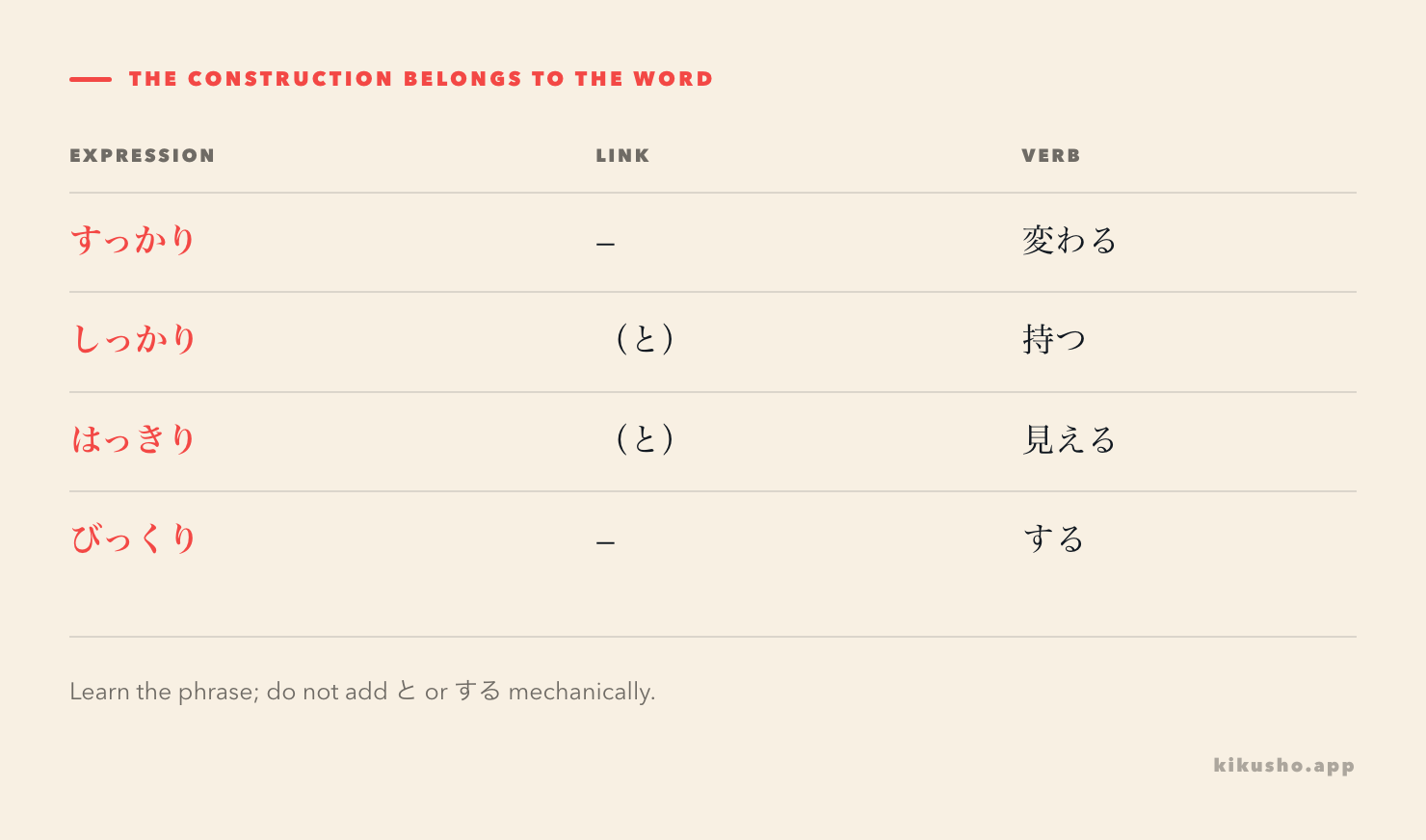
The following are useful patterns, not permission to substitute every word into every row.
| Pattern | Example | What it does |
|---|---|---|
| Expression + verb | すっかり変わった | Describes a complete change |
| Expression + optional と + verb | しっかり持つ / しっかりと持つ | Describes a firm hold |
| Expression + optional と + verb | はっきり見える / はっきりと見える | Describes clear visibility |
| Expression ending in と + verb | すっと立つ | The と is already present |
| Expression + する | びっくりする | Forms a predicate expressing surprise |
| Expression + している | はっきりしている | Describes an established clear state |
For a first productive pattern, use すっかり変わる and どんどん増える as they stand. Learn additional variants from real examples instead of mechanically adding と. Likewise, しっかりする and はっきりする do not make すっかりする a general equivalent of “be complete.” The particular word and sense determine the construction.
Keep one scene, then add another sense
When you first save どんどん, choose the event you encountered: increasing rain, rapid progress or pounding on a wall. Those examples share a word while answering different questions about the scene. A single English translation cannot recover them all.
Kikusho's editable examples let you keep the phrase you heard with the meaning you intended. If a later conversation reveals another sense, revise the note or add that example before saving. The card's audio then gives you the whole expression to revisit, including the small っ that separates several of these forms from a loose approximation.
Read the seven tasks below without consulting the corrections. All explanations follow together.
Practice questions
Question 1: check the written shape
You need the word bikkuri, expressing surprise. Which spelling keeps its sounds?
- A. びくり
- B. びっくり
- C. ぴっくり
- D. びっぐり
Question 2: describe the grip
A suitcase is heavy and slippery. Select the phrase asking someone to hold it securely.
- A. すっかり持ってください。
- B. びっくり持ってください。
- C. はっきり持ってください。
- D. しっかり持ってください。
Question 3: preserve the change
部屋の様子がすっかり変わりました。
Which statement captures what すっかり adds?
- A. The room's appearance has changed completely.
- B. The room's appearance has barely changed.
- C. The speaker can hear the room changing loudly.
- D. The room will begin changing next year.
Question 4: interpret the uncertainty
集合する場所は、まだはっきりしていません。
The speaker means that the meeting place:
- A. is already completely clear.
- B. surprised everyone when they arrived.
- C. is not definite yet.
- D. is growing rapidly.
Question 5: follow the movement
A person rises promptly in one smooth motion after being called. Complete the description.
彼は( )立ちました。
- A. すっかり
- B. すっと
- C. びっくりを
- D. はっきりを
Question 6: listen for what is described
隣から、どんどんと壁をたたく音が聞こえます。
What does どんどん convey in this sentence?
- A. The speaker's complete recovery.
- B. A clear decision about the wall.
- C. A neighbour growing more confident.
- D. Repeated heavy pounding.
Question 7: name the reaction
An unexpected message announces that a friend has won a prize. Choose the expression for the speaker's surprise.
その知らせに( )。
- A. びっくりしました
- B. すっかりしました
- C. どんどんをしました
- D. はっきりをしました
Answers and explanations
Use the correction to check the expression's meaning first, then the way it joins the rest of the sentence.
Answer 1
B: びっくり. A drops the small っ, C changes the initial consonant to ぴ, and D voices the consonant in く. Those changes do not preserve the target word.
Answer 2
D. しっかり持つ asks for a secure grip. すっかり concerns completeness, はっきり concerns clarity, and the isolated びっくり does not modify 持つ in the required way. None of A–C supplies the intended request.
Answer 3
A. The change is presented as complete. すっかり does not mean “barely,” imitate a changing sound or assign a future date. Read 様子 as ようす, the appearance or state of things.
Answer 4
C. はっきりしていません denies that the place is definite, and まだ adds “yet.” A loses the negative. B introduces surprise, while D introduces growth; neither is the meaning of this expression. 集合する場所 is the place where people will gather.
Answer 5
B. すっと describes the swift, smooth movement specified in the question. すっかり would emphasise a complete state or change rather than that manner of rising. C and D add を to expressions that do not function as the object of 立つ here.
Answer 6
D. 壁をたたく音, “the sound of hitting the wall,” supplies the literal sound context. The other options do not describe that noise. In a sentence about something increasing or progressing, the same どんどん would have another use.
Answer 7
A. びっくりしました expresses the reaction to the news, with に marking its cause. B does not form the intended surprise predicate; C and D insert an inappropriate を and also fail to supply its meaning. Surprise alone does not settle whether the speaker is delighted or alarmed.
Common questions
Do Japanese onomatopoeia always imitate a sound?
No. The broad category also includes mimetic words describing a state, movement or feeling. In this set, どんどん can imitate repeated pounding, while すっかり describes completeness and びっくり describes surprise.
Can I add と after every expressive word?
Learn the individual construction. しっかり持つ and しっかりと持つ both work, but すっと already ends in と. A useful first pattern for すっかり is すっかり変わる. Similar-looking words do not all follow one attachment rule.
How are しっかり and すっかり different?
しっかり describes firmness, reliability or doing something thoroughly. すっかり presents something as complete or wholly changed. A firm grip and a complete change are different claims, despite the similar spellings.