On this page
すっきり describes something clear, refreshed or free of clutter; どきどき conveys a pounding heart; にこにこ shows a cheerful smile. Learn each with its sentence pattern, because a feeling, a physical sensation and a visible expression call for different English translations.
Three expressions for how a situation feels or looks
Japanese expressive vocabulary can describe a state without imitating an audible noise. 擬態語(ぎたいご, gitaigo)is the term for such mimetic expressions; sound imitation is 擬音語(ぎおんご, giongo). NINJAL's introduction explains the distinction. A heartbeat expression can connect the physical beat with the feeling that accompanies it, so a single English category is less useful than the actual sentence.
This set teaches exactly すっきり, どきどき and にこにこ. They belong together because all three can form predicates with する, but each directs your attention somewhere different: the absence of something burdensome, the heart's activity, or the face. None requires a comic-book sound effect.
The curriculum places these three records in N2 vocabulary. Both retained level lists descend from Waller/Tanos; their agreement is one source family's judgment. The independent NINJAL usage material verifies ordinary situations, not an N2 classification. Treat the level as a study placement. Everyday encounters can precede that study placement; the current exam supplies no exhaustive word list for learners.
The earlier everyday onomatopoeia set teaches six different words, including しっかり and すっかり. This page adds three new items rather than relabelling those six as advanced vocabulary.
The words, readings and useful partners
| Word and reading | Sense practised here | Part of speech | Phrase to retain |
|---|---|---|---|
| すっきり(すっきり) | Refreshed or clear; uncluttered; neatly streamlined | Adverb; also combines with する | 頭がすっきりする: feel clear-headed; すっきりした部屋: an uncluttered room |
| どきどき(どきどき) | A heart pounding from exertion or emotion | Adverb; also combines with する; noun-like uses occur | 胸がどきどきする: one's heart pounds; どきどきしながら待つ: wait with one's heart pounding |
| にこにこ(にこにこ) | Smiling cheerfully | Adverb; also combines with する | にこにこ笑う: smile cheerfully; にこにこしている: be smiling |
Shogakukan's すっきり entry, どきどき entry and にこにこ entry identify the readings, adverbial status and uses with する. A dictionary label does not make every possible verb partner equally natural; retain the phrases as units.
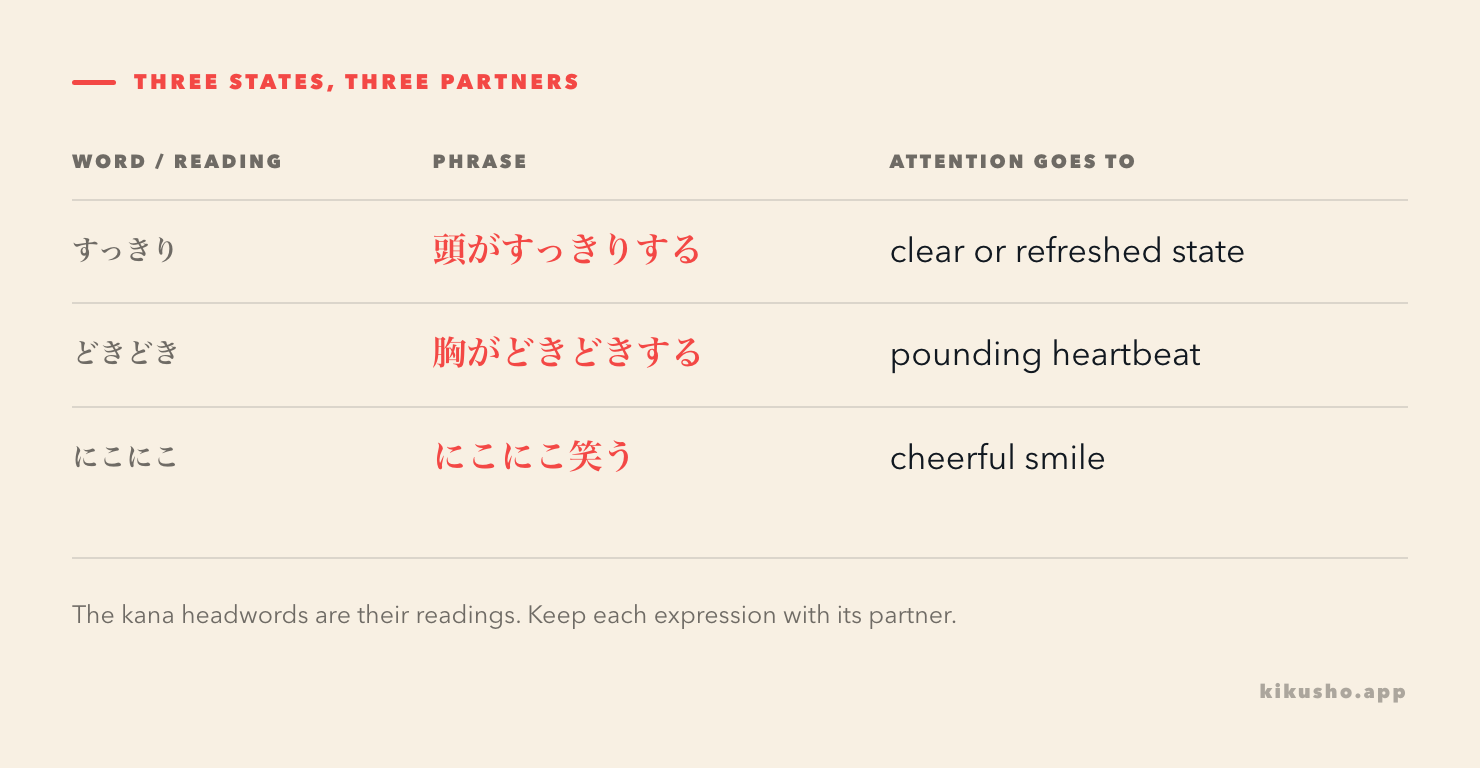
すっきり: refreshed, clear or uncluttered
昼寝をしたら、頭がすっきりしました。
ひるねを したら、あたまが すっきりしました。
After a nap, I felt clear-headed.
頭がすっきりする concerns the way your head feels. “My head became neat” would preserve a dictionary gloss and lose the meaning. For the broader feeling, 気分がすっきりする(きぶんが すっきりする)can mean feeling refreshed or relieved. NINJAL's explanation connects waking refreshed with a pleasant, unclouded feeling.
A room can have a related quality:
荷物を減らしたら、部屋がすっきりしました。
にもつを へらしたら、へやが すっきりしました。
After I reduced the amount of stuff, the room felt uncluttered.
The room's dimensions need not change. Removing excess makes the space look clear and orderly. すっきりしたデザイン(すっきりした でざいん)describes a clean, streamlined design; すっきりした文章(すっきりした ぶんしょう)describes concise, clear writing. Choose the translation for the thing being described.
The negative すっきりしない denies that clear or satisfying state. 説明を聞いても、気分がすっきりしません(せつめいを きいても、きぶんが すっきりしません)means “Even after hearing the explanation, I still don't feel settled.” It does not say that you failed to hear the words.
Shogakukan also records older uses meaning “completely” and, with negation, “not at all.” Those historical senses are outside this practice. In an ordinary sentence about a complete change, the neighbouring すっかり変わる is a separate expression; do not collapse the two words into a universal synonym rule.
どきどき: the heart's activity, with the cause supplied by context
面接の順番を待っている間、胸がどきどきしました。
めんせつの じゅんばんを まっている あいだ、むねが どきどきしました。
My heart was pounding while I waited for my interview turn.
胸がどきどきする is a useful emotional frame. Here the interview suggests nerves. Elsewhere a welcome meeting or an uncertain result can create anticipation; the word does not settle whether the experience is happy or frightening. Shogakukan's Japanese-language dictionary includes both expectation and anxiety as possible causes.
The same expression can describe exertion:
急いで階段を上ったので、心臓がどきどきしています。
いそいで かいだんを のぼったので、しんぞうが どきどきしています。
My heart is pounding because I hurried up the stairs.
This is a physical description, not evidence that the speaker fears the stairs. NINJAL's page explicitly separates public-speaking nerves, exercise and mixed expectations about an examination result.
どきどきしながら結果を待つ(どきどきしながら けっかを まつ)means “wait for the result with one's heart pounding.” The する becomes し before ながら. Noun-like 胸のどきどき refers to the pounding sensation. These are established constructions, not permission to attach を to every expressive adverb.
にこにこ: a cheerful smile you can observe
祖母はにこにこしながら、昔の話をしてくれました。
そぼは にこにこしながら、むかしの はなしを してくれました。
My grandmother smiled cheerfully as she told me stories about the past.
にこにこする describes smiling, and にこにこ笑う(にこにこ わらう)describes the cheerful manner of the smile. The optional と also works in にこにこと笑う. Shogakukan records both the adverbial construction and にこにこして話しかける, speaking to someone with a smile.
店員はにこにこして、私を迎えてくれました。
てんいんは にこにこして、わたしを むかえてくれました。
The shop assistant greeted me with a cheerful smile.
NINJAL's examples include a smiling baby, a helpful adult and pleased employees. The expression is therefore neither limited to children nor tied to a particular gender. It describes a cheerful appearance; it does not prove everything about a person's private feelings or character.
A smile need not make a sound. Translating this as “laughing loudly” adds a claim the word does not supply. Likewise, calling every にこにこ a smirk imposes a different attitude.
する carries the tense; the expressive word stays intact
| Job in the sentence | すっきり | どきどき | にこにこ |
|---|---|---|---|
| Plain predicate | すっきりする | どきどきする | にこにこする |
| Polite past | すっきりしました | どきどきしました | にこにこしました |
| Ongoing state | すっきりしている | どきどきしている | にこにこしている |
| Before a noun, in a useful frame | すっきりした部屋 | どきどきしている人 | にこにこしている人 |
These columns share する inflection, not identical meaning. すっきりした部屋 describes the room's state; the two expressions with 人(ひと)describe a person whose heart is pounding or who is smiling. Treating all three as ordinary な-adjectives would give you unsuitable combinations such as にこにこな人 in this basic construction.
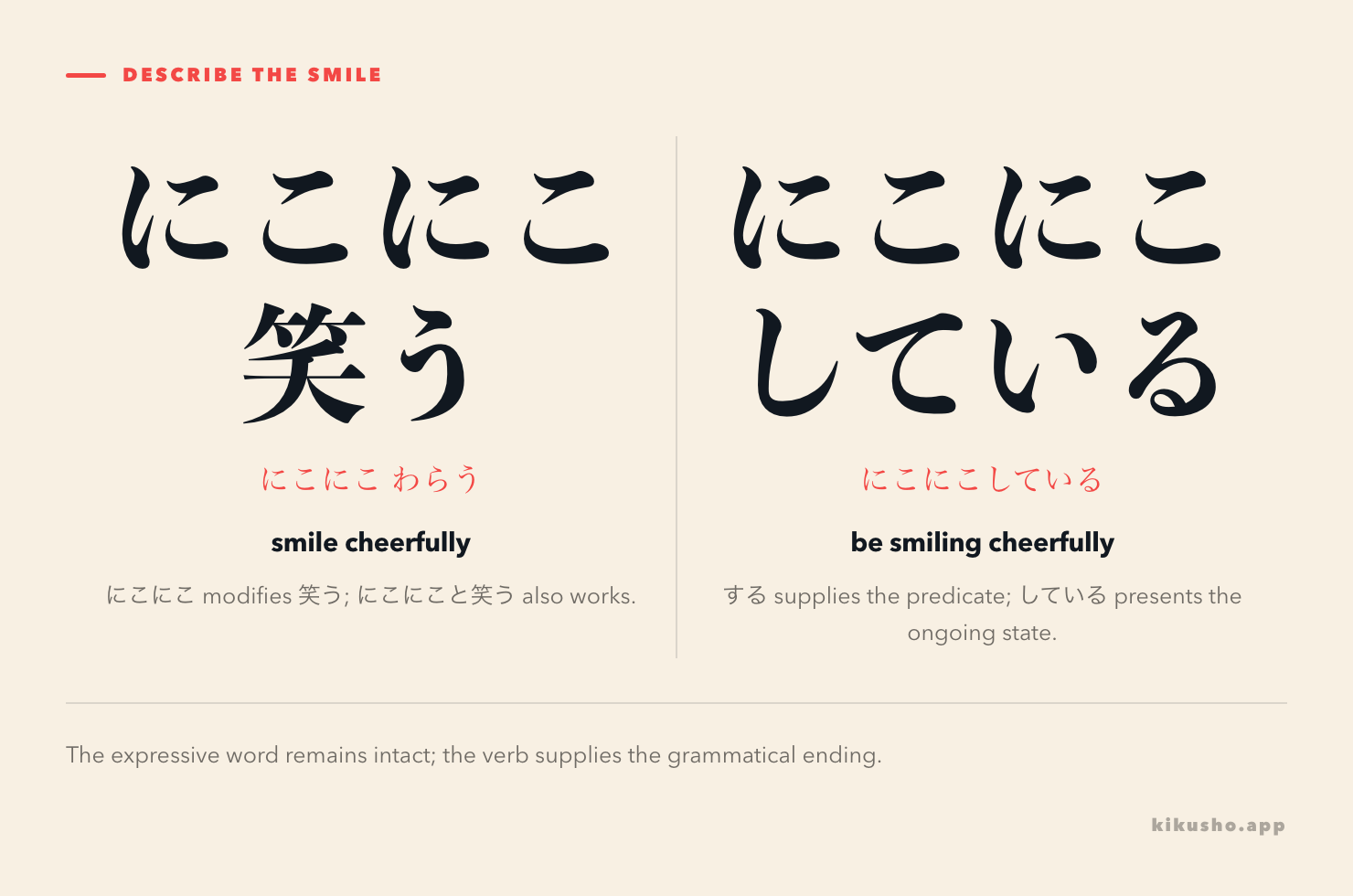
For spelling, keep the small っ in すっきり and both voiced ど in どきどき. Their katakana versions are スッキリ, ドキドキ and ニコニコ. A change of script does not turn these into English loans; the katakana vocabulary guide explains that broader use of the script.
Keep the situation with the word
Start with three contrasts you can recognise in ordinary life: waking with a clear head, waiting for a turn with a pounding heart, and greeting someone with a smile. The expression gains precision from its subject and verb partner, so save more than a one-word English gloss.
If you paste a sentence into Kikusho, check whether the generated explanation preserves that particular sense before keeping the card. For どきどき, note whether the scene involves exertion, nervousness or anticipation. Revisiting that example with the card's audio gives you the whole phrase to recognise later, rather than a rule that every pounding heart means fear.
Practice questions
Try all six tasks first. The corrections appear together after the last question.
Question 1
Choose the hiragana spelling of sukkiri, for a clear or refreshed state.
| A | B | C | D |
|---|---|---|---|
| すきり | すっきり | すっぎり | ずっきり |
Question 2
After climbing stairs in a hurry, the speaker notices a fast heartbeat. Complete the sentence with the expression describing that sensation.
急いで階段を上ったら、心臓が( )しました。
- A. にこにこ
- B. すっきり
- C. すっかり
- D. どきどき
Question 3
荷物を減らして、部屋がすっきりしました。
Which paraphrase preserves the description of the room?
- A. 部屋の中に物が増えました。
- B. 部屋の広さが二倍になりました。
- C. 余計な物が減って、部屋がさっぱりしました。
- D. 部屋から大きな音が聞こえました。
Question 4
Select the sentence that uses にこにこ to describe a person's cheerful smile.
| Choice | Sentence |
|---|---|
| A | 母はにこにこしながら、写真を見ていました。 |
| B | 母はにこにこを飲んでいました。 |
| C | この箱はにこにこいです。 |
| D | 母はにこにこく走りました。 |
Question 5
The speaker feels refreshed after resting. Choose the standard predicate for the blank.
少し休んだら、頭が( )。
- A. すっきりを飲みました
- B. すっきりなりました
- C. すっきりしました
- D. すっきりいでした
Question 6
子どもはにこにこしていました。
What is directly described?
- A. The child was smiling cheerfully.
- B. The child was shouting angrily.
- C. The child was necessarily laughing loudly.
- D. The child's heart was beating fast after exercise.
Answers and explanations
Answer 1: B — すっきり. A omits the small っ; C replaces き with voiced ぎ; D changes initial す to ず. None preserves the target word. Katakana スッキリ retains the same sounds.
Answer 2: D — どきどき. Read 心臓 as しんぞう, “heart,” and 階段を上った as かいだんを のぼった, “went up the stairs.” The stated sensation is a pounding heart. A describes smiling, B a clear or refreshed state, and C completeness. The staircase context supplies exertion as the cause.
Answer 3: C. 余計な物(よけいな もの)means unnecessary things, and さっぱりしました preserves the cleared, uncluttered state here. A says more things were added. B claims the room doubled in size, which the original never says. D adds a loud sound. This is a contextual paraphrase, not a claim that すっきり and さっぱり are interchangeable in every sentence.
Answer 4: A. 母はにこにこしながら、写真を見ていました(ははは にこにこしながら、しゃしんを みていました)means “My mother was looking at photos with a cheerful smile.” B treats the expression as a drinkable object. C invents an い-adjective; D invents its adverbial く-form. Neither follows the word's construction.
Answer 5: C. 少し休んだら、頭がすっきりしました(すこし やすんだら、あたまが すっきりしました)means “After resting a little, I felt clear-headed.” A says the head drank something and uses an unsuitable object. B lacks the required construction: do not treat the expressive adverb as a な-adjective before なる. D fabricates an adjective ending. The する in C carries the polite past tense.
Answer 6: A. 子ども(こども)was smiling cheerfully. B changes the expression to anger, C adds a necessary audible laugh, and D describes a different sensation. A cheerful-looking face does not give a complete account of the child's thoughts; it is what the sentence shows.
Common questions
Do these Japanese words describe real sounds?
Not necessarily. にこにこ describes a cheerful smile and すっきり a clear, refreshed or uncluttered state. どきどき connects a pounding heartbeat with physical exertion or feelings such as nervousness and anticipation.
Does どきどき always mean fear?
No. A heart can pound after exercise or from excitement, expectation, surprise or anxiety. The surrounding situation identifies the cause; the word alone does not decide whether the experience is pleasant.
Can I put な after すっきり or にこにこ?
These are adverbs that can also combine with する. Learn frames such as すっきりした部屋 and にこにこしている人 instead of treating them as ordinary な-adjectives. と is possible in particular adverbial constructions, such as にこにこと笑う.
Are these expressions only used at JLPT N2?
No. N2 is their placement in this curriculum's Waller/Tanos-derived reference lists, not a restriction on everyday use. NINJAL teaches them as ordinary expressions. The current JLPT has no exhaustive official vocabulary syllabus.