On this page
At N3, map vocabulary describes the structure of a route, not only the next turn: where a place sits, what surrounds it, which point a service passes through and why two possible paths differ. The fourteen assigned records are 横断(おうだん), 奥(おく), 角(かく), 経由(けいゆ), 左右(さゆう), 周囲(しゅうい), 角(すみ), 中央(ちゅうおう), 中心(ちゅうしん), 端(はし), 表(ひょう), 方向(ほうこう), 迷う(まよう) and 向かい(むかい).
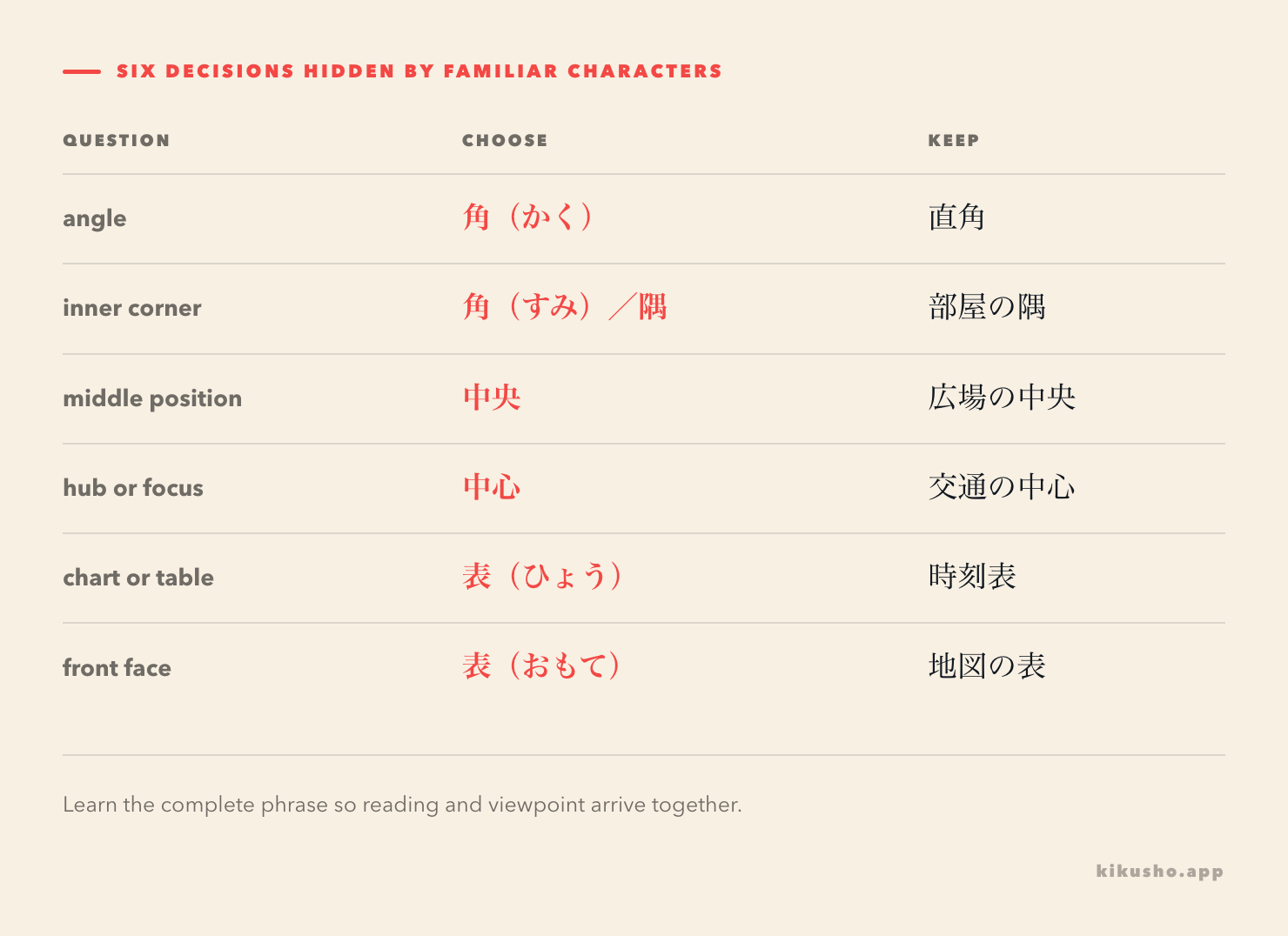
Several share a spelling with a word from an earlier level. That is the useful difficulty here. 表 is a table in this lesson, 角 carries two assigned readings, and a route's 中央 is not always its functional 中心.
Fourteen words divide a map into position, route and judgment
| Assigned word | Word class and selected sense | Phrase to retain |
|---|---|---|
| 横断(おうだん) | noun and する verb: crossing from one side to the other | 道路を横断する, cross a road |
| 奥(おく) | noun: deep inside; far end from an entrance | 店の奥, the back of a shop |
| 角(かく) | noun and suffix: angle | 直角, a right angle |
| 経由(けいゆ) | noun and する verb: passing through; via | 京都経由で行く, go via Kyoto |
| 左右(さゆう) | noun and する verb: left and right; influence | 左右を確認する, check left and right |
| 周囲(しゅうい) | noun: surroundings; perimeter | 建物の周囲, around the building |
| 角(すみ) | noun: an inner corner; often written 隅 | 部屋の角, a corner of a room |
| 中央(ちゅうおう) | noun: middle position; central authority | 広場の中央, the middle of the square |
| 中心(ちゅうしん) | noun: centre, hub or main focus | 交通の中心, a transport hub |
| 端(はし) | noun: edge, end or margin | 道の端, the edge of the road |
| 表(ひょう) | noun and suffix: table, chart or list | 時刻表, timetable |
| 方向(ほうこう) | noun: direction or course | 進行方向, direction of travel |
| 迷う(まよう) | godan intransitive verb: lose one's way; hesitate | 道に迷う, get lost |
| 向かい(むかい) | noun: directly opposite; across from | 駅の向かい, opposite the station |
The N4 route lesson supplies 進む, 戻る and 途中. Here the learner has to read a whole route display, distinguish reference points and explain an error after it happens.
奥, 端, 周囲 and 向かい locate four different regions
奥(おく) begins from an entrance or visible front and looks inward. Shogakukan's 奥 entry defines it as a place deep inside from the entrance or surface.
案内所は駅の奥にあります。
あんないじょは えきの おくに あります。
The information desk is in the back of the station.
端(はし) instead names an edge or end. A bench at ホームの端 is near the platform's end; it is not necessarily deep inside anything. The dictionary record for 端 includes はし, edge, end and extremity.
道の端を歩いてください。
みちの はしを あるいて ください。
Please walk along the edge of the road.
周囲(しゅうい) expands around a reference point. It can mean the surrounding area, a perimeter's length or the people and things around somebody; the route sense is the first. The 周囲 entry makes those senses explicit.
駅の周囲には小さな店が多い。
えきの しゅういには ちいさな みせが おおい。
There are many small shops around the station.
向かい(むかい) draws a line across a street or open space. It identifies the place directly opposite the reference point:
郵便局は駅の向かいにあります。
ゆうびんきょくは えきの むかいに あります。
The post office is opposite the station.
The 向かい dictionary entry records both facing something and a house on the opposite side of a road. 周囲 gives a ring of possible locations; 向かい gives one relation across from the landmark.
横断, 経由, 方向 and 左右 describe movement before the destination
横断(おうだん) is a crossing from one side to the other. It combines naturally with the area crossed and する:
信号が青になってから、道路を横断してください。
しんごうが あおに なってから、どうろを おうだんして ください。
Please cross the road after the light turns green.
Kanjipedia's 横断 entry includes crossing a road, railway or river and gives 横断歩道, pedestrian crossing. The noun focuses on a crosswise passage; 渡る in the N5 map lesson is the general motion verb.
経由(けいゆ) adds an intermediate point without turning it into the destination. Two patterns are common:
| Pattern | Example | Route logic |
|---|---|---|
| A経由でBへ行く | 京都経由で大阪へ行く | Kyoto is the stated route; Osaka is the destination |
| Aを経由してBへ行く | 京都を経由して大阪へ行く | the trip passes through Kyoto before Osaka |
Kanjipedia defines 経由 as reaching a destination through another point and also records an abstract “through an organisation” sense. 課長を経由して報告する is possible, but it is not a map route.
方向(ほうこう) is the way something faces or proceeds. Shogakukan's usage note distinguishes it from compass-based 方位 and notes that 方向 can use vertical, horizontal and relative orientations.
反対の方向へ歩いていたことに気づいた。
はんたいの ほうこうへ あるいて いた ことに きづいた。
I realised that I had been walking in the opposite direction.
Before crossing, 左右(さゆう) gathers left and right into one noun:
横断歩道では、左右を確認してから渡りましょう。
おうだんほどうでは、さゆうを かくにんしてから わたりましょう。
At a pedestrian crossing, check left and right before crossing.
The same word becomes a する verb meaning exert decisive influence: 天候が到着時刻を左右する, the weather affects the arrival time. The 左右 entry records both the spatial pair and this extended sense. A map context selects the spatial one.
角 carries a geometry reading and a corner reading
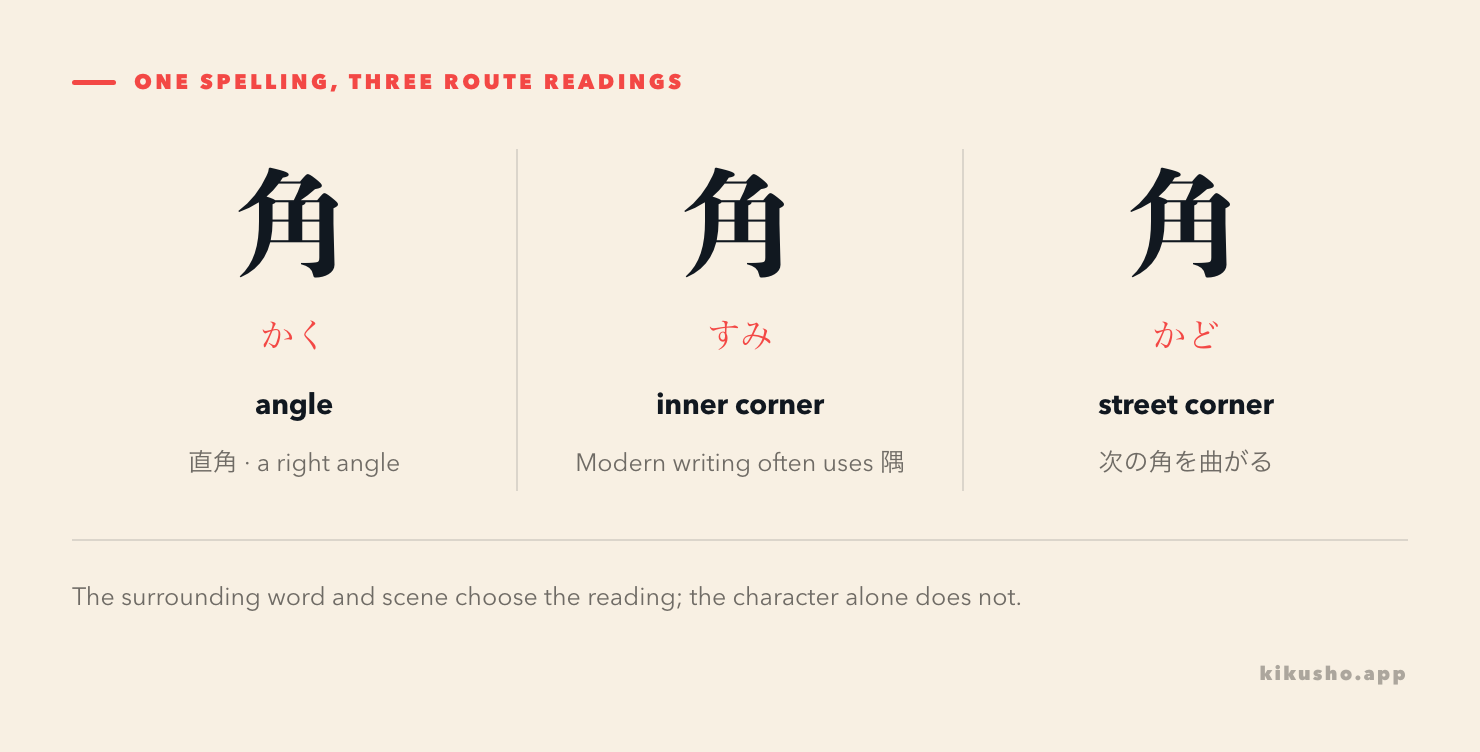
The assigned inventory contains two 角 records. 角(かく) is the on-reading used for an angle and inside compounds such as 直角(ちょっかく), right angle, and 角度(かくど), angle or viewpoint.
この二本の道は直角に交わっています。
この にほんの みちは ちょっかくに まじわって います。
These two roads intersect at a right angle.
角(すみ) is an assigned native reading for an inner corner. Modern prose commonly writes that word 隅, and dictionaries may mark the すみ reading of 角 as outside the standard reading list. The Japan Forum's illustrated lexical comparison distinguishes an inside すみ, an outside turn かど, and an edge はし.
部屋の角に案内図が置いてあります。
へやの すみに あんないずが おいて あります。
A guide map has been placed in the corner of the room.
This record also exposes a source error worth correcting. One inherited gloss attached “horn” to 角(すみ), but an animal horn is 角(つの). The spelling alone cannot carry the meaning. Shogakukan's 角 entry records かく, かど, つの and すみ across different words and senses.
中央 measures the middle; 中心 can organise what surrounds it
中央(ちゅうおう) is the middle relative to edges, ends or order. The 中央 definition begins with a position equally removed from the edges:
広場の中央に案内板があります。
ひろばの ちゅうおうに あんないばんが あります。
There is an information board in the middle of the square.
中心(ちゅうしん) overlaps for a physical centre, but it also names a hub, focus or most important element. The 中心 entry includes both the middle point and the place or person around which activity concentrates:
この駅は地域の交通の中心です。
この えきは ちいきの こうつうの ちゅうしんです。
This station is the region's transport hub.
A clock can hang in a wall's 中央 because its location is central. A station can be a city's 中心 even when it is not geometrically in the middle, because routes and activity gather there. The N3 grammar comparison of を中心に develops this organising relation without giving the vocabulary record a second canonical lesson.
表(ひょう) turns route information into rows and columns
The N4 lesson used 表(おもて) for the front of a map sheet. Here 表(ひょう) is a table, chart or organised list. The word appears alone and as the final element of compounds:
- 時刻表(じこくひょう): timetable
- 路線表(ろせんひょう): route table
- 一覧表(いちらんひょう): summary table or list
時刻表で、中央駅を経由する電車を調べた。
じこくひょうで、ちゅうおうえきを けいゆする でんしゃを しらべた。
I checked the timetable for a train that goes via Central Station.
The Japanese Kanji Aptitude Testing Foundation's 表 entry includes the ひょう sense for information arranged so it can be understood at a glance. 地図の表(おもて) and 時刻表(じこくひょう) contain the same character but are different words.
迷う reports either a lost route or an unsettled choice
迷う(まよう) is an intransitive godan verb. With 道に, it means losing the route:
駅の周囲で道に迷いました。
えきの しゅういで みちに まよいました。
I got lost around the station.
Without a physical route, it can describe indecision:
二つの経路のどちらにするか迷っています。
ふたつの けいろの どちらに するか まよって います。
I am unsure which of the two routes to choose.
The 迷う dictionary entry records both not knowing the road or direction and being unable to decide. English “be lost” can also mean not understanding an explanation, but 道に迷う is a fixed spatial reading of the situation.
Read one station route from the table to the exit
時刻表で、中央駅を経由する電車を調べた。到着後、進行方向を確認せずに反対側へ歩いたため、駅の奥で道に迷ってしまった。案内図を見ると、出口は広場の中央ではなく、建物の端にあった。駅員に聞くと、「この通路を進み、二本の道が直角に交わる所で右に曲がってください。横断歩道では左右を確認してください。郵便局の向かいが出口です」と教えてくれた。
じこくひょうで、ちゅうおうえきを けいゆする でんしゃを しらべた。とうちゃくご、しんこうほうこうを かくにんせずに はんたいがわへ あるいたため、えきの おくで みちに まよって しまった。あんないずを みると、でぐちは ひろばの ちゅうおうではなく、たてものの はしに あった。えきいんに きくと、「この つうろを すすみ、にほんの みちが ちょっかくに まじわる ところで みぎに まがって ください。おうだんほどうでは さゆうを かくにんして ください。ゆうびんきょくの むかいが でぐちです」と おしえて くれた。
I checked the timetable for a train that goes via Central Station. After arriving, I walked toward the opposite side without checking the direction of travel, so I got lost in the back of the station. The guide map showed that the exit was not in the middle of the square but at the edge of the building. A station employee said, “Continue along this passage and turn right where the two roads meet at a right angle. Check left and right at the pedestrian crossing. The exit is opposite the post office.”
This passage keeps the levels separate. Earlier words such as 案内図, 進む and 途中 remain prerequisites; the fourteen rows above receive the new vocabulary credit. If you capture a timetable or route notice in Kikusho, keep the row that includes 経由, the destination and the service. That card preserves the intermediate-point relation that a bare translation “via” cannot show.
The exact results page was led by Amiko's N3 directions and places list, which groups sixty-five words with examples. The separate dictionary references above verify the particular readings and senses used here. These are editorial level estimates: the JLPT organisers do not publish an exhaustive vocabulary syllabus. The dated Kikusho inventory places all fourteen records at N3, while one Waller-derived source also places 角(かく) at N1. That shared source family does not settle an official boundary, so the lesson teaches the required sense and records the disagreement.
Follow the route before revealing the answers
Question 1: kanji reading. Which reading belongs to 横断 in 道路を横断する?
- ア. よこだん
- イ. おうたん
- ウ. おうだん
- エ. よこぎり
Question 2: orthography. Which kanji completes 道にまよう, “get lost”?
- ア. 惑う
- イ. 迷う
- ウ. 違う
- エ. 回う
Question 3: route logic. What does Kyoto do in this sentence?
京都経由で大阪へ行きます。
- ア. It is the final destination.
- イ. It is an intermediate point on the way to Osaka.
- ウ. It is directly opposite Osaka.
- エ. It is the centre of Osaka.
Question 4: reading in context. How is 角 read in 直角?
- ア. かく
- イ. かど
- ウ. すみ
- エ. つの
Question 5: choose two centre words. Complete both sentences.
甲:広場の__に噴水がある。
乙:この駅は地域の交通の__だ。
- ア. 甲:中心 / 乙:中央
- イ. 甲:中央 / 乙:中心
- ウ. 甲:周囲 / 乙:中央
- エ. 甲:端 / 乙:周囲
Question 6: meaning and reading. What does 表 mean, and how is it read, in 時刻表を確認する?
- ア. front; おもて
- イ. surface; ひょう
- ウ. timetable or chart; ひょう
- エ. list; おもて
Question 7: ordering. Build the instruction “Check left and right, then cross the road” from these two chunks.
道路を横断してください / 左右を確認してから
Question 8: paraphrase. Which sentence best preserves the spatial meaning of 駅の周囲で道に迷った?
- ア. 駅の近くで、進む道が分からなくなった。
- イ. 駅の中央で、二つの商品から選べなかった。
- ウ. 駅の向かいで、時刻表を読んだ。
- エ. 駅の奥で、左右の店を比べた。
Answers and explanations
1. Choose ウ, おうだん. 横断(おうだん) is the noun and する verb for crossing something from one side to the other. The other strings are not the reading of this word.
2. Choose イ, 迷う. 道に迷う(みちにまよう) means lose one's way. 惑う is normally read まどう and focuses more on perplexity; 違う means differ or be wrong, and 回う is not this verb.
3. Choose イ. 京都経由で大阪へ行く makes Osaka the destination marked by へ and Kyoto the intermediate point named by 経由. The sentence gives no opposite-side or centre relation.
4. Choose ア, かく. 直角(ちょっかく) means a right angle, so 角 contributes the on-reading かく, with sound contraction in the compound. かど is a street or outside corner, すみ an inner corner reading, and つの a horn.
5. Choose イ: 甲 is 中央 and 乙 is 中心. The fountain occupies the square's middle position relative to its edges. The station is a hub around which regional transport is organised; it need not be geometrically central.
6. Choose ウ. 時刻表(じこくひょう) is a timetable, an organised chart or table. The reading おもて belongs to the front or outward face in phrases such as 地図の表.
7. 左右を確認してから、道路を横断してください。 ~てから places the check first. 道路を marks the space crossed by 横断する; nothing in the sentence says to cross before looking.
8. Choose ア. 周囲 places the event around the station, and 道に迷った says the traveller no longer knew which way to proceed. イ changes both location and sense of 迷う, while ウ and エ describe different actions.
Common questions
What is the difference between 中央 and 中心?
中央(ちゅうおう) usually points to a middle position measured from the edges, while 中心(ちゅうしん) can also name the hub, focus or most important part. A fountain can stand in a square's 中央, while a station can be the transport 中心 of a town.
How is 角 read in Japanese map vocabulary?
角 is read かく when it means an angle, as in 直角. It can be read すみ for an inner corner, although modern writing often uses 隅 for that word. Street-corner 角 is normally read かど, and an animal horn is つの.
What does 経由 mean on a Japanese route?
経由(けいゆ) means passing through an intermediate place on the way to a destination. 京都経由で大阪へ行く means go to Osaka via Kyoto, and 京都を経由して 大阪へ行く expresses the same route with を and して.
What is the difference between 迷う and 道に迷う?
迷う(まよう) can mean lose one's way or be unable to decide. 道に迷う fixes the spatial sense, while どちらにするか迷う means hesitate over which choice to make.