

On this page
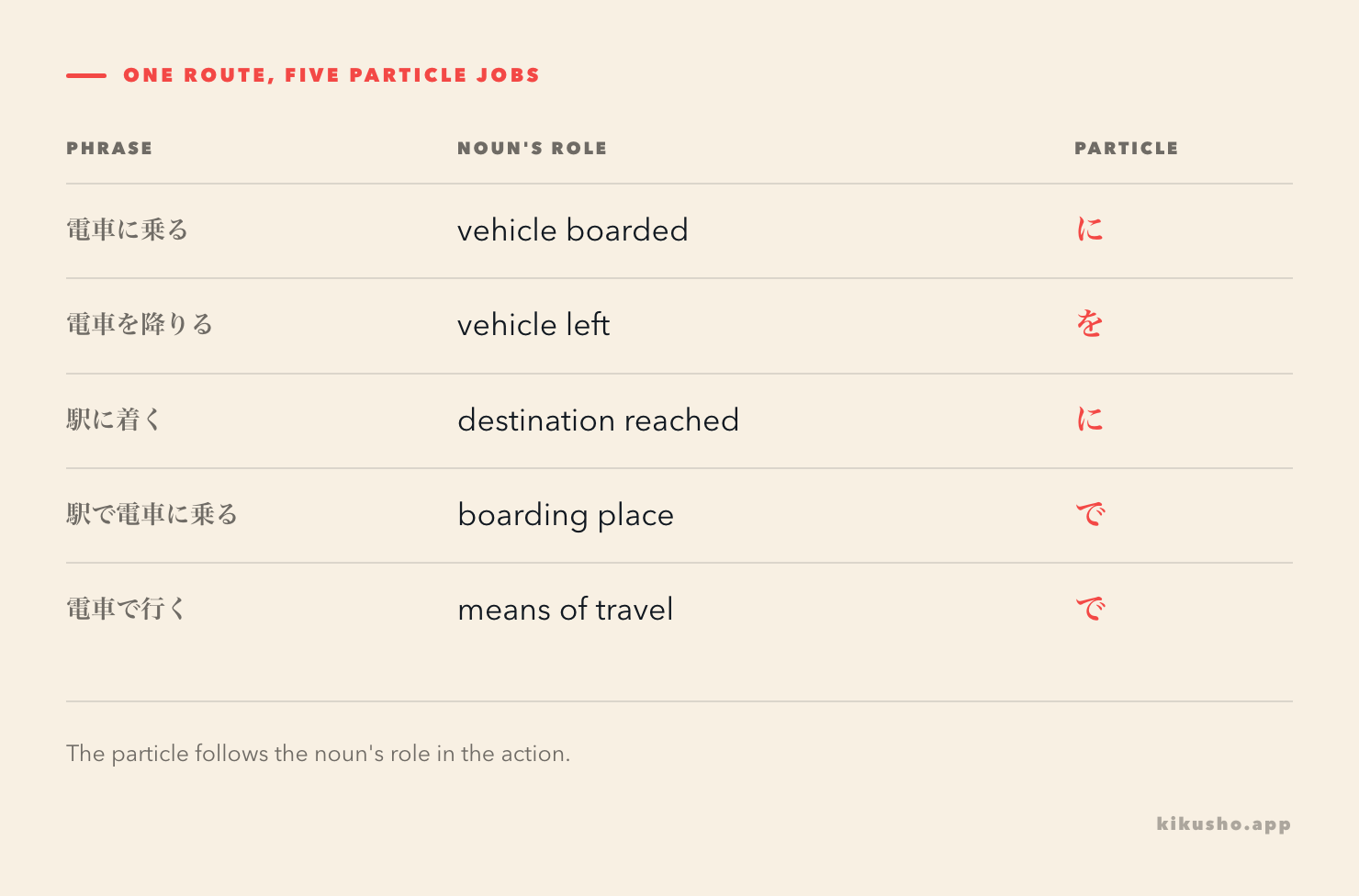
電車に乗ります means "I board the train"; 電車を降ります means "I get off the train." The vehicle takes に with 乗る(のる) and を with 降りる(おりる). When the action is arriving, the destination takes に: 駅に着きます, "I arrive at the station." Learn the word with its small phrase, and the particle stops being a guess.
Why these fourteen words belong together
A journey gives these words a job in sequence. You identify the station and a vehicle, get a ticket if that journey needs one, board, leave, and reach a place. This N5 set has fourteen assigned words. It does not include the verb for transferring between trains, 乗り換える(のりかえる); the Japan Foundation's route lesson uses that verb, but it is context for a later lesson here, not a fifteenth entry to memorise as part of this set.
The fourteen words, readings and useful partners
| Japanese and reading | Word type and transport sense | Short phrase |
|---|---|---|
| 駅(えき) | noun, railway station | 駅で電車に乗ります: board the train at the station |
| 降りる(おりる) | Group 2 verb, get off or descend | バスを降ります: get off the bus |
| 切符(きっぷ) | noun, ticket | 切符を買います: buy a ticket |
| 車(くるま) | noun, car or vehicle | 車で行きます: go by car |
| 自転車(じてんしゃ) | noun, bicycle | 自転車に乗ります: ride a bicycle |
| 自動車(じどうしゃ) | noun, automobile | 自動車に乗ります: ride in an automobile |
| タクシー(たくしー) | noun, taxi | タクシーに乗ります: take a taxi |
| 地下鉄(ちかてつ) | noun, subway | 地下鉄に乗ります: board the subway |
| 着く(つく) | Group 1 verb, arrive or reach | 駅に着きます: arrive at the station |
| 電車(でんしゃ) | noun, electric train | 電車に乗ります: board the train |
| 乗る(のる) | Group 1 verb, board or ride | 電車に乗ります: board the train |
| バス(ばす) | noun, bus in this context | バスを降ります: get off the bus |
| 飛行機(ひこうき) | noun, airplane | 飛行機に乗ります: board the airplane |
| 道(みち) | noun, road, street or way | 道を歩きます: walk along the road |
The Japan Foundation's Starter word list checks the readings and transport senses of 駅, 電車, 地下鉄, バス, タクシー, 飛行機 and 乗る. The Tokyo University of Foreign Studies entry for 切符 gives 切符を買う; its 自転車 entry checks the bicycle reading. バス is "bus" in a station or vehicle sentence, even though the same katakana can represent other loanwords in other contexts.
乗る, 降りる and 着く choose different nouns
Start with the vehicle: 電車に乗ります (board the train), then 電車を降ります (get off the train). Do not carry the boarding particle across to the second verb. Hamada's transport chapter explicitly distinguishes vehicle に with 乗る from vehicle を with 降りる. The Japan Foundation's route lesson independently uses バスに乗ります and バスを降ります in travel directions.
Arrival names a place instead: 駅に着きます, "I arrive at the station." A train can also arrive at a station, but this sentence leaves the traveller understood. The Japan Foundation's arrival lesson uses 駅に着きました for a station reached. Try the three phrases as one small route: 駅で電車に乗ります。次の駅で電車を降ります。家に着きます。 "I board the train at the station. I get off at the next station. I arrive home."
What で marks at the station and on the journey
駅で電車に乗ります has two particle jobs: 駅で marks where boarding happens, while 電車に marks what you board. 電車で行きます means "I go by train"; で now marks the means of travel. That is a different idea from boarding the train. The Japan Foundation's Marugoto note checks えきで でんしゃに のります and バスを おります. Its Irodori worksheet also sets 駅で電車に乗ります beside バスで行きます.
The station does not always take で. In 駅に着きます, it is the destination, so に is natural. With 道を歩きます, を marks a path you travel along; it does not turn the road into an object being "walked" in the way a ticket is bought. The earlier everyday-verbs lesson develops that path use of を, and the location-words lesson explains 駅の前 when you need to locate something relative to the station.
Three vehicle words that are easy to mix up
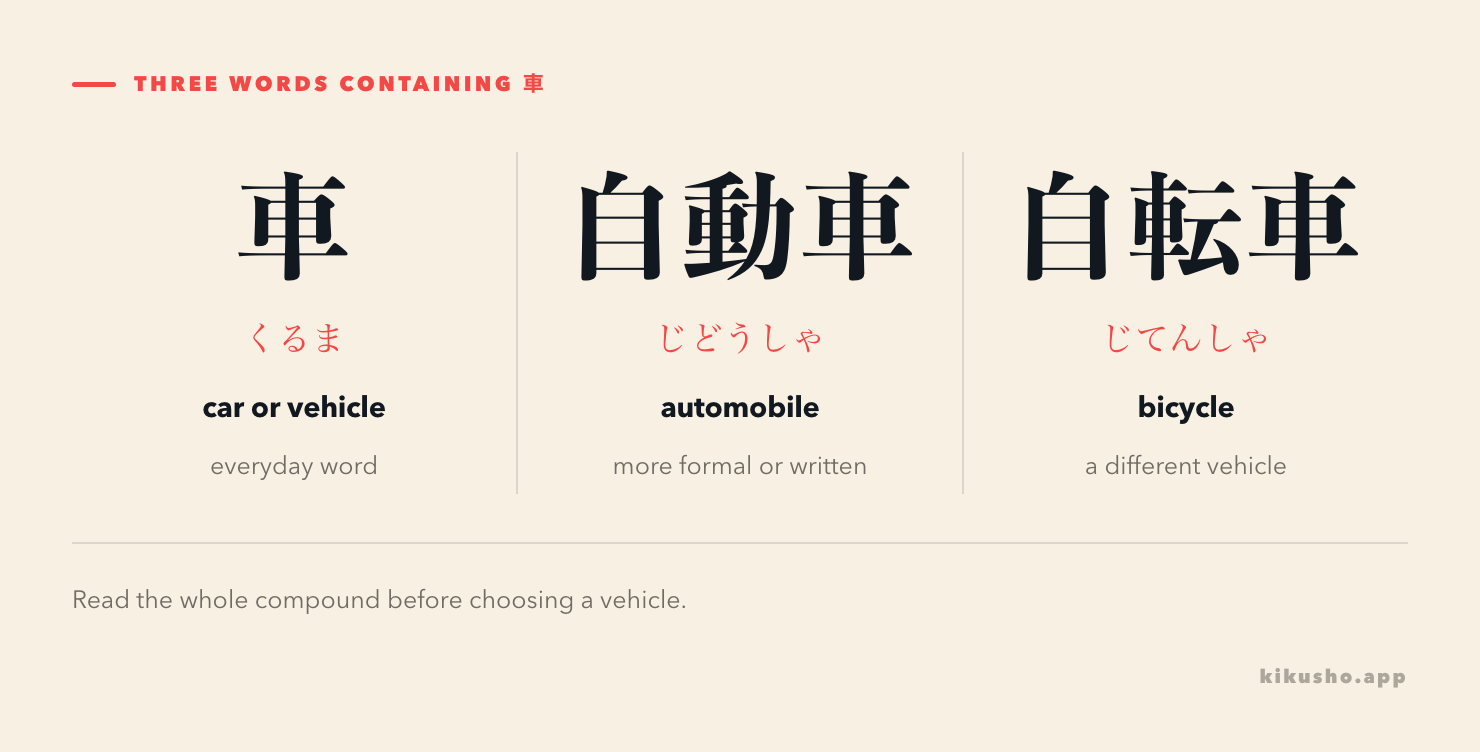
車(くるま) is an everyday car or vehicle word. 自動車(じどうしゃ) is specifically an automobile and can sound more formal or written. 自転車(じてんしゃ) is a bicycle, even though it shares 車. Compare 車で行きます (go by car) with 自転車で行きます (go by bicycle): the same travel-means で, different vehicle. You can also say 自転車に乗ります when the action is riding it. NINJAL's 車 entry and 自動車 entry document the near-synonyms and examples; a Tokyo Japanese-school teacher gives 自転車に乗る and distinguishes it from 車を運転する, driving a car.
A first route to practise
At a station, read 駅 and 切符 if they appear on a sign. Say 電車に乗ります for boarding and 電車を降ります for leaving; if you switch to a bus, say バスに乗ります for that boarding action. Use 駅に着きます when you reach the station and 道を歩きます for the road you walk along. A transport photo or a phrase you heard on that route can become a Kikusho card after you check its reading and meaning. Keep the phrase with the verb so the particle survives on the card.
Check yourself
Question 1. What is the reading of 切符 in 「切符を買います」? Choose one: a) きっぷ b) きぷ c) きふ d) きっふ.
Question 2. Which spelling is じてんしゃ, a bicycle? Choose one: a) 車 b) 自動車 c) 自転車 d) 電車.
Question 3. Fill the particle for the vehicle boarded: 「駅で電車_乗ります。」 Choose one: a) に b) を c) で.
Question 4. Fill the particle for the vehicle left: 「次の駅でバス_降ります。」 Choose one: a) に b) を c) で.
Question 5. Which sentence means "I go by train" rather than "I board the train"? Choose one: a) 電車に乗ります b) 電車で行きます c) 電車を降ります.
Question 6. Which sentence means "I arrive at the station"? Choose one: a) 駅で着きます b) 駅を着きます c) 駅に着きます.
Answers and explanations
Answer 1. a) きっぷ. The small っ doubles the following consonant, and the final sound is ぷ. The other options alter one or both parts of the reading.
Answer 2. c) 自転車. 車 alone is car or vehicle; 自動車 is automobile; 電車 is train. Their shared 車 does not make them interchangeable.
Answer 3. a) に. 駅で already marks the boarding place. 電車に is the vehicle you board with 乗る; 電車で would describe a travel means with a different verb, such as 行く.
Answer 4. b) を. バスを is the vehicle you leave with 降りる. 次の駅で marks where you get off; に would go with boarding the bus, not leaving it.
Answer 5. b) 電車で行きます. で marks the means of travel, "by train." a) describes boarding and c) describes getting off, not the journey's means.
Answer 6. c) 駅に着きます. 駅 is the destination reached with 着く. 駅で would mark an action location with a suitable action verb; 駅を does not mark this arrival destination.
Common questions
Which particle goes with the vehicle in 乗る and 降りる?
Use に for the vehicle you board, as in 電車に乗ります, and を for the vehicle you leave, as in 電車を降ります. The verbs describe different actions, so the vehicle takes a different particle.
Why is it 駅で電車に乗ります but 駅に着きます?
駅で marks the station where boarding happens. 電車に marks the train boarded. 駅に marks the destination reached with 着く. The noun's role changes with the verb.
Do 車, 自動車 and 自転車 mean the same thing?
車 is the everyday word for a car or vehicle. 自動車 specifies an automobile and sounds more formal. 自転車 is a bicycle, so it is a different mode of travel.
Is a word for changing trains in this fourteen-word set?
No. The assigned words cover vehicles, stations, roads, boarding, leaving and arriving. 乗り換える is useful for a transfer, but it is additional context, not one of the fourteen words taught and reviewed here.