On this page
These eleven N5 words let you describe a complete study session: go to 学校 or 図書館, use a ノート, do 宿題, write a 作文, and 覚える the 漢字 you learned. The useful unit is not the isolated English gloss, but the short Japanese partner: 漢字を覚える, 作文を書く, and 図書館で勉強する.
Eleven school and study words with their partners
The table gives the assigned spelling and reading for every item in this set. Read the phrase partner as one small unit. The extra words in those phrases supply context; they are not additional vocabulary counted in this lesson.
| Role in a study session | Word | Reading | Meaning and part of speech | Phrase partner |
|---|---|---|---|---|
| Place | 学校 | がっこう | school; noun | 学校へ行く, go to school |
| Place | 図書館 | としょかん | library; noun | 図書館で勉強する, study at the library |
| Material | ノート | のーと | notebook; notes; noun | ノートに書く, write in a notebook |
| Work | 宿題 | しゅくだい | homework; noun | 宿題をする, do homework |
| Work | 作文 | さくぶん | composition; composing; noun / する verb | 作文を書く, write a composition |
| Text | 文章 | ぶんしょう | text, passage, connected writing; noun | 文章を読む, read a passage |
| Writing system | 漢字 | かんじ | kanji, Chinese character; noun | 漢字を覚える, learn kanji |
| Teaching action | 教える | おしえる | teach; tell; transitive verb | 学生に漢字を教える, teach kanji to a student |
| Learning action | 習う | ならう | learn through instruction; transitive verb | 先生に日本語を習う, learn Japanese from a teacher |
| Memory action | 覚える | おぼえる | remember, learn, memorise; transitive verb | 新しい言葉を覚える, learn a new word |
| Memory failure | 忘れる | わすれる | forget; transitive verb | 宿題を忘れる, forget homework |
The small っ in 学校(がっこう) closes the first beat before こう; do not read it がこう. ノート has a long ノー, even though its kana reading is sometimes shown in hiragana as のーと in a vocabulary list. In ordinary writing, keep the katakana spelling ノート.
Search results for this topic often mix classroom people, supplies, subjects and work vocabulary into one long list. A current school-and-work list, for example, includes 学校, ノート and 図書館 with short sentences. This lesson has a narrower job: it connects all eleven assigned words through the roles they actually take in a study session.
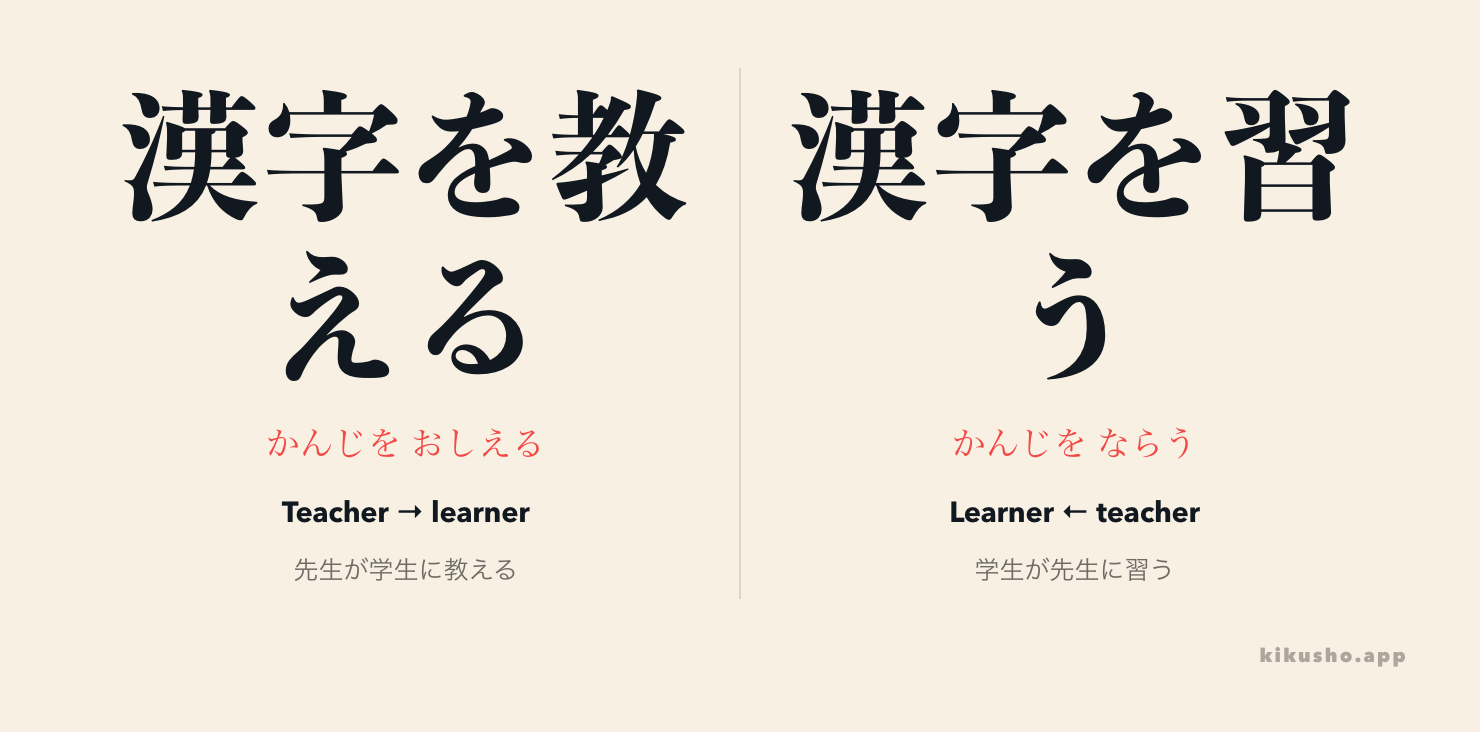
教える and 習う show the same lesson from opposite sides
先生が学生に漢字を教えます。
せんせいが がくせいに かんじを おしえます。
The teacher teaches kanji to the student.
Here 先生 is the teacher, 学生に identifies the learner, and 漢字を identifies the content being taught. 教える looks outward from the person who supplies the information or instruction.
学生が先生に漢字を習います。
がくせいが せんせいに かんじを ならいます。
The student learns kanji from the teacher.
The event can be the same, but the viewpoint changes. Now the student is the actor, 先生に identifies the source of instruction, and 漢字を is what the student learns. The NINJAL usage dictionary describes 習う as learning a skill or systematic knowledge with someone's guidance. Its separate 教える entry records both teaching and telling or showing information.
That second sense of 教える matters outside a classroom. 道を教えてください means “Please tell me the way” or “Please show me the route.” No formal lesson is taking place. The common thread is that one person gives another information they did not have.
The short pairs are therefore worth storing whole:
- 先生が学生に教える: the teacher teaches the student.
- 学生が先生に習う: the student learns from the teacher.
- 漢字を教える/習う: kanji is the taught or learned content.
This is vocabulary with a particle frame, not a complete lesson on に and を. The N5 direct-object lesson develops what を marks; the place-particle lesson separates recipients, destinations and activity locations.
覚える builds the memory; 忘れる loses it
覚える can mean remember, learn or memorise. In a study routine, 漢字を覚える means getting a kanji into memory rather than merely looking at it once. The NINJAL dictionary gives the natural study example 日本語の勉強ではまずひらがなを覚える, “In studying Japanese, first learn hiragana,” in its entry for まず.
毎日、漢字を三つ覚えます。
まいにち、かんじを みっつ おぼえます。
I learn three kanji every day.
忘れる points in the other direction. 漢字を忘れる means the kanji no longer comes back when needed. 宿題を忘れる can mean forgetting the homework itself or forgetting to deal with it, depending on the situation. If the object was left in a place, name that place with に:
学校にノートを忘れました。
がっこうに ノートを わすれました。
I left my notebook at school.
That sentence does not mean the speaker forgot what a notebook is. The notebook remains at school because the speaker failed to take it. Context decides whether 忘れる concerns information, a duty, or an object left behind.
Learning and forgetting are not exact opposites in every construction, but 漢字を覚える/漢字を忘れる makes a clean practice pair. Keep the same object and exchange the verb; the meaning change stays visible.
作文 is the composition task; 文章 is the text
English “writing” can hide two different nouns. 作文 is composing a piece of writing or the resulting composition, especially a school assignment. 文章 is the written text or connected passage that expresses a thought or topic.
今日は日本語で作文を書きます。
きょうは にほんごで さくぶんを かきます。
Today I will write a composition in Japanese.
この文章を読んでください。
この ぶんしょうを よんでください。
Please read this passage.
Shogakukan's dictionary entry for 作文 includes both writing a text and the school composition produced by a pupil. Its entry for 文章 describes text that joins sentences into a meaningful whole. In everyday use, 文章 can sometimes refer to one written sentence too, but it is broader than the grammatical unit 文, “sentence.”
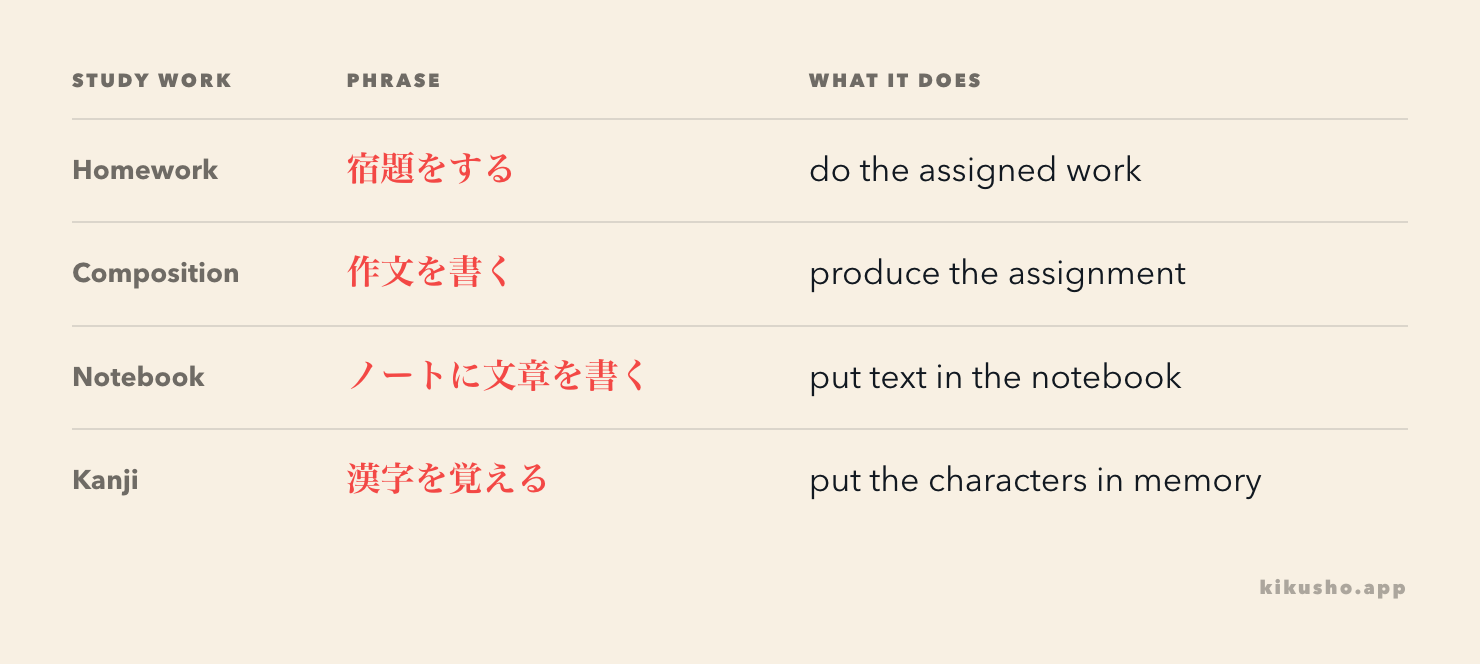
The safest beginner pair is 作文を書く for producing the assignment and 文章を読む for reading the text. You can also say 文章を書く when the focus is writing text rather than completing a named composition task. The two nouns overlap, but they are not interchangeable labels in every school situation.
学校 and 図書館 change role with the verb
Both place words can be destinations or activity sites. The verb decides the role:
| Place role | School | Library |
|---|---|---|
| Destination | 学校へ行く, go to school | 図書館へ行く, go to the library |
| Activity site | 学校で習う, learn at school | 図書館で勉強する, study at the library |
In 学校へ行く, へ points toward the destination. In 図書館で勉強する, で marks where the studying happens. Saying “school takes へ” or “library takes で” would miss the pattern: the same place can take either marker when the sentence gives it a different job.
The N5 place-particle comparison teaches this distinction in full. Here, remember the two vocabulary phrases as parts of a study route: first 図書館へ行く, then 図書館で勉強する.
ノート and 宿題 need ordinary Japanese partners
ノート usually means a notebook or the notes kept in one, not a single short message. ノートに書く names the notebook as the writing surface or destination. ノートを取る means to take notes. The object marked by を is the notes as a record, not a physical notebook being picked up.
宿題 pairs naturally with する:
図書館で宿題をします。
としょかんで しゅくだいを します。
I do homework at the library.
The sentence combines three roles without confusion: 図書館で gives the activity site, 宿題を gives the work being done, and します gives the action. You can extend it with a tool or record: ノートに答えを書きます, “I write the answer in my notebook.”
The earlier home and classroom vocabulary lesson covers the desk, pencil, paper and reading materials around this notebook. This lesson starts where that object list stops: it pairs the materials with studying, teaching, remembering and forgetting.
Keep a study event, not an English list
Imagine one short sequence: 学校で先生に漢字を習います。図書館で宿題をして、ノートに作文を書きます。新しい漢字を覚えます。 You learn kanji from a teacher at school, do homework at the library, write a composition in a notebook, and learn the new kanji.
That sequence gives every word a role. If you meet one on a notice or worksheet, save enough of its phrase to preserve that role. A Kikusho card for 習う is more useful with 先生に日本語を習う than with the English word “learn” alone; the sentence keeps the source, subject and action together for later review.
The eleven items are assigned to Kikusho's N5 curriculum inventory. They are not presented as an official exhaustive test list. The JLPT FAQ explains that the test organisers no longer publish a complete vocabulary, kanji and grammar specification, so practical study order must use declared editorial sources and dated inventories.
Practice: finish all seven before checking
Question 1 — reading. Which reading matches 図書館?
- ① としょうかん
- ② としょかん
- ③ ずしょかん
- ④ としょがん
Question 2 — spelling. Which written word matches しゅくだい, “homework”?
- ① 宿題
- ② 宿代
- ③ 縮題
- ④ 宿台
Question 3 — context. A teacher is giving kanji instruction to students. Complete 先生は学生に漢字を( )。
- ① 習います
- ② 忘れます
- ③ 教えます
- ④ 覚えます
Question 4 — context. You are the learner receiving Japanese instruction from a teacher. Complete 私は先生に日本語を( )。
- ① 習います
- ② 教えます
- ③ 忘れます
- ④ 書きます
Question 5 — paraphrase. Which Japanese phrase restates “write a school composition”?
- ① 文章を教える
- ② 作文を書く
- ③ 漢字を行く
- ④ 宿題を読む
Question 6 — context. You studied new characters and can now recall them. Complete 新しい漢字を三つ( )。
- ① 行きました
- ② 習いました
- ③ 教えました
- ④ 覚えました
Question 7 — orthography and use. Which sentence correctly writes the notebook word and says “I write in a notebook”?
- ① ノトを書きます。
- ② ノートを書きます。
- ③ ノートに書きます。
- ④ のおとで書きます。
Answers and explanations
Answer 1. ② としょかん. 図書館 is “library.” Choice ① inserts a long vowel that is not in the reading; ③ begins with ず instead of と; ④ voices the final consonant.
Answer 2. ① 宿題. 宿題 is しゅくだい, homework. The other choices replace one of its kanji with a character that does not form the assigned word.
Answer 3. ③ 教えます. The teacher is the actor, 学生に identifies the learners, and 漢字を is the content taught. 習います would normally put the learner in the actor role. 覚えます and 忘れます describe memory, not the teacher supplying instruction here.
Answer 4. ① 習います. 先生に日本語を習います presents the speaker as learning Japanese through the teacher's instruction. 教えます would reverse the direction and make the speaker teach; the other choices do not express receiving instruction.
Answer 5. ② 作文を書く. 作文 names the composition task or product, and 書く is the ordinary verb for writing it. 文章 is text or a passage, but 教える does not mean “write.” Choice ③ gives 漢字 an impossible destination frame, while ④ says “read homework” instead of doing or writing it.
Answer 6. ④ 覚えました. 漢字を三つ覚えました means “I learned three kanji.” 習いました could describe receiving instruction in a subject, but this prompt says the three characters can now be recalled. 行きました is movement; 教えました would make the speaker the teacher.
Answer 7. ③ ノートに書きます. ノート keeps the katakana long-vowel mark, and に marks the notebook as where the writing goes. Choice ② means “I write a notebook,” treating the physical notebook as the thing composed. Choice ① drops the long vowel; ④ changes the spelling and uses で as if the notebook were an instrument.
Common questions
What is the difference between 教える and 習う?
教える(おしえる)describes the teacher's action: teaching or telling someone something. 習う(ならう)describes the learner's action: learning a subject or skill through instruction. The same lesson can therefore be 先生が学生に漢字を教える from the teacher's viewpoint and 学生が先生に漢字を習う from the student's viewpoint.
What is the difference between 作文 and 文章?
作文(さくぶん)is the act or product of composing a piece of writing, especially a school composition. 文章(ぶんしょう)is the written text or connected passage itself. You can write a 作文, and that composition is made of 文章.
Does ノート mean one short note in Japanese?
Usually not in this beginner school context. ノート(のーと)means a notebook or the notes kept in it. ノートに書く means to write in a notebook, while ノートを取る means to take notes.
Are these eleven words an official JLPT N5 list?
They are the eleven items assigned to this lesson in Kikusho's dated N5 inventory. The JLPT no longer publishes an exhaustive official list of vocabulary, kanji and grammar, so level labels from study lists are study guidance rather than a promise about a particular test.