On this page
These 16 N3 vocabulary records let you describe what an object is made of, the form it takes and whether an edge or observation is sharp. The set contains 12 visible headwords, because 管, 球 and 円 each appear with more than one reading and the reading changes how the word is normally used.
Sixteen records describe objects from material to form
| Headword | Reading | Word class and practical meaning | Useful combination |
|---|---|---|---|
| 板 | いた, ita | noun; board, plank or flat plate | 木の板 |
| 円 | えん, en | noun; circle; yen | 円を描く |
| 管 | かん, kan | noun; pipe or tube, especially technical; counter for tubes | 試験管 |
| 球 | きゅう, kyū | noun; sphere or ball, especially formal or technical | 球の直径 |
| 金属 | きんぞく, kinzoku | noun; metal as a class of material | 金属製 |
| 銀 | ぎん, gin | noun; silver | 銀の指輪 |
| 管 | くだ, kuda | noun; pipe or tube as an ordinary physical object | 細い管 |
| 四角 | しかく, shikaku | noun; square, rectangle or four-cornered form | 四角い箱 |
| 磁器 | じき, jiki | noun; porcelain, china | 磁器の皿 |
| 鋭い | するどい, surudoi | i-adjective; sharp, pointed or keen | 鋭い刃 |
| 球 | たま, tama | noun; ball or rounded object in everyday language | ガラスの球 |
| 鉄 | てつ, tetsu | noun; iron | 鉄の棒 |
| プラスチック | ぷらすちっく, purasuchikku | noun; plastic, synthetic resin material | プラスチック製 |
| 棒 | ぼう, bō | noun; pole, rod or stick | 長い棒 |
| 丸 | まる, maru | noun; circle, round mark, whole or completeness | 丸を付ける |
| 円 | まる, maru | noun; round mark or circle, an alternate spelling of 丸 | 円を書く |
Kikusho's September 2026 reference inventory places these records in the N3 lesson, but four have unstable borders. One Waller-derived row places 管(かん) and 磁器 at N3 while another puts them at N1; the same family splits 四角 and プラスチック between N3 and N2. Those are inherited editorial differences, not four independent JLPT decisions. A separate comparison page also lists 金属 as N3 vocabulary. The JLPT organisers do not publish an exhaustive vocabulary syllabus, so learn the language and treat the level label as a study estimate.
板, 棒, 管 and 球 progress from flat to solid and hollow forms
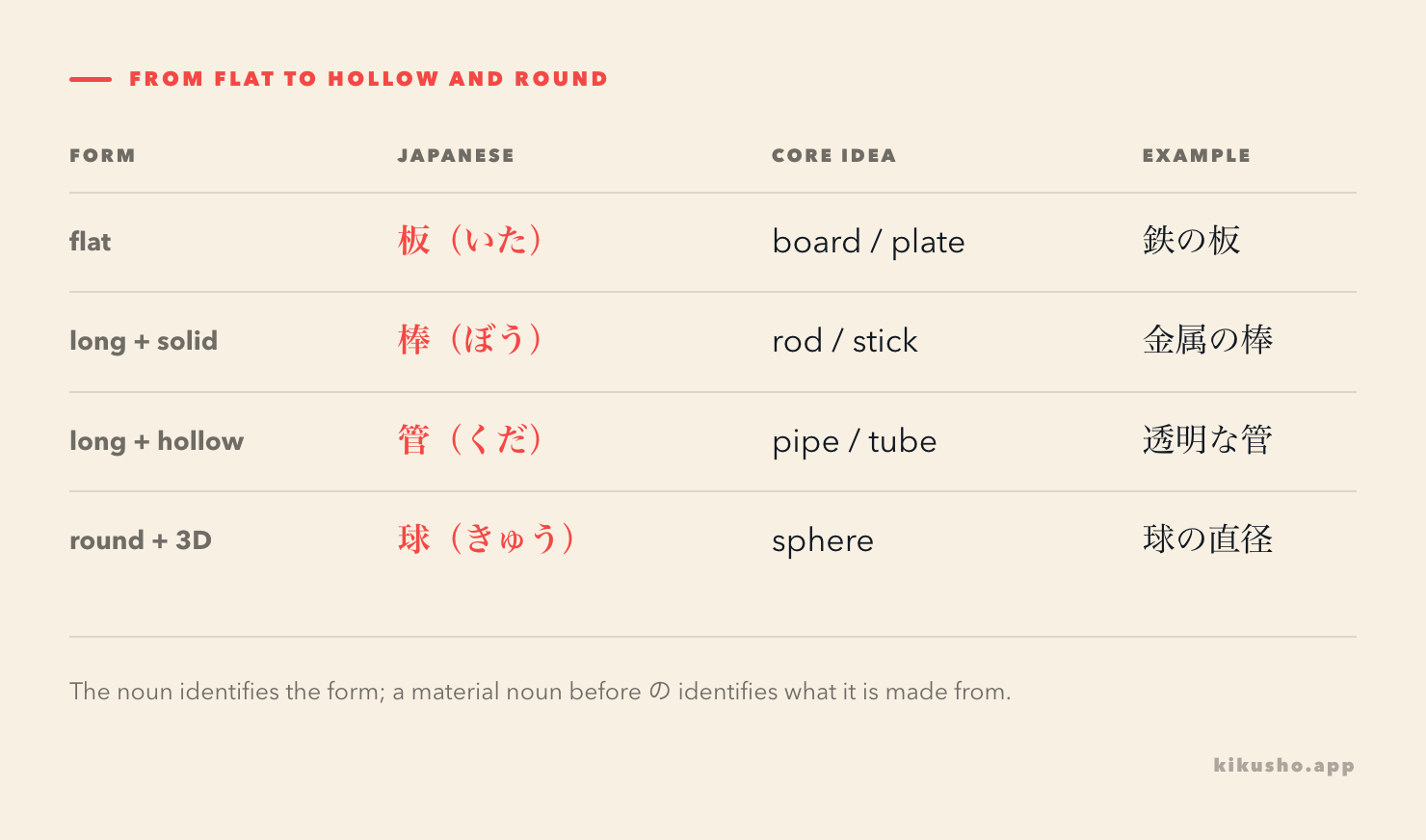
板 is a broad, flat, usually rigid piece. A 木の板 is a wooden board; a 鉄の板 is an iron plate. The word names the form, while the noun before の names the material.
作業台の上に、薄い鉄の板を置きました。
さぎょうだいの うえに、うすい てつの いたを おきました。
I placed a thin iron plate on the workbench.
棒 is long and solid: a rod, pole or stick. You can hold a 棒, stir with it or use it as a support.
この金属の棒は重いですが、簡単には曲がりません。
この きんぞくの ぼうは おもいですが、かんたんには まがりません。
This metal rod is heavy, but it does not bend easily.
管 is long and hollow, so liquid, gas or another object can pass through it. The dictionary entry for 管 records both かん and くだ and also the counter use of かん.
透明な管の中を水が流れています。
とうめいな くだの なかを みずが ながれています。
Water is flowing through the transparent tube.
球 is a three-dimensional round body. A circle is flat, but a sphere has volume.
この球の直径を測ってください。
この きゅうの ちょっけいを はかって ください。
Please measure the diameter of this sphere.
That distinction connects directly to the N3 measurement lesson: you can measure a 板's 幅, a 棒's 長さ, a 管's 内径 and a 球's 直径.
The reading chooses the register for 管 and 球
The physical meaning can remain close while the social setting changes. Native Japanese readings often sound natural for a standalone everyday object; Sino-Japanese readings are common in technical descriptions and compounds.
| Written form | Everyday reading | Formal or compound reading | Examples |
|---|---|---|---|
| 管 | くだ | かん | 細い管(くだ); 試験管(しけんかん); 血管(けっかん) |
| 球 | たま | きゅう | ガラスの球(たま); 球形(きゅうけい); 地球(ちきゅう) |
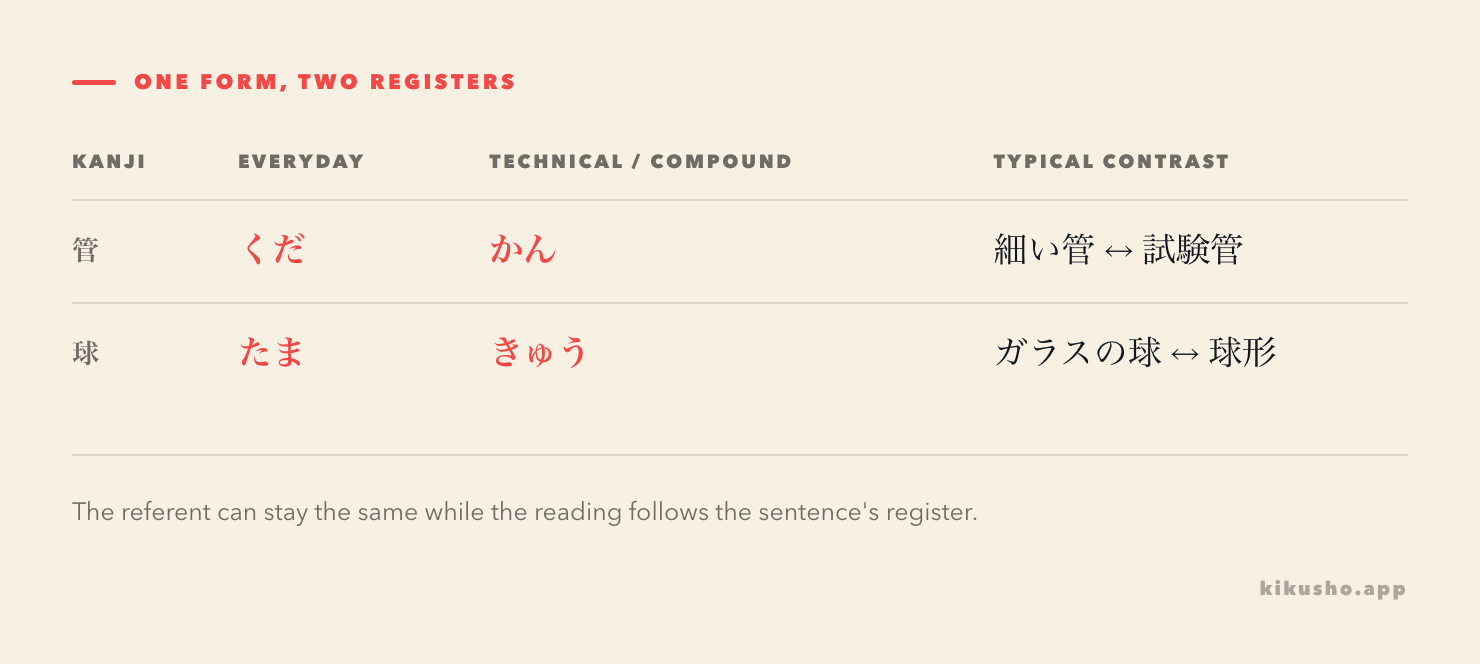
Say ゴムの管(くだ) when pointing to a rubber tube on the table. In a laboratory inventory, 試験管(しけんかん) is a test tube, and 金属管(きんぞくかん) is a metal pipe. As a counter, 二管(にかん) can mean two tubes, although ordinary conversation often counts the objects with 本.
For 球, たま is the independent everyday word in a phrase such as ガラスの球, a glass ball. きゅう names the geometric sphere and appears in compounds: 球形, spherical form; 地球, Earth; 電球, light bulb. The dictionary record for 球 connects both readings with round objects while showing their different compound patterns.
円, 丸 and 四角 separate geometry from everyday marks
円(えん) is the safe word for a geometric circle. It also names Japan's currency unit, so context decides whether 百円 means one hundred yen or whether 円 is part of a mathematics sentence.
紙に半径五センチの円を描きました。
かみに はんけい ごセンチの えんを かきました。
I drew a circle with a radius of five centimetres on the paper.
丸(まる) is the everyday round mark or round form. Teachers put a 丸 beside a correct answer, and 丸を付ける means to mark something with a circle. It can also suggest completeness in words such as 丸一日, a whole day.
円(まる) is an alternate written form of that same everyday noun. It occurs, but it is less helpful to a learner because 円 strongly invites the readings えん and the meaning “yen.” Use 円(えん) for geometry and 丸(まる) for an ordinary circular mark unless a source supplies the alternate spelling.
四角 literally points to four corners. Depending on the object, it may mean a square, rectangle or boxy four-sided form. 四角い is the adjective used before a noun.
四角い紙の中央に、大きな丸を書いてください。
しかくい かみの ちゅうおうに、おおきな まるを かいて ください。
Please draw a large circle in the centre of the square sheet of paper.
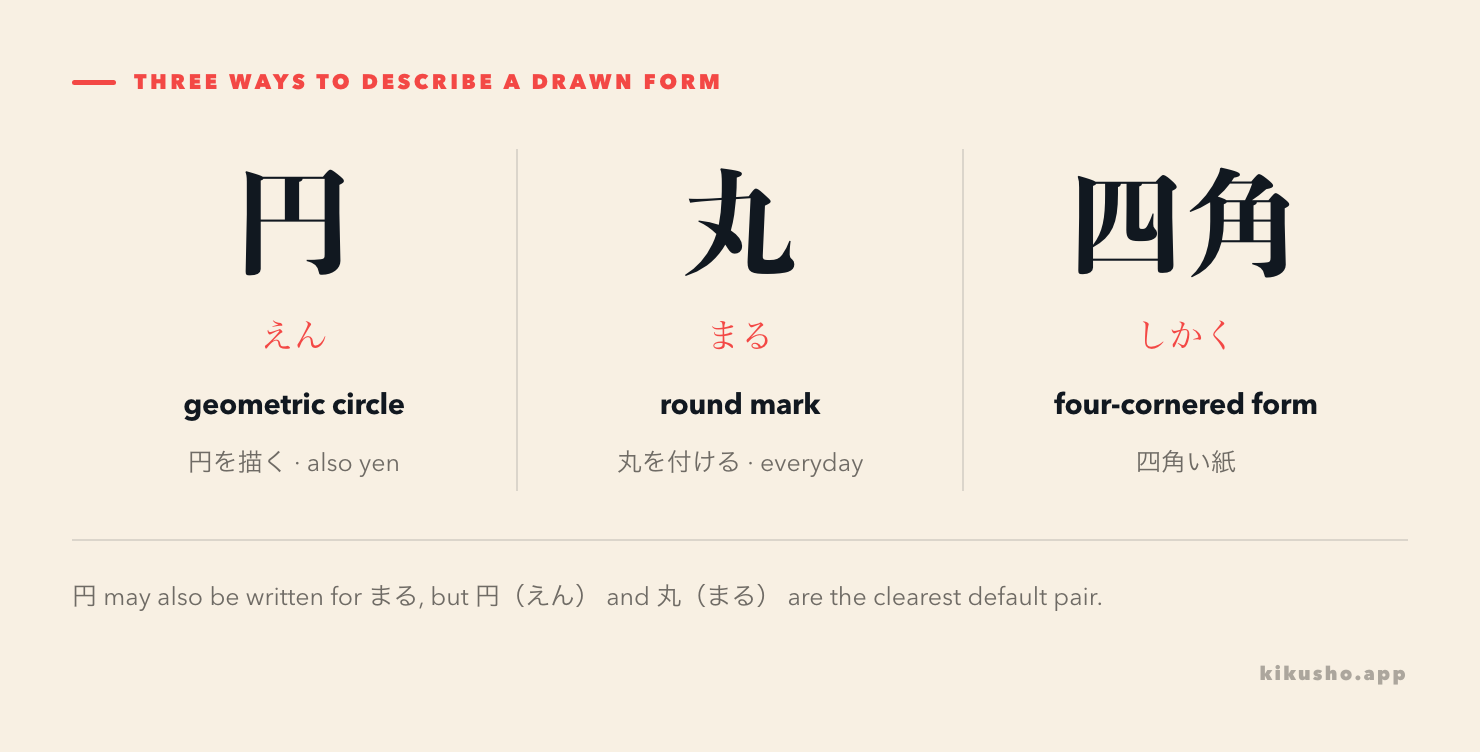
The dictionary entry for 円 covers the geometric, monetary and round senses. In a reading question, do not choose まる merely because the picture is round. First ask whether the sentence describes geometry, money, a written mark or an everyday shape.
金属 is the category; 鉄 and 銀 name particular metals
金属 is the broad material category. Metals generally conduct heat and electricity, have a characteristic lustre and can be shaped, although individual metals do not share every property. A label ending in 〜製 states what an item is made from: 金属製, made of metal.
この容器は金属製なので、電子レンジに入れないでください。
この ようきは きんぞくせいなので、でんしレンジに いれないで ください。
This container is made of metal, so do not put it in the microwave.
鉄 is iron, a specific metal. It appears in 鉄の棒, an iron rod, 鉄板, an iron plate, and 鉄道, railway. Iron is strong and magnetic, but untreated iron can rust.
銀 is silver. The same noun can refer to the metal, a silver colour or something made from silver, depending on the expression: 銀の指輪, a silver ring; 銀色, silver-coloured. The category relation is simple: 鉄 and 銀 are both 金属.
The definitions of 金属 and 鉄 support the category and material distinction. In a description, choose the most informative true word. If the precise metal is known, 鉄 is more specific than 金属.
プラスチック and 磁器 describe non-metal materials
プラスチック is plastic, a group of synthetic resin materials that can be moulded into many forms. It is a material word, so it combines naturally with 製 or の.
- プラスチック製の管: a plastic tube
- プラスチックの板: a plastic sheet or board
- プラスチックの球: a plastic ball
磁器 is porcelain or china. It is commonly hard, vitrified, pale, minimally absorbent and sometimes slightly translucent. Cups, plates and laboratory vessels may be made from it.
白い磁器の皿に、金属のスプーンを置きました。
しろい じきの さらに、きんぞくの スプーンを おきました。
I placed a metal spoon on the white porcelain plate.
Do not automatically translate every ceramic object as 磁器. 陶器 refers broadly to pottery or earthenware and tends to be more opaque and absorbent. The porcelain entry and pottery entry describe a continuum rather than a perfectly sharp visual border. When the manufacturing material is unknown, 陶磁器, ceramics, safely groups both.
鋭い describes an edge, a sense or an observation
鋭い first describes a point or edge that can pierce or cut: 鋭い針, a sharp needle; 鋭い刃, a sharp blade. Its meaning then extends to perception and thought.
- 鋭い目: a keen eye
- 鋭い感覚: acute senses
- 鋭い質問: a penetrating question
- 鋭い観察: a keen observation
その研究者は、小さな変化にも気づく鋭い目を持っています。
その けんきゅうしゃは、ちいさな へんかにも きづく するどい めを もって います。
That researcher has a keen eye that notices even small changes.
The physical and figurative meanings share an image: something sharp reaches a point or notices a distinction quickly. The dictionary entry for 鋭い records both pointed edges and keen perception.
A catalogue description can combine all sixteen records
箱の中には、鉄の板、銀色の棒、透明なプラスチックの管、白い磁器の球が入っています。板と棒はどちらも金属製です。管(くだ)は細いですが、説明書では「管(かん)」と書かれています。球(たま)は手のひらに乗る大きさで、図では球(きゅう)として直径が示されています。円(えん)の図の横には丸(まる)が付き、別の欄では円を「まる」と読ませています。四角い板の角は鋭いので、手袋をしてください。
The box contains an iron plate, a silver-coloured rod, a transparent plastic tube and a white porcelain ball. The plate and rod are both made of metal. The tube is thin; the instructions write the same object with the technical reading かん. The ball fits in the palm, and the diagram treats it as a geometric sphere and gives its diameter. A round mark appears beside the circle diagram, while another field uses 円 with the reading まる. The corners of the rectangular plate are sharp, so wear gloves.
The paragraph shows why a card needs more than an English gloss. 管 and 球 can keep the same physical referent while their reading follows the context. 円, 丸 and 四角 need a sentence that tells you whether the writer means geometry, a mark or a four-cornered object. When Kikusho builds a card from a real sentence, preserve that combination instead of reducing everything to “shape” or “material.”
The N2 continuation replaces broad 四角 with 三角, 正方形 and 長方形, then adds line orientation and material properties.
Practice
1 · Porcelain label. Choose the reading of 磁器.
- A. じき
- B. ぎん
- C. てつ
- D. しかく
2 · Object form. Which word describes something long and solid rather than long and hollow?
- A. 球
- B. 管
- C. 棒
- D. 板
3 · Everyday tube. Complete the sentence: 水は細い( )の中を流れている。
- A. 管(くだ)
- B. 管(かん)
- C. 球(きゅう)
- D. 円(えん)
4 · Technical compound. Which is the standard reading of 試験管?
- A. しけんくだ
- B. じっけんくだ
- C. じっけんかん
- D. しけんかん
5 · Geometric description. Which sentence clearly refers to a sphere rather than a flat circle?
- A. 円に丸を付けた。
- B. 球の直径を測った。
- C. 四角い紙を切った。
- D. 丸を三つ書いた。
6 · Material hierarchy. Which statement is correct?
- A. 金属 is one type of 鉄.
- B. 銀 and 鉄 are types of 金属.
- C. プラスチック is a type of 銀.
- D. 磁器 is always made of 鉄.
7 · Natural combination. Which phrase means “a plastic tube”?
- A. プラスチック製の管
- B. プラスチック鋭い管
- C. 管製のプラスチック
- D. プラスチックを球の管
8 · Circle in geometry. Complete the instruction: コンパスで( )を描いてください。
- A. 銀
- B. 円
- C. 磁器
- D. 鉄
9 · Figurative property. In 鋭い質問, what does 鋭い mean?
- A. physically round
- B. made of metal
- C. penetrating or perceptive
- D. hollow
10 · Connected text. 図では「球の直径は十センチ」と書いてありますが、会話では「この( )は軽いね」と言いました。 Which reading best fits the everyday conversation?
- A. きゅう
- B. えん
- C. かん
- D. たま
Check all ten answers
1 · A. 磁器 is read じき and means porcelain or china.
2 · C. 棒 is a solid rod or stick. 管 is hollow, 板 is flat, and 球 is round in three dimensions.
3 · A. 管(くだ) is natural for the standalone physical tube in an everyday sentence. The kan reading かん is common in technical use and compounds.
4 · D. 試験管 is read しけんかん. 管 takes its Sino-Japanese reading in this compound.
5 · B. A 球 is a three-dimensional sphere, and its diameter can be measured through its centre. 円 and 丸 describe flat circular forms or marks here.
6 · B. 金属 is the broad category; 銀 and 鉄 are particular metals.
7 · A. プラスチック製の管 states that the tube is made of plastic. 〜製 attaches to the material name.
8 · B. 円を描く is the standard geometric expression for drawing a circle with a compass.
9 · C. 鋭い extends from a sharp edge to keen perception, so 鋭い質問 is a penetrating question.
10 · D. The diagram uses the formal geometric reading きゅう, while この球(たま) fits an everyday comment about the ball-like object.
Common questions
What is the difference between 管 read かん and 管 read くだ?
Both can mean a pipe or tube. くだ is the usual standalone word for a physical tube, while かん is common in technical language and compounds such as 試験管, 血管 and 配管. 管 read かん can also be a counter for tubes.
What is the difference between 球 read きゅう and 球 read たま?
きゅう is the formal or technical reading used for a sphere and in compounds such as 地球 and 電球. たま is the everyday reading for a ball or rounded object. The object can be similar, but the register differs.
How are 円, 丸 and 四角 different?
円 read えん is the mathematical circle and the currency unit yen. 丸 read まる is an everyday round mark, round form or complete whole. 円 may also be read まる as a written variant of 丸. 四角 means a four-cornered shape and may describe a square, rectangle or boxy form depending on context.
What is the difference between 磁器 and 陶器?
磁器 is porcelain: usually hard, vitrified, pale and minimally absorbent. 陶器 is pottery or earthenware: generally more opaque and absorbent. The manufacturing boundary is continuous, so appearance alone is not always decisive.