On this page
The 13 words in this N3 money set are 金(かね)、給料、金(きん)、現金、硬貨、高価、小銭、札、支出、借金、収入、貯金 and 両替. They separate the money itself from its form, its price, what comes in, what goes out and what remains as savings or debt.
Thirteen words form three practical groups
Three reading traps organise the set. The spelling 金 represents separate headwords read かね and きん. 硬貨 and 高価 are both こうか. The money reading of 札 normally appears as お札 or after a denomination, as in 千円札.
| Assigned word | Reading | Word class and sense here | Phrase to keep |
|---|---|---|---|
| 金 | かね, kane | noun; money, normally お金 in neutral speech | お金を使う: spend money |
| 給料 | きゅうりょう, kyūryō | noun; salary, wages, pay for work | 給料をもらう: receive one's pay |
| 金 | きん, kin | noun; gold | 金でできた指輪: a ring made of gold |
| 現金 | げんきん, genkin | noun; cash | 現金で払う: pay in cash |
| 硬貨 | こうか, kōka | noun; coin | 百円硬貨: a 100-yen coin |
| 高価 | こうか, kōka | noun; na-adjective; high-priced, expensive | 高価な時計: an expensive watch |
| 小銭 | こぜに, kozeni | noun; coins or small change | 小銭を用意する: prepare small change |
| 札 | さつ, satsu | noun; banknote in お札 and denomination compounds | 千円札: a 1,000-yen note |
| 支出 | ししゅつ, shishutsu | noun; suru verb; expenditure, money paid out | 支出を減らす: reduce expenses |
| 借金 | しゃっきん, shakkin | noun; suru verb; debt, borrowing | 借金を返す: repay a debt |
| 収入 | しゅうにゅう, shūnyū | noun; income, money received | 収入が増える: income increases |
| 貯金 | ちょきん, chokin | noun; suru verb; savings, saving money | 毎月貯金する: save every month |
| 両替 | りょうがえ, ryōgae | noun; suru verb; money or currency exchange | 円をドルに両替する: exchange yen for dollars |
Current N3 guides from Nanako's JLPT Cafe and WKWK Japan independently group overlapping cash, savings, debt and exchange words at N3. The sources below verify the particular uses.
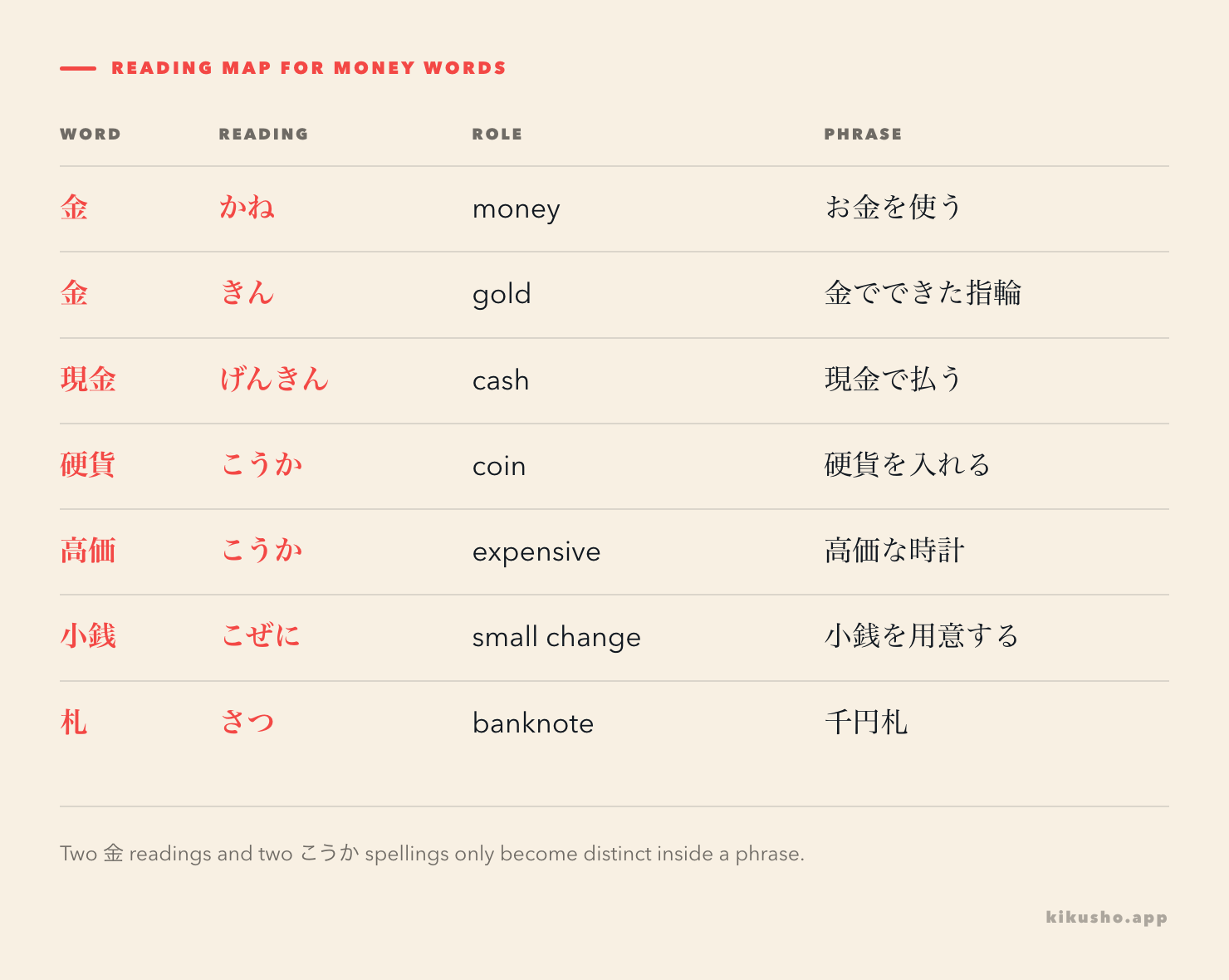
金 changes from money to gold when the reading changes
金(かね) means money. In ordinary neutral conversation, the polite prefix is common: お金(おかね).
今月はお金を使いすぎました。
こんげつはおかねをつかいすぎました。
I spent too much money this month.
Bare 金(かね) appears readily in casual statements such as 金がない, “I have no money,” and in fixed combinations. Using お金 gives you a safer conversational starting point. Shogakukan's 金 entry separates the かね money headword from the きん gold headword.
金(きん) is gold, the metal:
この指輪は金でできています。
このゆびわはきんでできています。
This ring is made of gold.
Here でできている identifies the material. The reading きん also appears inside many compounds in this lesson: 現金, 借金 and 貯金. That does not make each compound a type of gold. Store the complete word and its reading rather than assigning one English meaning to the character.
奨学金(しょうがくきん), covered in the N3 university vocabulary lesson, ends in きん because 金 is a compound element; isolated お金 keeps かね. In shogi, 金 can also abbreviate 金将(きんしょう), the gold general, a specialised sense separate from the material here.
現金 contains both coins and notes
現金(げんきん) is cash as a payment method or money physically available. It contrasts with a card, transfer or other non-cash method:
この店では現金で払いました。
このみせではげんきんではらいました。
I paid in cash at this shop.
The particle で marks the method. The N4 shopping lesson teaches 払う, price and returned change; this lesson divides cash into 硬貨 and 札. A separate adjective use, 現金な人, describes somebody calculating or quick to change attitude for personal advantage.
硬貨(こうか) is the category word for a coin. The Bank of Japan's educational page pairs 銀行券(お札), banknotes, with 貨幣(硬貨), coins.
The spelling 札 also names a tag, label or charm, usually with the reading ふだ. The assigned reading さつ is the banknote reading. In the money sense, use a context that fixes it:
- お札(おさつ): a banknote or banknotes
- 千円札(せんえんさつ): a 1,000-yen note
- 一万円札(いちまんえんさつ): a 10,000-yen note
財布には千円札が二枚あります。
さいふにはせんえんさつがにまいあります。
There are two 1,000-yen notes in my wallet.
小銭(こぜに) means coins or small change considered as a usable collection. The scope is practical rather than a scientific coin category:
バスに乗る前に、小銭を用意しました。
バスにのるまえに、こぜにをよういしました。
I prepared small change before getting on the bus.
A coin remains a 硬貨 whether or not it is the small change you need. The Japan Foundation's bus guide changes a 1,000-yen note into 500-, 100-, 50- and 10-yen coins at a 両替機, joining 札, 硬貨, 小銭 and 両替 without making them synonyms.
硬貨 and 高価 sound alike but behave differently
硬貨 and 高価 are both read こうか. The characters and the grammar distinguish them:
| Word | Class | Meaning | Sentence frame |
|---|---|---|---|
| 硬貨 | noun | coin | 硬貨を入れる |
| 高価 | noun; na-adjective | high-priced, expensive | 高価な品物 |
この機械に百円硬貨を入れてください。
このきかいにひゃくえんこうかをいれてください。
Please insert a 100-yen coin into this machine.
これは高価な時計なので、買いません。
これはこうかなとけいなので、かいません。
This is an expensive watch, so I will not buy it.
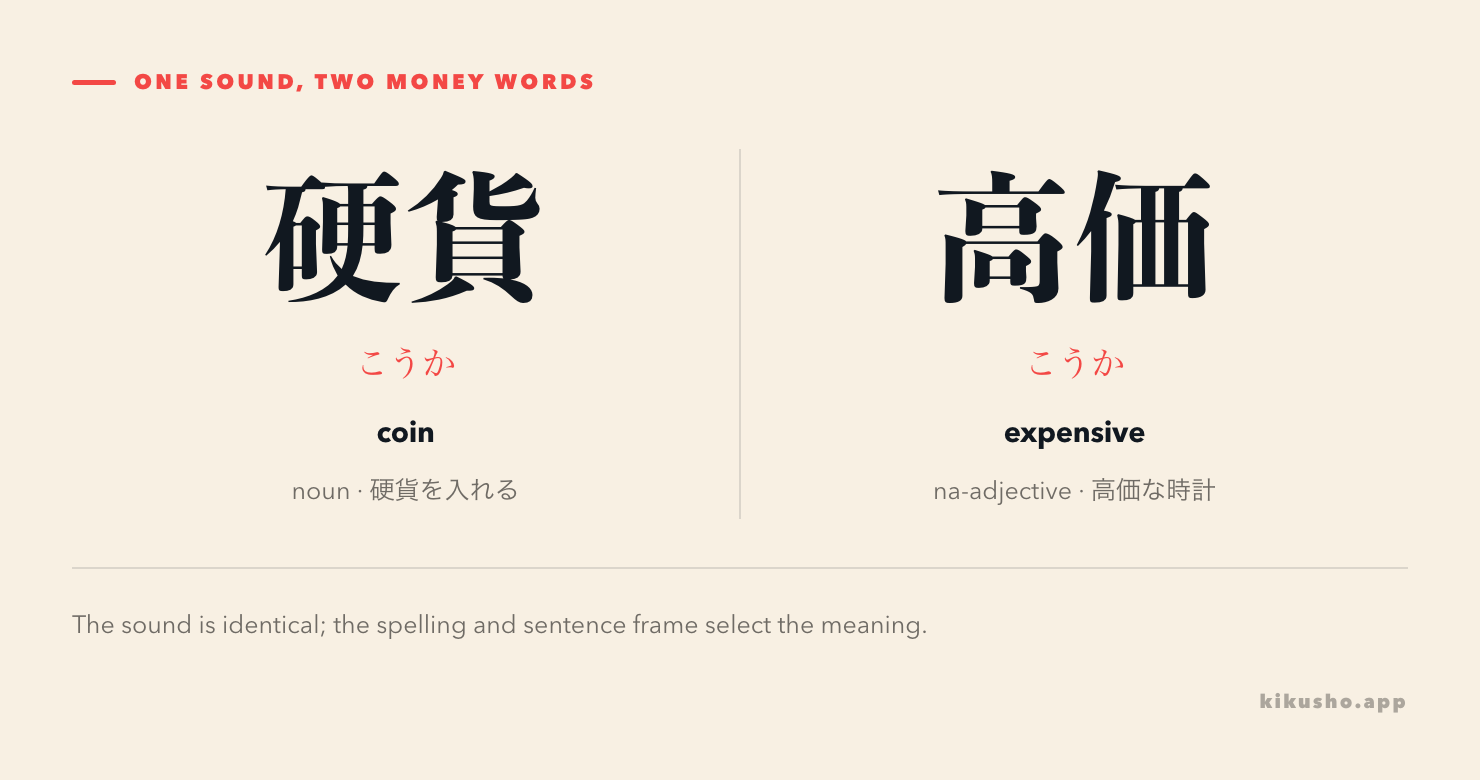
The current JapaneseTest4You page for 高価 classifies it as a noun and na-adjective and uses 高価な before expensive items. Everyday 高い can also mean expensive; 高価 is more descriptive and often modifies a noun as 高価なN.
Hearing こうか is therefore not enough. こうかを入れる selects a coin because を marks something inserted. こうかな時計 selects the expensive-quality word because な connects it to 時計.
給料 is one source inside the wider 収入
給料(きゅうりょう) is pay received for work. The long vowels matter: きゅう has small ゅ and a long う, while りょう has small ょ and another long う.
毎月二十五日に給料をもらいます。
まいげつにじゅうごにちにきゅうりょうをもらいます。
I receive my salary on the 25th of every month.
The independent JapaneseTest4You entry confirms the N3 label, reading and salary sense, with 給料をもらう and employer contexts.
収入(しゅうにゅう) is income coming in from all sources relevant to the speaker or account. A salary can be the main part of it, but the category can also contain other earnings:
去年より収入が増えました。
きょねんよりしゅうにゅうがふえました。
My income increased compared with last year.
Choose 給料 for employer pay and 収入 for money received across relevant sources. One is a common source inside the wider category.
支出, 貯金 and 借金 show where the balance goes
支出(ししゅつ) is expenditure: money paid out for a purpose. It belongs naturally in budgets, reports and household records. Digital Daijisen gives 支出を抑える and identifies 収入 as its opposite.
家賃が上がったので、毎月の支出が増えました。
やちんがあがったので、まいつきのししゅつがふえました。
My monthly expenses increased because the rent went up.
An individual payment is a 支払い. 支出 views paid-out money as a total or flow, fitting 支出を記録する, 支出を減らす and 収入と支出を比べる.
貯金(ちょきん) can name savings or the act of saving money:
旅行のために、毎月二万円ずつ貯金しています。
りょこうのために、まいつきにまんえんずつちょきんしています。
I save 20,000 yen each month for a trip.
貯金がある presents an amount held; 貯金する presents the action.
借金(しゃっきん) is debt or borrowing. Keep the small っ in the reading. It can combine with する to take on debt, and with 返す to repay it:
借金を少しずつ返しています。
しゃっきんをすこしずつかえしています。
I am repaying the debt little by little.
The current JapaneseTest4You entry is titled N3 despite its older N2-looking URL, and verifies しゃっきん, debt or loan, and 借金を返す. Learn the saved page's content rather than inferring a level from its path.
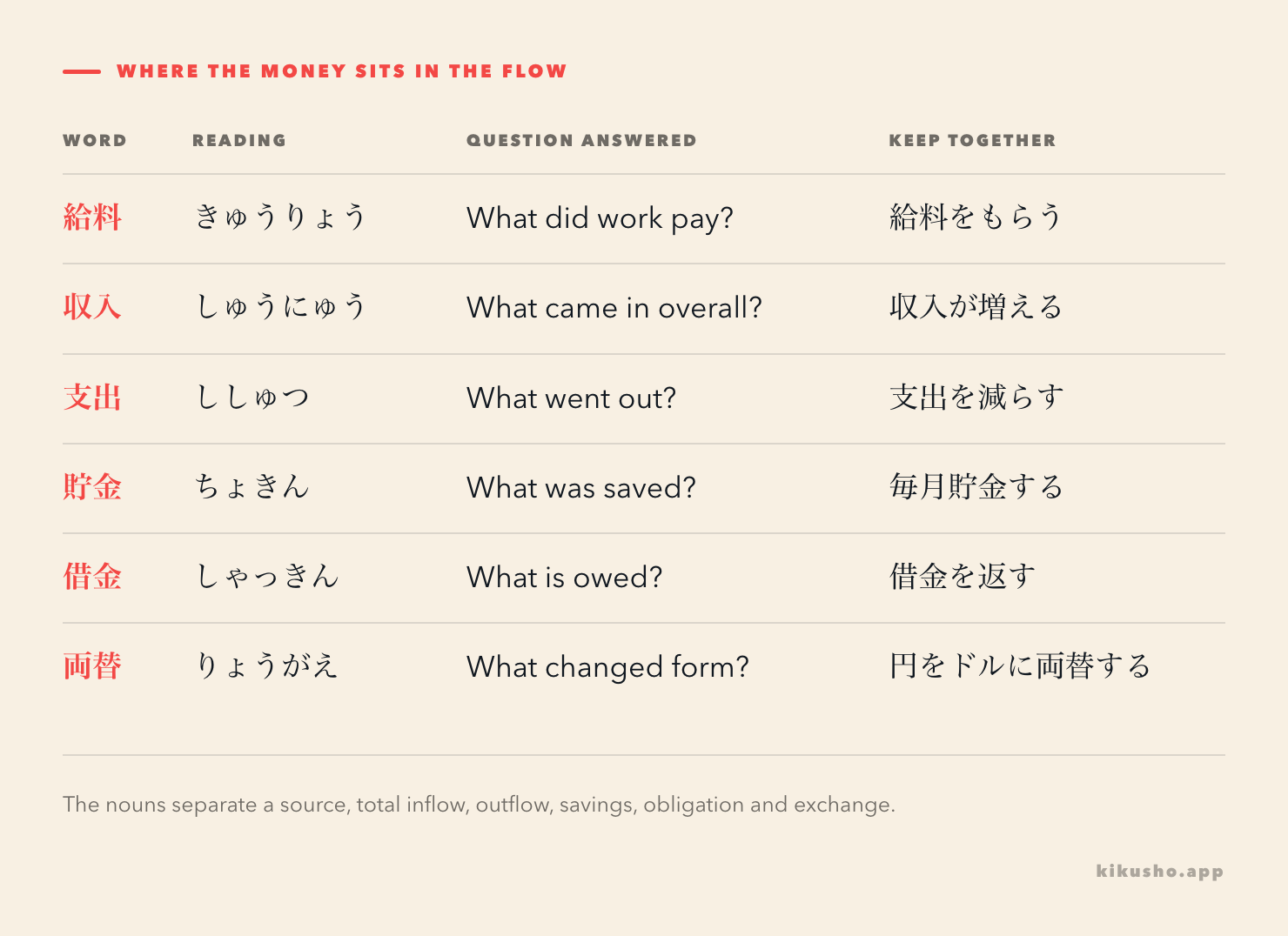
両替 changes the form of money, not the price
両替(りょうがえ) means exchanging money. The exchange may be between currencies or between denominations of one currency:
空港で円をドルに両替しました。
くうこうでえんをドルにりょうがえしました。
I exchanged yen for dollars at the airport.
千円札を百円硬貨に両替できますか。
せんえんさつをひゃくえんこうかにりょうがえできますか。
Can I change a 1,000-yen note into 100-yen coins?
The original currency or form takes を; the result can take に. The Japan Foundation's ATM service lesson uses 両替 for changing note denominations, while its bus lesson uses a 両替機 to produce coins.
Do not use 両替 for the おつり returned after a purchase. In that scene, the price stays fixed and the seller returns the difference. With 両替, the value is exchanged into another currency or combination of notes and coins.
One monthly scene keeps all 13 roles separate
今月の給料が入り、収入と支出を確認しました。生活費として現金を下ろし、千円札を小銭に両替しました。財布には札と硬貨を分けて入れました。高価な物は買わず、残ったお金は貯金しました。金でできたアクセサリーも見ましたが、借金してまで買うつもりはありません。
こんげつのきゅうりょうがはいり、しゅうにゅうとししゅつをかくにんしました。せいかつひとしてげんきんをおろし、せんえんさつをこぜににりょうがえしました。さいふにはさつとこうかをわけていれました。こうかなものはかわず、のこったおかねはちょきんしました。きんでできたアクセサリーもみましたが、しゃっきんしてまでかうつもりはありません。
This month's salary arrived, and I checked my income and expenses. I withdrew cash for living expenses and changed a 1,000-yen note into coins. I separated notes and coins in my wallet. I did not buy anything expensive and saved the money left over. I also saw gold jewellery, but I do not intend to go into debt to buy it.
The repeated sound こうか changes from 硬貨, after 札 in the wallet, to 高価な, before 物. The two 金 readings also separate: お金 is money left over, while 金でできた describes gold as a material.
N3 is an editorial study placement
Kikusho's September 2026 inventory assigns all 13 entries here. Its two baseline files share Waller/Tanos ancestry, so they count as one source family. 小銭 is the recorded disagreement: one descendant puts it at N3 and another at N1. Independent current lists from WKWK Japan and Japanese Compass place it at N3.
Because the current test has no official exhaustive word inventory, N3 here describes Kikusho's study order rather than guaranteed exam content. Retain the verified reading, sense and sentence role.
Nine attempts before the explanations
Record a response to every item, including the two short written answers, before opening the solution block.
Question 1 — two readings. Supply the reading of each bold word in order.
お金を貯めて、金の指輪を買いました。
Question 2 — orthography. Choose the word written こうか that means a coin.
ア. 効果
イ. 硬貨
ウ. 高価
エ. 降下
Question 3 — context. A shop accepts no cards. Complete the notice: 支払いは( )のみです。
ア. 現金
イ. 収入
ウ. 給料
エ. 借金
Question 4 — word form. Which phrase unambiguously identifies a 1,000-yen banknote?
ア. 千円金
イ. 千円銭
ウ. 千円札
エ. 千円価
Question 5 — category. Which statement is accurate?
ア. 給料 is every possible source of income, while 収入 is only employer pay.
イ. 給料 is pay for work and can form part of one's wider 収入.
ウ. 給料 means expenditure and 収入 means debt.
エ. The words are two spellings of the same noun.
Question 6 — incoming and outgoing money. Complete the household sentence with two different words: 今年は(甲)が減ったので、(乙)も減らしました。 The meaning is “Income fell this year, so I also reduced expenses.”
Question 7 — savings and debt. Choose the sentence that says someone is repaying debt rather than adding to savings.
ア. 毎月、貯金しています。
イ. 貯金が増えました。
ウ. 借金を返しています。
エ. 収入を確認しました。
Question 8 — exchange or returned change. You put a 1,000-yen note into a machine and receive coins of the same total value, without buying anything. Which noun names that operation?
ア. 給料
イ. 支出
ウ. おつり
エ. 両替
Question 9 — connected text. Read the sentence and choose the accurate account.
給料をもらったので、支出を確認し、残ったお金の半分を貯金しました。
ア. The speaker borrowed half of the salary before checking a price.
イ. The speaker received pay, checked expenses and saved half of the money left.
ウ. The speaker exchanged gold for coins and paid in cash.
エ. The speaker's income disappeared because an expensive item was returned.
Answers and explanations
Answer 1. おかね, then きん. お金 names money and keeps the native reading かね after お. 金の指輪 selects gold as the material, read きん. The repeated character does not force one reading across both clauses.
Answer 2. イ, 硬貨. 硬貨(こうか)is a coin. 高価 has the same reading but means expensive or high-priced. 効果 is an effect and 降下 is descent; neither belongs to the assigned money set.
Answer 3. ア, 現金. 現金のみ means cash only, matching the notice that rejects cards. 収入 is income, 給料 is pay for work and 借金 is debt or borrowing. Those are financial nouns but not payment methods in this frame.
Answer 4. ウ, 千円札. Adding a denomination fixes the banknote sense of 札: 千円札 is a 1,000-yen note. The other combinations do not name that standard cash form.
Answer 5. イ. 給料 identifies pay received for work. 収入 is the wider income category, which can include that pay and other sources. Reversing the scopes or replacing them with expense and debt meanings loses the source distinction.
Answer 6. 甲 = 収入; 乙 = 支出: 今年は収入が減ったので、支出も減らしました。 収入 is money coming in. 支出 is money paid out and can be deliberately reduced. 給料 could name one source of the reduced income, but the English prompt asks for the total category.
Answer 7. ウ. 借金を返しています means the debt is being repaid. 貯金する and 貯金が増える concern savings, while 収入を確認する means checking income. None of those states that an obligation is being repaid.
Answer 8. エ, 両替. The operation exchanges one denomination for another while preserving the total value. おつり requires a purchase and an amount returned above the price. 給料 and 支出 name pay and expenditure, not a change machine's operation.
Answer 9. イ. 給料をもらった reports receiving pay. 支出を確認した reports checking expenses. 残ったお金の半分を貯金した says half of the money remaining was saved. The sentence contains no borrowing, gold, coin exchange or returned item.
For review, hide the English meanings and rebuild one phrase for each word. Then reverse the cue: start with a salary arriving, a coin slot, an expensive item or a change machine and retrieve the noun whose reading and grammatical role fit that scene.
Common questions
Is 金 read かね or きん?
Both readings are assigned here, but they represent different words. 金(かね) means money and usually appears as お金 in neutral conversation. 金(きん)means gold. Compounds such as 現金 and 貯金 also use the sound きん.
What is the difference between 硬貨 and 小銭?
硬貨(こうか)is a coin as a category of physical money. 小銭(こぜに)is the small change or collection of coins someone has available. A commemorative coin is still a 硬貨 even when it is not the 小銭 in your pocket.
What is the difference between 給料 and 収入?
給料(きゅうりょう)is pay received for work. 収入(しゅうにゅう)is income from all relevant sources, so a salary can be part of one's income. The two words are not interchangeable when the source matters.
Does 両替 mean receiving change after a purchase?
両替(りょうがえ)means exchanging money, either between currencies or between denominations. おつり is the difference returned after paying more cash than the price. Changing a 1,000-yen note into coins is 両替 even without a purchase.